Empa researchers have developed a new material based on a fungal mycelium and its extracellular matrix. It is not only fully biodegradable but also tear-resistant and possesses versatile functional properties. All this with minimal processing steps and completely without chemicals—you can even eat it. Its secret: It is alive.
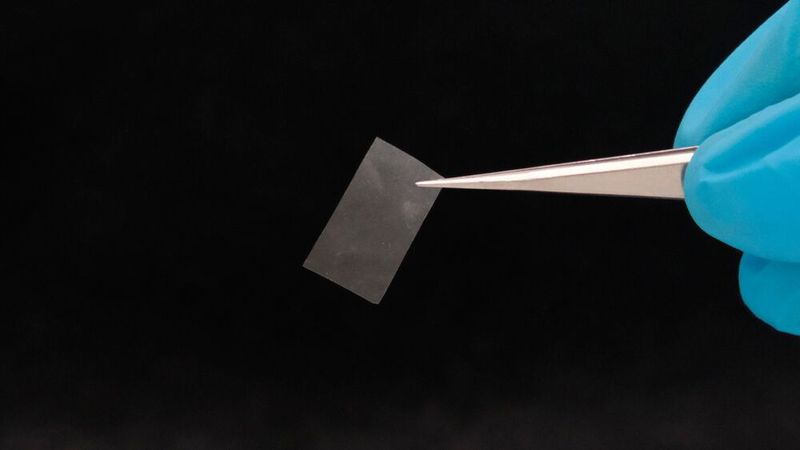
The living film is almost transparent and has good tear resistance. It could be used as a bio-plastic, for example.
(Image: Empa)
Sustainably produced, biodegradable materials are an important focus of modern materials research. However, processing natural materials such as cellulose, lignin, or chitin presents researchers with a trade-off. In their pure form, natural materials are biodegradable but often not efficient enough. Through chemical processing steps, they can be made stronger, more resistant, or more flexible—but in doing so, they lose some of their sustainability.
Empa researchers from the "Cellulose and Wood Materials" lab have now developed a bio-based material that cleverly bypasses this compromise. It is not only fully biodegradable but also tear-resistant and possesses versatile functional properties. All this with minimal processing steps and completely without chemicals—you can even eat it. Its secret: It is alive.
The fungus uses this extracellular matrix to impart structure and other functional properties. Why shouldn't we do the same?
Ashutosh Sinha
As the basis for their material, the researchers used the mycelium of the common split-gill mushroom, a widely distributed edible fungus that grows on dead wood. Mycelia are root-like thread-like fungal structures that are already being actively explored as potential material sources. Typically, the mycelial fibers—known as hyphae—are cleaned and possibly chemically processed, which involves the known trade-off between performance and sustainability.
The Empa researchers chose a different approach. Instead of extensively processing the mycelium, they use it as a whole. During growth, the fungus not only forms the hyphae but also an extracellular matrix: a network of different fiber-like macromolecules, proteins, and other biological substances secreted by the living cells. "The fungus uses this extracellular matrix to provide itself with structure and other functional properties. Why shouldn't we do the same?" explains Empa researcher Ashutosh Sinha. "Nature has already developed an optimized system," adds Gustav Nyström, head of the "Cellulose and Wood Materials" lab.
With a bit of targeted optimization, the researchers helped nature along. From the vast genetic diversity of the common split-gill mushroom, they selected a strain that produces a particularly large amount of two specific macromolecules: the long-chain polysaccharide schizophyllan and the soap-like protein hydrophobin. Due to their structure, hydrophobins gather at interfaces between polar and non-polar liquids, such as water and oil. Schizophyllan is a nanofiber: less than a nanometer thick but more than a thousand times as long. Together, these two biomolecules give the living mycelium material properties that make it suitable for a variety of applications.
A Living Emulsifier
The researchers demonstrated the versatility of their material directly in the lab. In their study published in the journal "Advanced Materials," they presented two application possibilities for the living material: a plastic-like film and an emulsion. Emulsions are mixtures of two or more liquids that typically do not blend. If you want to see an example, just open the refrigerator: milk, salad dressing, or mayonnaise are examples. But various cosmetics, paints, and varnishes are also emulsions.
The use as an emulsifier in the cosmetics and food industries is therefore particularly interesting.
Gustav Nyström
One challenge is stabilizing such mixtures so they do not "demix" back into the individual liquids over time. Here, the living mycelium shows its best side: both the schizophyllan fibers and the hydrophobins act as emulsifiers. And the living fungus constantly releases more of these molecules. "This is probably the only kind of emulsion that becomes more stable over time," says Sinha. Both the fungal threads themselves and their helper molecules are completely non-toxic, biologically compatible, and even edible—the common split-gill mushroom is considered an edible mushroom in many parts of the world. "The application as an emulsifier in the cosmetics and food industry is therefore particularly interesting," notes Nyström.
From Compost Bags to Batteries
But the living fungal network is also suitable for classic material applications. In a second experiment, the researchers produced thin films from their mycelium. The extracellular matrix with the long schizophyllan fibers gives the material very good tear resistance, which can be further enhanced by the targeted alignment of the fungal and polysaccharide fibers.
Date: 08.12.2025
Naturally, we always handle your personal data responsibly. Any personal data we receive from you is processed in accordance with applicable data protection legislation. For detailed information please see our privacy policy.
Consent to the use of data for promotional purposes
I hereby consent to Vogel Communications Group GmbH & Co. KG, Max-Planck-Str. 7-9, 97082 Würzburg including any affiliated companies according to §§ 15 et seq. AktG (hereafter: Vogel Communications Group) using my e-mail address to send editorial newsletters. A list of all affiliated companies can be found here
Newsletter content may include all products and services of any companies mentioned above, including for example specialist journals and books, events and fairs as well as event-related products and services, print and digital media offers and services such as additional (editorial) newsletters, raffles, lead campaigns, market research both online and offline, specialist webportals and e-learning offers. In case my personal telephone number has also been collected, it may be used for offers of aforementioned products, for services of the companies mentioned above, and market research purposes.
Additionally, my consent also includes the processing of my email address and telephone number for data matching for marketing purposes with select advertising partners such as LinkedIn, Google, and Meta. For this, Vogel Communications Group may transmit said data in hashed form to the advertising partners who then use said data to determine whether I am also a member of the mentioned advertising partner portals. Vogel Communications Group uses this feature for the purposes of re-targeting (up-selling, cross-selling, and customer loyalty), generating so-called look-alike audiences for acquisition of new customers, and as basis for exclusion for on-going advertising campaigns. Further information can be found in section “data matching for marketing purposes”.
In case I access protected data on Internet portals of Vogel Communications Group including any affiliated companies according to §§ 15 et seq. AktG, I need to provide further data in order to register for the access to such content. In return for this free access to editorial content, my data may be used in accordance with this consent for the purposes stated here. This does not apply to data matching for marketing purposes.
Right of revocation
I understand that I can revoke my consent at will. My revocation does not change the lawfulness of data processing that was conducted based on my consent leading up to my revocation. One option to declare my revocation is to use the contact form found at https://contact.vogel.de. In case I no longer wish to receive certain newsletters, I have subscribed to, I can also click on the unsubscribe link included at the end of a newsletter. Further information regarding my right of revocation and the implementation of it as well as the consequences of my revocation can be found in the data protection declaration, section editorial newsletter.
"We are combining established methods for processing fiber-based materials with the emerging field of living materials," explains Nyström. Sinha adds, "Our mycelium is, so to speak, a living fiber composite material." The researchers can control the properties of this material by altering the conditions under which the fungus grows. The use of other fungal strains or species that produce different functional macromolecules is also conceivable.
Instead of compostable plastic bags for kitchen waste, one could make bags from them that compost the organic waste themselves.
Ashutosh Sinha
Working with the living material also brings certain challenges. "Biodegradable materials always react to their environment," Nyström notes. "We want to find application possibilities where this interaction is not a hindrance—or even an advantage." However, biodegradability is only one part of the story for the mycelium. It is also biologically degrading: the common split-gill mushroom can actively decompose wood and plant materials. Here, Sinha sees another application possibility: "Instead of compostable plastic bags for kitchen waste, one could make bags that compost the organic waste themselves," says the researcher.
Next Goal: Biodegradable Battery
There are also promising applications for mycelium in the field of sustainable electronics. For example, the fungal material responds reversibly to moisture and could be used to manufacture biodegradable moisture sensors. Another application that Nyström's team is currently working on combines the living material with two other research projects from the "Cellulose and Wood Materials" lab: the fungal battery and the paper battery. "We want to create a compact, biodegradable battery whose electrodes consist of a living 'fungal paper'," says Sinha.
Secure and Compliant Authentication in Laboratories



:quality(80)/p7i.vogel.de/wcms/35/57/3557c819943c53acec41a0ccba87da4f/0130049064v1.jpeg "Researchers at the Fraunhofer IWU in Chemnitz have long known that many typical sheet metal parts can be manufactured more cost-effectively using hollow embossing rollers. Now there is news to report ... (Image:Fraunhofer IWU)")
:quality(80)/p7i.vogel.de/wcms/77/9b/779b0685d010dfe45c9c2cb1cfecd467/0128886425v1.jpeg "The BlueEye is the first \"real\" hyperspectral camera for the UV range and covers the wavelength range from 220 to 380nm. (Image:Inno-spec GmbH)")
:quality(80)/p7i.vogel.de/wcms/73/60/73608418789b1d9c393f5e2fa974eda2/0130209906v1.jpeg "The robots of the X6 generation from b+m enable very high painting quality and are also particularly compact and easy to maintain. (Image:Beckhoff)")
:quality(80)/p7i.vogel.de/wcms/82/90/8290dfe3595b6c6b33726ae8b76172c7/0130319587v1.jpeg "The concept image illustrates how the pattern of tiny protrusions and depressions created on the substrate (MgO, bottom) controls the arrangement of atoms in the superconducting material (YBCO, top). At the interface between the two layers, an electronic structure enables superconductivity to occur at higher temperatures than previously possible. (Image:Chalmers University of Technology / Riccardo Arpaia)")
:quality(80)/p7i.vogel.de/wcms/dd/08/dd086510d9ae7b50181f6070e4463b44/0129363730v1.jpeg "Typical application for ionizing devices: Wrapping films. (Picture: ©Adobe Stock/SMC)")
:quality(80)/p7i.vogel.de/wcms/78/e9/78e9188c25a8a94e67c34c9bf8ffe495/visual-agile-20robots-20and-20google-20deepmind-20partner-20to-20bring-20intelligence-20to-20robotics-2500x1406v1v1.jpeg "Together, the partners are developing adaptable, intelligent robots for a wide range of applications (Image:Agile Robots SE)")
:quality(80)/p7i.vogel.de/wcms/e7/66/e7669ecf0260ae8fc54c214e34e4902a/0130316817v1.jpeg "Siemens and Palo Alto Networks offer tested cybersecurity solution for industrial 5G. (Image:Siemens)")
:quality(80)/p7i.vogel.de/wcms/9f/55/9f55324832c4f426958031375124d9de/siemens-20ubtech-20hmnd-1920x1079v1v1.png "Ready for the factory floor: While Ubtech is planning mass production, Siemens is already testing humanoids in real factory applications in Erlangen. (Image:Siemens)")
:quality(80)/p7i.vogel.de/wcms/59/02/590246e3b3f415c65edbee377c14ca77/26-06-pi-fraunhofer-iws-41450-direktplattieren-pic-01-7771x4369v1v1.jpeg "The Fraunhofer IWS has developed the new \"direct laser cladding\" process, which creates a functional layer directly on the base body by applying a strip-shaped metal to rotationally symmetrical components in a spiral and bonding it locally by laser. (Image:Christoph Wilsnack/Fraunhofer IWS)")
:quality(80)/p7i.vogel.de/wcms/e4/51/e451d52ce0182fb0aaa46a5774f832ef/26-04-pi-fraunhofer-iws-21160-bioslide-pic-01-4128x2321v1v1.jpeg "With the BioSlide research project, the Fraunhofer IWS is investigating how sliding systems can be designed to be more sustainable and energy-efficient. New materials can be tested in a particularly application-oriented manner on this plain bearing test stand. (Image:Fraunhofer IWS)")
![Thanks to advanced 3D printing technology, a more efficient use of resources should contribute to lower-emission aviation—this is the goal of ['skai]-lab. (Image:Oleksandr Pashchenko - stock.adobe.com / AI-generated)](https://cdn1.vogel.de/nghHNSbySccfOjG3n1qCA-FVOjQ=/288x162/smart/filters:format(jpg):quality(80)/p7i.vogel.de/wcms/62/64/626424c97a16e69f871bf216c9629c2a/adobestock-1927043193--c2-a9-20oleksandr-20pashchenko-20-e2-80-93-20stock-adobe-com-ki-generiertv1v1.jpeg "Thanks to advanced 3D printing technology, a more efficient use of resources should contribute to lower-emission aviation—this is the goal of ['skai]-lab. (Image:Oleksandr Pashchenko - stock.adobe.com / AI-generated)")
:quality(80)/p7i.vogel.de/wcms/78/28/7828775af76773458b4d1409ceb1cf0c/368945-20dam-20imagery-digital-transformation-pc-1920x1079v1v1.jpeg "Complex development projects with high regulatory requirements, such as in the aerospace industry, benefit in particular from the Intelligent Product Lifecycle. (Image:PTC)")
:quality(80)/p7i.vogel.de/wcms/c1/79/c179ce9acd000e7cf48318e03e3fe4da/0130333964v1.jpeg "Magna is expanding its hybrid portfolio with the DHD REX, a dedicated hybrid drive for REEVs. (Image:Magna)")
:quality(80)/p7i.vogel.de/wcms/62/5f/625f41e87ebfef156a98c8e6393e32fd/0130211654v1.jpeg "Axial flux motors have some advantages over radial flux motor—but their production is currently still expensive. (Image:RWTH Aachen University)")
:quality(80)/p7i.vogel.de/wcms/80/c2/80c2ea3fbe2df808a263d99adad93f66/0130160344v1.jpeg "Francois Provost has been CEO of Renault since summer 2025. (Image:Renault)")
:quality(80)/p7i.vogel.de/wcms/8d/f8/8df87aa10e28419e1869acb641b4c4dd/0130324805v1.jpeg "With the Affela 1 in the Signature Edition, the Sony Honda Mobility joint project was to be launched in a few months' time. (Image:SHM)")
:quality(80)/p7i.vogel.de/wcms/4d/dd/4dddf438e91f394c04a095dbfd109d1c/0130236430v1.jpeg "Measurement modules: The 720301 module in combination with the SL2000 enables RMS and power calculations, among other things. (Image:Yokogawa)")
:quality(80)/p7i.vogel.de/wcms/61/fc/61fcf95f5cca15494ad18343901ae585/0130317237v1.jpeg "With the AGI CPU, Arm says it is taking a \"historic step\": With the processor aimed at AI in data centers, the company is presenting itself for the first time as a provider of its own chips, not just as a pure IP licensor. (Image:Arm)")
:quality(80)/p7i.vogel.de/wcms/11/36/113695ed260e29c8c2d9d39dc5f9d869/0130213768v1.jpeg "AI can work cheaply in China and deliver the results rapidly all over the world. (Image:Dall-E / AI-generated)")
:quality(80)/p7i.vogel.de/wcms/22/08/22085b4997a696887dd5a712a30b262b/0130211045v1.jpeg "Imec has announced that the world's most advanced high numerical aperture (High NA) EUV lithography system, the ASML EXE:5200, has arrived at its 300mm cleanroom in Leuven. (Image:Imec)")
:quality(80)/p7i.vogel.de/wcms/94/ee/94ee7a04f7b514f6184bd926dfdd73c1/0124727610v1.jpeg "The living film is almost transparent and has good tear resistance. It could be used as a bio-plastic, for example.(Image: Empa)")
:quality(80)/p7i.vogel.de/wcms/ed/ac/edac76f94e4622d8c61dde5bdbfe71d8/0124727611v1.jpeg "Thanks to the helper molecules in their extracellular matrix, mycelium fibers are good natural emulsifiers—they are even edible.(Image: Empa)")
:quality(80)/p7i.vogel.de/wcms/a8/10/a81060c19d5f29d7a9626c8f6ad5e673/0124728130v1.jpeg "In nature, the split gill fungus grows on dead wood and forms fruiting bodies that are considered edible mushrooms in many parts of the world.(Image: Adobe Stock)")
:quality(80)/p7i.vogel.de/wcms/c8/e4/c8e4da6187797bc07de1652db59c0ef7/0124728134v1.jpeg "(Image: Empa)")
:quality(80):fill(efefef,0)/p7i.vogel.de/wcms/67/ac/67acb931a438c/elatec-wp-gmp.png "Elatec WP GMP")
:quality(80)/p7i.vogel.de/wcms/e2/99/e2993175de251193db39b12705ea6172/0127461340v1.jpeg "The biodegradable mouse works like any other computer mouse. The 3D-printed casing was made by the researchers using a mix of biodegradable plastic and wood fibers. (Image:Empa)")
:quality(80)/p7i.vogel.de/wcms/63/21/6321beb732bf7d92640df46d7aa77573/0130125122v1.jpeg "As part of the Carbon Lab Factory Lausitz, a pilot plant for the production of sustainable, cost-effective and competitive carbon fibers will be built at the Guben site. (Image:Fraunhofer IAP / Kristin Stein)")