From March 11-13, 2025, Nuremberg becomes the hub of the embedded systems industry. Embedded World 2025 will showcase cutting-edge hardware, software, services, and tools, bringing together experts and innovators from around the globe.
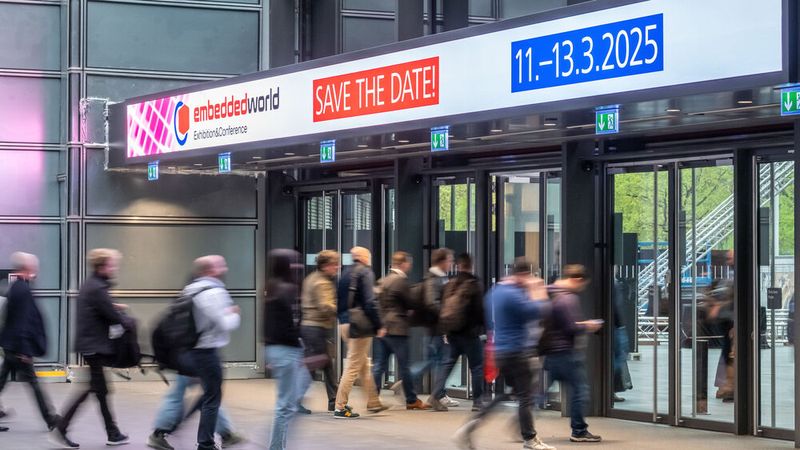
Embedded World opens its doors from March 11 to 13, 2025.
(Image: NürnbergMesse / Thomas Geiger)
The embedded community will come together for three days in mid-March 2025. It will be interesting to see whether the successful figures from 2024 can be topped this year. More than 1,100 exhibitors from almost 50 countries showcased their products, solutions and solutions at the trade fair. "The three days were great," said Executive Director Benedikt Weyerer after Embedded World 2024. According to the organizers, over 32,000 visitors came to the exhibition grounds in Nuremberg. It will be interesting to see what the trade fair has to offer this year. The manufacturers' product announcements already speak for themselves - especially in the automotive sector.
Middleware and microprocessor tuning
Safety is the top priority on the road to software-defined vehicles and automated driving. The Etas trade fair presentation in Hall 4A at Stand 512 is dedicated to software development tools that are designed to develop and calibrate safety-critical vehicle functions more efficiently. One example is the Middleware Solution. Middleware acts as a link between the operating system and the applications on control units. It ensures smooth communication between different software functions and simplifies the integration of new software functions.
Middleware Solution integrates all functional domains for the first time - from chassis and comfort functions to braking systems and automated driving functions. It also includes tools for validating driver assistance systems in virtual environments that can simulate unpredictable and dangerous scenarios. The company also provides embedded AI coders. In the automotive industry, when using embedded systems and microcontrollers in control units, the focus is on minimal latency and high functional safety, which often comes at the expense of memory capacity and computing power. However, the development of complex functions for ADAS and autonomous driving requires the management of large amounts of data and the use of trained neural networks. Topic number 3: the measurement and calibration of microprocessor-based vehicle computers.
The future of zonal architectures for software-defined vehicles will be presented by NXP in Hall 4A, Stand 222. The semiconductor manufacturer will be highlighting the current challenges faced by automotive manufacturers, such as the consolidation of electronic control units and the different requirements for the various zonal areas.
Chiplet and HMI functions
Socionext will highlight its expertise in providing high-performance, scalable and energy-efficient system-on-chips (SoCs) tailored to industry-specific requirements in Hall 4A at booth 628. For the automotive sector, the semiconductor manufacturer will be showcasing chiplet-based architectures for AI-supported ADAS, high-performance computing and automotive semiconductor solutions.
Microchip promises exciting innovations in Hall 3A at 135 with its ATMXT3072M1 and ATMXT2496M1 touchscreen controllers. Modern cockpit designs rely heavily on multiple screens and new technologies for human-machine interaction. This is accompanied by increased demands on the integration of capacitive touch sensors, primarily due to the thinner layer and the increasing number of touch electrodes.
Microchip offers the new components for this purpose. This provides HMI developers in the vehicle sector with reliable touch solutions. The controllers are designed to comply with ASIL A/B standards. They have been developed in accordance with Microchip's ISO26262 Functional Safety Management System, which is certified by TÜV Rheinland. FMEDA and safety manuals help to make certification for the touch function of their systems more efficient and cost-effective. The firmware of the touch controllers can be updated via the vehicle's main computer and verified using the integrated firmware authentication. This cybersecurity feature enables reliable over-the-air updates in accordance with ISO 21434:2021.
To limit the time spent looking away from the road and ensure safer driving, manufacturers will be encouraged to use separate physical controls for basic functions in the Euro NCAP tests in 2026. The manufacturer's Knob-on-Display technology allows intuitive physical buttons to be added to the touchscreen, improving safety while maintaining the sleek look of modern vehicle displays. In addition, haptic feedback on the touchscreen reduces driver distraction.
Date: 08.12.2025
Naturally, we always handle your personal data responsibly. Any personal data we receive from you is processed in accordance with applicable data protection legislation. For detailed information please see our privacy policy.
Consent to the use of data for promotional purposes
I hereby consent to Vogel Communications Group GmbH & Co. KG, Max-Planck-Str. 7-9, 97082 Würzburg including any affiliated companies according to §§ 15 et seq. AktG (hereafter: Vogel Communications Group) using my e-mail address to send editorial newsletters. A list of all affiliated companies can be found here
Newsletter content may include all products and services of any companies mentioned above, including for example specialist journals and books, events and fairs as well as event-related products and services, print and digital media offers and services such as additional (editorial) newsletters, raffles, lead campaigns, market research both online and offline, specialist webportals and e-learning offers. In case my personal telephone number has also been collected, it may be used for offers of aforementioned products, for services of the companies mentioned above, and market research purposes.
Additionally, my consent also includes the processing of my email address and telephone number for data matching for marketing purposes with select advertising partners such as LinkedIn, Google, and Meta. For this, Vogel Communications Group may transmit said data in hashed form to the advertising partners who then use said data to determine whether I am also a member of the mentioned advertising partner portals. Vogel Communications Group uses this feature for the purposes of re-targeting (up-selling, cross-selling, and customer loyalty), generating so-called look-alike audiences for acquisition of new customers, and as basis for exclusion for on-going advertising campaigns. Further information can be found in section “data matching for marketing purposes”.
In case I access protected data on Internet portals of Vogel Communications Group including any affiliated companies according to §§ 15 et seq. AktG, I need to provide further data in order to register for the access to such content. In return for this free access to editorial content, my data may be used in accordance with this consent for the purposes stated here. This does not apply to data matching for marketing purposes.
Right of revocation
I understand that I can revoke my consent at will. My revocation does not change the lawfulness of data processing that was conducted based on my consent leading up to my revocation. One option to declare my revocation is to use the contact form found at https://contact.vogel.de. In case I no longer wish to receive certain newsletters, I have subscribed to, I can also click on the unsubscribe link included at the end of a newsletter. Further information regarding my right of revocation and the implementation of it as well as the consequences of my revocation can be found in the data protection declaration, section editorial newsletter.
Safety & Security
At Embedded World 2025, Perforce poses the question of whether artificial intelligence (AI) ensures greater safety or creates a higher risk. AI removes the limitations of deterministic software in the safety environment. This means that the software no longer reacts unambiguously in the desired way to the same event. On the one hand, this is due to the higher degree of freedom that artificial intelligence inherently brings with it. On the other hand, the constant training of the AI ensures that once learned reactions to events and behaviors can change.
Traditional standards and processes for the verification and validation of functional safety are therefore no longer fully applicable. This is illustrated by the company's "2025 State of Automotive Software Development" study, in which 650 managers from the automotive industry expressed their concerns about AI. For 78 percent of the study participants, the functionally safe decision-making of AI algorithms in autonomous and automated vehicles is extremely or very worrying. Avoiding security vulnerabilities and cyberattacks as a result of the introduction of advanced AI technology is extremely or very worrying for 63 percent. And 71 percent of respondents said yes to the question of whether the planned new ISO/DPAS 8800 standard entitled "Road Vehicles—Safety and Artificial Intelligence" would be relevant to them. Perforce Software is currently working on AI-supported functions designed to increase safety and security in embedded development, as the company will be presenting in Hall 4, Stand 510.
In Hall 4, Stand 318, Parasoft will be showcasing its automated software test functions C/C++test, which enables consistent conformity with safety standards such as ISO 26262, DO-178B/C, IEC 62304, EN 50218 and IEC 61508. Automated processes accelerate conformity by around 50 percent. Parasoft C/C++test CT is aimed at large-scale applications. By closing a crucial gap between open-source test frameworks and certification requirements, Parasoft lowers major hurdles for developers of safety-critical applications. This enables a faster time-to-market.
RISC-V as an alternative to Autosar
RISC-V's native approach to adapting the architecture through software opens up new possibilities for solving tasks that are currently performed by Autosar. RISC-V can therefore represent an alternative for many typical Autosar functions. The open source instruction architecture has many advantages that make it attractive for the automotive industry, such as cost efficiency, adaptability to norms and standards, flexibility or high performance and efficiency. For this reason, Infineon is committed to establishing RISC-V as an open standard for automotive applications and is working with partners to accelerate the introduction and maturity of RISC-V-based solutions. The semiconductor manufacturer will be presenting its development progress in Hall 4A, Stand 138.
In addition, Quintauris—Infineon is a founding member alongside Bosch, Nordic, NXP and Qualcomm—announces RT-Europa, the first RISC-V profile for safety-critical real-time applications in vehicles. RT-Europa adapts RISC-V implementations for safety islands and domain controllers where deterministic execution and low latency are critical. This solution is the first step towards delivering ready-to-use RISC-V specifications optimized for functional safety and real-time performance workloads in the automotive industry.
Measuring and testing
For the development of dynamic energy systems with fast power electronic circuits such as those used in the e-mobility, aerospace and railroad industries, control system developers and test engineers require highly precise real-time simulations. For this purpose, dSpace has introduced XSG Power Electronics Systems (XSG PES).
The software for hardware-in-the-loop tests contains a library with ready-made models of power electronic circuits, so that users can create simulations of their power electronics quickly and easily. You will find dSpace in Hall 4 at Stand 327.
In Hall 4, Stand 320, Göpel electronic will be showcasing its new developments for testing camera, display and video applications as well as for ECU testing and residual bus simulation in the automotive sector.
The Global Navigation Satellite System (GNSS) is playing an increasingly important role in the automotive industry to enable new infotainment and automated driving functions. To ensure the required quality of GNSS systems on board vehicles, the Chinese National Technical Committee for Automotive Standardization has drawn up the guidelines "Requirements and Test Methods for On-board Positioning Systems". Rohde & Schwarz participated in the development of the standard. These requirements were published on November 28, 2024 with an "implementation date" of June 2025. While the test specification is currently only recommended, it is expected to be mandatory in the upcoming Chinese e-call standard.
Rohde & Schwarz has worked with u-blox to validate its new GNSS module for the automotive sector. The validation was carried out in accordance with the GB/T test requirement from China, which deals with GNSS positioning systems in vehicles. Both companies used the R&S SMBV100B-based GNSS simulator solution for the validation. Visitors can find the exhibitor in Hall 4, Stand 218.
Development tools
The new UDE 2025 version of the Universal Debug Engine, which PLS will be presenting in Hall 4, Stand 310, boasts new functions that make debugging and trace-based analysis of complex microcontroller applications easier for developers.
The new Easy-to-work start window is user-friendly and extremely helpful in everyday practice. Immediately after starting the program and sorted by time, users now have direct access to their most recently used debugger workspaces. Creating a new debugger session now also takes even less time thanks to the intuitive design. The Execution Sequence Chart, which visualizes the chronological sequence of executed functions or operating system tasks, has been further optimized. A specific function can now be searched for by its name, which is particularly helpful for large amounts of data recorded via trace.
The UDE 2025 not only provides a very user-friendly trace recording function for detailed analysis of the timing behaviour of real-time operating systems or Autosar software in particular using third-party timing analysis or visualization tools. It also offers convenient export functions for this data, which can then be imported into Vector or Inchron tools, for example, for further processing. The tool coupling for the timing analysis tool "T1.timing" from Gliwa is even closer.
Additional features have also been added to UDE's internal analysis functions for real-time operating systems. Based on recorded trace data, the CPU load can now be determined statistically for the individual tasks over the entire observation time. This makes it very quick and easy to determine initial indications for optimizing real-time-critical applications.
The debug and trace functions and ease of use are particularly useful for high-end microcontrollers such as the Aurix TC4Dx chip from Infineon, which has been available since the end of 2024, the RH850/U2C family from Renesas, the S32K31, S32K36 and i.MX RT1180 MCUs from NXP and the Stellar SR6 G6 line controller from ST Microelectronics. The UDE 2025 now also offers true multi-core debugging for the THA6 series from Tongxin Micro, China's first ASIL-D certified Arm Cortex-R52 with integrated Bosch Generic Timer Module (GTM).
Data transmission
Peak-System is bringing the Ixxat automotive gateway solutions to Embedded World 2025. In Hall 1, Stand 304, the company will be showcasing these easily configurable gateways, which enable access to a wide range of bus systems in vehicles, for example for sophisticated gateway, diagnostic, logging and visualization applications. (sp)



:quality(80)/p7i.vogel.de/wcms/dd/08/dd086510d9ae7b50181f6070e4463b44/0129363730v1.jpeg "Typical application for ionizing devices: Wrapping films. (Picture: ©Adobe Stock/SMC)")
:quality(80)/p7i.vogel.de/wcms/35/57/3557c819943c53acec41a0ccba87da4f/0130049064v1.jpeg "Researchers at the Fraunhofer IWU in Chemnitz have long known that many typical sheet metal parts can be manufactured more cost-effectively using hollow embossing rollers. Now there is news to report ... (Image:Fraunhofer IWU)")
:quality(80)/p7i.vogel.de/wcms/59/02/590246e3b3f415c65edbee377c14ca77/26-06-pi-fraunhofer-iws-41450-direktplattieren-pic-01-7771x4369v1v1.jpeg "The Fraunhofer IWS has developed the new \"direct laser cladding\" process, which creates a functional layer directly on the base body by applying a strip-shaped metal to rotationally symmetrical components in a spiral and bonding it locally by laser. (Image:Christoph Wilsnack/Fraunhofer IWS)")
:quality(80)/p7i.vogel.de/wcms/73/60/73608418789b1d9c393f5e2fa974eda2/0130209906v1.jpeg "The robots of the X6 generation from b+m enable very high painting quality and are also particularly compact and easy to maintain. (Image:Beckhoff)")
:quality(80)/p7i.vogel.de/wcms/78/e9/78e9188c25a8a94e67c34c9bf8ffe495/visual-agile-20robots-20and-20google-20deepmind-20partner-20to-20bring-20intelligence-20to-20robotics-2500x1406v1v1.jpeg "Together, the partners are developing adaptable, intelligent robots for a wide range of applications (Image:Agile Robots SE)")
:quality(80)/p7i.vogel.de/wcms/e7/66/e7669ecf0260ae8fc54c214e34e4902a/0130316817v1.jpeg "Siemens and Palo Alto Networks offer tested cybersecurity solution for industrial 5G. (Image:Siemens)")
:quality(80)/p7i.vogel.de/wcms/9f/55/9f55324832c4f426958031375124d9de/siemens-20ubtech-20hmnd-1920x1079v1v1.png "Ready for the factory floor: While Ubtech is planning mass production, Siemens is already testing humanoids in real factory applications in Erlangen. (Image:Siemens)")
:quality(80)/p7i.vogel.de/wcms/11/36/113695ed260e29c8c2d9d39dc5f9d869/0130213768v1.jpeg "AI can work cheaply in China and deliver the results rapidly all over the world. (Image:Dall-E / AI-generated)")
:quality(80)/p7i.vogel.de/wcms/62/5f/625f41e87ebfef156a98c8e6393e32fd/0130211654v1.jpeg "Axial flux motors have some advantages over radial flux motor—but their production is currently still expensive. (Image:RWTH Aachen University)")
:quality(80)/p7i.vogel.de/wcms/77/9b/779b0685d010dfe45c9c2cb1cfecd467/0128886425v1.jpeg "The BlueEye is the first \"real\" hyperspectral camera for the UV range and covers the wavelength range from 220 to 380nm. (Image:Inno-spec GmbH)")
:quality(80)/p7i.vogel.de/wcms/e4/51/e451d52ce0182fb0aaa46a5774f832ef/26-04-pi-fraunhofer-iws-21160-bioslide-pic-01-4128x2321v1v1.jpeg "With the BioSlide research project, the Fraunhofer IWS is investigating how sliding systems can be designed to be more sustainable and energy-efficient. New materials can be tested in a particularly application-oriented manner on this plain bearing test stand. (Image:Fraunhofer IWS)")
![Thanks to advanced 3D printing technology, a more efficient use of resources should contribute to lower-emission aviation—this is the goal of ['skai]-lab. (Image:Oleksandr Pashchenko - stock.adobe.com / AI-generated)](https://cdn1.vogel.de/nghHNSbySccfOjG3n1qCA-FVOjQ=/288x162/smart/filters:format(jpg):quality(80)/p7i.vogel.de/wcms/62/64/626424c97a16e69f871bf216c9629c2a/adobestock-1927043193--c2-a9-20oleksandr-20pashchenko-20-e2-80-93-20stock-adobe-com-ki-generiertv1v1.jpeg "Thanks to advanced 3D printing technology, a more efficient use of resources should contribute to lower-emission aviation—this is the goal of ['skai]-lab. (Image:Oleksandr Pashchenko - stock.adobe.com / AI-generated)")
:quality(80)/p7i.vogel.de/wcms/c3/c4/c3c4ce270b083eeac55654148611f064/0130237945v1.jpeg "China is not giving up on hydrogen, but is intensifying its efforts. (Image:freely licensed from Pixabay)")
:quality(80)/p7i.vogel.de/wcms/4e/c0/4ec0bd19390b169edfa23677373dcdf1/0130260089v1.jpeg "Renewable fuels can supply European road traffic, according to a study. (Image:Aral)")
:quality(80)/p7i.vogel.de/wcms/6f/c9/6fc9050301d745cad25585c6780f8f51/0130197341v1.jpeg "Production facilities are a worthwhile target and are therefore at risk. (Image:ABB Robotics)")
:quality(80)/p7i.vogel.de/wcms/b6/62/b662adc2cec8227d8172509bbfb6ee42/25c0207-107-4961x2789v1v1.jpeg "The GLB is the second model based on Mercedes' new MMA platform. Apparently, Geely's platform is better and cheaper, which is why the two companies are negotiating a partnership. (Image:Mercedes-Benz)")
:quality(80)/p7i.vogel.de/wcms/4d/dd/4dddf438e91f394c04a095dbfd109d1c/0130236430v1.jpeg "Measurement modules: The 720301 module in combination with the SL2000 enables RMS and power calculations, among other things. (Image:Yokogawa)")
:quality(80)/p7i.vogel.de/wcms/61/fc/61fcf95f5cca15494ad18343901ae585/0130317237v1.jpeg "With the AGI CPU, Arm says it is taking a \"historic step\": With the processor aimed at AI in data centers, the company is presenting itself for the first time as a provider of its own chips, not just as a pure IP licensor. (Image:Arm)")
:quality(80)/p7i.vogel.de/wcms/82/90/8290dfe3595b6c6b33726ae8b76172c7/0130319587v1.jpeg "The concept image illustrates how the pattern of tiny protrusions and depressions created on the substrate (MgO, bottom) controls the arrangement of atoms in the superconducting material (YBCO, top). At the interface between the two layers, an electronic structure enables superconductivity to occur at higher temperatures than previously possible. (Image:Chalmers University of Technology / Riccardo Arpaia)")
:fill(fff,0)/p7i.vogel.de/companies/67/eb/67eba621ef6ea/logo2.png "logo2 (Wuxi InfiMotion)")
:quality(80)/p7i.vogel.de/wcms/2c/7d/2c7dd82cd4ab194a509126bc75b34fcd/0129849981v1.jpeg "From March 10 to 12, 2026, everything in Nuremberg will once again revolve around embedded systems when Embedded World opens its doors. (Image:NürnbergMesse | Thomas Geiger)")
:quality(80)/p7i.vogel.de/wcms/0a/43/0a436a696528c4a9675af94c2e79d960/0126825714v1.jpeg "RISC-V is no longer a niche technology but has also arrived in the automotive industry. (Image:Tasking)")