An electronics manufacturer revises the layout of a new factory while construction is already underway. With a digital twin and task force, the redesign is completed in just three months.
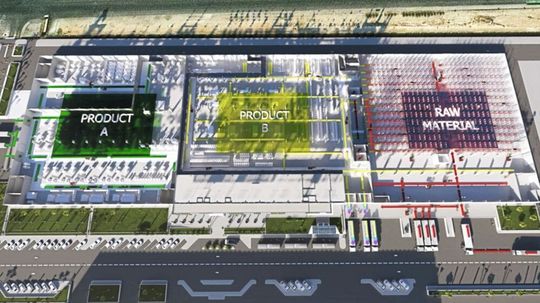
The company revised the factory layout even though construction work had already begun.
(Image: Efeso Management Consultants)
Time is of the essence when it comes to tapping into future markets. This is also the case with this project in the Middle East, with which a company in the electronics industry wants to secure its top position in an as yet untapped market.
Together with industrial consultants Efeso, the company is challenging the existing concept and factory layout for the greenfield construction of a new plant—but in an exceptionally tight time frame: construction work on the foundations is already underway when the original planning concept is modified. With a focused approach and a visualization of the future factory in the form of a digital building and process twin, the planning phase was successfully restarted.
New Plant Location to Accelerate Expansion
The demand for specialized electronic products for smart city applications such as energy supply, building technology and mobility is growing steadily around the world. A manufacturer of electrical construction products has been expanding in these and other markets for several years: with around 10,000 employees, the company is already present in the Middle East, Asia, Africa and Europe. Due to the increasing demand for low/high-voltage systems, charging technologies for e-mobility and other electrical engineering solutions, the company is expanding its network of plants to include a site in the Middle East.
With the Greenfield project, it is constructing a new, multi-storey factory building including a highly automated raw materials warehouse in an industrial city. The floor space of the entire factory was originally intended to be 484,000 square feet over three floors and house several production and assembly facilities; a new administration building is also planned directly adjacent.
The company developed a viable concept for the factory layout, which adequately took into account the general requirements of production and intralogistics. However, the management team discovered further optimization potential in the layout planning in good time.
In order to be able to use any space in the completed building as efficiently as possible for highly flexible production, the management commissioned a "task force" from the industrial consultancy with a comprehensive review of all planning elements for the building and infrastructure as well as the feasible operating and logistics processes. In this case, two framework conditions set the bar particularly high for the success of the project:
Time pressure: In October, the task force gained its first impression of the status quo on site—but the deadline for the start of construction work was set for January of the following year. The project started while the excavation pit was already being dug. The timeframe for making changes to the concept was correspondingly short. For comparison: an already tightly calculated time window in similar projects is six to ten months; on average, ten to twelve months is usual.
Starting production at top level: In contrast to the time constraints, costs were not a limiting factor. In order to start with the "best of the best" in terms of workplace design and technological equipment, the electronics manufacturer attached great importance to a rapid transfer of know-how from comparable, global best practice projects.
It was precisely this expertise for successful project realization—from the conception phase to the implementation of optimal operating processes in the newly created plant—that the team of consultants brought to the table.
"One-Stop Store" Solution Covers All Planning Strands
At the start of the project, the task force was expanded to a total of around twelve people: the production, logistics and building experts from the industrial consultancy were now supported by the relevant responsible employees from the company's functional areas. The work packages and objectives for this team were as follows:
Analyze and evaluate the existing concept including current workflows, material handling and building concept;
Checking and identifying planning incongruities between different value streams;
Developing and evaluating improvement alternatives with a focus on space utilization, cost impact and process improvement;
Creating the production concept and factory layout and defining the exact factory requirements;
Identify the ideal storage systems and material supply components.
Virtual Factory Opens Up New Scope
In order to achieve these goals within the given time frame, the task force had to ensure a common understanding of the spatial and design elements between all project participants as early as possible.
The team therefore visualized the future factory in detail due to the different and partly interlinked room and process characteristics: a digital twin of the entire factory building was created on the computer, including the equipment at the workstations and in the warehouse. On this basis, the team was able to precisely simulate all planning scenarios and the effects of even small changes on the work processes in the entire production and logistics area.
Even at this early stage of the project, it determined that the available space did not match the specified space requirements for the production volume of an important product group. The simulation showed how the space requirement could be reduced from 560,000 to 484,000 square feet.
This visualization played a key role in enabling the task force to analyze and coordinate all planning strands—buildings, administration, warehouse and logistics concept, production processes—from a single source and with few interfaces in a "one-stop store" approach. It paid particular attention to the following three lines of action.
Strand 1: Operations Excellence
Improvement of the operations footprint.
Identification of suitable Industry 4.0 technologies for the plant.
Simulation of the material flow for layout optimization.
Identification of future-oriented assembly concepts.
Focus on the simulation of later operations processes:
Illustration of a comprehensive value stream design.
Definition of an intralogistics concept including modern equipment.
Presentation of interfaces in production, e.g. for container design and machine layout adaptation.
Highlight result in the planning phase: Reduction of the lead time from the originally calculated 50 days to 30 days.
Line of Action 2: Building Excellence
Creation of energy-efficient MEP (Mechanical, Electrical and Plumbing) concepts
Design of a sustainable building in line with ESG requirements (Environmental, Social, Governance)
Development of a flexible and modular building layout
Focus on capex-(capital expenditure)-optimized solutions
Focus on the simulation of later operating processes:
Requirements for the building, such as floor slabs, sprinkler systems, etc.
Infrastructure requirements
Properties / load capacity of the power grid
Consideration of energy efficiency and sustainability requirements
Highlight result in the planning phase: Reduction of the space required for the production volume of a product group from the original 560,000 to 484,000 square feet.
Strand 3: Warehouse Excellence
Identification of needs-based and capex-optimized warehouse technology
Development of a hybrid material distribution system for high flexibility in the event of changes
Integration of these points into the production concept
Focus on the simulation of later operations processes:
Visualization of the logistics concept and technology selection
Presentation and review of infrastructure requirements
Presentation of the interfaces between buildings, infrastructure and production
Highlight result in the planning phase: 35 percent reduction in transportation costs.
Fast And Effective Action Thanks to Thorough Preparation
The following aspects proved to be crucial to the success of the project:
Enable project management to make clear decisions—from day one! Making effective decisions, especially under time pressure, requires careful preparation and the ability to quickly process consistent and comprehensive information. This should be supported or enabled by sound information and data analysis. Outlining scenarios is helpful here, as it shifts the discussion from the abstract to the concrete. Clear priorities and decision criteria must also be formulated in order to be able to act quickly and purposefully.
Cast the ideal team! Even if you have a very ambitious timeframe, don't waste time putting together the right team of experienced professionals for the project. A well-cast team can respond quickly to unexpected challenges, develop creative solutions and ensure that projects or problem areas are managed efficiently and successfully.
Get all stakeholders on board! All project participants should be involved in the work of the task force or the responsible project team as early as possible. Clear communication and involvement of the relevant teams and stakeholders promote understanding and acceptance of decisions. This can be achieved through regular meetings and updates as well as the establishment of feedback loops. Early and continuous collaboration with the relevant parties also ensures that everyone is pulling in the same direction and pursuing the same goals.
Knowledge Transfer During Plant Visits
With the one-stop-shop solution approach, the project task force quickly identified potential for improvement in the factory layout of the new site. It identified planning inconsistencies and, as the sole point of coordination, ensured a clear flow of information between all project participants. This approach prevented discrepancies in the rest of the construction project that would have led to inefficiency or higher costs.
Another positive effect for the continuation of the project beyond the planning phase resulted from the fact that the task force visited three plants in Europe in just a few days during a "best practice tour". There, the employees of the electronics manufacturer experienced exemplary production and logistics processes in practice.
Timo Gerhardt is Senior Manager at Efeso Management Consultants
Overcome Design Challenges when using Reflective Encoders
Naturally, we always handle your personal data responsibly. Any personal data we receive from you is processed in accordance with applicable data protection legislation. For detailed information please see our privacy policy.
Consent to the use of data for promotional purposes
I hereby consent to Vogel Communications Group GmbH & Co. KG, Max-Planck-Str. 7-9, 97082 Würzburg including any affiliated companies according to §§ 15 et seq. AktG (hereafter: Vogel Communications Group) using my e-mail address to send editorial newsletters. A list of all affiliated companies can be found here
Newsletter content may include all products and services of any companies mentioned above, including for example specialist journals and books, events and fairs as well as event-related products and services, print and digital media offers and services such as additional (editorial) newsletters, raffles, lead campaigns, market research both online and offline, specialist webportals and e-learning offers. In case my personal telephone number has also been collected, it may be used for offers of aforementioned products, for services of the companies mentioned above, and market research purposes.
Additionally, my consent also includes the processing of my email address and telephone number for data matching for marketing purposes with select advertising partners such as LinkedIn, Google, and Meta. For this, Vogel Communications Group may transmit said data in hashed form to the advertising partners who then use said data to determine whether I am also a member of the mentioned advertising partner portals. Vogel Communications Group uses this feature for the purposes of re-targeting (up-selling, cross-selling, and customer loyalty), generating so-called look-alike audiences for acquisition of new customers, and as basis for exclusion for on-going advertising campaigns. Further information can be found in section “data matching for marketing purposes”.
In case I access protected data on Internet portals of Vogel Communications Group including any affiliated companies according to §§ 15 et seq. AktG, I need to provide further data in order to register for the access to such content. In return for this free access to editorial content, my data may be used in accordance with this consent for the purposes stated here. This does not apply to data matching for marketing purposes.
Right of revocation
I understand that I can revoke my consent at will. My revocation does not change the lawfulness of data processing that was conducted based on my consent leading up to my revocation. One option to declare my revocation is to use the contact form found at https://contact.vogel.de. In case I no longer wish to receive certain newsletters, I have subscribed to, I can also click on the unsubscribe link included at the end of a newsletter. Further information regarding my right of revocation and the implementation of it as well as the consequences of my revocation can be found in the data protection declaration, section editorial newsletter.



:quality(80)/p7i.vogel.de/wcms/7f/fd/7ffd32863352c40f562f4245e4766e61/0129745849v1.jpeg "After US President Donald Trump once again resorted to his favorite weapon, tariffs, concerns rose in the EU that the so-called tariff deal could become invalid. But it looks as if the sea remains relatively calm ... (Image:F. Schneidler)")
:quality(80)/p7i.vogel.de/wcms/53/69/5369bed136061188d873441dfefd6d6e/0129245111v1.jpeg "The company revised the factory layout even though construction work had already begun. (Image:Efeso Management Consultants)")
:quality(80)/p7i.vogel.de/wcms/d2/d7/d2d79e3fb84663cb7e918c88f123989b/0129733908v1.jpeg "Mineral decision! This is how lithium is mined. There is a lot of it in Chile, Australia, Bolivia and also in Zimbabwe. However, the latter country has now announced that the export of all minerals, including lithium concentrate, will be stopped. Read more about the reasons here ... (Image:Largbatt)")
:quality(80)/p7i.vogel.de/wcms/8e/7a/8e7a8d7cd0b947550da99f3d888a57a6/maas-blechnetbeitrag-20blechnext-2563x1440v1v1.png "Blechnext shows that the future of sheet metal processing lies not only in better machines, but also in smarter business models. \"Machine-as-a-Service\" is not just a financing tool; it is an accelerator for digital transformation. (Image:Blechnext)")
:quality(80)/p7i.vogel.de/wcms/13/4d/134dee0c2b8af6b4f28937ca5b586e0d/0129499541v1.jpeg "The industry now needs to build a flexible, powerful and sovereign infrastructure that can exploit the full potential of artificial intelligence while guaranteeing control over data and processes. (Picture: ©Gorodenkoff - stock.adobe.com)")
:quality(80)/p7i.vogel.de/wcms/c6/71/c671ce338f12be49d39d1b04b40a54f7/0129697443v1.jpeg "Claas is working on making its combine harvesters fit for refurbishment. (Image:Claas)")
:quality(80)/p7i.vogel.de/wcms/f2/4b/f24b8f1c3070e7f13e4f0ffd7854e75a/0129653538v1.jpeg "The production of the BMW iX3 is to be taken as far as possible in terms of sustainability. This is also ensured by the climate-friendly Blueprint recycled steel from Thyssenkrupp Steel ... (Image:BMW)")
:quality(80)/p7i.vogel.de/wcms/84/2d/842d51915fa4fe69c72da5cc4ba52ed1/newsimage418103-3408x1917v1v1.jpeg "3 Printing can also be sustainable—if recyclable ink is used. (Image:Hereon/Steffen Niemann)")
:quality(80)/p7i.vogel.de/wcms/b0/78/b078e07634ffd4d5ee6b73af42cc7c55/newsimage418259-1000x563v1v1.jpeg "Magnesium during forming. (Image:TU Bergakademie Freiberg)")
:quality(80)/p7i.vogel.de/wcms/bc/8c/bc8c831daa7f85dbd1e44ea8fbd8089b/open-source-bild5-406x228v1v1.png "Four steps to an open source crash simulation - find out how here. (Image:Alsado)")
:quality(80)/p7i.vogel.de/wcms/af/9d/af9dc917a1eb91fd0e201d5bf8b7a57c/0129614075v1.jpeg "The future of manufacturing will be determined by demonstrable productivity gains - with more digitalization, networked data streams and simulation-based decisions. (Image:Visual Components)")
:quality(80)/p7i.vogel.de/wcms/29/b5/29b536a22d9b5ac80387b02620cce554/20260212-sue-60-6000x3372v1v1.jpeg "The People Mover at its world premiere. The large polycarbonate windshield is clearly visible. One of several materials contributed by Covestro. (Image:UE | STUDIOS)")
:quality(80)/p7i.vogel.de/wcms/a0/3e/a03e71cec3a956df095607a0b176a7b0/0129584071v1.jpeg "Andreas Mindt will be Head of Design at the Volkswagen Group from March. (Image:Volkswagen AG)")
:quality(80)/p7i.vogel.de/wcms/fc/bd/fcbdbf5c6fdf969dc3e005b3ae512915/can-ai-5000x2812v1v1.jpeg "Anyone who allows themselves to be distracted in China when the assistance system is switched on is responsible. The \"Supreme People's Court\" came to this conclusion. (Image:Togg)")
:quality(80)/p7i.vogel.de/wcms/0a/79/0a79d81b63254586a4548085ab0f609c/0129744210v1.jpeg "The Schaeffler Group wants to reduce its dependence on the automotive industry. (Image:Schaeffler)")
:quality(80)/p7i.vogel.de/wcms/0f/b2/0fb28656d39754b67a76b90b42243cda/0129655768v1.jpeg "Driven by GaN wafer production at 300 millimeters, Infineon's GaN products deliver outstanding performance with clear application benefits. (Image:Infineon Technologies AG)")
:quality(80)/p7i.vogel.de/wcms/98/c7/98c77993453c1edf3d2bd54b0028fa6a/0129630827v1.jpeg "Left: High Bandwidth Flash (HBF) stacks multiple layers of NAND chips to significantly increase storage capacity; Right: Concept of the \"hybrid\" H³ architecture presented in the IEEE study. (Image:Sandisk (left) / Sk hynix (right))")
:quality(80)/p7i.vogel.de/wcms/ae/cf/aecf874a057676aa69b3b5e4c7b52411/0129609464v1.jpeg "Glass storage in action: Microsoft has stored map data from the Flight Simulator on this piece of glass. (Image:Microsoft Research)")
:quality(80)/p7i.vogel.de/wcms/2c/8d/2c8da4b72e35ded278178929afb94d55/0129561713v1.jpeg "Change in direction: The shift away from PFAS in semiconductor manufacturing and the move toward sustainable chip production is demonstrated by the trilateral collaboration between Fraunhofer ENAS, the Paul Scherrer Institute PSI, and Memsstar Limited, which rely on the environmentally friendly Gas-MacEtch technology. (Image:andreyarmyagov/Canva)")
:fill(fff,0)/images.vogel.de/vogelonline/companyimg/76800/76895/65.jpg "FAULHABER_120mm.jpg ()")
:fill(fff,0)/p7i.vogel.de/companies/69/88/69882c428938e/tmts2026-ticec-banner-en-2000px.png "tmts2026-ticec-banner-en-2000px (https://www.tmts.tw/en)")
:fill(fff,0)/p7i.vogel.de/companies/67/eb/67eba621ef6ea/logo2.png "logo2 (Wuxi InfiMotion)")
:quality(80):fill(efefef,0)/p7i.vogel.de/wcms/68/ac/68ac55a537d06/ebv-broadcom-wp-titelbild-399114.png "EBV Broadcom WP Titelbild 399114")
:quality(80)/p7i.vogel.de/wcms/ad/da/adda2b0237d0167d79524dc8845649b8/0128720455v1.jpeg "Pepsico is digitizing selected production facilities and warehouses in the USA using Digital Twin Composer. (Image:Pepsico)")
:quality(80)/p7i.vogel.de/wcms/c3/39/c33969504326b0f67f10ed013ba29be4/0124398503v1.jpeg "Micros Automation is a specialist in the planning and implementation of individual automation solutions in special-purpose machine building. (Bild:Micros Automation)")