The electrochemical analysis of battery slurries promises significant efficiency gains in lithium-ion battery development. An integrated measuring system now makes this technology accessible to developers without specialized electrochemistry knowledge.
Electrochemical analysis: With the help of slurry analysis, efficiency in the development of lithium-ion batteries can be increased. Using suitable hardware, developers can determine the ideal ratio between active material and conductive additives.
(Image: Hioki)
Batteries are everywhere today and are an integral part of our lives. Whether in a simple flashlight, smartphone, laptop, or electric car—practically nothing works without batteries anymore. They are even found in pacemakers and other important medical or safety-related systems. They not only store electricity from renewable energy sources but also ensure that our devices function or step in when the power goes out.
Without batteries, a large part of our mobile technological world would be hardly conceivable. In all areas of application, batteries should function efficiently, sustainably, as well as reliably and fail-safe. Extensive testing is therefore required in the development and production of batteries. These tests include various chemical, physical, and electrotechnical methods.
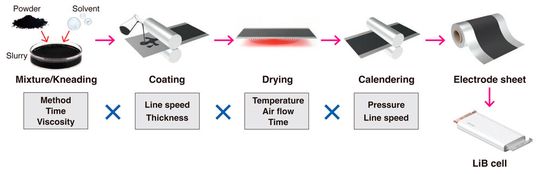
Slurry Processes in Modern Battery Production
Image 1: The slurry process is an essential component of modern battery production.
(Image: Hioki)
Known test parameters of batteries include charge/discharge behavior, self-discharge, aging processes, energy retention, performance characteristics, and internal resistance. Another practical yet less known testing area is slurry analysis.
Slurry processes are an essential component of modern battery production. Slurry refers to a viscous paste made of binder, conductive carbon, and solvents (water or organic solvents) used to coat metal foils for electrode production (Image 1). After the coating and drying process, the electrode foils for lithium-ion cells are created.
The challenge lies in the fact that carbon nanotubes (CNTs) exhibit excellent electrical conductivity but tend to agglomerate. Therefore, a homogeneous dispersion in the slurry is crucial for the electrochemical properties of the final battery cell. Slurry analysis makes it possible to evaluate the quality of the electrode paste before further processing. This is an important quality assurance step in the production chain.
In slurry analysis, both the rheological properties (viscosity) and the particle size distribution are examined. However, there has been a gap in electrochemical characterization so far. This gap is closed by the slurry analysis solution SA2634-KIT from Hioki, which enables a direct electrochemical evaluation of the slurry before electrode production.
Complete Electrochemical Analysis of the Battery
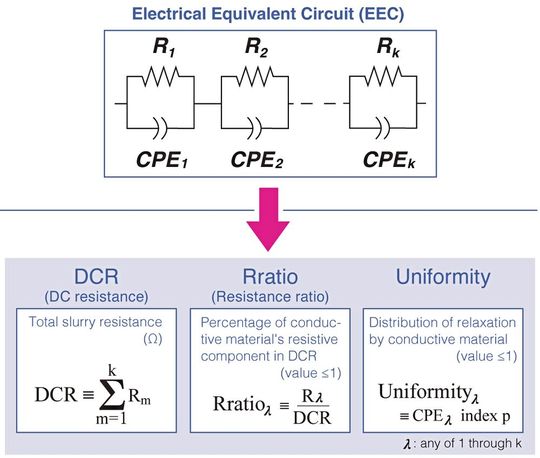
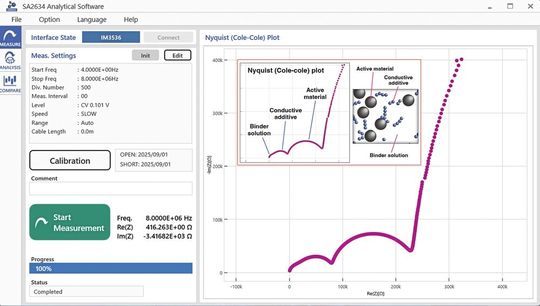
Image 2: The system also models an equivalent circuit using EIS data to extract three proprietary parameters.
(Image: Hioki)
The system enables a complete electrochemical characterization of battery slurries already in the development and production phase. It helps developers identify the optimal mixing state and determine the ideal ratio between active material and conductive additives.
Based on electrochemical impedance spectroscopy (EIS), the system models an equivalent circuit and extracts three proprietary parameters: DCR, Rratio, and Uniformity. These objective measurements quantify the conductivity properties of lithium-ion battery slurries and replace subjective evaluation methods.
The practical benefit lies in the optimization of R&D processes and production efficiency: High-performance slurries can be identified more quickly, leading to better electrode foils and cells, shorter development cycles, and higher battery yields.
The three key parameters in detail:
DCR (DC Resistance): Quantifies the overall resistance of the slurry suspension.
Rratio (Resistance Ratio): Determines the proportion of the resistance component of the conductive material in the DCR.
Uniformity: Assesses the homogeneity of the conductive paths and the consistency of the electrode coating.
Uniformity is particularly critical, as uneven coatings can lead to performance losses, reduced efficiency, and potential safety risks due to inhomogeneous ion transfer and conductivity distribution.
The Setup of the Measurement System and Software Integration
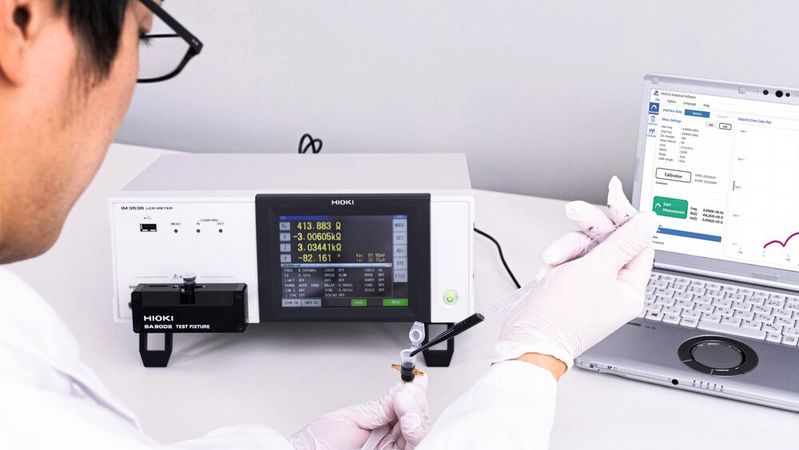
Image 3: The system consists of an LCR meter (IM3536), with which the software performs EIS measurements.
(Image: Hioki)
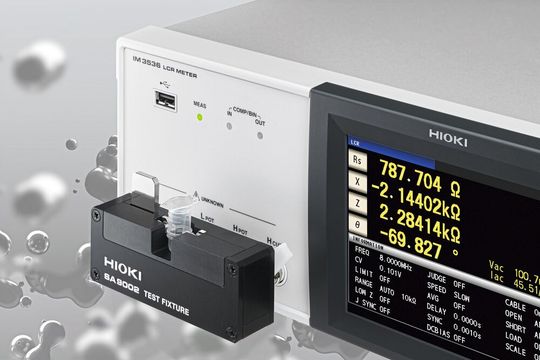
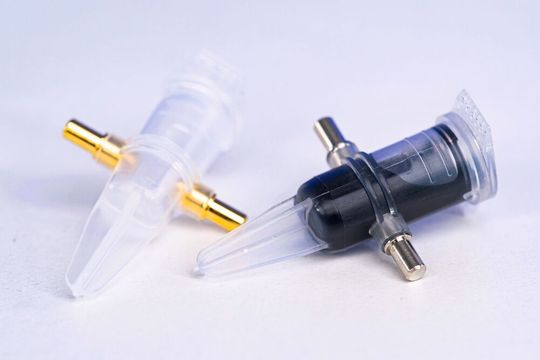
Image 4: The one for the LCR meter, to hold the electrode cells with the actual material samples.
(Image: Hioki)
The Japanese measurement technology specialist Hioki (distributed by Meilhaus Electronic) has expanded its portfolio to include battery measurement technology and now offers a complete solution for electrochemical slurry analysis. The system is based on an LCR meter (IM3536) that performs electrochemical impedance spectroscopy measurements (EIS) via the corresponding software. On the hardware side, the system includes a special holder on the LCR meter that accommodates electrode cells with the material samples to be analyzed.
The Windows-based analysis program SA2634 was specifically developed for slurry analysis and complements the LCR meter with advanced evaluation functionalities. A key feature is the Nyquist representation (Cole-Cole plot), where developers can directly read the characteristic properties of the individual slurry components:
Binder solution,
Conductive additives and
Active electrode material.
The curve progression in the Nyquist diagram provides direct insight into the electrochemical properties and interactions of the various material components. This enables a well-founded assessment of slurry quality even before electrode production. The integrated system thus offers a seamless measurement chain from hardware acquisition to detailed data analysis.
Date: 08.12.2025
Naturally, we always handle your personal data responsibly. Any personal data we receive from you is processed in accordance with applicable data protection legislation. For detailed information please see our privacy policy.
Consent to the use of data for promotional purposes
I hereby consent to Vogel Communications Group GmbH & Co. KG, Max-Planck-Str. 7-9, 97082 Würzburg including any affiliated companies according to §§ 15 et seq. AktG (hereafter: Vogel Communications Group) using my e-mail address to send editorial newsletters. A list of all affiliated companies can be found here
Newsletter content may include all products and services of any companies mentioned above, including for example specialist journals and books, events and fairs as well as event-related products and services, print and digital media offers and services such as additional (editorial) newsletters, raffles, lead campaigns, market research both online and offline, specialist webportals and e-learning offers. In case my personal telephone number has also been collected, it may be used for offers of aforementioned products, for services of the companies mentioned above, and market research purposes.
Additionally, my consent also includes the processing of my email address and telephone number for data matching for marketing purposes with select advertising partners such as LinkedIn, Google, and Meta. For this, Vogel Communications Group may transmit said data in hashed form to the advertising partners who then use said data to determine whether I am also a member of the mentioned advertising partner portals. Vogel Communications Group uses this feature for the purposes of re-targeting (up-selling, cross-selling, and customer loyalty), generating so-called look-alike audiences for acquisition of new customers, and as basis for exclusion for on-going advertising campaigns. Further information can be found in section “data matching for marketing purposes”.
In case I access protected data on Internet portals of Vogel Communications Group including any affiliated companies according to §§ 15 et seq. AktG, I need to provide further data in order to register for the access to such content. In return for this free access to editorial content, my data may be used in accordance with this consent for the purposes stated here. This does not apply to data matching for marketing purposes.
Right of revocation
I understand that I can revoke my consent at will. My revocation does not change the lawfulness of data processing that was conducted based on my consent leading up to my revocation. One option to declare my revocation is to use the contact form found at https://contact.vogel.de. In case I no longer wish to receive certain newsletters, I have subscribed to, I can also click on the unsubscribe link included at the end of a newsletter. Further information regarding my right of revocation and the implementation of it as well as the consequences of my revocation can be found in the data protection declaration, section editorial newsletter.
Practical Application
Image 5: Practical use is simple. For this purpose, 1 ml of the slurry to be examined is filled into the sample holder/electrode cell.
(Image: Hioki)
The measurement process is straightforward and standardizable. First, one milliliter of the slurry to be characterized is filled into a disposable electrode cell. The sample holders are available in packs of 50 and ensure reproducible measurement conditions. The filled sample holder is then inserted into the system holder and fixed to the LCR meter (IM3536). The LCR meter is connected to a PC via USB or Ethernet.
The SA2634 software controls the LCR meter and automatically performs an EIS sweep (electrochemical impedance spectroscopy), capturing impedance spectra over a defined frequency range. After the measurement, the software automatically calculates the characteristic parameters DCR, Rratio, and Uniformity from the impedance data and generates the corresponding equivalent circuit diagram. The transformation of raw impedance spectra into practically relevant parameters is the crucial factor in this process.
A key advantage of the system is that no advanced EIS knowledge is required from the user. The complex impedance analysis is fully automated by the software and converted into directly interpretable quality parameters for slurry evaluation, making it accessible even for developers without specialized electrochemistry expertise. (heh)



:quality(80)/p7i.vogel.de/wcms/9f/7b/9f7be35880605811e045acd3af8b571b/0129558586v1.jpeg "An example of the V210 processing machine, which, according to Voortman, supplements the laser cutting of the V353 with drilling, thread cutting and milling. (Image:Voortman)")
:quality(80)/p7i.vogel.de/wcms/b0/41/b041264d931df4347bc760fff1c7cb7b/0129439236v1.jpeg "The circular milling system proves to be a problem solver in the numerous standard variants, as well as in special shapes for some other milling processes. (Image:Horn/Sauermann)")
:quality(80)/p7i.vogel.de/wcms/33/ab/33abf15b4b5625a8904cb57c51597709/0129982307v1.jpeg "This is a new development from Fraunhofer IFAM and partners: an automated adhesive splitting system for the reliable and more productive bonding of composite parts. Here, a frame for an airplane window is measured in real time and a precise amount of adhesive is applied. (Image:Fraunhofer IFAM)")
:quality(80)/p7i.vogel.de/wcms/df/26/df26e72a2f7c890171a1059b48eef68e/0129962397v1.jpeg "The Swedish cutting tool manufacturer Sandvik Coromant now has two additional geometries for its Corodrill DE10 replaceable head drilling system, which it says will further expand the already wide range of applications - for example for cast materials ... (Image:Sandvik Coromant)")
:quality(80)/p7i.vogel.de/wcms/92/5e/925ee98ea36ad9bd574fa1cea11d0e53/0129964352v1.jpeg "The production of hardware components for humanoid robots offers great market potential. (Image:Fraunhofer IPA)")
:quality(80)/p7i.vogel.de/wcms/08/72/0872dd2dd119a54824c41e0e580e45a8/0129576591v1.jpeg "The Rose enclosure systems can be customized on request. (Image:Rose Systemtechnik GmbH)")
:quality(80)/p7i.vogel.de/wcms/73/17/7317794432521bf911711b91287cfc28/0129961259v1.jpeg "ABB Robotics and Nvidia are enabling the widespread use of physical AI in the world of robotics. This means that systems can be created virtually and with high precision and optimized much more cost-effectively. In the large image the virtual system, next to it the real robot cell ... (Image:ABB)")
:quality(80)/p7i.vogel.de/wcms/09/a2/09a2e832b1c0271d299fc130201e5717/adobestock-1767409934-4191x2360v1.jpeg "(Source: © ImageFlow - stock.adobe.com)")
:quality(80)/p7i.vogel.de/wcms/68/89/688937087188b77da95b2079399ca862/0130009534v1.jpeg "Here you can see the Dualis layout configurator in use at Montratec. (Picture: ©Gorodenkoff - stock.adobe.com)")
:quality(80)/p7i.vogel.de/wcms/9e/98/9e984afbf9c6f2bcc8963bd13465b180/26-02-pi-fraunhofer-iws-41300-ultragrain-project-closing-pic-02-1562x878v1v1.png "The process of laser wire build-up welding (DED-LB) with pulse laser-induced plasma, which contributed to the success of the Ultra Grain project, is shown at high speed. (Image:Fraunhofer IWS)")
:quality(80)/p7i.vogel.de/wcms/28/00/28008d9477bb07daa3b28ce4ac0ae907/newsimage418436-1536x864v1v1.jpeg "Researchers have produced elastic ear cartilage from human cells in the laboratory, which remains dimensionally stable in animal models. (Image:ETH Zurich)")
:quality(80)/p7i.vogel.de/wcms/1e/7d/1e7d6a316cdd7a7ba5e84d7c9a3efb80/newsimage418837-3000x1687v1v1.jpeg "Driverless shuttles can strengthen public transport, especially in rural areas. (Image:ZF Friedrichshafen)")
:quality(80)/p7i.vogel.de/wcms/c5/d2/c5d2655e427c7cbfe2f537dccfbd06e3/0129971639v1.jpeg "Volkswagen Group Charging, Elli, has connected its first electricity storage system to the grid. (Image:Elli)")
:quality(80)/p7i.vogel.de/wcms/b4/fc/b4fc9420fca6915b291eca0ae2532688/0129978040v1.jpeg "MAN has completed winter tests with nine buses. (Image:Bulent Camci)")
:quality(80)/p7i.vogel.de/wcms/a7/22/a722a06c823b5d7405eb9fb15a0b4e7d/0129931201v1.jpeg "The company offers access to its charging network, which now has more than 1,000,000 charging points across Europe, via the Elli app. (Image:Elli | Volkswagen)")
:quality(80)/p7i.vogel.de/wcms/89/5d/895dfb4fb9a90c33ddd287c7d09c9ffd/0129938355v1.jpeg "Ganfeng Lithium has developed semi-solid batteries for eVTOLs together with Geely subsidiary Aerofugia. (Image:Aerofugia)")
:quality(80)/p7i.vogel.de/wcms/c2/a8/c2a8a93f306c1475489dff074ad59731/0129967672v1.jpeg "Figure 1: Imec's logic technology roadmap showing the extension of the nanosheet era from 2nm to the A10 node with the outer-wall forksheet, before the transition to CFET for A7 and beyond. (Image:imec)")
:quality(80)/p7i.vogel.de/wcms/07/79/0779a3ba2b38d583fc9b515900be2add/0129957428v1.jpeg "If the Chinese government has its way, domestic data centers full of Nvidia hardware will be a thing of the past. (Image:Nvidia)")
:quality(80)/p7i.vogel.de/wcms/aa/4c/aa4cd2c6c10199015d47caf72eca2115/0129962687v1.jpeg "Bosch Rexroth and AMD are working together on Software-Defined Automation: ctrlX OS now also supports AMD Embedded x86 CPUs and adaptive SoCs, promising even greater hardware design flexibility, seamless scalability and a secure, modular operating system foundation. (Image:Bosch Rexroth AG)")
:quality(80)/p7i.vogel.de/wcms/7b/10/7b108d8ec7bf09cb1a20998364483525/0129923685v1.jpeg "The concept of the blade battery. (Image:BYD Europe B.V.)")
:fill(fff,0)/images.vogel.de/vogelonline/companyimg/76800/76895/65.jpg "FAULHABER_120mm.jpg ()")
:fill(fff,0)/p7i.vogel.de/companies/67/eb/67eba621ef6ea/logo2.png "logo2 (Wuxi InfiMotion)")
:quality(80)/p7i.vogel.de/wcms/00/90/00907b4860e11d3060011778c1244187/0125027192v1.jpeg "The calendars from Dürr Ingecal are used for film compaction in both wet and dry coating. (Image:Dürr Systems AG)")
:quality(80)/p7i.vogel.de/wcms/2b/e5/2be5ce9bf015efbcfd42ee4580feeea1/0125077385v1.jpeg "With the new Drytraec dry transfer technology, electrodes of energy storage cells are coated with a dry film instead of liquid chemicals. (Image:Fraunhofer / Piotr Banczerowski)")