Cruises are more popular than ever. However, the cruise industry suffers from image problems. Heavy fuel oil and diesel are the reason. Gas is also not exactly climate-neutral. So what alternatives are there?
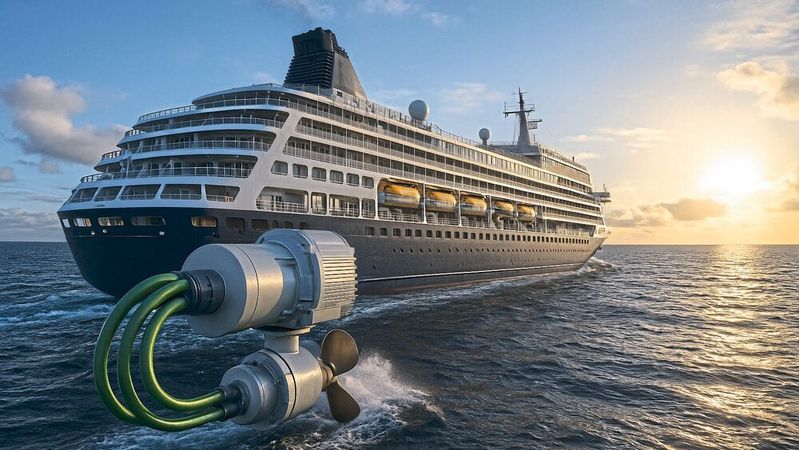
A cruise ship with an electric drive sails low-emission into the sunset. A symbol of change in maritime mobility.
(Image: Dall-E / AI-generated)
The maritime industry is on the brink of one of the biggest technological upheavals in its history. Electric drives are evolving from experimental technologies to commercially viable solutions with the potential to fundamentally change shipping. The global market for electric ships has exploded from 5.2 billion US dollars in 2020 to over 14 billion US dollars by 2025, driven by Norwegian ferry innovations and increasing regulatory pressure.
This transformation represents the most significant revolution in ship propulsion since the transition from sail to steam. While the full electrification of large ocean vessels is still a distant prospect, smaller vehicles and short-distance connections have already demonstrated that electric drives are not only technically feasible but also economically compelling.
Current Fleet Demonstrates Commercial Feasibility
The success story of maritime electrification began in 2015 with the MF Ampere, the world's first fully electric car ferry. This 80-meter-long ship, equipped with 1,000 kWh lithium-ion batteries and 900 kW electric motors, has now completed over 124,000 crossings, achieving a 95% reduction in CO₂ emissions and 50% lower energy consumption compared to conventional diesel ferries.
The success of the Ampere catalyzed Norway's comprehensive electrification program. Today, 70-90 electric ferries are in operation nationwide. The Bastø Electric, commissioned in 2021, became the world's largest fully electric ferry at 456 feet in length at the time of its inauguration. With its 4.3 MWh battery system, it transports 600 passengers and 200 vehicles, saving 1.6 million gallons of diesel annually, which corresponds to a 75% reduction in CO₂ emissions.
Diversification of Applications
The success story of maritime electrification began in 2015 with the MF Ampere, the world's first fully electric car ferry. This 260 feet-long ship, equipped with 1,000 kWh lithium-ion batteries and 900 kW electric motors, has now completed over 124,000 crossings, achieving a 95% reduction in CO₂ emissions and 50% lower energy consumption compared to conventional diesel ferries.
The success of the Ampere catalyzed Norway's comprehensive electrification program. Today, 70-90 electric ferries are in operation nationwide. The Bastø Electric, commissioned in 2021, became the world's largest fully electric ferry at 456 feet in length. With its 4.3 MWh battery system, it transports 600 passengers and 200 vehicles, saving 6 million liters of diesel annually, which corresponds to a 75% reduction in CO₂ emissions.
Diversification of Applications: Beyond ferries, pioneering projects demonstrate the versatility of electric drives. The Elektra, the world's first hydrogen-powered push boat in Berlin, combines 2,500 kWh batteries with 1,650 pounds of compressed hydrogen storage, achieving a range of 250 miles. Hurtigruten's Roald Amundsen, the first hybrid-electric expedition cruise ship, can operate fully electric for 30 minutes and reduces fuel consumption under Arctic conditions by 20 percent.
The technical specifications of modern electric ships show impressive performance data. Battery capacities range from 530 kWh for small ferries to over 40 MWh for the largest ships under construction. Charging systems have evolved from 260 kWh land batteries to 9 MW fast charging facilities, enabling charging times of 5-10 minutes and thus adhering to operational schedules.
Technical Challenges Drive Innovation Forward
Battery Technology as a Key Factor: Battery technology remains the primary bottleneck. Current lithium iron phosphate (LFP) systems achieve energy densities of 150-205 Wh/kg. However, breakthroughs in solid-state batteries by companies like Sealence reportedly have already reached 245 Wh/kg for complete marine battery packs, with projections for 1,200 Wh/l volumetric density by 2030. These advancements could enable the economical electrification of routes up to 3,100 miles.
Charging Infrastructure and Energy Management: The development of charging infrastructure has become crucial for widespread adoption. The EU directive for alternative fuels requires onshore power supply in major ports by 2025, while California mandates that 50 percent of container ships must use shore power. High-power charging systems today support megawatt requirements, with large cruise ships needing up to 10 MW in port.
Date: 08.12.2025
Naturally, we always handle your personal data responsibly. Any personal data we receive from you is processed in accordance with applicable data protection legislation. For detailed information please see our privacy policy.
Consent to the use of data for promotional purposes
I hereby consent to Vogel Communications Group GmbH & Co. KG, Max-Planck-Str. 7-9, 97082 Würzburg including any affiliated companies according to §§ 15 et seq. AktG (hereafter: Vogel Communications Group) using my e-mail address to send editorial newsletters. A list of all affiliated companies can be found here
Newsletter content may include all products and services of any companies mentioned above, including for example specialist journals and books, events and fairs as well as event-related products and services, print and digital media offers and services such as additional (editorial) newsletters, raffles, lead campaigns, market research both online and offline, specialist webportals and e-learning offers. In case my personal telephone number has also been collected, it may be used for offers of aforementioned products, for services of the companies mentioned above, and market research purposes.
Additionally, my consent also includes the processing of my email address and telephone number for data matching for marketing purposes with select advertising partners such as LinkedIn, Google, and Meta. For this, Vogel Communications Group may transmit said data in hashed form to the advertising partners who then use said data to determine whether I am also a member of the mentioned advertising partner portals. Vogel Communications Group uses this feature for the purposes of re-targeting (up-selling, cross-selling, and customer loyalty), generating so-called look-alike audiences for acquisition of new customers, and as basis for exclusion for on-going advertising campaigns. Further information can be found in section “data matching for marketing purposes”.
In case I access protected data on Internet portals of Vogel Communications Group including any affiliated companies according to §§ 15 et seq. AktG, I need to provide further data in order to register for the access to such content. In return for this free access to editorial content, my data may be used in accordance with this consent for the purposes stated here. This does not apply to data matching for marketing purposes.
Right of revocation
I understand that I can revoke my consent at will. My revocation does not change the lawfulness of data processing that was conducted based on my consent leading up to my revocation. One option to declare my revocation is to use the contact form found at https://contact.vogel.de. In case I no longer wish to receive certain newsletters, I have subscribed to, I can also click on the unsubscribe link included at the end of a newsletter. Further information regarding my right of revocation and the implementation of it as well as the consequences of my revocation can be found in the data protection declaration, section editorial newsletter.
Hybrid propulsion systems offer immediate solutions for longer routes and larger ships. These configurations combine electric motors with diesel or LNG engines, enabling 15-25 percent fuel savings through optimized engine operation and peak load shaving. The MV Fehn Pollux demonstrated 15-20 percent fuel savings by integrating Flettner rotors with hybrid propulsion.
Alternative Energy Integration: The integration of alternative energy sources shows promising results. Modern Flettner rotors achieve 10 times the efficiency of conventional sails, enabling 3-15 percent fuel savings depending on route and conditions. Hydrogen fuel cells, exemplified by the 6.3 MW PowerCell systems for cruise ships, offer scalable solutions for larger vessels. Studies on solar photovoltaic integration indicate that 5-7 percent of the energy demand can be covered by solar panels on cargo ships.
Environmental Regulation Creates A Binding Transformation timeline
International Regulations: International shipping accounts for about 2-3 percent of global greenhouse gas emissions, with the sector's emissions approximately doubling since 1990. The IMO strategy of 2023 requires net-zero emissions by 2050, with a 70 percent reduction by 2040 compared to 2008 levels. The IMO net-zero framework, coming into force in 2027, establishes a two-tier CO₂ pricing system ranging from 100 to 380 US dollars per ton of CO₂.
Regional regulations increase the pressure. The EU regulation FuelEU Maritime requires a 2 percent GHG intensity reduction by 2025, rising to 80 percent by 2050, while the emissions trading system will be expanded to cover 40-100 percent of shipping emissions by 2024-2026. Norway's zero-emission requirements for World Heritage fjords by 2026 represent the world's strictest maritime environmental standards.
Environmental Benefits of Electric Systems
Electric drives demonstrate significant environmental benefits. Shore power systems achieve up to a 98 percent reduction in port emissions when using clean grid electricity, while hydrogen systems show an 85.7 percent emissions reduction compared to marine gas oil. The environmental impact goes beyond CO₂: electric systems eliminate sulfur and particulate emissions and reduce nitrogen oxides by up to 70 percent.
Proven Cost-effectiveness in Ferries: Electric ferries demonstrate superior cost-effectiveness with 4-8 years of payback time and 8-18 percent lower total operating costs compared to conventional ships. Energy costs alone show 21-31 percent savings, with electricity proving more stable than volatile ship fuel prices. Norwegian operators report 31 percent lower electricity costs compared to diesel, along with 85 percent propulsion efficiency compared to 40 percent with diesel engines.
Investment Challenges and Long-term Benefits: Capital costs remain challenging, with new electric ships typically costing 27.9 percent more than conventional alternatives. However, the $3.98 billion electrification program of the Washington State Ferries projects savings of 240 million gallons of diesel over the vessels' lifetimes, demonstrating long-term economic benefits.
Infrastructure investments are significant. Port charging systems cost 3-10 million US dollars per berth, while ships require megawatt power for fast charging. Grid capacity upgrades are often necessary, with some ports operating on heavily loaded electrical connections. However, these investments enable the operation of multiple ships and support broader port electrification initiatives.
Future Prospects Balance Technological Progress With Realistic Constraints
Battery Technology Advances: Advances in battery technology are driving electrification potential forward. Costs have reached 100-134 US dollars/kWh as of 2024, with projections of 50 US dollars/kWh by 2030, enabling the economic electrification of 1,900–3,100 miles routes. Solid-state batteries, expected around 2027-2028, could double the energy density, while iron-air batteries offer cost-effective alternatives for long-duration applications.
Regional Developments and Innovation Ecosystem: Regional developments show different approaches. Norway leads with 70-90 operational electric ferries and mandates for complete ferry electrification by 2030. The EU's Horizon Europe program provides $101 billion for climate and mobility projects, including substantial maritime electrification funding. China operates 700-unit container ships with swappable batteries on the Yangtze, while North America focuses on government-led demonstration projects.
Limits for Large Ships: Electrifying large ships encounters fundamental limitations. Current cruise ships require 20-50 MW of propulsion power, with AIDAperla's 10 MWh battery system only covering hotel loads and maneuvering. Hybrid solutions offer more immediate feasibility, enabling 15-25 percent fuel savings through peak load shaving and emissions-free port operations. Full electrification of large ships requires breakthrough battery technologies with 1,200+ Wh/l energy density.
Near-term goals by 2030: The next decade will see the complete electrification of ferry operations, with 70 percent of new ferry orders already featuring electric powertrains. Offshore supply ships and tugboats will adopt hybrid systems as the standard, while coastal freight operations will begin electrification in segments under 930 miles.
By 2030, 40 percent of intraregional container routes could be electrified with improved battery technology, while bulk carriers could achieve a 3,100-mile economic range. Cruise ships will standardize hybrid systems, with some short-distance ships achieving fully electric operation.
Long-term Vision: The period after 2030 will enable hydrogen fuel cells for long-distance applications and autonomous electric ships in coastal operations. The success of electric drives in shipping critically depends on continuous battery cost reduction to 50 US dollars/kWh, comprehensive charging infrastructure development, and ongoing regulatory support including CO₂ pricing mechanisms.
Selective Transformation With Expanding Horizons
Electric drives in shipping have markedly developed from vision to reality in specific segments, particularly short-distance ferries and coastal operations. The Norwegian model demonstrates that with appropriate technology, infrastructure, and regulatory support, electric drives deliver superior environmental and economic performance.
However, the diversity of the maritime industry requires nuanced approaches, with hybrid solutions serving as crucial bridges to full electrification. The next five years will be critical for establishing the technological and infrastructural foundations necessary for widespread maritime decarbonization by 2050.
While challenges for large ships and long routes remain, the combination of advancing battery technology, strengthening regulatory frameworks, and proven economic advantages positions electric drives as a crucial component of the sustainable future of shipping. The industry's success will depend on maintaining momentum in supportive segments while simultaneously developing breakthrough technologies for more demanding applications.
Maritime electrification is no longer a question of "if," but of "how fast" and "in which segments first." The course for this transformation is set—now it is about making the right technological and economic decisions to unlock the full potential of this revolutionary propulsion technology. (mr)
Secure and Compliant Authentication in Laboratories



:quality(80)/p7i.vogel.de/wcms/dd/08/dd086510d9ae7b50181f6070e4463b44/0129363730v1.jpeg "Typical application for ionizing devices: Wrapping films. (Picture: ©Adobe Stock/SMC)")
:quality(80)/p7i.vogel.de/wcms/35/57/3557c819943c53acec41a0ccba87da4f/0130049064v1.jpeg "Researchers at the Fraunhofer IWU in Chemnitz have long known that many typical sheet metal parts can be manufactured more cost-effectively using hollow embossing rollers. Now there is news to report ... (Image:Fraunhofer IWU)")
:quality(80)/p7i.vogel.de/wcms/59/02/590246e3b3f415c65edbee377c14ca77/26-06-pi-fraunhofer-iws-41450-direktplattieren-pic-01-7771x4369v1v1.jpeg "The Fraunhofer IWS has developed the new \"direct laser cladding\" process, which creates a functional layer directly on the base body by applying a strip-shaped metal to rotationally symmetrical components in a spiral and bonding it locally by laser. (Image:Christoph Wilsnack/Fraunhofer IWS)")
:quality(80)/p7i.vogel.de/wcms/73/60/73608418789b1d9c393f5e2fa974eda2/0130209906v1.jpeg "The robots of the X6 generation from b+m enable very high painting quality and are also particularly compact and easy to maintain. (Image:Beckhoff)")
:quality(80)/p7i.vogel.de/wcms/78/e9/78e9188c25a8a94e67c34c9bf8ffe495/visual-agile-20robots-20and-20google-20deepmind-20partner-20to-20bring-20intelligence-20to-20robotics-2500x1406v1v1.jpeg "Together, the partners are developing adaptable, intelligent robots for a wide range of applications (Image:Agile Robots SE)")
:quality(80)/p7i.vogel.de/wcms/e7/66/e7669ecf0260ae8fc54c214e34e4902a/0130316817v1.jpeg "Siemens and Palo Alto Networks offer tested cybersecurity solution for industrial 5G. (Image:Siemens)")
:quality(80)/p7i.vogel.de/wcms/9f/55/9f55324832c4f426958031375124d9de/siemens-20ubtech-20hmnd-1920x1079v1v1.png "Ready for the factory floor: While Ubtech is planning mass production, Siemens is already testing humanoids in real factory applications in Erlangen. (Image:Siemens)")
:quality(80)/p7i.vogel.de/wcms/11/36/113695ed260e29c8c2d9d39dc5f9d869/0130213768v1.jpeg "AI can work cheaply in China and deliver the results rapidly all over the world. (Image:Dall-E / AI-generated)")
:quality(80)/p7i.vogel.de/wcms/62/5f/625f41e87ebfef156a98c8e6393e32fd/0130211654v1.jpeg "Axial flux motors have some advantages over radial flux motor—but their production is currently still expensive. (Image:RWTH Aachen University)")
:quality(80)/p7i.vogel.de/wcms/77/9b/779b0685d010dfe45c9c2cb1cfecd467/0128886425v1.jpeg "The BlueEye is the first \"real\" hyperspectral camera for the UV range and covers the wavelength range from 220 to 380nm. (Image:Inno-spec GmbH)")
:quality(80)/p7i.vogel.de/wcms/e4/51/e451d52ce0182fb0aaa46a5774f832ef/26-04-pi-fraunhofer-iws-21160-bioslide-pic-01-4128x2321v1v1.jpeg "With the BioSlide research project, the Fraunhofer IWS is investigating how sliding systems can be designed to be more sustainable and energy-efficient. New materials can be tested in a particularly application-oriented manner on this plain bearing test stand. (Image:Fraunhofer IWS)")
![Thanks to advanced 3D printing technology, a more efficient use of resources should contribute to lower-emission aviation—this is the goal of ['skai]-lab. (Image:Oleksandr Pashchenko - stock.adobe.com / AI-generated)](https://cdn1.vogel.de/nghHNSbySccfOjG3n1qCA-FVOjQ=/288x162/smart/filters:format(jpg):quality(80)/p7i.vogel.de/wcms/62/64/626424c97a16e69f871bf216c9629c2a/adobestock-1927043193--c2-a9-20oleksandr-20pashchenko-20-e2-80-93-20stock-adobe-com-ki-generiertv1v1.jpeg "Thanks to advanced 3D printing technology, a more efficient use of resources should contribute to lower-emission aviation—this is the goal of ['skai]-lab. (Image:Oleksandr Pashchenko - stock.adobe.com / AI-generated)")
:quality(80)/p7i.vogel.de/wcms/c3/c4/c3c4ce270b083eeac55654148611f064/0130237945v1.jpeg "China is not giving up on hydrogen, but is intensifying its efforts. (Image:freely licensed from Pixabay)")
:quality(80)/p7i.vogel.de/wcms/4e/c0/4ec0bd19390b169edfa23677373dcdf1/0130260089v1.jpeg "Renewable fuels can supply European road traffic, according to a study. (Image:Aral)")
:quality(80)/p7i.vogel.de/wcms/6f/c9/6fc9050301d745cad25585c6780f8f51/0130197341v1.jpeg "Production facilities are a worthwhile target and are therefore at risk. (Image:ABB Robotics)")
:quality(80)/p7i.vogel.de/wcms/b6/62/b662adc2cec8227d8172509bbfb6ee42/25c0207-107-4961x2789v1v1.jpeg "The GLB is the second model based on Mercedes' new MMA platform. Apparently, Geely's platform is better and cheaper, which is why the two companies are negotiating a partnership. (Image:Mercedes-Benz)")
:quality(80)/p7i.vogel.de/wcms/4d/dd/4dddf438e91f394c04a095dbfd109d1c/0130236430v1.jpeg "Measurement modules: The 720301 module in combination with the SL2000 enables RMS and power calculations, among other things. (Image:Yokogawa)")
:quality(80)/p7i.vogel.de/wcms/61/fc/61fcf95f5cca15494ad18343901ae585/0130317237v1.jpeg "With the AGI CPU, Arm says it is taking a \"historic step\": With the processor aimed at AI in data centers, the company is presenting itself for the first time as a provider of its own chips, not just as a pure IP licensor. (Image:Arm)")
:quality(80)/p7i.vogel.de/wcms/82/90/8290dfe3595b6c6b33726ae8b76172c7/0130319587v1.jpeg "The concept image illustrates how the pattern of tiny protrusions and depressions created on the substrate (MgO, bottom) controls the arrangement of atoms in the superconducting material (YBCO, top). At the interface between the two layers, an electronic structure enables superconductivity to occur at higher temperatures than previously possible. (Image:Chalmers University of Technology / Riccardo Arpaia)")
:fill(fff,0)/p7i.vogel.de/companies/67/eb/67eba621ef6ea/logo2.png "logo2 (Wuxi InfiMotion)")
:quality(80):fill(efefef,0)/p7i.vogel.de/wcms/67/ac/67acb931a438c/elatec-wp-gmp.png "Elatec WP GMP")
:quality(80)/p7i.vogel.de/wcms/d7/70/d7701664f79783eb568e20551818070e/0125540160v1.jpeg "The hydrogen-electric tugboat \"Qing Dian Tuo 1\" has been commissioned at the port of Qingdao. (Image:CSSC Ship Electric Technology (Wuxi) Co., Ltd.)")
:quality(80)/p7i.vogel.de/wcms/b0/95/b09529a8952b5b03f1fa096af571967c/0129618836v1.jpeg "The Aurora Botnia ferry currently has the largest battery capacity of any RoPax ship in the world. (Image:Wasaline)")