To reduce internal stresses in metallic structures, vibratory stress relief is suitable.
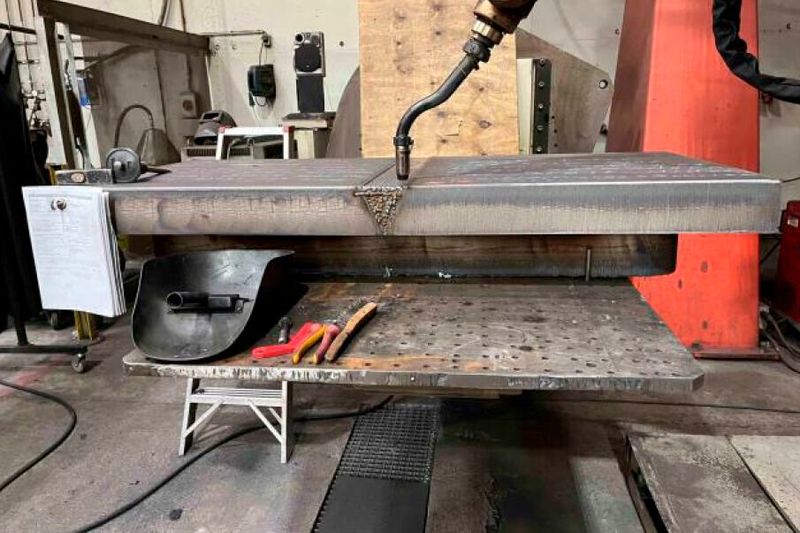
The manually tacked components are welded by a welding robot.
(Image: Jebens)
In components made of metallic materials, internal stresses arise during manufacturing, processing, and deformation, which are unevenly developed and distributed. During further processing, these can lead to warping and cracking of the component, and together with operational loads, even to its failure. Traditionally, stress relief annealing is considered the method of choice to reduce internal stresses in metallic structures. Equally proven for decades, but significantly less known and used, is vibration stress relief—a method that is considerably faster, more cost-effective, and environmentally friendly. In light of increasing demands for environmental protection, resource conservation, and cost structure, vibration stress relief is gaining importance for dimensional stabilization of welded components before, during, or after mechanical processing, with a focus on sustainability and cost-effectiveness.
As a recognized expert in large heavy flame-cut parts and complex assemblies, Jebens GmbH, based in Korntal-Münchingen (Germany), uses this method out of conviction and advocates for its broad acceptance. Introduced in the USA about 100 years ago and distributed in Germany for 50 years by VSR-Industrietechnik GmbH—where it has also been significantly improved—vibration stress relief works with targeted vibrations in component areas with existing internal stresses. Through the targeted application of load from the imbalance motor in areas with a high proportion of internal stress, the yield point of the material is locally exceeded. This results in local relaxation and reduction of internal stresses.
The stress relief process
At the start of the process, it's important to consider the correct positioning of the workpiece in addition to the material and weight of the component. Then, the required minimum acceleration in the component of ten meters per square second and the maximum speed of up to 6,000 revolutions per minute are determined and set at the natural resonances. The modal hammer generates a force impulse several times by striking the component firmly. In vibration stress relief, two vibration sensors measure and monitor the acceleration induced in the component by the impulse. A triaxial accelerometer measures the acceleration of the workpiece in the X, Y, and Z axes. A monoaxial sensor measures how much acceleration reaches a point on the sheet metal farthest from the motor. The relaxation process occurs in five cycles with up to ten frequencies, during which the modal hammer determines the natural frequencies of the component. Once the frequency of the component changes, the automatic control adjusts the imbalance and rotation speed accordingly using modal analysis. The respective relaxation state of the component is determined based on the frequency band. After the five cycles are completed, a final measurement is conducted. All frequencies are recorded in a protocol, and the relaxation state is depicted in a diagram. For large components, as is common at Jebens, the motor must be repositioned several times to ensure the relaxation of the entire component. All processing frequencies are automatically determined, executed, and documented alphanumerically and graphically in the vibration protocol.
According to VSR-Industrietechnik, modal analysis provides scientifically valid proof that internal stresses in the component have been reduced to the extent that distortion can be excluded. The low vibration amplitude also excludes cracking in the components. The company, headquartered in Duisburg, has sold around 150 systems for vibration stress relief to date. Renowned industrial companies such as ThyssenKrupp, Audi, Ford, Caterpillar, Liebherr, and Sennebogen have been using this method in their own production for decades or require their suppliers to apply it. At Jebens, many demanding industrial customers also rely on vibration stress relief for components for press brakes with up to 100 tons of part weight, forging manipulators with up to 40 tons of part weight, or presses with up to 80 tons of part weight.
The advantages
There are numerous advantages to this method: While an average stress relief annealing emits around 6.6 tons of CO2, CO2 emissions with vibration stress relief are only 0.03 tons. The energy consumption of 32,400 kWh for stress relief annealing contrasts with just 8 kWh for vibration stress relief. The time required is also significantly lower: a furnace run typically takes 72 hours, while vibration stress relief takes only about eight hours for large components. Additionally, vibration stress relief does not create a scale layer on the component that would need to be removed by sandblasting, saving costly rework and being more gentle on the material. Subsequent straightening is generally not needed either, as no distortion occurs with vibration stress relief. Since any component size between 100 kilograms and 200 tons, including extreme component geometries, can be treated on-site, transport to a suitable annealing furnace is unnecessary. Despite the higher personnel effort during treatment, vibration stress relief is a considerably more cost-effective solution to reduce internal stresses due to the substantial savings in energy, rework, transport, and time. Jebens also favored the method because the component dimensions produced there are often so large that complete annealing is not possible, or a suitable furnace can only be reached with great effort. Lastly, for tempered components, annealing is not feasible, as no significant stress reduction would occur at the permissible annealing temperature for these components.
Date: 08.12.2025
Naturally, we always handle your personal data responsibly. Any personal data we receive from you is processed in accordance with applicable data protection legislation. For detailed information please see our privacy policy.
Consent to the use of data for promotional purposes
I hereby consent to Vogel Communications Group GmbH & Co. KG, Max-Planck-Str. 7-9, 97082 Würzburg including any affiliated companies according to §§ 15 et seq. AktG (hereafter: Vogel Communications Group) using my e-mail address to send editorial newsletters. A list of all affiliated companies can be found here
Newsletter content may include all products and services of any companies mentioned above, including for example specialist journals and books, events and fairs as well as event-related products and services, print and digital media offers and services such as additional (editorial) newsletters, raffles, lead campaigns, market research both online and offline, specialist webportals and e-learning offers. In case my personal telephone number has also been collected, it may be used for offers of aforementioned products, for services of the companies mentioned above, and market research purposes.
Additionally, my consent also includes the processing of my email address and telephone number for data matching for marketing purposes with select advertising partners such as LinkedIn, Google, and Meta. For this, Vogel Communications Group may transmit said data in hashed form to the advertising partners who then use said data to determine whether I am also a member of the mentioned advertising partner portals. Vogel Communications Group uses this feature for the purposes of re-targeting (up-selling, cross-selling, and customer loyalty), generating so-called look-alike audiences for acquisition of new customers, and as basis for exclusion for on-going advertising campaigns. Further information can be found in section “data matching for marketing purposes”.
In case I access protected data on Internet portals of Vogel Communications Group including any affiliated companies according to §§ 15 et seq. AktG, I need to provide further data in order to register for the access to such content. In return for this free access to editorial content, my data may be used in accordance with this consent for the purposes stated here. This does not apply to data matching for marketing purposes.
Right of revocation
I understand that I can revoke my consent at will. My revocation does not change the lawfulness of data processing that was conducted based on my consent leading up to my revocation. One option to declare my revocation is to use the contact form found at https://contact.vogel.de. In case I no longer wish to receive certain newsletters, I have subscribed to, I can also click on the unsubscribe link included at the end of a newsletter. Further information regarding my right of revocation and the implementation of it as well as the consequences of my revocation can be found in the data protection declaration, section editorial newsletter.
The comparison test
Nevertheless, there are also customers at Jebens who do not yet allow the process. Unlike stress relief annealing, there is no established factor in the FKM guideline for calculating the strength of machine components as a design guideline for proving fatigue strength. Therefore, Jebens recently conducted a highly regarded comparative experiment on deformation during milling of stress-relief annealed and vibration-stress-relieved components. The aim of this experiment was to draw conclusions about the stress state in the component. For this purpose, Jebens cut two plates with a thickness of 110 millimeters to 800 x 800 millimeters (approx. 4,3 inches to 31,5 x 31,5 inches). Then, the company prepared a weld seam preparation for a V 110 seam on one side and tack-welded the components by hand. They were then welded with a welding robot. Both welds were carried out with the same parameters, which were chosen to create the highest possible internal stresses in the weld area. One set of plates was then stress-relief annealed, and the other was vibration-stress-relieved. Next, milling in the weld area was intended to create a change in the internal stresses in the components and lead to deformation of the workpieces. Since internal stress, unlike deformation, cannot be measured in a component, three measurement grooves were milled into the back of each plate set. In these grooves, the respective flatness deviations were to be measured by laser after each milling pass. An initial measurement was taken as a zero measurement in this state.
On the top side of the weld seam, a wide milling path was milled out to completely remove the weld material and heat-affected zone. Three millimeters were added per milling pass. In total, three milling passes were conducted with a chip thickness of three millimeters. The first two passes were milled with coolant, and the third without. Each milling pass was performed using the same parameters. After each pass, the flatness of the measurement grooves was measured and plotted in a diagram where each path was represented separately. The unified scaling of the diagrams allowed for a direct comparison of the results: the deflection in the vibration-stress-relieved component was only one-third as large as in the stress-relief-annealed component. From Jebens' perspective, this suggests that the internal stresses are lower in the vibration-stress-relieved component than in the stress-relief-annealed one. This practical result confirms a theoretical study that VSR conducted several years ago with RWTH Aachen University (Germany). The Aachen researchers demonstrated through FEM calculations that vibration stress relief surpasses the efficiency of stress relief annealing. This conclusion was also confirmed by users like Audi, Ford, and ThyssenKrupp in their own practical investigations, and they subsequently adopted the method. Therefore, from the perspective of Jebens and VSR-Industrietechnik, vibration stress relief is as reliable as conventional stress relief annealing, yet it outshines it in most cases with its array of advantages.



:quality(80)/p7i.vogel.de/wcms/ed/78/ed786ed6b280ff6c692908f01f715e3d/0113143253v1.jpeg "In our China Market Insider, we regularly provide you with relevant information straight from China. (Image:© Eisenhans - stock.adobe.com)")
:quality(80)/p7i.vogel.de/wcms/68/a5/68a5ce0896756c1dcf48dbeceefafbd3/0132300990v1.jpeg "Christoph Geigges is President and CEO of Walter AG. Headquartered in Tübingen (Germany), the company is one of the world’s leading suppliers of precision tools for metalworking. Under Geigges’ leadership, this long-established company is increasingly transforming itself from a tool manufacturer into an engineering partner that supports the entire manufacturing process. (Image: Walter AG)")
:quality(80)/p7i.vogel.de/wcms/3e/7c/3e7c26f44c68545fc7318597b6b65903/0133649650v1.jpeg "The flexible Heller circular storage system can store and process pallets measuring both 630 millimeters by 630 millimeters and 800 millimeters by 800 millimeters—even in mixed-mode operation. This makes the entire production line particularly flexible. (Image:Brighter)")
:quality(80)/p7i.vogel.de/wcms/16/29/162983885950ec1df27ab441bfe88613/0133132549v1.jpeg "Bernd Hermeler is the CEO of Cemecon AG. He studied mechanical engineering at RWTH Aachen University (Germany)—the very university from which the company emerged as a spin-off 40 years ago. Today, Hermeler is responsible for the global strategy of the coating specialist, which, with branches in Europe, the U.S., China, Japan, and India, is considered the global technology leader in the coating of cutting tools. (Image: Cemecon AG)")
:quality(80)/p7i.vogel.de/wcms/4b/7c/4b7c11f510878f154012d04c18a7c3cc/0133798118v1.jpeg "RobCo Becomes a Unicorn: The Munich-based robotics company has reached a valuation of more than one billion U.S. dollars and is driving the next generation of autonomous industrial robotics with Alfie. (Image:RobCo)")
:quality(80)/p7i.vogel.de/wcms/c8/a9/c8a96d5841d508c9e9c609c64168cbaa/0133758997v1.jpeg "Hospital Robotics: Neura Robotics' autonomous healthcare platform is designed to independently transport empty hospital beds between wards and floors. (Image:Neura Robotics)")
:quality(80)/p7i.vogel.de/wcms/88/dc/88dc38a1a0b5e016192ab83b0850fbd0/0133514708v1.jpeg "Scalable data sovereignty is the foundation for the transition from computationally intensive AI processing and growing data streams to sustainable, energy-efficient storage systems. (Image:Gemini / AI-generated)")
:quality(80)/p7i.vogel.de/wcms/1c/ef/1cef66e13c5cc02c5731fefcc99c00d2/0133697754v1.jpeg "Embodied AI in Industry: FMC³ Robotics combines AI-based perception and adaptation with traditional robot control to prepare robots for use in industrial manufacturing. (Image:FMC³/processed by AI)")
:quality(80)/p7i.vogel.de/wcms/a7/8a/a78a582a42a96aaaff38bd6b8f97a015/vishal-lal-mit-kernuhrv1.jpeg "It's ticking: Researchers have stabilized the first atomic clock. (Source: PTB)")
:quality(80)/p7i.vogel.de/wcms/36/f9/36f96a206fc408c9a632ce849de1f7fa/newsimage428299v1.jpeg "Polystyrene is used in protective packaging for televisions and electronic devices, in decorative moldings and baseboards for interior home construction, and even in Petri dishes. (Source: Hereon/Marcel Schwickerath)")
:quality(80)/p7i.vogel.de/wcms/90/30/90300137452b00d22f95113eff065ac3/fliehkraftkupplungen-und-bremsen-montage-centrifugal-clutches-and-brakes-assembly-1v1.jpeg "Installation: Centrifugal clutches should always be precisely matched to the machine. (Source: Amsbeck Machine Technology)")
:quality(80)/p7i.vogel.de/wcms/93/84/9384230e840a99a2015fdd3e0af11e2b/newsimage428236v1.jpeg "The crutch replicates the natural, biomechanical movement pattern of the human body. (Source: Leon Kast)")
:quality(80)/p7i.vogel.de/wcms/50/23/5023ffaefac8f9a47286b368143b88eb/0133801078v1.jpeg "Life isn't exactly a walk in the park for Porsche right now. And now Porsche management is saying that next year will be even worse. Read here to find out why that's supposed to be the case... (Image: Porsche)")
:quality(80)/p7i.vogel.de/wcms/2f/ab/2fabf62cdd2f57cb279e00931c91c869/0133794991v1.jpeg "The Atto 2 SUV is one of BYD's most popular plug-in hybrids. (Image:BYD)")
:quality(80)/p7i.vogel.de/wcms/e9/6e/e96e34d467ca1017f2a689275ae07302/0133815122v1.jpeg "Porsche CEO Leiters has shared new information about the company's model plans. (Image:Porsche)")
:quality(80)/p7i.vogel.de/wcms/0a/50/0a50938be0b598b36efc4e5457ed56dd/forvia-siege-zen-massage-16-9-06v1.jpeg "Seat with massage function by Forvia. (Source: Forvia)")
:quality(80)/p7i.vogel.de/wcms/4d/eb/4debf44ac7c0349544c70033bb9a182c/0133750488v1.jpeg "AI-enabled hardware: is a prerequisite for successful AI projects. (Image:Tung Lam)")
:quality(80)/p7i.vogel.de/wcms/36/f0/36f0472d20227013871aa790f4d48ac6/0133726018v1.jpeg "Ion beams can ablate, coat, or smooth surfaces down to the atomic level. Such processes are used, among other things, in optical chips, precision optics, and superconducting materials. (Image:AI-generated)")
:quality(80)/p7i.vogel.de/wcms/1f/47/1f47da6ee12c38a745eb478a04157a65/0133726100v1.jpeg "The schematic diagram shows the structure of a 3D NAND memory device with memory cells stacked on top of one another and vertical connections for high storage density. (Image:Dall-E / AI-generated)")
:quality(80)/p7i.vogel.de/wcms/b6/06/b6060e0b986e103e442b3971b6c0724c/0133731535v1.jpeg "Rendering of the planned Terafab facility in Texas (presumably generated using AI). Elon Musk does not seem to be making progress with his plans to operate his own semiconductor manufacturing facility. The SpaceX CEO has confirmed that he is currently in talks with TSMC regarding a stake in the Terafab project. (Image:SpaceX)")
:fill(fff,0)/images.vogel.de/vogelonline/companyimg/76800/76895/65.jpg "FAULHABER_120mm.jpg ()")
:fill(fff,0)/p7i.vogel.de/companies/69/de/69de1b7403b0d/simtos-logo.jpeg "simtos-logo (SIMTOS)")
:quality(80)/p7i.vogel.de/wcms/dc/0b/dc0bb45fae3c250a7e75c1d9a1f5e041/thyssenkrupp-profile-aus-zm-beschichteten-bandstahlv1.jpeg "With ZM Ecoprotect Solar, thyssenkrupp Steel offers a variant developed for PV mounting systems. The coating is applied to the steel strip before forming, allowing profiles to be produced without the disadvantages of subsequent batch galvanizing. (Source: Thyssenkrupp Steel)")
:quality(80)/p7i.vogel.de/wcms/f2/af/f2af678854664143c1d3a886cbfb7e5f/0128694427v1.jpeg "Position, angle, inclination, acceleration, vibration: Key measurements for precise productions (Image:Michael Heßhaus/abj/Midjourney)")