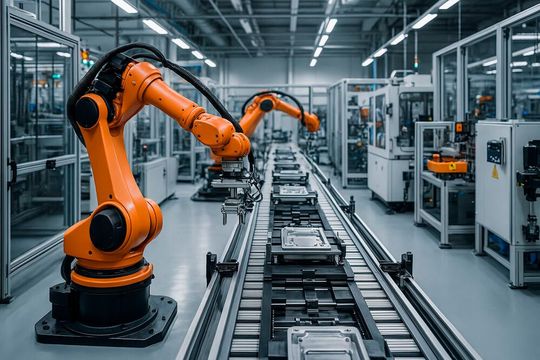
Automation solutions are the key for many medium-sized companies to succeed in an increasingly competitive market environment. This requires an understanding of the challenges faced by medium-sized businesses and the ability to provide automation solutions that are both economically and technically convincing.
Micros Automation is a specialist in the planning and implementation of individual automation solutions in special-purpose machine building.
(Image: Micros Automation)
The automation of industrial processes is no longer a privilege of large industries. Medium-sized manufacturing and assembly companies are also increasingly recognizing the strategic importance of efficient, comprehensive automation solutions. The reasons are varied: rising energy costs, increasing labor shortages, and growing quality requirements force companies to rethink production processes. "In the end, solutions for automating entire production lines reduce the need for personnel resources, increase efficiency, and ensure quality. This is a decisive competitive factor today," explains Michael Ott, Head of Sales at Micros Automation, a specialist in the planning and implementation of customized automation solutions in special machine construction based in South Tyrol.
Especially in medium-sized companies, production processes have often evolved individually and are characterized by partially automated stand-alone solutions or even manual work. Both variants tie up capacities and prevent companies from fully realizing their potential. In light of this, the endeavor to establish comprehensive automation itself becomes a challenge. "Many medium-sized companies do not have the internal capacities to develop complex automation solutions for their entire process lines themselves," says Michael Ott. "What is needed is not just a machine manufacturer, but a specialized implementation partner who understands the big picture and, with their holistic expertise, also provides technological impetus."
A central issue is that resources in areas like manufacturing engineering are often limited. Moreover, standard solutions rarely meet the specific requirements of medium-sized businesses. Michael Ott emphasizes, "Medium-sized businesses are very often faced with the situation that can be summed up as follows: 'I don't need an off-the-shelf machine, but someone who understands and solves my specific problem.' This is precisely where successful implementation must start, to approach automation holistically—and not just at individual points like a single machine."
The need for flexibility is often accompanied by uncertainty for medium-sized companies: "What is technologically feasible?" or "What investments are necessary?" are questions that frequently arise. Therefore, it is important, as Michael Ott states, that implementation partners do not simply act as suppliers but explore solutions collaboratively with the respective medium-sized company. Only in this way can sustainable solutions be developed.
Structured Process in Five Phases
For example, Micros Automation operates with a clearly structured five-phase model: from the analysis of the task to concept creation and verification, and finally to the realization of the final machine. The foundation is the concept and performance specification, which is created in an early project phase. It includes the customer requirements, an initial layout, and a budget estimate of the automated process line.
"Apart from determining the requirements and information necessary to comprehensively automate a process line, this also serves another purpose: exploring potential synergies that have so far remained unrecognized," explains Michael Ott. It is particularly important to technically verify solutions together with the product developers on the respective company's side. "This ensures that the final concept is not only technically feasible but also considers all product-specific requirements." Transparency is considered a key to success: "Clarity about what is realistic—both technically and economically—is highly relevant. This significantly reduces risks on both sides."
Modularity Creates Flexibility and Efficiency
An essential element of the individual automation approach is also the modular machine architecture. Systems consist of standardized base modules into which individual components are integrated, allowing production lines to be tailored to the user, their requirements, and budget. This not only speeds up setup and commissioning but also reduces transportation risks.
This avoids an approach with rigid basic machines. Instead, a situational decision is made about which concept—whether rotary table, workpiece carrier, or transfer line—is best suited for the respective process. "Compared to classic systems, this flexibility presents a significant advantage, as it comes closest to a tailor-made production line," explains Michael Ott. Such an architecture also allows for individual modules to be expanded or replaced if necessary. This enables adaptation to changes in the production process without the immediate need for a completely new system.
Wide Technology Spectrum: from Robotics to Camera Technology
Modern automation systems for assembly, handling, testing, and packaging increasingly rely on a high degree of automation while simultaneously reducing personnel deployment. The goal is to create seamless production lines in which delivered individual components are fully automated into ready-to-install products.
Various technologies are employed here: robots perform precise and repeatable handling tasks, intelligent sensor technology controls processes in real-time, and camera-based inspection systems ensure comprehensive quality assurance. "The camera serves as the 'eye' of the system. It detects whether a part is placed correctly, whether it is defect-free, and directly sends this information to the control system," explains Michael Ott. The technological spectrum is complemented by modern control and visualization solutions that make complex processes manageable while enabling user-friendly operation. The aim is to achieve the most intuitive operability of systems possible.
Date: 08.12.2025
Naturally, we always handle your personal data responsibly. Any personal data we receive from you is processed in accordance with applicable data protection legislation. For detailed information please see our privacy policy.
Consent to the use of data for promotional purposes
I hereby consent to Vogel Communications Group GmbH & Co. KG, Max-Planck-Str. 7-9, 97082 Würzburg including any affiliated companies according to §§ 15 et seq. AktG (hereafter: Vogel Communications Group) using my e-mail address to send editorial newsletters. A list of all affiliated companies can be found here
Newsletter content may include all products and services of any companies mentioned above, including for example specialist journals and books, events and fairs as well as event-related products and services, print and digital media offers and services such as additional (editorial) newsletters, raffles, lead campaigns, market research both online and offline, specialist webportals and e-learning offers. In case my personal telephone number has also been collected, it may be used for offers of aforementioned products, for services of the companies mentioned above, and market research purposes.
Additionally, my consent also includes the processing of my email address and telephone number for data matching for marketing purposes with select advertising partners such as LinkedIn, Google, and Meta. For this, Vogel Communications Group may transmit said data in hashed form to the advertising partners who then use said data to determine whether I am also a member of the mentioned advertising partner portals. Vogel Communications Group uses this feature for the purposes of re-targeting (up-selling, cross-selling, and customer loyalty), generating so-called look-alike audiences for acquisition of new customers, and as basis for exclusion for on-going advertising campaigns. Further information can be found in section “data matching for marketing purposes”.
In case I access protected data on Internet portals of Vogel Communications Group including any affiliated companies according to §§ 15 et seq. AktG, I need to provide further data in order to register for the access to such content. In return for this free access to editorial content, my data may be used in accordance with this consent for the purposes stated here. This does not apply to data matching for marketing purposes.
Right of revocation
I understand that I can revoke my consent at will. My revocation does not change the lawfulness of data processing that was conducted based on my consent leading up to my revocation. One option to declare my revocation is to use the contact form found at https://contact.vogel.de. In case I no longer wish to receive certain newsletters, I have subscribed to, I can also click on the unsubscribe link included at the end of a newsletter. Further information regarding my right of revocation and the implementation of it as well as the consequences of my revocation can be found in the data protection declaration, section editorial newsletter.
Advantages for SMEs
The advantages for medium-sized companies are clear: consistent, higher output, consistent quality, reduced personnel needs, and thus more planning security. Automation relieves monotonous, non-value-adding tasks while simultaneously increasing productivity.
"Through automation, a machine or production line ultimately delivers consistently the same performance—regardless of sickness, shift systems, or motivation. Especially in times of labor shortages, this is an invaluable advantage," says Michael Ott. Added to this are positive effects on the work environment: employees can focus on value-added and interesting tasks while routine activities run automatically. "This also increases team motivation," adds Michael Ott.
Use in Different Industries
Individual automation solutions find application in a variety of industries. Whether in powertrain and steering systems in the automotive sector, in the machining of die-cast parts for e-mobility, or in plastic injection molding parts and packaging processes in the food industry; wherever high quality requirements need to be combined with efficiency and flexibility, customized systems are in demand. This opens up the possibility to adapt proven technologies from different industries to new fields of application. However, the key to implementation is primarily the close integration of all project participants. Short distances and interdisciplinary teams promote exchange and accelerate development processes.
Trends: Energy Efficiency and Demographic Change
Even in light of current megatrends, automation is a central issue. "Energy efficiency in production is becoming increasingly important. Therefore, solutions that design processes in a resource-saving manner and minimize energy use are increasingly in demand," says Michael Ott. Another driver is the demographic change; the availability of skilled personnel is steadily declining. Automation is therefore not only a matter of efficiency but also of the future viability of companies and how the deficit of personnel can be compensated with automated systems. At the same time, flexible investment concepts are gaining importance. "Many products are difficult or uncertain to estimate in their lifecycle. Companies therefore need automation solutions that can be modularly expanded or adjusted—without major new investments," says Michael Ott.
Conclusion
The SME sector faces profound upheavals. The challenges are complex: The labor shortage is growing, demands for efficiency and quality are increasing, and ecological aspects are becoming increasingly important. At the same time, investments in automation must be economically viable and technologically future-proof.
It becomes evident that well-conceived automation solutions are already capable of managing this balancing act. A continuous approach is crucial: from structured analysis to modular plant concepts and the use of the latest technologies such as robotics, camera technology, and intelligent control systems. Those who understand the automation process as a partnership development not only establish stable processes but also gain flexibility and competitiveness. "The key point is that it's not just about delivering technology, but solving a very specific problem. It's important to think in terms of processes and user benefits, rather than just machines," summarizes Michael Ott.
Company profile
Micros Automation specializes in the planning and implementation of customized automation solutions in special machine construction. The company develops highly automated production systems for assembly, workpiece handling, inspection, and packaging—specifically tailored to the requirements of medium-sized industrial companies. With a modular system approach, innovative robotic technology, and intelligent process monitoring, Micros Automation realizes efficient, reliable, and future-proof production lines. The focus is on maximum productivity, quality, and flexibility.



:quality(80)/p7i.vogel.de/wcms/53/f7/53f7dadbe4d656a3fd4f4077445f29f6/0129828707v1.jpeg "Thanks to its compact design and drilling/unscrewing function, the Fire Birdie is suitable for applications with limited installation space and frequent tool changes. (Image:Marcel Kraibühler)")
:quality(80)/p7i.vogel.de/wcms/da/4d/da4da8d34671dc6bce80e496212de877/0129850788v1.jpeg "Mate-XT Go supports the arms and shoulders during overhead work and repetitive tasks and is designed to significantly reduce muscle strain in everyday working life. (Image:Comau)")
:quality(80)/p7i.vogel.de/wcms/95/97/95976dbaac68b249eb65e74c5aad5300/0129651893v1.jpeg "The C2.0 centric clamps, the S2 fixed jaw clamps and the \"gredoc\" zero-point clamping systems are used for machining the raw parts. Fastening is carried out with width across flats 27. (Image:Gressel)")
:quality(80)/p7i.vogel.de/wcms/57/1b/571b8895efb299d70846bbdbd7af2338/0130043886v1.jpeg "Servo hydraulics independent of the control system: The servo hydraulics software module is integrated directly into the b Maxx 5500 servo drive (pictured: Mehmet Sari, Export Sales Manager at Hürsan Pres (left), Özgür Deniz Demirbaş, Country Manager at Baumüller Turkey) (Image:Baumüller)")
:quality(80)/p7i.vogel.de/wcms/3b/27/3b27f6c5848be73acecb04054bf0a146/0130115209v1.jpeg "Spectroscopic glucose measurement with infrared spectroscopy enables more regular measurements without physical strain. (Image:Endrich)")
:quality(80)/p7i.vogel.de/wcms/3f/cc/3fccb748b0fe16f1f61249d94c72f126/0130149439v1.jpeg "Requirements for integrated power supply systems: Precise AC and DC power supply systems that not only provide energy, but also reliably combine measurement, analysis and system integration. (Image:Schulz Electronic)")
:quality(80)/p7i.vogel.de/wcms/fd/93/fd93e01c16f5a4709278499d981a459c/0130061090v1.jpeg "Revealed: These servo drives are assembled at Aerotech in Fürth. (Image:Aerotech)")
:quality(80)/p7i.vogel.de/wcms/cb/8a/cb8ae7f5205365efce3e7285154fc3cf/0130132198v1.jpeg "Markus Huber (left) and Nicolai Friis from TU Wien know how to make quantum computers multidimensional in order to perform computing operations even better. (Image:TU Vienna / A. Rommel)")
:quality(80)/p7i.vogel.de/wcms/63/21/6321beb732bf7d92640df46d7aa77573/0130125122v1.jpeg "As part of the Carbon Lab Factory Lausitz, a pilot plant for the production of sustainable, cost-effective and competitive carbon fibers will be built at the Guben site. (Image:Fraunhofer IAP / Kristin Stein)")
:quality(80)/p7i.vogel.de/wcms/53/4f/534fe0f168f6ee070ded4a48faca4cef/business-wire-main-image-1103x620v1.jpeg "The new UR AI Trainer, developed by Universal Robots and Scale AI, is the first direct lab-to-factory solution for AI model training.
(Source: Universal Robots)")
:quality(80)/p7i.vogel.de/wcms/08/70/087062e2e1a9b9add5777410dd746ee9/adobestock-1923991605-5607x3156v1v1.jpeg "A new type of tactile sensor, inspired by human skin, even recognizes grains of sand. (Image:Curioso.Photography - stock.adobe.com)")
:quality(80)/p7i.vogel.de/wcms/7f/08/7f087d7013424d123ab7275cd2e3fe55/adobestock-809456218--c2-a9-20degimages-20-e2-80-93-20stock-adobe-com-ki-generiert-4179x2351v1v1.jpeg "The digital upgrading of existing machines conserves resources, saves energy and reduces the need for new production. (Image:Degimages - stock.adobe.com/AI-generated)")
:quality(80)/p7i.vogel.de/wcms/90/db/90db3087d3af0560fcdb4dbc42443ce1/0130157448v1.jpeg "The switch to SDV is the most complex transformation the industry has ever had to master. The end consumer gets a vehicle that gains rather than loses value over its lifetime. (Image:Sonatus)")
:quality(80)/p7i.vogel.de/wcms/73/f0/73f00bb99a23197db05bb584fe78f20f/0130080581v1.jpeg "The \"China Speed\" analysis by Roland Berger shows that the speed of development has only a limited connection with labor costs. (Image:freely licensed at Pexels)")
:quality(80)/p7i.vogel.de/wcms/2f/5b/2f5ba6a150b52c2b8efada560c5cdafe/0130143442v1.jpeg "Automotive suppliers are facing a severe crisis, which is primarily due to a combination of structural change and economic problems. (Image:freely licensed at Pexels)")
:quality(80)/p7i.vogel.de/wcms/22/d0/22d03cd48e992435338b59464c428d41/0129739814v1.jpeg "More electric vehicles on the roads mean a higher demand for electricity - which should ideally be covered by renewable energies. (Image:BMW)")
:quality(80)/p7i.vogel.de/wcms/94/7a/947ac066b98cbcd3470e83ff9da3e25f/0130096114v1.jpeg "The use of amorphous steels in the stator enables a significant reduction in losses and increases the efficiency of modern electric motors in vehicle drives. (Image:Horse Powertrain)")
:quality(80)/p7i.vogel.de/wcms/e5/f1/e5f171d3d7ae021332cc0aeae4d6e299/0130127049v1.jpeg "In collaboration with Shanghai Jiao Tong University, Lenovo has presented a silicon anode battery under the name \"ED1000\" as a proof of concept for mobile workstations. (Image:Lenovo)")
:quality(80)/p7i.vogel.de/wcms/fa/69/fa696e59706b96fff02283dd74cc2398/0130129635v1.jpeg "Samsung Co-CEO Jun Young-hyun wants to respond to the AI-driven boom in demand in the memory market with contracts for up to five years. This should provide more planning security in the traditionally volatile storage business. At the same time, however, this is likely to increase the pressure on customers to secure precise long-term requirements, prices and supply chains. (Image:Samsung)")
:quality(80)/p7i.vogel.de/wcms/31/a8/31a883a47b86634c382923e78fd9a4c9/0130133225v1.jpeg "Figure 1: GMSL-capable point-to-point connection. (Image:ADI)")
:fill(fff,0)/images.vogel.de/vogelonline/companyimg/76800/76895/65.jpg "FAULHABER_120mm.jpg ()")
:fill(fff,0)/p7i.vogel.de/companies/67/eb/67eba621ef6ea/logo2.png "logo2 (Wuxi InfiMotion)")
:quality(80)/p7i.vogel.de/wcms/55/e6/55e6087dd3c08f7296485f64f2f0cc9d/0124398489v1.jpeg "Michael Ott, Head of Sales at Micros Automation: \"Ultimately, solutions for automating entire production lines reduce the need for human resources, increase efficiency, and ensure quality. This is a crucial competitive factor today.\"(Image: Micros Automation)")
:quality(80)/p7i.vogel.de/wcms/8f/81/8f81c4f07d1841c26d2564efc0c89f7c/0124398487v1.jpeg "Michael Ott, Head of Sales at Micros Automation: \"Ultimately, solutions for automating entire production lines reduce the need for human resources, increase efficiency, and ensure quality. This is a crucial competitive factor today.\"(Image: Micros Automation)")
:quality(80)/p7i.vogel.de/wcms/52/cf/52cf6c6d8621b7bef067993f7c07717e/0124398482v1.jpeg "Micros Automation is a specialist in the planning and implementation of individual automation solutions in special-purpose machine building.(Image: Micros Automation)")
:quality(80)/p7i.vogel.de/wcms/cf/d6/cfd69346fe4fb2fec83849632b757c86/0124398481v1.jpeg "Micros Automation is a specialist in the planning and implementation of individual automation solutions in special-purpose machine building.(Image: Micros Automation)")
:quality(80):fill(efefef,0)/p7i.vogel.de/wcms/67/ad/67adf4a647532/elatec-wp-machine-authentication.png "Elatec WP Machine Authentication")
:quality(80)/p7i.vogel.de/wcms/92/ff/92ffd331bc54321f27cd8b65cf3b4da1/0124228537v1.jpeg "Turck's Ethernet multiprotocol I/O modules ensure efficient data communication along the system. (Image:Turck)")
:quality(80)/p7i.vogel.de/wcms/1b/34/1b3437fb1a1da6828e1f0e5ce72047f3/0128402395v1.jpeg "The compact design and high power density of axial flux motors open up new possibilities for vehicle concepts in the field of electromobility. (Image: ©paul_craft - stock.adobe.com)")