Sustainable development is the declared goal of a growing number of companies—a major task. Because it means nothing less than companies having to change the way they develop, manufacture, sell and maintain their physical products. But there are systems that support them in this.
With a digital thread between the physical and the digital world that covers the entire product lifecycle, as well as precise supply chain data with the CO2 footprint of materials, companies can develop, manufacture and maintain their products more sustainably.
Sustainability encompasses the three areas of ecology, economy, and social issues. In this post, we focus on the first two, which are often closely linked. An example: less material or energy consumption reduces costs and CO2 emissions. Social aspects often start at different points and usually require different methods, which is why they are omitted here.
Sustainability and digitalization are closely linked
Companies that want to become more sustainable first and foremost need information about when, where and how they have the greatest environmental impact. In order to collect and evaluate these data, but also to implement respective measures, they need software solutions. That's why companies' sustainability strategies are closely linked to their degree of digitalization.
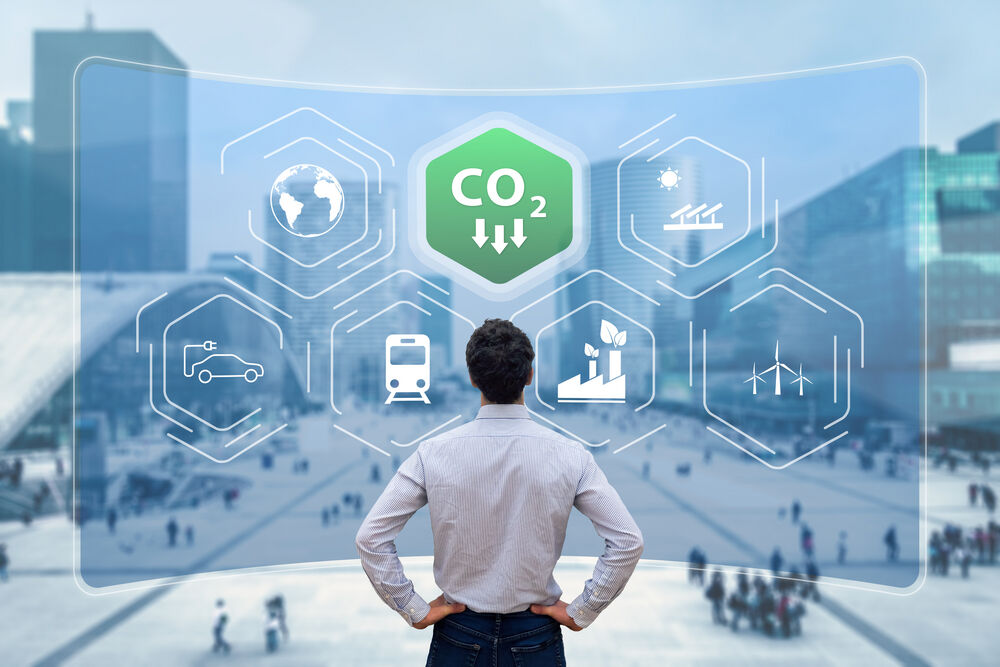
Sustainability and digitalization are closely intertwined.
(Image:NicoElNino - stock.adobe.com/PTC)
Practical example: Vestas, manufacturer of wind turbines, links a digital representation of the basic materials used in production with the design tools to ensure that the various processes harmonize with each other and support the sustainability strategy. Many of the turbine components are processed externally. In order to maintain an overview of the materials used, Vestas creates digital images of the parts. In the future, these data are to be linked with the data of the suppliers, so that Vestas can continuously check whether the design process is based on basic materials that correspond to the sustainability goals.
Construction: Sustainability from the beginning
When considering the life cycle of a product, the focus on sustainability must start in the design and construction phase. Because this is where numerous aspects are determined that shape the CO2 footprint of the product.
Practical example: Cummins, an independent developer and manufacturer of diesel and gas engines and a leading provider of electrification systems, began to rethink its construction process. About 70 percent of the CO2 footprint that a product leaves behind during its lifecycle is determined during the construction process.
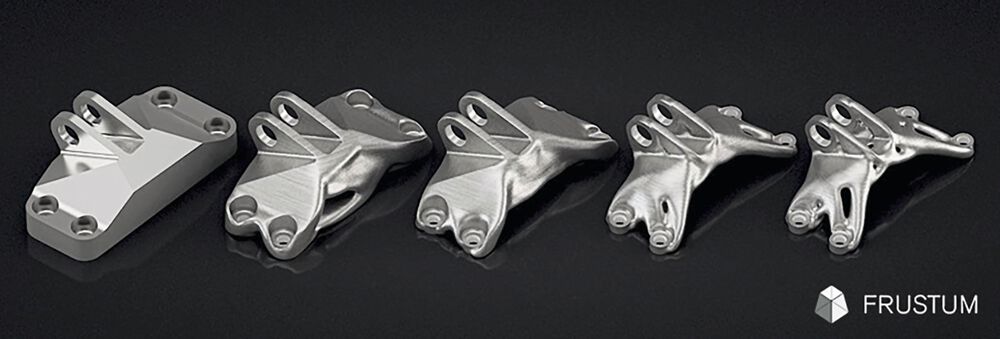
Thanks to generative design, a lot of material can be saved at non-load-bearing points.
(Image:PTC)
This means: Cummins had to start already in the design phase in order to minimize the impact of a product on the environment. The manufacturer used PTC's Creo CAD software and generative design to save 10 to 15 percent of the materials in the design of engine components.
Product designers and engineers typically use a CAD system. With it, they can replace physical prototypes with digital ones, thereby significantly reducing the time, money, and materials required. This is particularly significant when it comes to materials that have a high environmental impact, such as steel, aluminum, plastic, or glass.
In addition, integrated design simulation and analysis functions reduce the need for modeling and physical prototypes. Designers can virtually test designs and analyze the stresses and strains the product will be subjected to in its application before a prototype is physically realized.
Practical example: When shaping and processing the glass, a company consumes a lot of energy and water. In the traditional workflows, about a dozen prototypes are needed to find the optimal variant. Because no one knows exactly what happens when the glass is actually in the form. With a simulation software, this can be virtually investigated. Thus, the manufacturer was able to validate a new design with only two physical prototypes.
Six aspects of sustainable products
The next step is to consider the six principles that contribute to more sustainable products over the entire life cycle:
Material reduction
modular design
reuse
remanufacturing
refurbishing
repairability
repurposing
recyclability
Due to the CO2 content of the processed materials and components, all companies in discrete manufacturing have high Scope-3 emissions. For them, material reduction is a major lever for more sustainability. AI-driven generative design supports designers in this:
The AI simultaneously evaluates all simulation conditions at each point within the design space and weighs the benefits and costs of placing material at the respective spot.
This makes the solution a continuous area from which a shape emerges.
The system optimizes the design until it meets its requirements and function with a minimum of material.
This is further supported in Creo by the ability to perform real-time simulations. For this, PTC has partnered with Ansys. Ansys Granta offers a materials database that not only feeds into the simulation but also calculates the CO2 footprint of materials. This allows designers to specifically select materials that reduce the footprint without compromising on quality.
In order to take into account the manufacturing process already in the design of products, PTC is also expanding its cooperation with Apriori. Based on the product design, Apriori can estimate, analyze, and thus predict the costs and CO2 emissions resulting from the subsequent processing processes.
Date: 08.12.2025
Naturally, we always handle your personal data responsibly. Any personal data we receive from you is processed in accordance with applicable data protection legislation. For detailed information please see our privacy policy.
Consent to the use of data for promotional purposes
I hereby consent to Vogel Communications Group GmbH & Co. KG, Max-Planck-Str. 7-9, 97082 Würzburg including any affiliated companies according to §§ 15 et seq. AktG (hereafter: Vogel Communications Group) using my e-mail address to send editorial newsletters. A list of all affiliated companies can be found here
Newsletter content may include all products and services of any companies mentioned above, including for example specialist journals and books, events and fairs as well as event-related products and services, print and digital media offers and services such as additional (editorial) newsletters, raffles, lead campaigns, market research both online and offline, specialist webportals and e-learning offers. In case my personal telephone number has also been collected, it may be used for offers of aforementioned products, for services of the companies mentioned above, and market research purposes.
Additionally, my consent also includes the processing of my email address and telephone number for data matching for marketing purposes with select advertising partners such as LinkedIn, Google, and Meta. For this, Vogel Communications Group may transmit said data in hashed form to the advertising partners who then use said data to determine whether I am also a member of the mentioned advertising partner portals. Vogel Communications Group uses this feature for the purposes of re-targeting (up-selling, cross-selling, and customer loyalty), generating so-called look-alike audiences for acquisition of new customers, and as basis for exclusion for on-going advertising campaigns. Further information can be found in section “data matching for marketing purposes”.
In case I access protected data on Internet portals of Vogel Communications Group including any affiliated companies according to §§ 15 et seq. AktG, I need to provide further data in order to register for the access to such content. In return for this free access to editorial content, my data may be used in accordance with this consent for the purposes stated here. This does not apply to data matching for marketing purposes.
Right of revocation
I understand that I can revoke my consent at will. My revocation does not change the lawfulness of data processing that was conducted based on my consent leading up to my revocation. One option to declare my revocation is to use the contact form found at https://contact.vogel.de. In case I no longer wish to receive certain newsletters, I have subscribed to, I can also click on the unsubscribe link included at the end of a newsletter. Further information regarding my right of revocation and the implementation of it as well as the consequences of my revocation can be found in the data protection declaration, section editorial newsletter.
PLM systems: keeping an eye on the entire product lifecycle
A tool that contains a large amount of information on the product lifecycle is the PLM system. Through meaningful integrations, it can serve as a data hub for sustainable companies, thus ensuring transparency and traceability throughout the entire product lifecycle.
A PLM system helps designers select sustainable materials and monitor environmental impacts based on the bill of materials. By integrating material databases or Lifecycle Assessment Tools (LCA) into a PLM system, it provides information for more sustainable procurement. In particular, the integration of LCA tools allows the comparison of product alternatives and greatly simplifies the generation of environmental reports at each stage of the product lifecycle. The insights gained in this way can be used to identify the product characteristics that have the greatest potential for increased sustainability.
By integrating REACH (Regulation concerning the Registration, Evaluation, Authorisation and Restriction of CHemicals) and RoHS (Restriction of Certain Hazardous Substances) databases, PLM also helps to avoid dangerous and toxic substances in products. The REACH directive regulates the use of chemical substances in product manufacture, and the RoHS directive restricts the use of certain substances in electrical and electronic products.
PLM enables modularization
Since a PLM system ensures the traceability of requirements and components, it also supports the standardization and modularization of components and assemblies. This has the advantage that components can be installed in various products or product lines and can be repurposed later. Modular product design also simplifies the disassembly or deconstruction of products so that components can be reconditioned and reinstalled as part of a refurbishment or overhaul.
Standardization of parts ensures better repairability because parts can be easily replaced and service personnel must familiarize themselves with fewer parts. This too contributes to longer product usage and thus to greater sustainability. If a machine has been running for 30 years, however, there is usually little information available about its components and the processes are correspondingly time-consuming if spare parts are to be procured or parts of the machine are to be recycled. PLM systems then provide valuable information.
And finally, PLM systems provide quality-relevant and manufacturing-specific information that can reduce scrappage and rework in production. This too saves energy and material.
Sustainability in manufacturing
In manufacturing, both in economical and ecological terms, the aim is to improve the overall efficiency of the plants (Overall Equipment Effectiveness, OEE). Because the higher it is, the higher is the energy efficiency. With an IIoT (Industrial Internet of Things) platform, it's not just possible to monitor and optimize energy consumption during the entire manufacturing process, but also the quality. Defects that lead to recall actions or scrap can thus be reduced to a minimum. This has a double benefit: it avoids unplanned, costly machine downtime as well as unsustainable, sometimes expensive material losses.
In addition, such a platform offers the data basis on which manufacturing processes can be designed to be more flexible, agile, and efficient. It enables predictive maintenance and corresponding service, so that the lifespan of machines, systems, and devices can be extended.
Through context-related work instructions, it can improve the accuracy of machine and system operators and minimize human errors that lead to scrap or rework.
By allowing knowledge and visual work instructions to be quickly and location-independently distributed to all employees via AR applications, a more flexible and agile production is possible, and repair times are shortened.
In addition, customers can correctly perform service procedures themselves, reducing the need for paper-based instructions and travel for service technicians.
Sustainable until the end
To reduce the CO2 footprint in the use phase of products, energy-efficient, highly utilized, and durable parts are needed, supported by a matching service. This is especially true for things that have a large CO2 footprint in this phase. These mainly include mobile and service-intensive things like cars, medical imaging devices, elevators, bulldozers, or manufacturing machines.
For this, a facility-oriented field service is required that uses product knowledge and remote functions.
Practical example: 3D Systems, the provider of 3D printers, exemplifies how an asset-oriented field service reduces the need for spare parts including the necessary transports. The company uses PTC's Servicemax for asset-oriented management to track its devices in use, manage work orders, and connect its IoT functions. This has led to a reduction in spare part consumption by 62 percent and a decrease in repeat visits by 39 percent, while the NPS (Net Promoter Score, customer satisfaction) has risen from 22 percent to 65 percent. In addition, Servicemax ensures that the right service request is assigned to the right technician. This results in better service outcomes and at the same time reduces potential emissions from travel to customers.
In addition, recyclability is increasingly becoming a priority in order to increase reusability and thus avoid waste. A service program informs operators and technicians about how to maintain a product and how to responsibly disassemble it for reuse, refurbishing, or recycling in the end.
Conclusion
The explanations show: With a digital thread between the physical and the digital world that covers the entire product lifecycle, as well as precise supply chain data with the CO2 footprint of materials, companies can develop, manufacture, and maintain their products more sustainably.



:quality(80)/p7i.vogel.de/wcms/1d/85/1d856c359855885a633f48d9f77fe69c/0130227630v1.jpeg "Two \"HBZ AeroCell 160\" in the Moyola factory. The machines mark a significant milestone in Moyola's ongoing commitment to performance, innovation and global competitiveness. (Image:Moyola)")
:quality(80)/p7i.vogel.de/wcms/78/e3/78e3db1b32fb30c9a9195e36864db885/0129830906v1.jpeg "Siemens and Caphenia sign the partnership agreement. From left to right: Nicky Ahnert, Jürgen Giegerich, Frank Knauf (all Siemens), Dr. Mark Misselhorn, Dr. Andreas Waibel (both Caphenia). (Image:Siemens)")
:quality(80)/p7i.vogel.de/wcms/5a/d7/5ad72fd14971344dbfed431e07ae6423/0130200276v1.jpeg "A new machining job needs to be processed! Open the drawer—but the right tool is missing! That's what happens when you work with old data. But EVO Informationssysteme has an AI tool that means the problem will never slow down production again. (Image:EVO Information Systems)")
:quality(80)/p7i.vogel.de/wcms/53/f7/53f7dadbe4d656a3fd4f4077445f29f6/0129828707v1.jpeg "Thanks to its compact design and drilling/unscrewing function, the Fire Birdie is suitable for applications with limited installation space and frequent tool changes. (Image:Marcel Kraibühler)")
:quality(80)/p7i.vogel.de/wcms/21/3b/213b5e5454b0c4344ba0eaa700857607/0129635774v1.jpeg "The QRV flow control valves from Lee are available in sizes from 5.5 to 18 mm and cover a flow rate of 0.2 to 20 l/min. Depending on the version, the pressure range is either between 0.1 and 2.75 bar (1.5 - 40 psi) or between 0.17 and 2 bar (2.5 - 30 psi). (Image:Lee)")
:quality(80)/p7i.vogel.de/wcms/63/e9/63e9db3259a656cca88c5f7158af3fcb/0129385769v1.jpeg "The Agibot A2 at a Fortune China event in December 2025. (Image:Agibot)")
:quality(80)/p7i.vogel.de/wcms/df/a1/dfa1786a3b05f5ff2e51d0f633695c57/0130137877v1.jpeg "Openclaw inspires AI communities. (Image:Openclaw.ai)")
:quality(80)/p7i.vogel.de/wcms/16/9c/169ce3040d09673a91a403598d15dbf1/0130162776v1.jpeg "From networked cameras to vacuum robots, industrial robots, drones and humanoids, AI is moving ever closer to sensors and actuators as it develops from \"basic intelligence\" to \"multi-purpose intelligence\", while software-defined architectures make long-term systems flexibly upgradeable for new functions and AI models. (Image:Globalfoundries)")
:quality(80)/p7i.vogel.de/wcms/78/28/7828775af76773458b4d1409ceb1cf0c/368945-20dam-20imagery-digital-transformation-pc-1920x1079v1v1.jpeg "Complex development projects with high regulatory requirements, such as in the aerospace industry, benefit in particular from the Intelligent Product Lifecycle. (Image:PTC)")
:quality(80)/p7i.vogel.de/wcms/e7/82/e7822e208621ba2ae892d609e60481e8/texas-20uni-850x478v1v1.jpeg "Superfoam is a composite that is capable of absorbing 10 times more energy than a conventional foam. (Image:Abbey Toronjo/Texas A&M University Division of Marketing & Communications)")
:quality(80)/p7i.vogel.de/wcms/da/4d/da4da8d34671dc6bce80e496212de877/0129850788v1.jpeg "Mate-XT Go supports the arms and shoulders during overhead work and repetitive tasks and is designed to significantly reduce muscle strain in everyday working life. (Image:Comau)")
:quality(80)/p7i.vogel.de/wcms/3f/cc/3fccb748b0fe16f1f61249d94c72f126/0130149439v1.jpeg "Requirements for integrated power supply systems: Precise AC and DC power supply systems that not only provide energy, but also reliably combine measurement, analysis and system integration. (Image:Schulz Electronic)")
:quality(80)/p7i.vogel.de/wcms/2b/0b/2b0b5ff55299be32174cb0ed76718253/0130177406v1.jpeg "Rolls-Royce has received funding of 70 million US dollars from the EU public-private partnership \"Joint Undertakings for Clean Aviation\". (Image:Rolls-Royce)")
:quality(80)/p7i.vogel.de/wcms/95/7e/957ed49b185794b3e76b9e610a8a389f/0130217926v1.jpeg "Bosch wants to offer components for e-vehicles in India together with Tata. (Image:Bosch)")
:quality(80)/p7i.vogel.de/wcms/d8/11/d8118b193939ca897a4962aeb1bbc5ae/0130224537v1.jpeg "Opel plans to participate in the Formula Ene racing series from fall 2026 with the fully electric Gen4 racing cars. (Image:Opel)")
:quality(80)/p7i.vogel.de/wcms/92/f1/92f12f22e5045c6af002ab48a59841d0/0130171646v1.jpeg "The US electric vehicle manufacturer Rivian is to supply self-driving vehicles to Uber. (Image:Rivian)")
:quality(80)/p7i.vogel.de/wcms/3a/50/3a50d3f269f38f14d7a25a93c6f2b2f8/0130147601v1.jpeg "The compact modulator enables fast and energy-efficient data transmission and can be manufactured cost-effectively. (Image:Hugo Larocque, EPFL)")
:quality(80)/p7i.vogel.de/wcms/54/d3/54d34bf24912ac87780c1fbfa745dad7/0130174841v1.jpeg "Simulation can help to optimize material flows in production. (Image:freely licensed)")
:quality(80)/p7i.vogel.de/wcms/1f/8e/1f8e294ac0af3a801575c7e1400cc830/0130164847v1.jpeg "While micro-injection molding takes 10 to 12 weeks for critical components, 3D printing offers faster manufacturing and greater flexibility for design iterations, Collins said. (Image:Boston Micro Fabrication)")
:quality(80)/p7i.vogel.de/wcms/ae/8f/ae8f87001d67841b6a6f9e3efb5a2f1a/0130176499v1.jpeg "Almost 160 exhibitors and 2,400 participants came to Munich for LOPEC 2026 to find out about printed electronics. (Image:Messe München GmbH)")
:fill(fff,0)/images.vogel.de/vogelonline/companyimg/76800/76895/65.jpg "FAULHABER_120mm.jpg ()")
:fill(fff,0)/p7i.vogel.de/companies/69/88/69882c428938e/tmts2026-ticec-banner-en-2000px.png "tmts2026-ticec-banner-en-2000px (https://www.tmts.tw/en)")
:fill(fff,0)/p7i.vogel.de/companies/67/eb/67eba621ef6ea/logo2.png "logo2 (Wuxi InfiMotion)")
:quality(80)/p7i.vogel.de/wcms/08/7e/087e5cbeb0039395c8759c8fdb54e24c/0129120874v1.jpeg "Digital consistency: Using Fresenius as an example, the article shows how companies benefit from integrated development processes. (Image:Fresenius Medical Care)")
:quality(80)/p7i.vogel.de/wcms/82/e1/82e16f091de3198fd428db965f34a2a9/0124487900v1.jpeg "The growing information demand poses increasing challenges for manufacturers and operators of products and resources. (Image:Phoenix Contact)")