The digital transformation and the use of generative AI models provide companies with an innovative solution to make sales processes future-proof. However, implementing this vision requires overcoming various complexity drivers.
Even in mechanical engineering, customer interaction is increasingly determined by digital touch points.
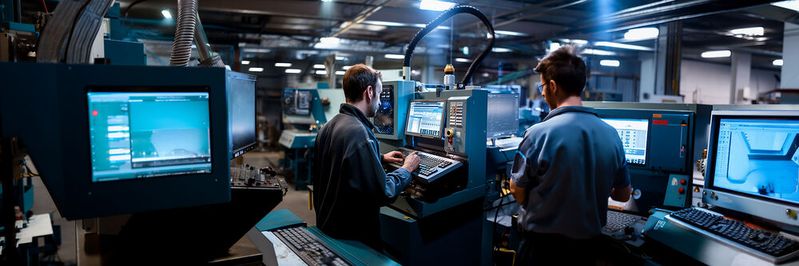
(Image: Eraneos Germany generates using generative AI.)
Fabian Tönnesmann is a partner and Managing Director at Eraneos Germany.
Nikolai Roll works as a Senior Manager at Eraneos Germany.
Our digital world is changing expectations of selection and ordering processes: Today, 94 percent of B2B buyers prefer to purchase goods and services online. 68 percent expect a customer experience tailored to them through personalised processes. 64 percent of B2B executives would switch providers to receive personalised real-time pricing. And 73 percent of tech-savvy millennials are involved in the purchase. This presents promising opportunities along the sales process, but also business-critical challenges. Manufacturing companies in Germany are technologically not yet able to meet these challenges in many areas. However, more and more manufacturers are recognising the urgency of modernising and actively managing their customer journey. Only in this way can they create contemporary customer experiences and remain competitive. Our vision is a new approach to the customer journey: generative AI models help to realise a conversational commerce platform and thus future-proof the sales processes.
The problem: unclear structures and complex products
Manufacturing companies are currently subject to a very high level of complexity. Complicated structures meet unclear, silo-like operational models and outdated technological foundations. At the same time, many business areas are still not able to function without manual processes. In this confusing environment, companies have to sell demanding and explanation-needing products and services. For this to succeed, it is important to design the customer journey seamlessly. In a goal-oriented control of the process, the manufacturer comes into contact with the customer at every stage. Companies that digitalise interaction for this purpose must meet high demands. Yet, the tasks quickly exceed the available capacities and competencies.
Five complexity drivers in the digital sales process
The following complexity drivers often stand in the way of implementing an orchestrated digital sales process:
Different customer roles - such as users, development engineers, or procurement staff - need to be balanced and addressed. This creates a new quality of customer complexity.
The customer journey runs along internal structures, so that different touchpoints and changing responsibilities affect the customer experience.
The various sales structures from direct sales to distributors require high flexibility in orchestration.
Digital processes and digital channels - such as product lifecycle management or a complete customer view - only function based on professionally organized data. However, product and customer information is often scattered across departments and incomplete.
Many companies rely on inflexible and non-scalable legacy systems, such as older CRM versions. Market-wide solutions are rare. Lack of system integration and data migration ultimately hamper effective cooperation and data-driven decision-making.
Generative AI creates conversational commerce.
A possible answer to the challenges described is Conversational Commerce, or C-Commerce for short. Here, sales take place via automated interaction in real time with the customer - realised with technical tools like digital voice assistants or chatbots. We have developed a visionary approach for a successful customer journey in C-Commerce including Configure Price Quote (short: CPQ) and aftersales on revenue-oriented websites. Generative Artificial Intelligence acts here as a kind of hyperpersonalisation machine to create personalised buying experiences for users. The AI models learn the patterns and structures of the entered training data like texts, images or other media and develop new data based on this - for example, personalised information for users of a website that is generated and played out in real time.
Let's imagine the fictitious company Ineq, which sells complex production plants for various industries. Ineq lacks the human resources to manually create and maintain current personalised content, such as product advantages for every conceivable target group, on its own website and in other digital channels on a large scale. Our approach consists of the following modules for a future-proof C-Commerce platform using generative AI.
Date: 08.12.2025
Naturally, we always handle your personal data responsibly. Any personal data we receive from you is processed in accordance with applicable data protection legislation. For detailed information please see our privacy policy.
Consent to the use of data for promotional purposes
I hereby consent to Vogel Communications Group GmbH & Co. KG, Max-Planck-Str. 7-9, 97082 Würzburg including any affiliated companies according to §§ 15 et seq. AktG (hereafter: Vogel Communications Group) using my e-mail address to send editorial newsletters. A list of all affiliated companies can be found here
Newsletter content may include all products and services of any companies mentioned above, including for example specialist journals and books, events and fairs as well as event-related products and services, print and digital media offers and services such as additional (editorial) newsletters, raffles, lead campaigns, market research both online and offline, specialist webportals and e-learning offers. In case my personal telephone number has also been collected, it may be used for offers of aforementioned products, for services of the companies mentioned above, and market research purposes.
Additionally, my consent also includes the processing of my email address and telephone number for data matching for marketing purposes with select advertising partners such as LinkedIn, Google, and Meta. For this, Vogel Communications Group may transmit said data in hashed form to the advertising partners who then use said data to determine whether I am also a member of the mentioned advertising partner portals. Vogel Communications Group uses this feature for the purposes of re-targeting (up-selling, cross-selling, and customer loyalty), generating so-called look-alike audiences for acquisition of new customers, and as basis for exclusion for on-going advertising campaigns. Further information can be found in section “data matching for marketing purposes”.
In case I access protected data on Internet portals of Vogel Communications Group including any affiliated companies according to §§ 15 et seq. AktG, I need to provide further data in order to register for the access to such content. In return for this free access to editorial content, my data may be used in accordance with this consent for the purposes stated here. This does not apply to data matching for marketing purposes.
Right of revocation
I understand that I can revoke my consent at will. My revocation does not change the lawfulness of data processing that was conducted based on my consent leading up to my revocation. One option to declare my revocation is to use the contact form found at https://contact.vogel.de. In case I no longer wish to receive certain newsletters, I have subscribed to, I can also click on the unsubscribe link included at the end of a newsletter. Further information regarding my right of revocation and the implementation of it as well as the consequences of my revocation can be found in the data protection declaration, section editorial newsletter.
Dialogue-based technology: Dialogue-oriented entry points offer user-centered content. This creates a personalized shopping experience. Based on continuous communication with the potential buyer, the AI provides personalized landing pages for the offers. The data is interpreted in real time. This allows the products to be configured automatically and personalized based on the respective specific customer requirements.
Service Integration: At check-out, the customer automatically receives offers for personalized product-specific services. Unified user movements on the website through active control allow uncomplicated upselling of service offers during the customer journey.
Simplified purchasing process: Users who make contact are directed straight to the purchasing department. This way, they find a competent contact person without detours and time loss, and the company saves personnel resources. At the same time, the risk of losing potential buyers on the way to the responsible contact person is reduced.
On-Device: Our vision is based on an agnostic approach to the end devices. This means in practice: The customer orders spare parts via the user interfaces of their machines. A production employee receives, for example, information directly from the machine he is operating, such as when a part is worn out. He can also immediately initiate the purchase, without having to first request it from the procurement department. The ongoing process is instead automatically forwarded to other devices, such as the tablet of the responsible procurement employee.
The implementation is carried out via a headless commerce platform. Since the backend and frontend are separated, multiple frontends are possible without affecting the backend infrastructure. The created on-device access allows seamless communication with the customer's staff. The interaction takes place directly at the machine and is enriched by generative AI with individual data from previous communication. This way, the user can make data-based and therefore informed decisions when ordering.
The result: Lower costs, more sales, satisfied customers.
If the fictitious company Ineq implements all the recommended measures, the following effects can be expected: The multifunctional personalized support strengthens trust in the brand and reduces customer inquiries. The fully automated and generative offer system increases the users' willingness to buy, thus boosting sales. The generative AI streamlines processes, improves data-driven purchase decisions, and creates additional customer benefits. This saves time for both customers and Ineq's employees, customer satisfaction and loyalty grow, and sales increase. Hybrid sales enable 50 percent more revenue because customers are more involved and a broader employee pool is used than in traditional sales.
The good news: the prerequisites are in place.
The scenario described is not a vision of the future, but is already within reach today: everything manufacturers need to implement our vision for INEQ in their operation is either close to market readiness or even already in use. Meanwhile, the competition is not sleeping and is creating the technological prerequisites, as figures from 2022 show: for example, 26 percent of manufacturers were already using a headless commerce solution. 50 percent of companies that were able to increase their market share by more than ten percent had previously introduced new sales technologies. And customers are already prepared for the technological change: 88 percent have had a first experience with a chatbot. Up to 80 percent prefer digital and self-service sales contact. Now it's a matter of gradually preparing the technical infrastructure and internal processes for a future-proof C-Commerce platform using generative AI.
Creating the foundations for the future in five steps.
Manufacturers should prepare for the changes in the sales environment now. Small steps towards the future are preferable to large and complex change projects. The recommended measures are already providing immediate added value for the manufacturers today.
Prepare content: The task is to create transparency about the content available and to structure the processes for creating new content with clear responsibilities. This ensures the company's ability to create digital content on a large scale.
Additional benefit: Efficiency and effectiveness of digital marketing improve significantly.
Expand digital sales: Digital sales channels should be introduced and developed based on headless platforms to build critical infrastructures and competencies.
Additional benefit: Manufacturers integrate digital sales, thus strengthening their positioning in the competition.
Digitalize service and workflows: Processes in the value chain can already be digitalized and automated today, for example in research and development, production, and service.
Additional benefit: Workflows become more efficient and transparency is increased.
Automate price setting: The workflows behind pricing and offers should be analyzed and optimized with the goal of automating and personalizing prices.
Additional benefit: Pricing becomes more competitive and fact-based, with optimized margins.
Implementing data management: A holistic data strategy with clear responsibilities, workflows, control mechanisms and transparency should actually already be implemented in every company.
Additional benefit: Data-driven use cases can be quickly developed and executed, and data exchange is facilitated.



:quality(80)/p7i.vogel.de/wcms/53/f7/53f7dadbe4d656a3fd4f4077445f29f6/0129828707v1.jpeg "Thanks to its compact design and drilling/unscrewing function, the Fire Birdie is suitable for applications with limited installation space and frequent tool changes. (Image:Marcel Kraibühler)")
:quality(80)/p7i.vogel.de/wcms/da/4d/da4da8d34671dc6bce80e496212de877/0129850788v1.jpeg "Mate-XT Go supports the arms and shoulders during overhead work and repetitive tasks and is designed to significantly reduce muscle strain in everyday working life. (Image:Comau)")
:quality(80)/p7i.vogel.de/wcms/95/97/95976dbaac68b249eb65e74c5aad5300/0129651893v1.jpeg "The C2.0 centric clamps, the S2 fixed jaw clamps and the \"gredoc\" zero-point clamping systems are used for machining the raw parts. Fastening is carried out with width across flats 27. (Image:Gressel)")
:quality(80)/p7i.vogel.de/wcms/57/1b/571b8895efb299d70846bbdbd7af2338/0130043886v1.jpeg "Servo hydraulics independent of the control system: The servo hydraulics software module is integrated directly into the b Maxx 5500 servo drive (pictured: Mehmet Sari, Export Sales Manager at Hürsan Pres (left), Özgür Deniz Demirbaş, Country Manager at Baumüller Turkey) (Image:Baumüller)")
:quality(80)/p7i.vogel.de/wcms/3b/27/3b27f6c5848be73acecb04054bf0a146/0130115209v1.jpeg "Spectroscopic glucose measurement with infrared spectroscopy enables more regular measurements without physical strain. (Image:Endrich)")
:quality(80)/p7i.vogel.de/wcms/3f/cc/3fccb748b0fe16f1f61249d94c72f126/0130149439v1.jpeg "Requirements for integrated power supply systems: Precise AC and DC power supply systems that not only provide energy, but also reliably combine measurement, analysis and system integration. (Image:Schulz Electronic)")
:quality(80)/p7i.vogel.de/wcms/fd/93/fd93e01c16f5a4709278499d981a459c/0130061090v1.jpeg "Revealed: These servo drives are assembled at Aerotech in Fürth. (Image:Aerotech)")
:quality(80)/p7i.vogel.de/wcms/cb/8a/cb8ae7f5205365efce3e7285154fc3cf/0130132198v1.jpeg "Markus Huber (left) and Nicolai Friis from TU Wien know how to make quantum computers multidimensional in order to perform computing operations even better. (Image:TU Vienna / A. Rommel)")
:quality(80)/p7i.vogel.de/wcms/63/21/6321beb732bf7d92640df46d7aa77573/0130125122v1.jpeg "As part of the Carbon Lab Factory Lausitz, a pilot plant for the production of sustainable, cost-effective and competitive carbon fibers will be built at the Guben site. (Image:Fraunhofer IAP / Kristin Stein)")
:quality(80)/p7i.vogel.de/wcms/53/4f/534fe0f168f6ee070ded4a48faca4cef/business-wire-main-image-1103x620v1.jpeg "The new UR AI Trainer, developed by Universal Robots and Scale AI, is the first direct lab-to-factory solution for AI model training.
(Source: Universal Robots)")
:quality(80)/p7i.vogel.de/wcms/08/70/087062e2e1a9b9add5777410dd746ee9/adobestock-1923991605-5607x3156v1v1.jpeg "A new type of tactile sensor, inspired by human skin, even recognizes grains of sand. (Image:Curioso.Photography - stock.adobe.com)")
:quality(80)/p7i.vogel.de/wcms/7f/08/7f087d7013424d123ab7275cd2e3fe55/adobestock-809456218--c2-a9-20degimages-20-e2-80-93-20stock-adobe-com-ki-generiert-4179x2351v1v1.jpeg "The digital upgrading of existing machines conserves resources, saves energy and reduces the need for new production. (Image:Degimages - stock.adobe.com/AI-generated)")
:quality(80)/p7i.vogel.de/wcms/90/db/90db3087d3af0560fcdb4dbc42443ce1/0130157448v1.jpeg "The switch to SDV is the most complex transformation the industry has ever had to master. The end consumer gets a vehicle that gains rather than loses value over its lifetime. (Image:Sonatus)")
:quality(80)/p7i.vogel.de/wcms/73/f0/73f00bb99a23197db05bb584fe78f20f/0130080581v1.jpeg "The \"China Speed\" analysis by Roland Berger shows that the speed of development has only a limited connection with labor costs. (Image:freely licensed at Pexels)")
:quality(80)/p7i.vogel.de/wcms/2f/5b/2f5ba6a150b52c2b8efada560c5cdafe/0130143442v1.jpeg "Automotive suppliers are facing a severe crisis, which is primarily due to a combination of structural change and economic problems. (Image:freely licensed at Pexels)")
:quality(80)/p7i.vogel.de/wcms/22/d0/22d03cd48e992435338b59464c428d41/0129739814v1.jpeg "More electric vehicles on the roads mean a higher demand for electricity - which should ideally be covered by renewable energies. (Image:BMW)")
:quality(80)/p7i.vogel.de/wcms/94/7a/947ac066b98cbcd3470e83ff9da3e25f/0130096114v1.jpeg "The use of amorphous steels in the stator enables a significant reduction in losses and increases the efficiency of modern electric motors in vehicle drives. (Image:Horse Powertrain)")
:quality(80)/p7i.vogel.de/wcms/e5/f1/e5f171d3d7ae021332cc0aeae4d6e299/0130127049v1.jpeg "In collaboration with Shanghai Jiao Tong University, Lenovo has presented a silicon anode battery under the name \"ED1000\" as a proof of concept for mobile workstations. (Image:Lenovo)")
:quality(80)/p7i.vogel.de/wcms/fa/69/fa696e59706b96fff02283dd74cc2398/0130129635v1.jpeg "Samsung Co-CEO Jun Young-hyun wants to respond to the AI-driven boom in demand in the memory market with contracts for up to five years. This should provide more planning security in the traditionally volatile storage business. At the same time, however, this is likely to increase the pressure on customers to secure precise long-term requirements, prices and supply chains. (Image:Samsung)")
:quality(80)/p7i.vogel.de/wcms/31/a8/31a883a47b86634c382923e78fd9a4c9/0130133225v1.jpeg "Figure 1: GMSL-capable point-to-point connection. (Image:ADI)")
:fill(fff,0)/p7i.vogel.de/companies/69/88/69882c428938e/tmts2026-ticec-banner-en-2000px.png "tmts2026-ticec-banner-en-2000px (https://www.tmts.tw/en)")
:fill(fff,0)/p7i.vogel.de/companies/67/eb/67eba621ef6ea/logo2.png "logo2 (Wuxi InfiMotion)")
:quality(80)/p7i.vogel.de/wcms/93/33/93337b12f88eb2c776c80d4f9e49d323/0129247650v1.jpeg "Isolated IoT data becomes connected real-time personalization. (Image: ©PB Studio Photo - stock.adobe.com)")
:quality(80)/p7i.vogel.de/wcms/e2/d3/e2d39c973d55c3b307e530e1ae2015ec/0124602377v1.jpeg "With AI technology in customer service, routine inquiries are answered automatically, relieving support teams and significantly improving efficiency and service quality. (Image:Andres Mejia - stock.adobe.com)")