Choosing the right DC/DC high-voltage converter often determines the success or failure of an application. Only practical use shows whether a converter really delivers what the data sheets promise or whether the design has reached its limits.
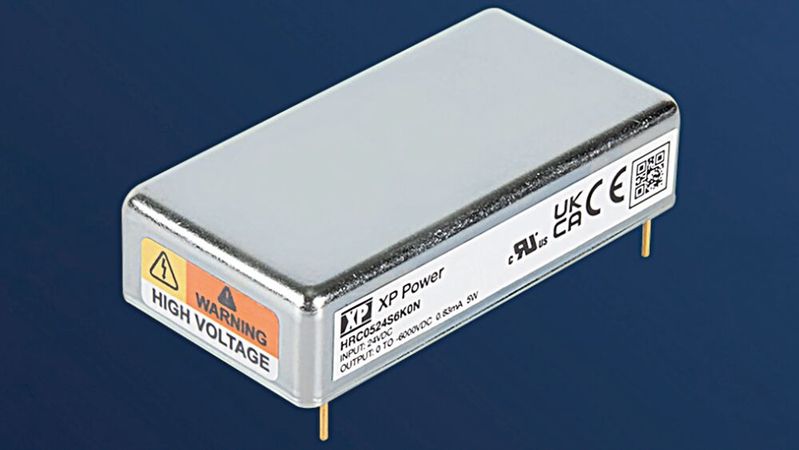
Figure 1: The form factor of the regulated 5W DC/DC high-voltage converters of the HRC05 series.
(Image: XP Power)
Choosing the right DC/DC converter is an important decision when developing applications that require compact, isolated high-voltage sources. The converters must ensure accurate, stable and adjustable output voltages while withstanding various electrical and environmental stresses that can affect reliability and safety.
The performance data of a DC/DC high-voltage converter may look solid on paper, but the real test only begins when the module is integrated into a physical product and used in practice.
Understanding the evaluation and integration of DC/DC converters contributes significantly to the success of prototype development and the transfer to production.
DC/DC high-voltage converters play a crucial role in applications such as analytical equipment, semiconductor manufacturing, medical diagnostics and scientific research. The integration of high-voltage modules in critical, long-term operating applications requires certain criteria:
Mass spectrometry and electrophoresis require a stable, low-noise high voltage for accurate chemical separation and detection.
Electrostatic clamping devices in wafer production require a precise voltage to hold silicon or glass substrates during processing.
Scanning electron microscopes (SEM) rely on an extremely stable bias voltage for beam control and image sharpness.
Photomultiplier tubes (PMTs) require a stable bias voltage and a ripple-free voltage to avoid noise during measurements or photon detection.
Capacitor charging circuits benefit from the controller's fast current limiting and arc protection.
Medical diagnostic devices use high-voltage modulators to detect analytes (target substances) or for therapeutic control and must therefore be extremely reliable and safe.
A leading solution is XP Power's HRC05 series DC/DC high-voltage converter modules (Figure 1), which meet these requirements with compact 5W versions that combine balanced regulation performance with ease of implementation.
Module Prerequisites
Whether you are developing compact measurement devices, experimenting with sensors or designing a new imaging system, knowing where these modules can be used will allow you to implement them effectively and creatively. The HRC05 series offers product developers a highly integrated solution, but its effective use requires consideration of some details at the design level.
An examination of the HRC0524S6K0P and HRC0524S6K0N models from XP Power illustrates the design decisions. They have almost identical electrical and mechanical properties, but deliver opposite polarities. Both offer the following:
Input voltage: 22 VDC to 30 VDC (nominal voltage 24 VDC)
Output range: 0 to ±6,000 V programmable via 0 V to 5 V control pin
Maximum output current: 0.83 mA (~5 W)
Form factor: compact SIP housing (~2.6 in × 1.3 in × 0.6 in)
Temperature range: −40 °F to 158 °F
Protection: short circuit, arc, overload, input undervoltage/overvoltage, thermal shutdown
Insulation: Input to output 5.2 kVDC
The decisive difference lies in the output polarity: The HRC0524S6K0P provides a positive high-voltage output in the range from 0 V to +6,000 V, while the HRC0524S6K0N provides a negative high-voltage output in the range from 0 V to -6,000 V.
The end application determines the choice of polarity (Figure 2). For example, photomultiplier tubes (PMTs) and electrostatic chucking devices often require a negative bias voltage to attract electrons or hold a substrate in place. In contrast, piezoelectric actuators, capacitor charging circuits or ion optics may require a positive voltage.
Both modules have the same space requirement and the same control behavior, which is helpful when developing a platform or a product family with several variants. A developer can switch from one polarity to the other without changing the board layout—only the electrical connections and application logic change.
Incorrect polarity will not necessarily damage the module, but can render a carefully designed product unusable. Even if the transducer appears to work, it may not function properly or provide inaccurate measurements.
Understanding the electrical requirements of the load is just as important as meeting the voltage or power specifications. Depending on the application, the required voltage and polarity must be clearly defined.
Power Converters for High Voltages
In high-voltage systems, output accuracy is a critical performance factor. Even small voltage errors or ripple can affect the performance of the entire system.
XP Power's HRC05 series provides a simple way to control the output voltage via an analog interface, offering simplicity and flexibility to developers. A signal of 0 to 5 V applied to the VIN_CTRL pin programs the output linearly from 0 V to the maximum rated voltage of the module, which can be between 2 kV and 6 kV.
Equally important is the output stability. The HRC05 series typically keeps ripple below 0.5% of full-scale output current (% ), which is more than adequate for most analog front ends, bias supplies and sensor circuits. In many systems, especially those with low-level optics or signal detection, this low ripple can make the difference between a clean measurement and a noisy, unusable result.
For high-precision applications, however, control without feedback may not be sufficient. In such cases, external calibration or even setting up a control loop is often necessary. For example, a high-impedance voltage divider can reduce the output to a safe value for an ADC, which in turn provides feedback to a microcontroller. This feedback loop can then dynamically adjust the VIN_CTRL signal to maintain a precise target voltage, even if temperature or load conditions change.
Date: 08.12.2025
Naturally, we always handle your personal data responsibly. Any personal data we receive from you is processed in accordance with applicable data protection legislation. For detailed information please see our privacy policy.
Consent to the use of data for promotional purposes
I hereby consent to Vogel Communications Group GmbH & Co. KG, Max-Planck-Str. 7-9, 97082 Würzburg including any affiliated companies according to §§ 15 et seq. AktG (hereafter: Vogel Communications Group) using my e-mail address to send editorial newsletters. A list of all affiliated companies can be found here
Newsletter content may include all products and services of any companies mentioned above, including for example specialist journals and books, events and fairs as well as event-related products and services, print and digital media offers and services such as additional (editorial) newsletters, raffles, lead campaigns, market research both online and offline, specialist webportals and e-learning offers. In case my personal telephone number has also been collected, it may be used for offers of aforementioned products, for services of the companies mentioned above, and market research purposes.
Additionally, my consent also includes the processing of my email address and telephone number for data matching for marketing purposes with select advertising partners such as LinkedIn, Google, and Meta. For this, Vogel Communications Group may transmit said data in hashed form to the advertising partners who then use said data to determine whether I am also a member of the mentioned advertising partner portals. Vogel Communications Group uses this feature for the purposes of re-targeting (up-selling, cross-selling, and customer loyalty), generating so-called look-alike audiences for acquisition of new customers, and as basis for exclusion for on-going advertising campaigns. Further information can be found in section “data matching for marketing purposes”.
In case I access protected data on Internet portals of Vogel Communications Group including any affiliated companies according to §§ 15 et seq. AktG, I need to provide further data in order to register for the access to such content. In return for this free access to editorial content, my data may be used in accordance with this consent for the purposes stated here. This does not apply to data matching for marketing purposes.
Right of revocation
I understand that I can revoke my consent at will. My revocation does not change the lawfulness of data processing that was conducted based on my consent leading up to my revocation. One option to declare my revocation is to use the contact form found at https://contact.vogel.de. In case I no longer wish to receive certain newsletters, I have subscribed to, I can also click on the unsubscribe link included at the end of a newsletter. Further information regarding my right of revocation and the implementation of it as well as the consequences of my revocation can be found in the data protection declaration, section editorial newsletter.
Ultimately, choosing a module from the HRC05 series provides developers with a solid foundation for precision. However, how well this precision is maintained depends on how well it is implemented throughout the system.
Reflections on the Boards
When integrating a DC/DC high-voltage converter such as the HRC05 series from XP Power into a printed circuit board, details that are not typical for low-voltage or purely digital systems must be taken into account in the layout.
High voltage development presents a number of challenges—some subtle, some less so—that can impact performance and safety if not considered early in the development process, including:
Appropriate creepage and clearance distances to low-voltage circuits
No ground planes in the high voltage range
Avoidance of sharp edges on the PCB pads
No screen printing in the vicinity of high-voltage circuits
No plated holes in the high-voltage range
Slots in the circuit board, if necessary, to ensure insulation
Protective coating and other insulating materials, if necessary
In addition, on the high-voltage side of the PCB, selecting components that are close to the transducer can be a challenge. Some considerations to keep in mind and important specifications are:
Voltage, current and rated power
Component power reduction
Temperature coefficients
Thermal performance
In addition to maintaining creepage and clearance distances on the PCB, designers may need to consider the use of insulation enhancements such as cutouts or protective coatings, especially when integrating the module in high humidity or dirty environments.
High voltage design means not only meeting electrical specifications, but also understanding how the physical characteristics of the PCB will interact with the electrical stresses it will be subjected to. A well-designed board ensures that an HRC05 module will operate reliably, safely and within specification for the life of the product.
Integration of the End Application
Choosing a high-voltage module is half the battle. Safe, reliable and cost-effective integration into the product requires careful consideration of both electrical and physical design aspects. XP Power's HRC05 series components are compact and reliable modules, but require thoughtful system integration to meet the needs of critical applications.
Designers should consider the height of the module—especially for products with limited space or those that are portable—and ensure adequate isolation from adjacent conductive surfaces. An HRC05 module is housed in a fully encapsulated SIP that measures approximately 2.6 in × 1.3 in × 0.6 in. It is mounted vertically over PCB pins, saving space on the board while increasing the creepage distance and clearance around high voltage pins.
The SIP housing simplifies thermal management by preventing hot components from coming into contact with the circuit board. However, developers should still ensure adequate ventilation or passive cooling if the device is operated close to its 5 W power limit, especially in warm environments.
The VIN_CTRL pin serves as the primary control interface, which uses a 0 V to 5 V analog signal that programs the output voltage linearly from 0% to 100% of the module's rated output (e.g. 0 kV to 6 kV). This design makes an HRC05 module an ideal choice for integration into microcontroller DACs or analog control loops. In addition, the module provides monitoring outputs: VOUT_MON (scaled voltage feedback) and IOUT_MON (proportional current output). These outputs allow the system to monitor the performance of the converter and execute protection or calibration routines.
For precision applications, the developer may choose to close the control loop via the firmware. This approach involves continuously adjusting the control signal based on the ADC readings of VOUT_MON and IOUT_MON. In this way, the system ensures stability under changing loads.
The HRC05 series has an input-to-output isolation of 5.2 kVDC and protects low-voltage control circuits from high-voltage hazards. The series also meets basic insulation requirements and is therefore suitable for various industrial and scientific applications. However, it should be noted that it may not be suitable for medical equipment connected to patients where reinforced or double insulation may be required.
The HRC05 series has no integrated EMI filtering. To pass EMC tests at system level, developers should therefore add input filters (e.g. π filters or common mode chokes) and, depending on the type of high-voltage load, take output attenuation or a resistive load into account.
Conclusion
The integration of high voltage functions into compact systems depends on the performance of the module and careful integration by the designer—from layout and thermal management to filtering and signal control. XP Power's HRC05 series DC/DC high voltage converters offer innovative solutions for applications requiring precise, stable and reliable high voltage supply. With its programmable output, excellent regulation, robust protection and compact design, the HRC05 series is an optimal solution in a miniature package for medical, industrial and scientific applications. (mr)



:quality(80)/p7i.vogel.de/wcms/8e/63/8e631ccb75fda465c197fc52848289fa/0130260202v1.jpeg "According to the Laser-Zentrum Hannover, what is sizzling away underwater marks the first steps towards a way of repairing steel structures more cheaply and without complications using robots, laser 3D printing and AI ... (Image:LZH)")
:quality(80)/p7i.vogel.de/wcms/67/30/6730b015b3dd6f925877edd795eda319/0130247463v1.jpeg "The comparison between the SLA printable plastics Accura Xtreme Grey (above) and the robust newcomer Accura Xtreme Black now used at Speedpart, which represents an inexpensive and deep black alternative to mechanically processed plastic prototypes ... (Image:Speedpart)")
:quality(80)/p7i.vogel.de/wcms/06/9d/069d939b77a4feab0a8d2ece62c28dc1/0129655701v1.jpeg "This turned part is slotted twice. The deburring that would otherwise be necessary is no longer required for high-pressure machining. (Image:Knoll)")
:quality(80)/p7i.vogel.de/wcms/3f/72/3f72e30d61f3522bff192171b60776a4/0130245214v1.jpeg "No idea what else your humanoid robot can do, or where it fails? Then it might be worth taking a look at the Humanoid Capabilities Navigator, which now helps you to find the right robot for a job, or to improve humanoids in a targeted manner ... (Image:Fraunhofer IPA)")
:quality(80)/p7i.vogel.de/wcms/ba/28/ba28ec056a82abd76758c8c87296c0d5/0130213997v1.jpeg "The Nexy automatic material call-off system (AMS) controls the replenishment of non-stocked materials or components. (Image:Steute Technologies GmbH & Co. KG, Löhne)")
:quality(80)/p7i.vogel.de/wcms/21/3b/213b5e5454b0c4344ba0eaa700857607/0129635774v1.jpeg "The QRV flow control valves from Lee are available in sizes from 5.5 to 18 mm and cover a flow rate of 0.2 to 20 l/min. Depending on the version, the pressure range is either between 0.1 and 2.75 bar (1.5 - 40 psi) or between 0.17 and 2 bar (2.5 - 30 psi). (Image:Lee)")
:quality(80)/p7i.vogel.de/wcms/63/e9/63e9db3259a656cca88c5f7158af3fcb/0129385769v1.jpeg "The Agibot A2 at a Fortune China event in December 2025. (Image:Agibot)")
:quality(80)/p7i.vogel.de/wcms/df/a1/dfa1786a3b05f5ff2e51d0f633695c57/0130137877v1.jpeg "Openclaw inspires AI communities. (Image:Openclaw.ai)")
:quality(80)/p7i.vogel.de/wcms/e4/51/e451d52ce0182fb0aaa46a5774f832ef/26-04-pi-fraunhofer-iws-21160-bioslide-pic-01-4128x2321v1v1.jpeg "With the BioSlide research project, the Fraunhofer IWS is investigating how sliding systems can be designed to be more sustainable and energy-efficient. New materials can be tested in a particularly application-oriented manner on this plain bearing test stand. (Image:Fraunhofer IWS)")
![Thanks to advanced 3D printing technology, a more efficient use of resources should contribute to lower-emission aviation—this is the goal of ['skai]-lab. (Image:Oleksandr Pashchenko - stock.adobe.com / AI-generated)](https://cdn1.vogel.de/nghHNSbySccfOjG3n1qCA-FVOjQ=/288x162/smart/filters:format(jpg):quality(80)/p7i.vogel.de/wcms/62/64/626424c97a16e69f871bf216c9629c2a/adobestock-1927043193--c2-a9-20oleksandr-20pashchenko-20-e2-80-93-20stock-adobe-com-ki-generiertv1v1.jpeg "Thanks to advanced 3D printing technology, a more efficient use of resources should contribute to lower-emission aviation—this is the goal of ['skai]-lab. (Image:Oleksandr Pashchenko - stock.adobe.com / AI-generated)")
:quality(80)/p7i.vogel.de/wcms/78/28/7828775af76773458b4d1409ceb1cf0c/368945-20dam-20imagery-digital-transformation-pc-1920x1079v1v1.jpeg "Complex development projects with high regulatory requirements, such as in the aerospace industry, benefit in particular from the Intelligent Product Lifecycle. (Image:PTC)")
:quality(80)/p7i.vogel.de/wcms/e7/82/e7822e208621ba2ae892d609e60481e8/texas-20uni-850x478v1v1.jpeg "Superfoam is a composite that is capable of absorbing 10 times more energy than a conventional foam. (Image:Abbey Toronjo/Texas A&M University Division of Marketing & Communications)")
:quality(80)/p7i.vogel.de/wcms/e6/53/e6539c6b5df2d2af2970ca981131fb42/0130215307v1.jpeg "Volkswagen is in first place in the first two months of 2026—no one has sold as many cars in China as the car manufacturer. (Image:Volkswagen)")
:quality(80)/p7i.vogel.de/wcms/b0/6d/b06d9ad54bfc39053e1db5494df5cb9a/0130237932v1.jpeg "Pleased about their partnership in the field of bidirectional charging: Christian Haferkamp and Aurélie Alemany from enercity as well as Stefan Mecha and Lars Krause, both Volkswagen Commercial Vehicles (from left to right). (Image:PSONNACK)")
:quality(80)/p7i.vogel.de/wcms/2b/0b/2b0b5ff55299be32174cb0ed76718253/0130177406v1.jpeg "Rolls-Royce has received funding of 70 million US dollars from the EU public-private partnership \"Joint Undertakings for Clean Aviation\". (Image:Rolls-Royce)")
:quality(80)/p7i.vogel.de/wcms/95/7e/957ed49b185794b3e76b9e610a8a389f/0130217926v1.jpeg "Bosch wants to offer components for e-vehicles in India together with Tata. (Image:Bosch)")
:quality(80)/p7i.vogel.de/wcms/22/08/22085b4997a696887dd5a712a30b262b/0130211045v1.jpeg "Imec has announced that the world's most advanced high numerical aperture (High NA) EUV lithography system, the ASML EXE:5200, has arrived at its 300mm cleanroom in Leuven. (Image:Imec)")
:quality(80)/p7i.vogel.de/wcms/48/f2/48f250e2385d3f43743dc44133cc4731/0130161592v1.jpeg "The world's first fully functional quantum battery as a proof-of-concept, developed by CSIRO and its cooperation partners, the University of Melbourne and RMIT. (Image:CSIRO and collaborators, The University of Melbourne and RMIT)")
:quality(80)/p7i.vogel.de/wcms/16/9c/169c092e854d8740928a080cead3b88e/0130241261v1.jpeg "NVIDIA's GB300 AI chip with HBM3E and HBM4 from SK Hynix. (Image:SK Hynix)")
:quality(80)/p7i.vogel.de/wcms/3a/50/3a50d3f269f38f14d7a25a93c6f2b2f8/0130147601v1.jpeg "The compact modulator enables fast and energy-efficient data transmission and can be manufactured cost-effectively. (Image:Hugo Larocque, EPFL)")
:fill(fff,0)/images.vogel.de/vogelonline/companyimg/76800/76895/65.jpg "FAULHABER_120mm.jpg ()")
:fill(fff,0)/p7i.vogel.de/companies/67/eb/67eba621ef6ea/logo2.png "logo2 (Wuxi InfiMotion)")
:quality(80):fill(efefef,0)/p7i.vogel.de/wcms/67/ad/67adf92d254d2/elatec-wp-smart-factory.png "Elatec WP Smart Factory")
:quality(80)/p7i.vogel.de/wcms/83/3e/833eb3113bd1dcc79419dcb29b680aa3/0127865054v1.jpeg "Probes in extreme environments: The PHT variants are specified up to 311 °F and the PUHT versions up to 392 °F. (Image:PMK)")
:quality(80)/p7i.vogel.de/wcms/14/68/146898ea8d787e16573bef0c22ef57b8/0127447996v1.jpeg "Power schematic circuit for the bi-directional three-level, two-phase converter. (Image: Efficient Power Conversion (EPC))")