The imitation of natural processes (biomimetic materials) has already led to groundbreaking developments, from superconductivity to self-healing materials. Researchers have discovered materials that behave like axons and amplify electrical impulses.
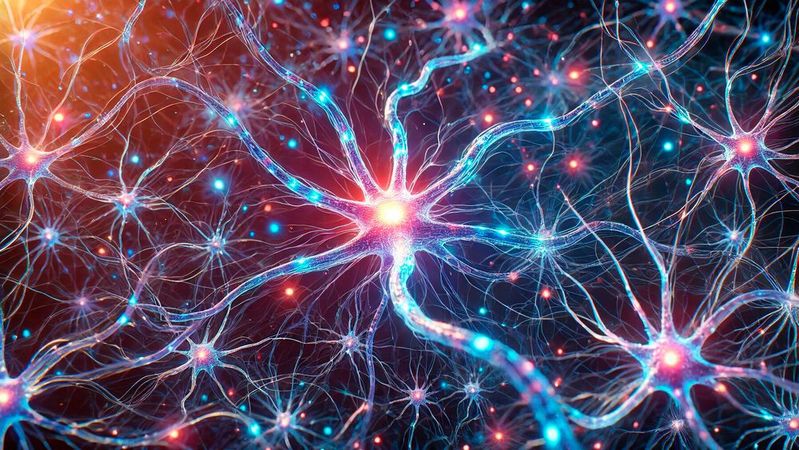
Nerve fibers serve information transmission (symbolic image).
(Image: DALL-E / AI-generated)
Biomimetic materials, which mimic processes from nature, have already led humanity to some technological developments that previously seemed difficult, if not impossible, to achieve. A team of researchers from Texas A&M University, Sandia National Lab, and Stanford University has drawn inspiration from the brain in the search for materials for more efficient data processing.
In doing so, they came across a material that mimics the behavior of an axon. This occurs by the material class spontaneously transmitting an electrical signal as it moves along a transmission line. Axons, to explain, are the long extensions of nerve cells that transmit electrical signals over long distances in the body. They enable communication between nerve cells and are thus crucial for motor and sensory functions.
If these developed materials are able to spontaneously amplify electrical impulses in a way that is efficient, scalable, and cost-effective, it could represent a real technological advancement. This could open up a whole new paradigm particularly in areas such as quantum computing, high-speed communication, or even neural networks. However, if the discovery is still associated with practical challenges, such as stability under various conditions, it will still be exciting to follow the developments further.
Farewell, signal loss?
Every electrical signal that propagates through a metallic conductor loses strength due to the metal's natural resistance. Modern computer processors and graphics processors can contain about 29.8 miles of fine copper wires that transmit electrical signals within the chip. These losses accumulate quickly and require amplifiers to maintain pulse integrity. These design constraints impact the performance of current chips with high interconnect density.
To counter this limitation, the research team drew inspiration from axons. "Often we want to transmit a data signal from one place to another, more distant location," says lead author Dr. Tim Brown, postdoctoral researcher at Sandia National Lab and former PhD student in materials science and engineering at Texas A&M. The study on the material was published in Nature.
"We need to transmit an electrical pulse from the edge of a CPU chip to the transistors near its center, among other things. Even with the most conductive metals, resistance at room temperature causes the transmitted signals to scatter and be lost, so we usually have to tap into the transmission line and amplify the signal, which costs energy, time, and space. Biology does it differently: Some signals in the brain are transmitted over short distances through axons made of resistant organic matter. And without ever interrupting and amplifying the signals."
According to Dr. Patrick Shamberger, a professor in the Department of Materials Science and Engineering at Texas A&M, axons are communication highways. They transmit signals from one neuron to a neighboring neuron. While neurons are responsible for processing signals, axons are like fiber optic cables that transmit signals.
Spontaneous amplification
Like the axons in the brain, the discovered materials are also in a prepared state that allows them to spontaneously amplify a voltage pulse as it travels down the axon. The researchers harnessed an electronic phase transition in lanthanum cobalt oxide, which causes the material to become significantly more electrically conductive when heated. This property interacts with the small amounts of heat generated as a signal passes through the material, resulting in a positive feedback loop.
The result is a range of exotic behaviors not observed in ordinary passive electrical components—resistors, capacitors, inductors. These include the amplification of small disturbances, negative electrical resistance, and unusually large phase shifts in alternating current signals. According to Shamberger, these materials are unique because they are in a half-stable "Goldilocks" state; that is, just right, but susceptible to disturbances. In this case, electrical impulses neither decay nor lead to thermal runaway and collapse.
Instead, the material naturally oscillates when held under constant current conditions. The researchers found that they could exploit this behavior to generate a spiking behavior and amplify a signal transmitted over a transmission line. "We are essentially leveraging internal instabilities in the material to further amplify an electronic pulse as it travels through the transmission line. Although this behavior was theoretically predicted by our co-author Dr. Stan Williams, this is the first confirmation of its existence."
Date: 08.12.2025
Naturally, we always handle your personal data responsibly. Any personal data we receive from you is processed in accordance with applicable data protection legislation. For detailed information please see our privacy policy.
Consent to the use of data for promotional purposes
I hereby consent to Vogel Communications Group GmbH & Co. KG, Max-Planck-Str. 7-9, 97082 Würzburg including any affiliated companies according to §§ 15 et seq. AktG (hereafter: Vogel Communications Group) using my e-mail address to send editorial newsletters. A list of all affiliated companies can be found here
Newsletter content may include all products and services of any companies mentioned above, including for example specialist journals and books, events and fairs as well as event-related products and services, print and digital media offers and services such as additional (editorial) newsletters, raffles, lead campaigns, market research both online and offline, specialist webportals and e-learning offers. In case my personal telephone number has also been collected, it may be used for offers of aforementioned products, for services of the companies mentioned above, and market research purposes.
Additionally, my consent also includes the processing of my email address and telephone number for data matching for marketing purposes with select advertising partners such as LinkedIn, Google, and Meta. For this, Vogel Communications Group may transmit said data in hashed form to the advertising partners who then use said data to determine whether I am also a member of the mentioned advertising partner portals. Vogel Communications Group uses this feature for the purposes of re-targeting (up-selling, cross-selling, and customer loyalty), generating so-called look-alike audiences for acquisition of new customers, and as basis for exclusion for on-going advertising campaigns. Further information can be found in section “data matching for marketing purposes”.
In case I access protected data on Internet portals of Vogel Communications Group including any affiliated companies according to §§ 15 et seq. AktG, I need to provide further data in order to register for the access to such content. In return for this free access to editorial content, my data may be used in accordance with this consent for the purposes stated here. This does not apply to data matching for marketing purposes.
Right of revocation
I understand that I can revoke my consent at will. My revocation does not change the lawfulness of data processing that was conducted based on my consent leading up to my revocation. One option to declare my revocation is to use the contact form found at https://contact.vogel.de. In case I no longer wish to receive certain newsletters, I have subscribed to, I can also click on the unsubscribe link included at the end of a newsletter. Further information regarding my right of revocation and the implementation of it as well as the consequences of my revocation can be found in the data protection declaration, section editorial newsletter.
Insights with future potential
These insights could be crucial for the energy-intensive future of data processing. It is expected that data centers will consume eight percent of electricity in the United States by 2030. And artificial intelligence could dramatically increase this demand.
In the long run, the discovery of the new materials is a step towards understanding dynamic materials and harnessing biological inspirations to promote more efficient data processing. "I had the idea for an active transmission line on the edge of chaos twelve years ago," said Dr. Stan Williams, co-author of the study, director of REMIND (Reconfigurable Electronic Materials Inspired by Nonlinear Neuron Dynamics), and professor in the Department of Electrical and Computer Engineering at Texas A&M. "To bring it into experimental reality required the resources, expertise, and teamwork of REMIND."
Founded in 2022, the REMIND EFRC (Energy Frontier Research Center) aims to develop fundamental scientific insights that underpin the operation of massively reconfigurable computer architectures. Real-time learning and embedded intelligence in these architectures are intended to emulate the specific neuronal and synaptic functions of the human brain.
Other members of the EFRC include Jenny Chong, a master's student in the Department of Materials Science and Engineering at Texas A&M, who contributed to developing a simulation to understand the phenomenon and designed transmission lines for better signal amplification. The team also includes researchers Dr. Suhas Kumar, Dr. Elliot Fuller, and Dr. Alec Talin from Sandia National Lab. The research work was conducted in collaboration with Dr. Eric Pop's research group at Stanford University. (sb)



:quality(80)/p7i.vogel.de/wcms/dd/08/dd086510d9ae7b50181f6070e4463b44/0129363730v1.jpeg "Typical application for ionizing devices: Wrapping films. (Picture: ©Adobe Stock/SMC)")
:quality(80)/p7i.vogel.de/wcms/35/57/3557c819943c53acec41a0ccba87da4f/0130049064v1.jpeg "Researchers at the Fraunhofer IWU in Chemnitz have long known that many typical sheet metal parts can be manufactured more cost-effectively using hollow embossing rollers. Now there is news to report ... (Image:Fraunhofer IWU)")
:quality(80)/p7i.vogel.de/wcms/59/02/590246e3b3f415c65edbee377c14ca77/26-06-pi-fraunhofer-iws-41450-direktplattieren-pic-01-7771x4369v1v1.jpeg "The Fraunhofer IWS has developed the new \"direct laser cladding\" process, which creates a functional layer directly on the base body by applying a strip-shaped metal to rotationally symmetrical components in a spiral and bonding it locally by laser. (Image:Christoph Wilsnack/Fraunhofer IWS)")
:quality(80)/p7i.vogel.de/wcms/73/60/73608418789b1d9c393f5e2fa974eda2/0130209906v1.jpeg "The robots of the X6 generation from b+m enable very high painting quality and are also particularly compact and easy to maintain. (Image:Beckhoff)")
:quality(80)/p7i.vogel.de/wcms/78/e9/78e9188c25a8a94e67c34c9bf8ffe495/visual-agile-20robots-20and-20google-20deepmind-20partner-20to-20bring-20intelligence-20to-20robotics-2500x1406v1v1.jpeg "Together, the partners are developing adaptable, intelligent robots for a wide range of applications (Image:Agile Robots SE)")
:quality(80)/p7i.vogel.de/wcms/e7/66/e7669ecf0260ae8fc54c214e34e4902a/0130316817v1.jpeg "Siemens and Palo Alto Networks offer tested cybersecurity solution for industrial 5G. (Image:Siemens)")
:quality(80)/p7i.vogel.de/wcms/9f/55/9f55324832c4f426958031375124d9de/siemens-20ubtech-20hmnd-1920x1079v1v1.png "Ready for the factory floor: While Ubtech is planning mass production, Siemens is already testing humanoids in real factory applications in Erlangen. (Image:Siemens)")
:quality(80)/p7i.vogel.de/wcms/11/36/113695ed260e29c8c2d9d39dc5f9d869/0130213768v1.jpeg "AI can work cheaply in China and deliver the results rapidly all over the world. (Image:Dall-E / AI-generated)")
:quality(80)/p7i.vogel.de/wcms/62/5f/625f41e87ebfef156a98c8e6393e32fd/0130211654v1.jpeg "Axial flux motors have some advantages over radial flux motor—but their production is currently still expensive. (Image:RWTH Aachen University)")
:quality(80)/p7i.vogel.de/wcms/77/9b/779b0685d010dfe45c9c2cb1cfecd467/0128886425v1.jpeg "The BlueEye is the first \"real\" hyperspectral camera for the UV range and covers the wavelength range from 220 to 380nm. (Image:Inno-spec GmbH)")
:quality(80)/p7i.vogel.de/wcms/e4/51/e451d52ce0182fb0aaa46a5774f832ef/26-04-pi-fraunhofer-iws-21160-bioslide-pic-01-4128x2321v1v1.jpeg "With the BioSlide research project, the Fraunhofer IWS is investigating how sliding systems can be designed to be more sustainable and energy-efficient. New materials can be tested in a particularly application-oriented manner on this plain bearing test stand. (Image:Fraunhofer IWS)")
![Thanks to advanced 3D printing technology, a more efficient use of resources should contribute to lower-emission aviation—this is the goal of ['skai]-lab. (Image:Oleksandr Pashchenko - stock.adobe.com / AI-generated)](https://cdn1.vogel.de/nghHNSbySccfOjG3n1qCA-FVOjQ=/288x162/smart/filters:format(jpg):quality(80)/p7i.vogel.de/wcms/62/64/626424c97a16e69f871bf216c9629c2a/adobestock-1927043193--c2-a9-20oleksandr-20pashchenko-20-e2-80-93-20stock-adobe-com-ki-generiertv1v1.jpeg "Thanks to advanced 3D printing technology, a more efficient use of resources should contribute to lower-emission aviation—this is the goal of ['skai]-lab. (Image:Oleksandr Pashchenko - stock.adobe.com / AI-generated)")
:quality(80)/p7i.vogel.de/wcms/c3/c4/c3c4ce270b083eeac55654148611f064/0130237945v1.jpeg "China is not giving up on hydrogen, but is intensifying its efforts. (Image:freely licensed from Pixabay)")
:quality(80)/p7i.vogel.de/wcms/4e/c0/4ec0bd19390b169edfa23677373dcdf1/0130260089v1.jpeg "Renewable fuels can supply European road traffic, according to a study. (Image:Aral)")
:quality(80)/p7i.vogel.de/wcms/6f/c9/6fc9050301d745cad25585c6780f8f51/0130197341v1.jpeg "Production facilities are a worthwhile target and are therefore at risk. (Image:ABB Robotics)")
:quality(80)/p7i.vogel.de/wcms/b6/62/b662adc2cec8227d8172509bbfb6ee42/25c0207-107-4961x2789v1v1.jpeg "The GLB is the second model based on Mercedes' new MMA platform. Apparently, Geely's platform is better and cheaper, which is why the two companies are negotiating a partnership. (Image:Mercedes-Benz)")
:quality(80)/p7i.vogel.de/wcms/4d/dd/4dddf438e91f394c04a095dbfd109d1c/0130236430v1.jpeg "Measurement modules: The 720301 module in combination with the SL2000 enables RMS and power calculations, among other things. (Image:Yokogawa)")
:quality(80)/p7i.vogel.de/wcms/61/fc/61fcf95f5cca15494ad18343901ae585/0130317237v1.jpeg "With the AGI CPU, Arm says it is taking a \"historic step\": With the processor aimed at AI in data centers, the company is presenting itself for the first time as a provider of its own chips, not just as a pure IP licensor. (Image:Arm)")
:quality(80)/p7i.vogel.de/wcms/82/90/8290dfe3595b6c6b33726ae8b76172c7/0130319587v1.jpeg "The concept image illustrates how the pattern of tiny protrusions and depressions created on the substrate (MgO, bottom) controls the arrangement of atoms in the superconducting material (YBCO, top). At the interface between the two layers, an electronic structure enables superconductivity to occur at higher temperatures than previously possible. (Image:Chalmers University of Technology / Riccardo Arpaia)")
:fill(fff,0)/images.vogel.de/vogelonline/companyimg/76800/76895/65.jpg "FAULHABER_120mm.jpg ()")
:fill(fff,0)/p7i.vogel.de/companies/69/88/69882c428938e/tmts2026-ticec-banner-en-2000px.png "tmts2026-ticec-banner-en-2000px (https://www.tmts.tw/en)")
:quality(80)/p7i.vogel.de/wcms/ce/ea/ceea07218c1d7db7c1a7edda80b75986/0125769957v1.jpeg "The integration of biological elements optimizes processes such as decision-making in unpredictable environments, which artificial intelligence has struggled with so far. (Image:freely licensed / AI-generated)")
:quality(80)/p7i.vogel.de/wcms/b6/01/b601f938f679791e60f3bba8d141968b/0129336204v1.jpeg "Biocomputing in medical electronics: the CL1 platform uses living neurons instead of silicon chips. Complex tasks can be learned in minutes. (Image:Reply)")