Open standards in the lighting industry help to save energy and to expand plants without problems in the future. Certified components are also available on the market for a longer time.
Natural light is best. But when artificial light is necessary, open standards in the lighting industry are recommended. They help to save energy and can also be expanded in the future.
Paul Drosihn is the General Manager at the DALI Alliance.
Climate change and rising costs are forcing companies to become more sustainable. This also includes reducing energy consumption and the CO2 footprint. With a share of about 15 percent of worldwide electricity consumption and five percent of worldwide greenhouse gas emissions, the lighting industry has a great chance to contribute to global sustainability goals and to satisfy customers. This is stated in the Global Lighting Report 2022, published by Lighting Global, an initiative of the World Bank. The report provides an overview of the global lighting market and analyzes the trends in the industry.
In addition, the trend towards a more circular economy requires products that can be easily reused, overhauled, upgraded, and recycled, offering the potential for lower energy consumption, less waste, and financial savings. Established global standards such as the DALI-2 certification program, developed and maintained by the DALI (Digital Addressable Lighting Interface) Alliance, play a crucial role in meeting all aspects of sustainability.
Gallery
How to reduce energy consumption in lighting
Despite the use of efficient lighting fixtures, lighting efficiency in most commercially used buildings is poor, as the lights are still on even when the illuminated rooms are not being used. Depending on the type of building, the proportion of lighting in the total energy costs is often between 20 and 30 percent, so the potential for savings could be substantial. Even simple time switches are better than relying on the occupants to turn off the lights.
However, a much more efficient approach is the introduction of automatic light controls with presence, motion, and daylight sensors. Through standardization, it is possible to combine multiple sensors from various manufacturers in a single light control system. PIR sensors (Passive Infrared Sensors) can detect the occupancy of various parts of the building and the system can switch the lighting on and off accordingly.
Control artificial lighting with sensors
Brightness sensors also contribute to energy savings. Since the sensor data tells the system how much natural light is present at a certain location, the artificial lighting can be controlled accordingly. The so-called Daylight Harvesting takes into account factors such as the time of day, the position of the sun, and even the season, thereby minimizing energy consumption. The more sophisticated, feature-rich, and smart a light management system is, the higher the possible energy savings.
Of course, this requires suitable software that is intuitive and user-friendly, as well as simple controls and user interfaces that can be understood and operated by the building users. This also includes the standardization of the functionality of input devices such as switches, sliders and buttons.
Standardization helps the lighting industry
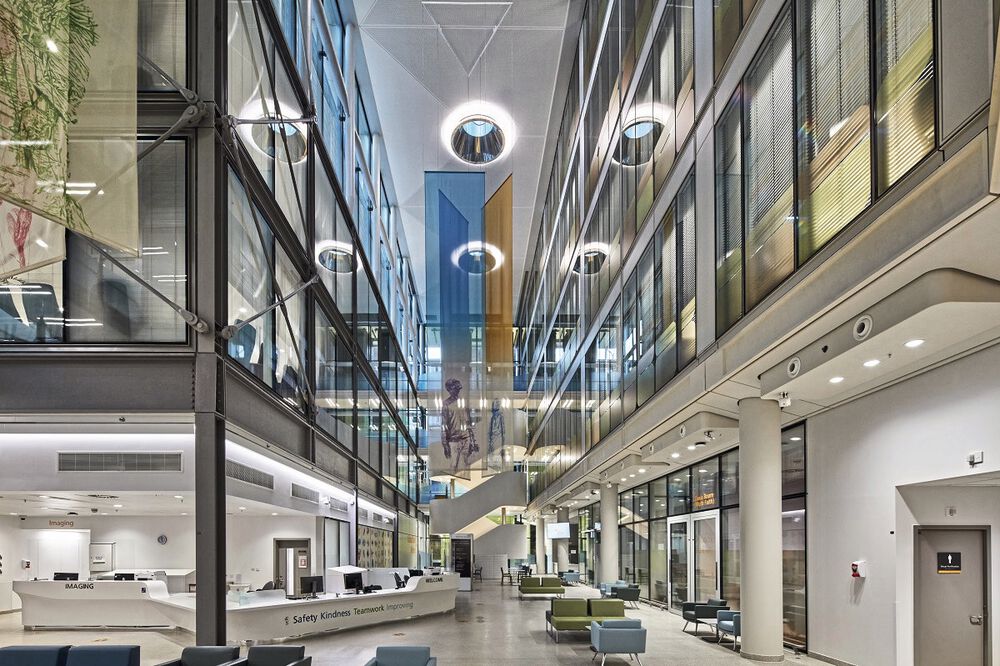
Image 1: The lighting equipped with a DALI light control system minimizes the energy demand in the Grafton Building of the UCL Hospital in London and ensures more sustainability.
(Image:DALI Alliance)
In an ideal scenario, planners and installers should be able to choose the most sustainable lighting solution regardless of the manufacturer. In reality, an optimal and sustainable lighting system may be complicated by the fact that the best products for the particular application simply aren't compatible with each other. A short-term solution could be to source everything from a single supplier, which, however, could impact future system expansions and updates. Outdated products or the inability to obtain spare parts could result in the entire system having to be replaced prematurely, which is anything but environmentally friendly.
A standardization where multiple manufacturers use the same open protocol reduces this risk. Thus, the DALI-2 certification has created an ecosystem of interoperable products from various manufacturers, ensuring the long-term availability of compatible components for improved sustainability (Image 1). Due to their longevity, DALI-2 certification offers both forward and backward compatibility and is supported by all major players in the lighting industry. This ensures long-term availability of compatible components and avoids issues related to tying to a specific manufacturer and dependency on proprietary solutions that may not be supported in the future.
Standardized systems are flexible and support future-proof designs that extend the life of a lighting control system and make it more sustainable. For example, changes to the design and operation of a DALI system can often be made by programming the software, not by rewiring or replacing luminaires and other devices.
Date: 08.12.2025
Naturally, we always handle your personal data responsibly. Any personal data we receive from you is processed in accordance with applicable data protection legislation. For detailed information please see our privacy policy.
Consent to the use of data for promotional purposes
I hereby consent to Vogel Communications Group GmbH & Co. KG, Max-Planck-Str. 7-9, 97082 Würzburg including any affiliated companies according to §§ 15 et seq. AktG (hereafter: Vogel Communications Group) using my e-mail address to send editorial newsletters. A list of all affiliated companies can be found here
Newsletter content may include all products and services of any companies mentioned above, including for example specialist journals and books, events and fairs as well as event-related products and services, print and digital media offers and services such as additional (editorial) newsletters, raffles, lead campaigns, market research both online and offline, specialist webportals and e-learning offers. In case my personal telephone number has also been collected, it may be used for offers of aforementioned products, for services of the companies mentioned above, and market research purposes.
Additionally, my consent also includes the processing of my email address and telephone number for data matching for marketing purposes with select advertising partners such as LinkedIn, Google, and Meta. For this, Vogel Communications Group may transmit said data in hashed form to the advertising partners who then use said data to determine whether I am also a member of the mentioned advertising partner portals. Vogel Communications Group uses this feature for the purposes of re-targeting (up-selling, cross-selling, and customer loyalty), generating so-called look-alike audiences for acquisition of new customers, and as basis for exclusion for on-going advertising campaigns. Further information can be found in section “data matching for marketing purposes”.
In case I access protected data on Internet portals of Vogel Communications Group including any affiliated companies according to §§ 15 et seq. AktG, I need to provide further data in order to register for the access to such content. In return for this free access to editorial content, my data may be used in accordance with this consent for the purposes stated here. This does not apply to data matching for marketing purposes.
Right of revocation
I understand that I can revoke my consent at will. My revocation does not change the lawfulness of data processing that was conducted based on my consent leading up to my revocation. One option to declare my revocation is to use the contact form found at https://contact.vogel.de. In case I no longer wish to receive certain newsletters, I have subscribed to, I can also click on the unsubscribe link included at the end of a newsletter. Further information regarding my right of revocation and the implementation of it as well as the consequences of my revocation can be found in the data protection declaration, section editorial newsletter.
Feedback and data exchange through digital two-way communication
To quantify the savings achieved through the efficient use of a lighting control system, effective monitoring of energy consumption is required - the savings must be measured and not estimated. It is not only necessary to measure the total energy consumption, but also to get more detailed information about what is actually happening in specific areas of a building or even with individual luminaires. Such data can be crucial when applying for energy rebates.
Standardization allows for data-rich networks where feedback and data exchange are possible through digital two-way communication. In this way, components can report their performance levels, information about lamp failures, emergency test data, and other information to application controls. Energy consumption and diagnostic data, as well as luminaire information, are stored and reported in a standardized format. The data analysis can then predict when individual components or luminaires should be replaced, instead of applying a comprehensive replacement plan based on a fixed period. This supports a data-driven predictive maintenance strategy, leading to significant cost savings and contributing to the overall sustainability of the lighting control system.
Examples of standardization in practice
Image 2: The Spanish city of Algeciras saves more than 50 percent energy with its new LED street lighting.
(Image:DALI Alliance)
The new Grafton Way Building of the University College London Hospital demonstrates what can be achieved with a standardized lighting control system. The eleven-story building, with five floors underground, was equipped with a DALI lighting system that contributes to minimizing energy consumption, improving sustainability, and optimizing operational efficiency.
Precise dimming and scene settings, depending on daylight and occupancy, allow for flexible lighting schemes in different areas of the hospital and enhance the comfort and wellbeing of patients and staff. The lighting system contributed to the building receiving the BREEAM 'Highly Commended' certification – a challenge for a heavily frequented health building with energy-intensive medical devices.
A second example comes from Spain, where the city of Algeciras has replaced its old street lighting with a DALI-based LED lighting system. The town hall achieved a total energy saving of more than 50 percent compared to the previous lighting system.
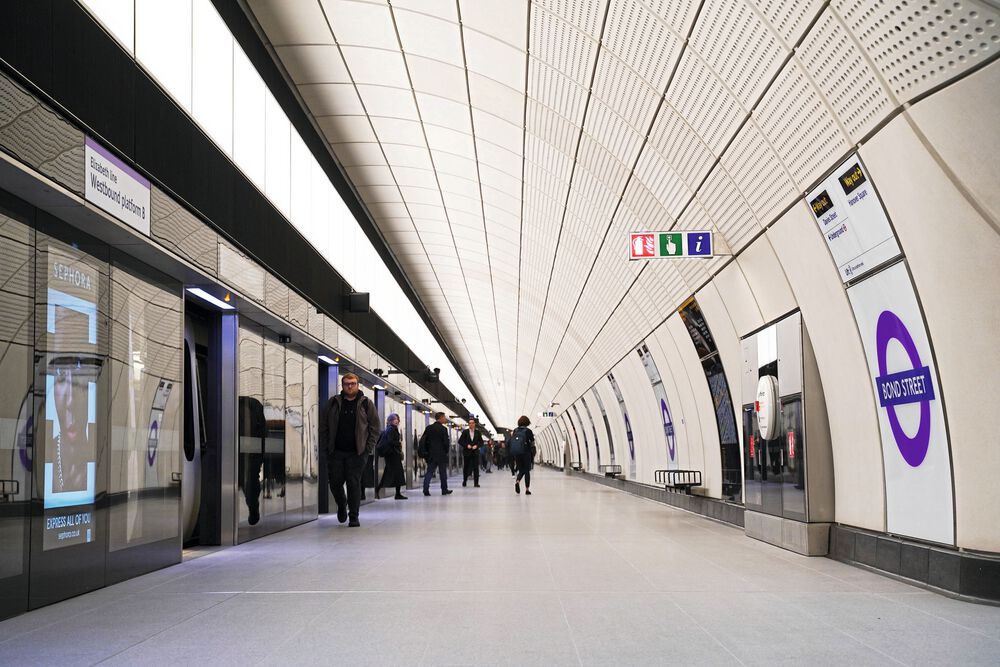
Image 3: Europe's largest infrastructure project is the Elizabeth Line of the London Underground. The station is equipped with more than 35,000 DALI lights.
(Image:DALI Alliance)
Another current application is the Elizabeth Line, the new 118 km long high-speed railway network for London and the southeast of England. This is the largest infrastructure project in Europe, where more than 35,000 DALI devices, including lights, sensors, switches, and controls, are used to optimize efficiency, safety, and aesthetics. It is one of the first projects of this magnitude where sustainability was considered from the start.
Conclusion: How standardization helps in lighting
Sustainable principles such as waste prevention, improved energy efficiency and the identification of cost-saving potential make economic sense. Standardization can meet all aspects of sustainability. An advanced lighting control system, based on a global standard like DALI, reduces energy consumption, improves the CO2 balance, and lowers the total operating costs. As a global industry organization focused on standardization and market acceptance, the DALI Alliance will continue to promote the broad adoption, scope, and technology leadership that the industry needs to offer more sustainable and energy-efficient lighting solutions.
The DALI standard in lighting
With the DALI standard, extensive lighting concepts can be networked. For each DALI line, only a limited number of individually addressable components can be connected. DALI allows 64 addresses per DALI line, with DALI-2 it's 128 addresses. In addition, DALI-2 is backward compatible. Thus, lights and accessories that are compatible with DALI-2 can be easily integrated into DALI systems.
A key difference with DALI-2 is that all luminaires and control devices can be connected to the same DALI line. This enables a reliable and simple communication structure.



:quality(80)/p7i.vogel.de/wcms/8d/ca/8dca960f81811a581332ba152fb51eea/0128759483v1.jpeg "AI will not make CNC experts obsolete in the foreseeable future but can facilitate and accelerate their work in the form of a CAM co-pilot. (Image:Siemens)")
:quality(80)/p7i.vogel.de/wcms/8b/c7/8bc7380a7e8dc5dcb9d7337383e93e46/0127912129v1.jpeg "For the second machining step, the thin-walled component is moved into the gap between the inner and outer tool. (Image:Mapal)")
:quality(80)/p7i.vogel.de/wcms/e1/b8/e1b8f2c81079d6f652a641ff0c8dcbef/0128918895v1.jpeg "Air bubbles make the flows in the gearbox visible: The left roller is actively driven by a motor (not shown), while the right roller passively rotates due to the flows. (Image:NYU (Applied Mathematics Laboratory))")
:quality(80)/p7i.vogel.de/wcms/9c/c1/9cc103887017ef58ccef3918281eb6c2/screenshot-202025-12-19-20150025-457x257v1v1.png "Various parts as produced by Kleiner in Pforzheim. (Image:Image: Kleiner)")
:quality(80)/p7i.vogel.de/wcms/2b/78/2b78c2ff6781704ed63902b59c22e195/0128897323v1.jpeg "The battery refreshers! Lithium-ion batteries for electric vehicles become unbalanced over time, causing a significant drop in performance. However, Battery X Metals knows how to restore the balance. The Canadians have now been able to prove this through tests. (Image:Power Boy)")
:quality(80)/p7i.vogel.de/wcms/2c/1f/2c1f12c11848eb8bd296de2e54726074/0128885487v1.jpeg "Matthias Lapp, CEO of the Lapp Group, sees great potential in the Taiwanese market. (Image:Lapp)")
:quality(80)/p7i.vogel.de/wcms/3d/47/3d477c7a3990157ffb8a2894ea8f6dc5/0127426206v1.jpeg "For metallic valve bodies, such as those manufactured by Gemü in the thousands, proof of structural strength is required. (Image:GEMÜ)")
:quality(80)/p7i.vogel.de/wcms/a4/d5/a4d50ff81ccd24c8247d64f12bec7fdf/0113143253v1.jpeg "In our China Market Insider, we regularly provide you with relevant information directly from China. (Image:© Eisenhans - stock.adobe.com)")
:quality(80)/p7i.vogel.de/wcms/46/5b/465bfc4297df5d51da3e8dd4db25b916/0128924879v1.jpeg "AI-based systems are restructuring traditional process flows in the interaction between design, prototyping, and manufacturing. (Image:Meviy)")
:quality(80)/p7i.vogel.de/wcms/f2/af/f2af678854664143c1d3a886cbfb7e5f/0128694427v1.jpeg "Position, angle, inclination, acceleration, vibration: Key measurements for precise productions (Image:Michael Heßhaus/abj/Midjourney)")
:quality(80)/p7i.vogel.de/wcms/77/f4/77f40a3ea0c8f9f18d72a42336e57104/0128775363v1.jpeg "Shunts with aluminum connectors are a perfect match for aluminum cables, which have long been the standard when it comes to weight reduction in mobile applications. (Image:Wickeder)")
:quality(80)/p7i.vogel.de/wcms/fa/65/fa653385df43d7b47543882ab3a89b79/0128816209v1.jpeg "Images on displays can now be touched. (Image: ©Lush Diaries - stock.adobe.com / AI-generated)")
:quality(80)/p7i.vogel.de/wcms/7f/6e/7f6e0c3d12baaf0fd6fd9301f3b3b9f7/0128909616v1.jpeg "Extended multi-ECU prototype with multi-fidelity and multi-ECU electronic simulation, integrating CarMaker from IPG Automotive and virtualization solutions from Synopsys via the SIL Kit. (Image:IPG Automotive)")
:quality(80)/p7i.vogel.de/wcms/53/0b/530b6af45fe6dfabd83e4a2d4f243e9f/0128921888v1.jpeg "Artificial intelligence has begun to conquer China's 380 million electric two-wheelers. (Image:Segway)")
:quality(80)/p7i.vogel.de/wcms/be/67/be67d69863c54f8e48c2fefaf168939b/0128749077v1.jpeg "Neura Robotics and Bosch collaborate on humanoid robots and Physical AI. In the image: the humanoid \"4NE1\". (Image:Neura Robotics)")
:quality(80)/p7i.vogel.de/wcms/58/63/5863c101435cf9c29ff718bf9bfd54a4/0128878544v1.jpeg "In all fully electric models of the BMW M Neue Klasse, two electric drive units on the front and rear axles, each with one electric motor per wheel, ensure typical BMW M driving performance. (Image: BMW AG)")
:quality(80)/p7i.vogel.de/wcms/a4/b5/a4b5d53e2b20f56fbba1b9031878eb75/0128894662v1.jpeg "The 6G mobile communication generation places high demands on test hardware. The RF measurement technology provider Anritsu is taking a new approach to test environments. (Image:freely licensed)")
:quality(80)/p7i.vogel.de/wcms/75/99/7599ac779069e5dd7d35039bdd8061c9/0128897141v1.jpeg "Nuclear power is controversial. However, at least in terms of CO2 emissions, it is not as harmful to the climate as coal or gas. (Image:freely licensed)")
:quality(80)/p7i.vogel.de/wcms/7e/c1/7ec1077a00504b919aabf27da99e93ef/0128873058v1.jpeg "Multiple structured semiconductor wafers with reflective interference colors. (Image:Dall-E / AI-generated)")
:quality(80)/p7i.vogel.de/wcms/3d/d5/3dd50e300bf8af537882d9a31d3268b8/0128891096v1.jpeg "Wolfspeed has produced a single-crystal 300-mm silicon carbide wafer. (Image:Wolfspeed)")
:fill(fff,0)/images.vogel.de/vogelonline/companyimg/76800/76895/65.jpg "FAULHABER_120mm.jpg ()")
:fill(fff,0)/p7i.vogel.de/companies/67/eb/67eba621ef6ea/logo2.png "logo2 (Wuxi InfiMotion)")
:quality(80)/p7i.vogel.de/wcms/9f/9f/9f9f98f4cdae7970c9b1ebb0f69402fa/0116255991.jpeg "Image 1: The lighting equipped with a DALI light control system minimizes the energy demand in the Grafton Building of the UCL Hospital in London and ensures more sustainability.(Image: DALI Alliance)")
:quality(80)/p7i.vogel.de/wcms/6b/ba/6bba9d169426b2615b5038bada202efc/0116256104.jpeg "Image 2: The Spanish city of Algeciras saves more than 50 percent energy with its new LED street lighting.(Image: DALI Alliance)")
:quality(80)/p7i.vogel.de/wcms/68/1a/681ad54b348df742504a6952d883cd25/0116255994.jpeg "Image 3: Europe's largest infrastructure project is the Elizabeth Line of the London Underground. The station is equipped with more than 35,000 DALI lights.(Image: DALI Alliance)")

:quality(80)/p7i.vogel.de/wcms/f5/b6/f5b632ba016acb4d853ff48cfd597292/0123947624v1.jpeg "Wireless lighting systems enable flexible and individualized lighting solutions in both private and professional settings. (Image:Insight Sip)")
:quality(80)/p7i.vogel.de/wcms/c2/c1/c2c1ee9e92113eb45140e8f868420219/0124272206v1.jpeg "Dracula Technologies aims to shed light, literally, on the sustainable energy supply of IoT sensors and make conventional batteries obsolete. (Image:freely licensed)")