Harting has equipped the traditional D-Sub connector with the groundbreaking push-pull technology. Read here why this development is revolutionary, how versatile the application possibilities are, and what advantages this innovation offers.
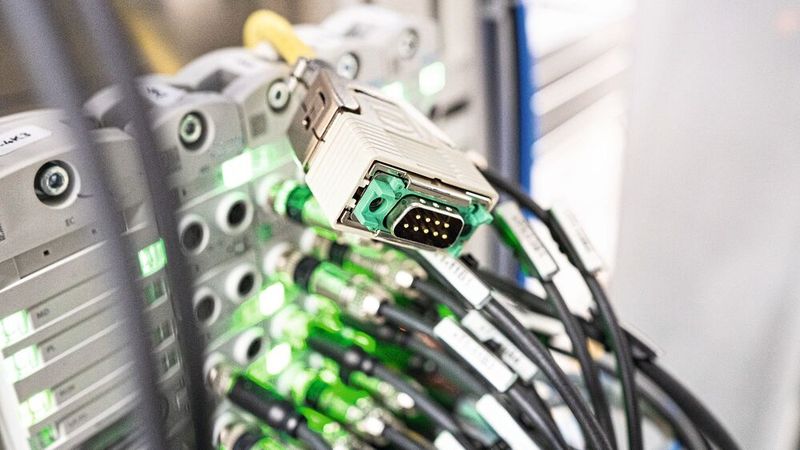
With the D-Sub Push-Pull connector, Harting introduces an advanced version of the classic D-Sub connector.
(Image: Harting)
At Hannover Messe 2025, Harting is presenting an exemplary advancement of one of the most established connectors on the market: the D-Sub miniature connector. Harting has successfully integrated push-pull technology into the D-Sub range, thereby expanding its portfolio of push-pull connectors. This development addresses a market that relies on proven yet innovative solutions.
Potential of the D-Sub Connector
D-Sub connectors are well known as established and long-proven interfaces. Since D-Sub connectors are found in standardized interfaces but are also commonly chosen for new and custom projects, Harting experts estimate their potential to be high. The technology group is a strong and established partner for customers in industrial environments in the area of D-Sub connections. Within the company, there is confidence that this advancement will solidify its perception in the market.
With its quick-locking mechanism, the D-Sub PP enables easy handling and reliable connections in demanding environments.
(Image: Harting)
When considering how the idea of a push-pull locking mechanism for D-Sub interfaces came about, there isn’t just one answer. Harting has been known for many years for its innovative locking systems. The drive to expand the portfolio further came from consistently positive feedback for push-pull locking mechanisms, which are self-explanatory, user-friendly, and highly process-secure during connection. Implementing a D-Sub push-pull housing was, therefore, a logical step in the product strategy. D-Sub connectors are often used alongside other interfaces that already feature push-pull locking mechanisms, such as Push-Pull Variant 4 or M12 circular connectors. Now, customers have the option to equip their devices with a unified locking mechanism, making things easier for everyone, especially the end user. Additionally, in recent years, competitive products featuring quick-locking systems for D-Sub connectors have increasingly entered the market. Harting's customers demanded a compatible solution from the company, and this has now been successfully executed. The task of developing an easy-to-use, fast, and absolutely secure locking mechanism was rethought entirely by Harting. Customers are now offered a true D-Sub push-pull housing that is compatible with other systems. This is a particularly crucial factor today, as customers need the assurance of a second source, emphasize the experts at Harting.
Locking System With Technical Features
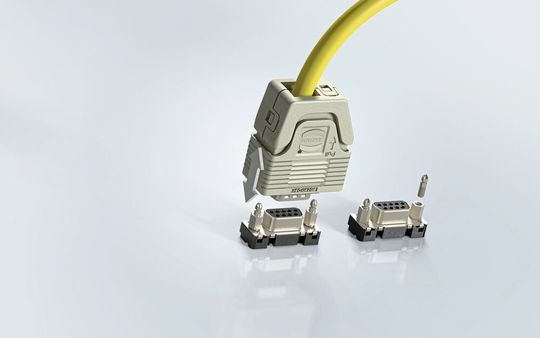
The push-pull housing enables a quick-lock function, providing greater efficiency and reliability.
(Image: Harting)
The locking system is based on two springs that latch onto special locking bolts, effectively preventing unintentional unlocking. When the contoured housing is pulled back on the movable part, the springs open, and the housing can be removed from the locking bolts. These locking bolts are the key to the entire system, as they make upgrading existing D-Sub interfaces very simple (retrofit). In addition to the push-pull mechanism, the housing has been equipped with further features. For example, Harting's D-Sub coding frames can be installed in housings with the appropriate mounting option. This allows customers to implement mechanical coding for up to 36 interfaces and prevents accidental mismating. This can help avoid communication problems in the system or damage to sensitive components.
Not only the locking mechanism itself but also the topics of assembly and packaging have been redesigned. The D-Sub push-pull housings do not require cover screws but are simply clicked together after the connector has been assembled and the cable attached. Two options are available for cable attachment.
the standard internal cable clamp, which is included in the delivery,
an external cable clamp, which is suitable for a wider range of cable diameters and provides more connection space inside the D-Sub Push-Pull housing.
In the packaging, the company focused on avoiding plastic and making the housing parts easily accessible.
D-Sub Push-Pull Connectors in Application
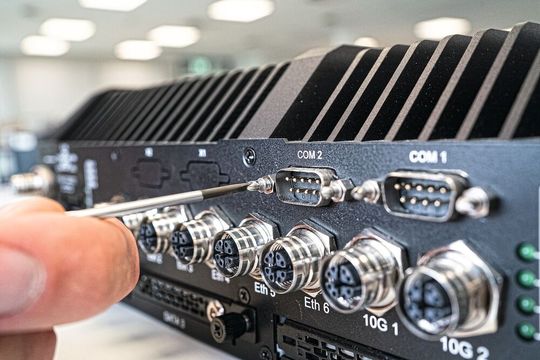
Upgrade pins enable retrofitting to modern, push-pull compatible interfaces.
(Image: Harting)
The push-pull mechanism is backward compatible with common products on the market. This means that all existing products on the market can be equipped with Harting D-Sub Push-Pull. For this purpose, the technology group offers corresponding "upgrade pins," which can be screwed into the existing screw bolts on the device side. This step is quickly implemented and only needs to be done once to create the locking level for the D-Sub Push-Pull housing. Alongside the "upgrade pins," HARTING will offer a wide variety of D-Sub Push-Pull screw bolts to meet every application need—whether customers prefer rear mounting or front mounting of the device connector, and whether they are using 0.04 inches or 0.10 inches panels.
Date: 08.12.2025
Naturally, we always handle your personal data responsibly. Any personal data we receive from you is processed in accordance with applicable data protection legislation. For detailed information please see our privacy policy.
Consent to the use of data for promotional purposes
I hereby consent to Vogel Communications Group GmbH & Co. KG, Max-Planck-Str. 7-9, 97082 Würzburg including any affiliated companies according to §§ 15 et seq. AktG (hereafter: Vogel Communications Group) using my e-mail address to send editorial newsletters. A list of all affiliated companies can be found here
Newsletter content may include all products and services of any companies mentioned above, including for example specialist journals and books, events and fairs as well as event-related products and services, print and digital media offers and services such as additional (editorial) newsletters, raffles, lead campaigns, market research both online and offline, specialist webportals and e-learning offers. In case my personal telephone number has also been collected, it may be used for offers of aforementioned products, for services of the companies mentioned above, and market research purposes.
Additionally, my consent also includes the processing of my email address and telephone number for data matching for marketing purposes with select advertising partners such as LinkedIn, Google, and Meta. For this, Vogel Communications Group may transmit said data in hashed form to the advertising partners who then use said data to determine whether I am also a member of the mentioned advertising partner portals. Vogel Communications Group uses this feature for the purposes of re-targeting (up-selling, cross-selling, and customer loyalty), generating so-called look-alike audiences for acquisition of new customers, and as basis for exclusion for on-going advertising campaigns. Further information can be found in section “data matching for marketing purposes”.
In case I access protected data on Internet portals of Vogel Communications Group including any affiliated companies according to §§ 15 et seq. AktG, I need to provide further data in order to register for the access to such content. In return for this free access to editorial content, my data may be used in accordance with this consent for the purposes stated here. This does not apply to data matching for marketing purposes.
Right of revocation
I understand that I can revoke my consent at will. My revocation does not change the lawfulness of data processing that was conducted based on my consent leading up to my revocation. One option to declare my revocation is to use the contact form found at https://contact.vogel.de. In case I no longer wish to receive certain newsletters, I have subscribed to, I can also click on the unsubscribe link included at the end of a newsletter. Further information regarding my right of revocation and the implementation of it as well as the consequences of my revocation can be found in the data protection declaration, section editorial newsletter.
The most well-known feature of push-pull connectors is the quick assembly and disassembly. In virtually any application, using push-pull connectors can save a significant amount of assembly time.
This time savings becomes particularly relevant with three or more D-Sub connectors per application or when a connection needs to be made frequently. Quality requirements in the industrial environment are constantly increasing, and customers are increasingly asking for tightening torques for traditional locking screws, according to the manufacturer. For customers with these demands, D-Sub Push-Pull is cost-effective even from the very first interface, as no special tools are required, and users are assured of a secure connection through audible feedback ("click"). Initial customer feedback has been: "A real problem solver. Why hasn’t this existed for 20 years?"
D-Sub Push-Pull Cleverly Combined
D-Sub connectors have traditionally been used in serial communication such as Profibus, RS232, CAN bus, or others. However, due to their widespread use, robustness, and ease of handling, they are often employed for other purposes as well. D-Sub connectors are "good enough" for many applications and are therefore also used in modern machinery. In addition, Harting offers a range of special D-Sub connectors, which can now be combined with the D-Sub Push-Pull housings. D-Sub Mixed is a good example: this connector series within the D-Sub portfolio offers countless combination possibilities. Special contacts for higher currents (up to 40 A), higher voltages, coaxial contacts, or even pneumatics can be used to meet customer application needs—when paired with D-Sub Push-Pull, this enables enormous application versatility.
Portfolio And Accessories for Every Application
The product launch for D-Sub Push-Pull took place in the first quarter of 2025. At Hannover Messe 2025, Harting was able to showcase initial application studies to the industry and demonstrate the time advantage compared to traditional screw locking using a demonstrator. The launch begins with a portfolio of plastic housings and metallized plastic housings in sizes 1, 2, and 3, suitable for 9, 15, and 25-pin standard D-Sub connectors. The housings can also be used with other D-Sub connectors, such as D-Sub High Density or D-Sub Mixed. In addition to the housings, Harting will offer a wide range of accessories, including upgrade pins and D-Sub Push-Pull screw bolts for every application case. The additional D-Sub coding elements provide customers with an added feature. By selecting D-Sub Push-Pull housings designed for coding elements (the housing includes an additional slot to accommodate a coding frame), up to 36 interfaces can be mechanically coded to prevent unwanted mismating.
In the industrial environment, there is a clear need for a wide variety of connectors. Since Harting is known for both push-pull locking technology and D-Sub connectors, the technology group sees great potential for future projects.
Future-Proof Authentication with Universal RFID Readers



:quality(80)/p7i.vogel.de/wcms/eb/2b/eb2bd1b8487afe577b37363cd02f16ff/0113143253v1.jpeg "In our China Market Insider, we regularly provide you with relevant information straight from China. (Image:© Eisenhans - stock.adobe.com)")
:quality(80)/p7i.vogel.de/wcms/dd/b8/ddb8edc98c49b384734ab2432b297eb5/adobestock-1913662309--irene-stock-adobe-com-ki-generiertv1.jpeg "Rotary joints are used in grippers and swivel mechanisms to allow assemblies to rotate or swivel smoothly relative to one another, even under very high loads (illustrative image). (Source: Irene - stock.adobe.com / KI-generiert)")
:quality(80)/p7i.vogel.de/wcms/d1/ef/d1ef6b6f7d4543f7999980bacccaf22b/0133499261v1.jpeg "As the growing imbalance in trade relations with China continues to widen, the EU Chamber of Commerce foresees a day when trade with China will have to be seriously reevaluated ... (Image: AI-generated)")
:quality(80)/p7i.vogel.de/wcms/fe/1f/fe1fa5ee713f94deaba963dc24c3abc5/0133299273v1.jpeg "The Flexistar enables highly flexible production of laser-welded tubes thanks to its tool-free clamping system. (Image:Because Technology, LLC)")
:quality(80)/p7i.vogel.de/wcms/60/ef/60ef4f07e4829b2c2929befc0f353c58/0133511729v1.jpeg "Humanoid robots can match human performance in certain tasks. (Image:Gemini / AI-generated)")
:quality(80)/p7i.vogel.de/wcms/2e/99/2e99726b522e4b35b690e25eb6a42643/0133463991v1.jpeg "Robotics: In AMR applications, connection technology must reliably transmit power, signals, and data despite vibration and shock loads—in very confined spaces and in a way that allows for regular maintenance. (Image:Hyperever)")
:quality(80)/p7i.vogel.de/wcms/d0/18/d01801e3d5dbd7bc9d0b4f60408b630c/0133468429v1.jpeg "Quality requirements for film packaging are on the rise. At the same time, many companies are turning to recyclable film materials, which, however, have their own challenges. Fraunhofer researchers have therefore developed a fast system that detects problems in real time. (Image:Fraunhofer IKTS)")
:quality(80)/p7i.vogel.de/wcms/b1/06/b106cf44923ce39565c3264982fd20eb/0133414574v1.jpeg "Robots Build Robots: At the new Ubtech factory, automated systems even handle parts of the material supply and logistics for the production of humanoid robots. (Image:Ubtech)")
:quality(80)/p7i.vogel.de/wcms/c0/52/c052f405eb55fc3d08c4837e77206fc0/adobestock-2021845957--aucartstudio-stock-adobe-com-ki-generiertv1.jpeg "An innovation from China to combat extreme summer heat: A novel coating lowers temperatures. (Source: © AucArtStudio – stock.adobe.com_AI-generated)")
:quality(80)/p7i.vogel.de/wcms/66/a7/66a7b78159caeacce57136529688799f/0133503398v1.jpeg "Sunlight Makes Stone! These stone blocks weren't made the traditional way. Instead, they were additively manufactured from sand using a laser. In the future, however, the laser is set to be replaced by concentrated sunlight—if the startup Addisol is successful... (Image:Addisol / F. Fiedler)")
:quality(80)/p7i.vogel.de/wcms/72/b9/72b995c2c8d812c5e2115cbef31e035a/0133462727v1.jpeg "Eggl manufactures center hoods that are precisely tailored to each cooking island—whether standard size or custom shape. They are made entirely of stainless steel and are individually customized in terms of size and filter arrangement. (Image:SPI)")
:quality(80)/p7i.vogel.de/wcms/13/5d/135dfae6229ceaf5c55467a43e8f7257/adobestock-1879961393--ardi-stock-adobe-com-ki-generiertv1.jpeg "Annoying chatterboxes or awkward silences in response to questions—a moderator should specifically prepare for difficult situations in order to navigate them effectively. (Image:ardi - stock.adobe.com_AI-generated)")
:quality(80)/p7i.vogel.de/wcms/aa/a2/aaa2c6dd2daa24b485cddbf9297590c0/0133467318v1.jpeg "Battery Monitoring: Battery monitoring using electrochemical impedance spectroscopy offers several advantages. (Image:TI)")
:quality(80)/p7i.vogel.de/wcms/39/b2/39b21bf03be1683831862239a369987c/0133469638v1.jpeg "Data from autonomous vehicles and robots operating autonomously is in high demand, and Ruqi wants to capitalize on this. (Image:Ruqi Mobility)")
:quality(80)/p7i.vogel.de/wcms/8a/bb/8abbb6217220595edc1549ac9b84f307/0133429906v1.jpeg "The IAA in Hanover showcased the ambitions of Chinese commercial vehicle manufacturers in Europe. (Image:Wehner - VCG)")
:quality(80)/p7i.vogel.de/wcms/0c/53/0c5313ef91c14b6df0d0996efc33c8ad/jpg03568-bearbeitetv1.jpeg "The category winners of the 2027 German Car of the Year award. (Source: GCOTY)")
:quality(80)/p7i.vogel.de/wcms/48/15/4815da27c45973ca629a99b375ac3aef/0133509585v1.jpeg "Ventuno Q RoadTest: Designed to help the Element14 community gain practical insights from real-world tests using the Ventuno Q. (Image:Farnell/Element14)")
:quality(80)/p7i.vogel.de/wcms/17/2b/172bd132f9febdfcbcedba292ad0504d/aufmacherv1.jpeg "Micro-Epsilon offers a wide range of IO-Link-compatible sensors. (Source: Micro-Epsilon Messtechnik GmbH & Co. KG)")
:quality(80)/p7i.vogel.de/wcms/ca/b4/cab46fd26d19d6a2febca032048200b6/0133471827v1.jpeg "Photonics SDK for C and Python: Computational operations are now abstracted as standard mathematical functions. (Image:Q.ANT)")
:quality(80)/p7i.vogel.de/wcms/92/b2/92b2ed5299cde450c0764f4f64468395/0133505895v1.jpeg "The \"Iris 100\" test system for high-precision volume production of microLEDs uses a spectrometer and a high-resolution camera. (Image:Teradyne)")
:fill(fff,0)/images.vogel.de/vogelonline/companyimg/76800/76895/65.jpg "FAULHABER_120mm.jpg ()")
:fill(fff,0)/p7i.vogel.de/companies/69/de/69de1b7403b0d/simtos-logo.jpeg "simtos-logo (SIMTOS)")

:quality(80):fill(efefef,0)/p7i.vogel.de/wcms/67/ae/67ae0b9ac31f8/elatec-wp-universal-reader.png "Elatec WP Universal Reader")
:quality(80)/p7i.vogel.de/wcms/44/98/4498b2a070022b916217103c79b86111/0127035708v1.jpeg "Quick connection technology: In a time where efficiency and user-friendliness are crucial, Harting has equipped the traditional D-Sub connector with push-pull locking. (Image:Harting)")
:quality(80)/p7i.vogel.de/wcms/30/44/304461dfe0c920f14b85739fbc231b9a/0131638193v1.jpeg "Connector review:
Product highlights in summer 2026 range from outdoor connectors to terminal blocks to industrial connectors. (Image: RdM)")