


:quality(80)/p7i.vogel.de/wcms/d1/ab/d1ab452217529e5c29a81add9aca7c22/0128871322v1.jpeg "Only one year to go: the new EU Machinery Regulation makes cybersecurity mandatory. Companies should act now. (Picture: ©Pisit - stock.adobe.com)")
:quality(80)/p7i.vogel.de/wcms/60/fd/60fd12ddfe1fb623568736f27d1cfe61/0128606899v1.jpeg "The future of supply chains: AI and dashboards to ensure optimal OTIF values (Picture: ©immimagery - stock.adobe.com)")
:quality(80)/p7i.vogel.de/wcms/eb/33/eb33b79b788b4a2697a44b0e0c4d6a88/0129183722v1.jpeg "Microsoft, Nvidia and Amazon probably want to pump 60 billion dollars into OpenAI. (Image:Apirak - stock.adobe.com)")
:quality(80)/p7i.vogel.de/wcms/be/4a/be4a354c2bff50bf23b706e8b0fb694f/0129240509v1.jpeg "Sky computer! Elon Musk wants to declare war on the energy crisis in terms of computing power for artificial intelligence. To this end, he is now pooling the expertise of Spacex and XAI. At the same time, robotaxi competitor Waymo is building up a financially strong cushion for its expansion on earth ... (Image:Tesla)")
:quality(80)/p7i.vogel.de/wcms/19/0e/190e21d5b81049f8b84a3fa4341180af/0129243674v1.jpeg "Polyurethane (PUR) is a versatile plastic that can be adjusted from hard to soft. It is essentially produced by reacting polyol with isocyanate. However, the latter is not non-toxic! That's why researchers in Potsdam, Germany have been looking for an alternative to isocyanate ... (Image:Fraunhofer IAP)")
:quality(80)/p7i.vogel.de/wcms/c3/6d/c36d161e7709095fd1de4cb9de27d927/0129133682v1.jpeg "Nanjing is Siemens' largest research and production center for CNC systems, drives and electric motors outside Germany. (Image:Siemens)")
:quality(80)/p7i.vogel.de/wcms/70/dc/70dc2fbc09e6958a72c63bd15e986e14/0129206156v1.jpeg "The global shoe machine manufacturer Desma relies on automation and has been revolutionizing shoe production—together with ABB Robotics for over 40 years. (Image:ABB Robotics)")
:quality(80)/p7i.vogel.de/wcms/ba/a0/baa0c49f17909b10766fb582d1f8b531/sandvik-olp-case-study-hero-1377x774v1v1.png "With Visual Components' offline programming software, Sandvik has more than halved robot programming time, improved welding quality and repeatability, and increased robot cell utilization. (Image:Visual Components)")
:quality(80)/p7i.vogel.de/wcms/0e/52/0e52ee794e7d24f8ddcb3e230f192e08/wscad-electrix-ai-2026-fill-cabinet-04-zoom-en-1720x967v1v1.png "The use of artificial intelligence makes it possible to systematically automate enclosure planning for the first time. This brings a number of advantages. (Image:WSCAD)")
:quality(80)/p7i.vogel.de/wcms/08/7e/087e5cbeb0039395c8759c8fdb54e24c/0129120874v1.jpeg "Digital consistency: Using Fresenius as an example, the article shows how companies benefit from integrated development processes. (Image:Fresenius Medical Care)")
:quality(80)/p7i.vogel.de/wcms/3d/63/3d637efb6dfefc529f08738bab2dc968/adobestock-1271004590--c2-a9-20the-20pixel-20store-20-e2-80-93-20stock-adobe-com-ki-generiert-2787x1568v1v1.jpeg "We present three innovations from the PLM and ALM world. (Image:The Pixel Store stock.adobe.com AI-generated)")
:quality(80)/p7i.vogel.de/wcms/55/ef/55ef5f4c8983e2b3d68c04ba38b36086/0129197850v1.jpeg "Sodium-ion batteries are suitable as an alternative to lithium-ion batteries, but high storage losses during the first charging cycle are hampering their development. BAM has developed a new core-shell design for anodes for this purpose. (Image:BAM)")
:quality(80)/p7i.vogel.de/wcms/78/84/78841963da07ee993f10c21d0e21d5cf/0129237953v1.jpeg "In times of increasingly complex development processes, the digital twin is a key tool for mastering this complexity and implementing products faster. (Image:Siemens)")
:quality(80)/p7i.vogel.de/wcms/09/ac/09acdff24adcd04d03b741a3230b2ad5/0129234647v1.jpeg "Mercedes has given its prestige S-Class model more comfort and luxury for model year 2026. (Image:Mercedes-Benz)")
:quality(80)/p7i.vogel.de/wcms/59/37/5937b916a3d8bcbe2984391be7c18d8e/0129152959v1.jpeg "Mathworks and dSpace deepen their partnership: Road models created with RoadRunner can now be used directly in ASM OpenX. (Image:dSpac)")
:quality(80)/p7i.vogel.de/wcms/f3/b7/f3b7879508974b441d973f6f5dd82c12/0129239468v1.jpeg "With the R&S FPL1044 spectrum analyzer, Rohde & Schwarz brings the Ka-band into the mid-range. (Image:Rohde & Schwarz)")
:quality(80)/p7i.vogel.de/wcms/cd/fe/cdfe212a3b3206e2ff09dcdf71c11240/0129219561v1.jpeg "Extended S-series: The new Cobot models from Omron lift up to 30 kilograms and are now also protected against dust and water thanks to protection class IP65. (Image:Omron)")
:quality(80)/p7i.vogel.de/wcms/2e/62/2e62e5977481169dd2a0301ab847dc2b/0129163687v1.jpeg "Increasing the voltage reduces the cable cross-sections and therefore the copper requirement considerably. (Image:Fraunhofer ISE)")
:quality(80)/p7i.vogel.de/wcms/5d/73/5d73b37d605e3d5f44de11d22447cedd/0129209328v1.jpeg "Agent BigEarth is based on a novel combination of several AI modules that work together as specialized sub-agents. (Image:BIFOLD)")
:fill(fff,0)/images.vogel.de/vogelonline/companyimg/76800/76895/65.jpg "FAULHABER_120mm.jpg ()")
:fill(fff,0)/p7i.vogel.de/companies/67/eb/67eba621ef6ea/logo2.png "logo2 (Wuxi InfiMotion)")
:quality(80)/p7i.vogel.de/wcms/3b/cf/3bcf70bcf3971e4e06daffcbd3df910a/0123224587v1.jpeg "Co-author and electron microscopy expert Sharona Horta.(Image: WSS, photo: Felix Wey, Baden)")
:quality(80)/p7i.vogel.de/wcms/0f/73/0f7316c49396027eb00e6334d86e950a/0123224585v1.jpeg "From left to right: Affiliate Professor of Energy Sciences and Head of the Werner Siemens Thermoelectric Laboratory Maria Ibáñez, Abayomi Lawal, first author Shengduo Xu, and Sharona Horta.(Image: ISTA)")
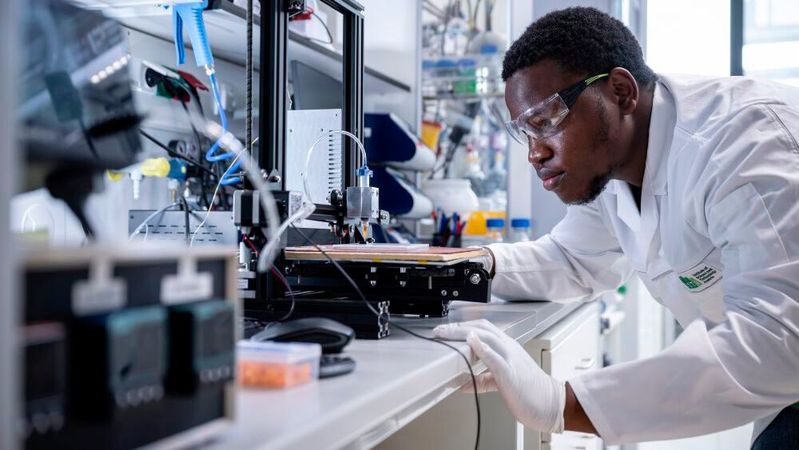
:quality(80)/p7i.vogel.de/wcms/53/4d/534d4edf9cbb33a7c8afc03a911f8ff8/0123224586v1.jpeg "3D printing of pellets for measuring thermoelectric properties.(Image: WSS, photo: Felix Wey, Baden)")
:quality(80)/p7i.vogel.de/wcms/06/bb/06bbd412e23dc980fb41435136df7612/0123224584v1.jpeg "Co-author Abayomi Lawal operates the 3D printer.(Image: WSS, photo: Felix Wey, Baden)")
:quality(80):fill(efefef,0)/p7i.vogel.de/wcms/67/ac/67acb931a438c/elatec-wp-gmp.png "Elatec WP GMP")
Date: 08.12.2025
Naturally, we always handle your personal data responsibly. Any personal data we receive from you is processed in accordance with applicable data protection legislation. For detailed information please see our privacy policy.
Consent to the use of data for promotional purposes
I hereby consent to Vogel Communications Group GmbH & Co. KG, Max-Planck-Str. 7-9, 97082 Würzburg including any affiliated companies according to §§ 15 et seq. AktG (hereafter: Vogel Communications Group) using my e-mail address to send editorial newsletters. A list of all affiliated companies can be found here
Newsletter content may include all products and services of any companies mentioned above, including for example specialist journals and books, events and fairs as well as event-related products and services, print and digital media offers and services such as additional (editorial) newsletters, raffles, lead campaigns, market research both online and offline, specialist webportals and e-learning offers. In case my personal telephone number has also been collected, it may be used for offers of aforementioned products, for services of the companies mentioned above, and market research purposes.
Additionally, my consent also includes the processing of my email address and telephone number for data matching for marketing purposes with select advertising partners such as LinkedIn, Google, and Meta. For this, Vogel Communications Group may transmit said data in hashed form to the advertising partners who then use said data to determine whether I am also a member of the mentioned advertising partner portals. Vogel Communications Group uses this feature for the purposes of re-targeting (up-selling, cross-selling, and customer loyalty), generating so-called look-alike audiences for acquisition of new customers, and as basis for exclusion for on-going advertising campaigns. Further information can be found in section “data matching for marketing purposes”.
In case I access protected data on Internet portals of Vogel Communications Group including any affiliated companies according to §§ 15 et seq. AktG, I need to provide further data in order to register for the access to such content. In return for this free access to editorial content, my data may be used in accordance with this consent for the purposes stated here. This does not apply to data matching for marketing purposes.
Right of revocation
I understand that I can revoke my consent at will. My revocation does not change the lawfulness of data processing that was conducted based on my consent leading up to my revocation. One option to declare my revocation is to use the contact form found at https://contact.vogel.de. In case I no longer wish to receive certain newsletters, I have subscribed to, I can also click on the unsubscribe link included at the end of a newsletter. Further information regarding my right of revocation and the implementation of it as well as the consequences of my revocation can be found in the data protection declaration, section editorial newsletter.
:quality(80)/p7i.vogel.de/wcms/b3/f3/b3f3338762d84d6ba0aab1fc9b8190f1/0126169322v1.jpeg "With the cold spray technique, copper and aluminum can be joined. The copper is then applied only to the necessary areas, saving weight and costs. (Image:impact innovations)")
:quality(80)/p7i.vogel.de/wcms/f0/bf/f0bf7db87605ba6d74e26fa3e27e0e8e/0128192836v1.jpeg "Researchers use a single-phase reaction of metal ions and an organic compound to produce conductive, well-organized colloidal coordination nanolayers. (Image:Tokyo University of Science)")