Contrinex not only manufactures exceptionally small optical sensors but has also developed a groundbreaking technology for detecting transparent objects. The company's sensor solutions enable the industry to significantly optimize their processes.
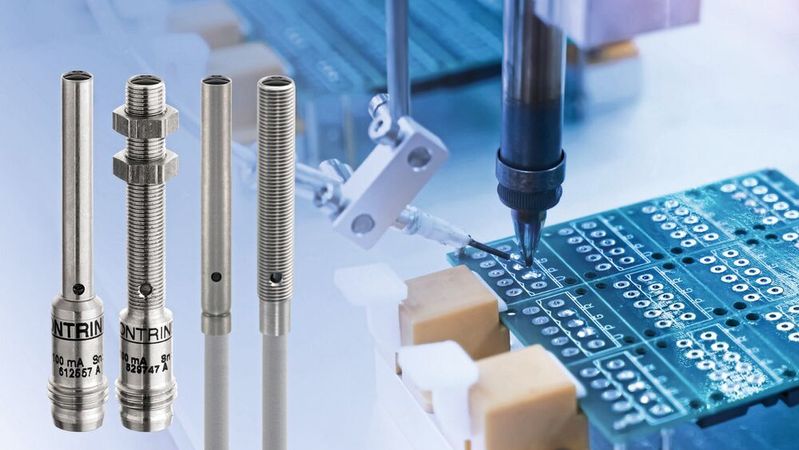
According to the manufacturer, Contrinex's photoelectric miniature sensors are the smallest optical sensors with integrated electronics on the market. They are available as diffuse sensors or through-beam sensors.
(Image: Contrinex, Shutterstock/asharkyu)
Optical sensors are now ubiquitous in automation technology: they count glass bottles on conveyor belts, detect the position of circuit boards in soldering systems, or monitor the temperature in jam production. Since the objects to be detected often vary greatly and move very quickly, the requirements for the sensors used are high. They must not only reliably differentiate between light and dark surfaces but also cover large detection areas.
Inductive and capacitive sensors are not suitable for these applications, as they only detect objects made of specific materials or are easily affected. Optical sensors, therefore, provide the most reliable detection of objects with differently structured and colored surfaces.
The reason for the extremely high accuracy of optical sensors lies in their functionality: An emitting diode (LED) emits a beam of pulsed light that strikes the object to be detected. This beam is partially interrupted and partially reflected. Depending on the type of optical sensor used, either the interruption of the beam or the light reflected by the object is evaluated.
Top Performance in the Smallest Space
The sensor specialist Contrinex manufactures a wide portfolio of optical sensors with extensive detection ranges, including reflective photoelectric sensors, through-beam sensors, diffuse sensors with and without background suppression, and sensors with analog output. The product range also includes sensor technologies and sizes that are exclusively available from Contrinex, such as the TRU-C23 sensors for detecting transparent objects and the world's smallest optical sensors.
The photoelectric miniature sensors are particularly suitable for applications with very limited installation space. A good example is intelligent conveyor belts in packaging machines. Here, photoelectric sensors such as the LTI-D04MA-NSK-403 type with a diameter of only 0.16 inches are used. The sensors detect passing plastic trays from below and stop them so that the respective batch can be scanned and recorded.
Different Technologies for Different Objects
Since the trays to be detected are made of dark plastic, the user chose the infrared version of the sensors. With an infrared measuring beam, unlike with a laser or a standard LED, dark objects can be detected as they emit significantly more heat than light objects. This heat is then detected by the sensor and converted into a switching signal. The functional principle of diffuse sensors or laser LEDs, on the other hand, is different: they detect objects based on the reflection of an emitted LED beam. However, since dark objects hardly reflect light, these technologies were not suitable for detecting the plastic trays.
The LTI-D04MA-NSK-403 can detect objects at a distance between 0 inches and 0.47 inches (infrared LED 880 nm) and operates in ambient temperatures ranging from -13 to 149 °F. With a response time of ≤ 500 ms and a switching frequency of <1 kHz (normal mode), the sensor reliably detects even very fast-moving objects. For applications where the background should not be detected by the sensor, Contrinex also offers a teach-in variant (IO-Link or wire-teach), allowing the desired distance to be set precisely.
Reliably Detect Transparent Objects
Another unique feature of the Swiss sensor specialist is its TRU-C23 sensors for detecting transparent objects (detection range: 147 inches). The sensors are based on patented UV technology that leverages the properties of translucent materials.
Unlike light of other wavelengths, polarized UV light is largely absorbed even by transparent objects. For this reason, the threshold at which the sensors should switch can be set very easily by the user. Neither the thickness nor the shape of the object to be detected has any influence on the measurement result. At the heart of the TRU-C23 sensors are an LED that emits polarized UV light and a UV reflector. This allows the sensors to detect even the thinnest transparent objects.
Thicker transparent objects can be reliably detected with the C23 Transparent Standard sensor. It emits polarized red light and detects objects at distances of up to 197 inches. The C23 Transparent Standard sensors are equipped with a pinpoint LED, allowing them to completely suppress the background.
Date: 08.12.2025
Naturally, we always handle your personal data responsibly. Any personal data we receive from you is processed in accordance with applicable data protection legislation. For detailed information please see our privacy policy.
Consent to the use of data for promotional purposes
I hereby consent to Vogel Communications Group GmbH & Co. KG, Max-Planck-Str. 7-9, 97082 Würzburg including any affiliated companies according to §§ 15 et seq. AktG (hereafter: Vogel Communications Group) using my e-mail address to send editorial newsletters. A list of all affiliated companies can be found here
Newsletter content may include all products and services of any companies mentioned above, including for example specialist journals and books, events and fairs as well as event-related products and services, print and digital media offers and services such as additional (editorial) newsletters, raffles, lead campaigns, market research both online and offline, specialist webportals and e-learning offers. In case my personal telephone number has also been collected, it may be used for offers of aforementioned products, for services of the companies mentioned above, and market research purposes.
Additionally, my consent also includes the processing of my email address and telephone number for data matching for marketing purposes with select advertising partners such as LinkedIn, Google, and Meta. For this, Vogel Communications Group may transmit said data in hashed form to the advertising partners who then use said data to determine whether I am also a member of the mentioned advertising partner portals. Vogel Communications Group uses this feature for the purposes of re-targeting (up-selling, cross-selling, and customer loyalty), generating so-called look-alike audiences for acquisition of new customers, and as basis for exclusion for on-going advertising campaigns. Further information can be found in section “data matching for marketing purposes”.
In case I access protected data on Internet portals of Vogel Communications Group including any affiliated companies according to §§ 15 et seq. AktG, I need to provide further data in order to register for the access to such content. In return for this free access to editorial content, my data may be used in accordance with this consent for the purposes stated here. This does not apply to data matching for marketing purposes.
Right of revocation
I understand that I can revoke my consent at will. My revocation does not change the lawfulness of data processing that was conducted based on my consent leading up to my revocation. One option to declare my revocation is to use the contact form found at https://contact.vogel.de. In case I no longer wish to receive certain newsletters, I have subscribed to, I can also click on the unsubscribe link included at the end of a newsletter. Further information regarding my right of revocation and the implementation of it as well as the consequences of my revocation can be found in the data protection declaration, section editorial newsletter.
New Optics Provide Even Higher Accuracy
Contrinex continuously optimizes its photoelectric sensors. Since the latest redesign, a combination of PBT/PMMA is used instead of sapphire. As a result, the beam of infrared, laser, and pinpoint LEDs is even more focused and can now detect even the smallest objects. For easy handling, the optical miniature sensors are also available in a red light version: here, the light spot is visible and can therefore be aligned to the objects to be detected with minimal effort.
For detecting the smallest black objects against a bright background, Contrinex offers reflective sensors with background suppression. These feature a patented dual-optic system with an exceptionally large adjustment range of 1 to 20 inches and exhibit no black-and-white shift.
Contrinex uses a special autocollimation optics system in its reflective photoelectric sensors and TRU-C23 sensors. This prevents the creation of a blind zone near the sensor where objects cannot be detected. The autocollimation optics are characterized by identical optical axes for the transmitting and receiving channels. To achieve this, the light is deflected using a semi-transparent mirror.
ASIC Processes Sensor Signals
The signal processing of Contrinex's photoelectric sensors is performed on a highly complex application-specific chip (ASIC) developed in-house. All optical sensors in the C23, C55, and M18 series also feature an IO-Link interface, making them ready for intelligent Smart Factory applications. IO-Link not only enables continuous monitoring of process data but also allows for constant monitoring of the sensor status, sensitivity adjustment, and verification of the sensor ID. This ensures that the correct sensor is in the right location.
Both calibration and installation of Contrinex's optical sensors are straightforward. Since most series are calibrated through ASIC parameterization, minimal effort is required. This type of calibration also ensures high measurement accuracy and low unit variation. The sensors are also very easy to integrate into applications, as they can be mounted in any position. This applies to all designs, but especially to the miniaturized models. Thanks to the IO-Link interface, it is even possible to adjust the sensors while they are installed.
Dipl.-Ing. Norbert Matthes is Technical Sales Manager at Contrinex Sensor GmbH



:quality(80)/p7i.vogel.de/wcms/8e/fa/8efad6aa006fcf624d07c645b774d8ce/screenshot-202026-01-21-20113324-764x430v1v1.png "The system processes heavy sheets weighing up to 200 kg fully automatically, without programming or teaching. (Image:Teqram)")
:quality(80)/p7i.vogel.de/wcms/0c/58/0c587c8221ae96052b5dcc0f40eb3dcd/0128880879v1.jpeg "A chip surfer with a solid carbide head is used for finishing in the third operation. (Image:Ingersoll)")
:quality(80)/p7i.vogel.de/wcms/a2/9b/a29bb02b3f1e34962e28579dccfbbc49/0129266114v1.jpeg "Bevel gears on workpiece carriers in the rotary indexing conveyor of the VSC 400 DDS - the pick-up spindle removes the workpiece precisely and reproducibly for hard machining at EWS. (Image:Emag)")
:quality(80)/p7i.vogel.de/wcms/c0/2c/c02c6f8c4c079cc5db6a21c00affcecd/0128311235v1.jpeg "Tatra chose a Fastems FPC3000 system as the automation solution, which initially contains twelve pallet spaces, and in a later stage 18 pallet spaces and a linear conveyor. (Image:Starrag/Ralf Baumgarten)")
:quality(80)/p7i.vogel.de/wcms/4d/74/4d745446555110ca9797db1eabb7c9d3/0129551585v1.jpeg "Jochen Gemeinhardt is responsible for NTT Data's AI business in the DACH region as Head of Production & Supply Chain and Head of Industry Line Global Business. (Image:NTT Data)")
:quality(80)/p7i.vogel.de/wcms/7a/c8/7ac81c41bab1cc98fbe7b20c95644c6c/0129575667v1.jpeg "For the live gala show celebrating the New Year festival, Unitree rehearsed an impressive performance with its robots. (Image:Unitree/YouTube)")
:quality(80)/p7i.vogel.de/wcms/a3/0c/a30c4c3a36910e92d6082fde37261730/0129555015v1.jpeg "From command recipient to decision-maker: thanks to Agentic AI, robots no longer just stubbornly execute pre-programmed scripts. Instead, they analyze visual data in real time and decide autonomously on the next process step (Image:Nano Banana / AI-generated)")
:quality(80)/p7i.vogel.de/wcms/60/00/6000deb595c3e6b2dd0bfe508aa71653/newsimage418166-5084x2861v1v1.jpeg "The robot-guided friction stir welding gun \"Steppwelder\" in use on a conventional 6-axis industrial robot. (Image:Image: Dominik Walz, MPA, University of Stuttgart)")
:quality(80)/p7i.vogel.de/wcms/48/38/4838074eab3f29ec319797fb63881b18/adobestock-693942839--c2-a9-20wirot-20-e2-80-93-20stock-adobe-com-3389x1907v1v1.jpeg "Leaves or bird droppings can cause hotspots on solar modules and reduce performance. (Image:Wirot stock.adobe.com.)")
:quality(80)/p7i.vogel.de/wcms/3f/7f/3f7f9f45ebccd4751d41106866314aea/newsimage418028-2772x1559v1v1.jpeg "Live in the ice channel—detailed recordings in real time make the smallest mistakes and thus time losses in the luge run visible. (Image:Mittweida University of Applied Sciences)")
:quality(80)/p7i.vogel.de/wcms/05/b7/05b7c58dcf5a7fc900348d1c30f7c116/0129540459v1.jpeg "Researchers from Stuttgart have investigated whether the \"technology\" behind hairy elephant trunks, which function as a sensitive gripping system, can also be used in robotics. (Image:Zoo Magic)")
:quality(80)/p7i.vogel.de/wcms/95/00/95009ae2972690e3fdab0dc701e202c3/0129621847v1.jpeg "Last year, Airbus's revenue increased by six percent to 81 billion US dollars. (Image:Airbus SAS 2024)")
:quality(80)/p7i.vogel.de/wcms/ee/66/ee668414d90f1bffbb6e4574ba790d89/0129639616v1.jpeg "Anyone relying on the fuel consumption figures in the description of their \"plug-in\" hybrid might be in for a surprise. Researchers have found in real-world tests that theory and practice differ significantly ... (Image:Koenigsreuther)")
:quality(80)/p7i.vogel.de/wcms/fb/c5/fbc5a1d3151a05241d0b5afc0f017759/0129596854v1.jpeg "The prospects for European cell production have been poor for some time. The reasons for this are high production costs, technical difficulties in ramping up production and overcapacity on the market. (Image:McKinsey)")
:quality(80)/p7i.vogel.de/wcms/69/38/69381399780e10e1bbb446a6a5bfd3e1/0129500927v1.jpeg "Complex design, simple production: With the \"Front-IQ Light\" headlamp, a film is three-dimensionally formed directly in the tool thanks to Colorform technology. (Image:Leonard Kurz)")
:quality(80)/p7i.vogel.de/wcms/41/85/41855b7e5c57936c33039a7e785462c9/0129633555v1.jpeg "A chip processing method developed by MIT could help cryptographic processes keep data secure by allowing two chips within the same system to authenticate each other using a common fingerprint. (Image:freely licensed)")
:quality(80)/p7i.vogel.de/wcms/f3/56/f3568508f969e8560cf1c8d3a3f2885c/0127958464v1.jpeg "According to the manufacturer, Contrinex's photoelectric miniature sensors are the smallest optical sensors with integrated electronics on the market. They are available as diffuse sensors or through-beam sensors. (Image:Contrinex, Shutterstock/asharkyu)")
:quality(80)/p7i.vogel.de/wcms/ab/82/ab82dfd86fd624854af173066cfacea5/0129154593v1.jpeg "The digital Mycelium Lifecycle Platform supports production managers in operating their machines safely, securely, efficiently, and in compliance with standards throughout their entire lifecycle. It combines the management of personnel and machines on a single platform. (Image:Pilz GmbH & Co. KG)")
:quality(80)/p7i.vogel.de/wcms/5c/6b/5c6b52f55eced3f21a82b49b4d29972c/0129641027v1.jpeg "Bytedance has popularized the short video format with the TikTok app, among other things. AI is used in many of the Group's products. (Image:Bytedance)")
:fill(fff,0)/images.vogel.de/vogelonline/companyimg/76800/76895/65.jpg "FAULHABER_120mm.jpg ()")
:fill(fff,0)/p7i.vogel.de/companies/67/eb/67eba621ef6ea/logo2.png "logo2 (Wuxi InfiMotion)")
:quality(80)/p7i.vogel.de/wcms/f1/95/f195dc8d21f6a54e0861e0f98fe77f41/0126654379v1.jpeg "The photoelectric sensor TRU-C23 uses UV light and detects transparent objects with high reliability.(Image: Contrinex)")
:quality(80)/p7i.vogel.de/wcms/ef/e1/efe194eb5577891b234247e5d1195cbe/0126654385v1.jpeg "Photoelectric miniature sensors of type LTI-D04MA-NSK-403 have a diameter of just 4 mm.(Image: Contrinex)")
:quality(80)/p7i.vogel.de/wcms/7b/6b/7b6b95ade8ca6b00f98c9a119c8cc296/0126654369v1.jpeg "The optical miniature sensors from Contrinex offer pre-calibrated detection ranges of 12, 24, 60, or 120 mm in the diffuse sensor version. As through-beam sensors, they even reach up to 600 mm.(Image: Contrinex)")
:quality(80)/p7i.vogel.de/wcms/8e/56/8e56e9e862f3dc735a43a9e1772d8bfc/0126654365v1.jpeg "A micro-mechanical system with a sensor.(Image: Contrinex)")
:quality(80):fill(efefef,0)/p7i.vogel.de/wcms/68/2b/682b2c790057d/elatec-titelbild-wp7-pac.png "Elatec Titelbild WP7 PAC")
:quality(80)/p7i.vogel.de/wcms/a9/18/a9189a26e5a3b3347658eb3babe10637/0127958464v1.jpeg "The photoelectric mini sensors from Contrinex are, according to the manufacturer, the smallest optical sensors with integrated electronics on the market. They are available as diffuse sensors or through-beam sensors. (Image:Contrinex, Shutterstock/asharkyu)")
:quality(80)/p7i.vogel.de/wcms/33/7a/337a519e463cabd1a4314b0bf1d70462/0125477241v1.jpeg "The new Baumer ToF sensors OT200 (pictured) and OT330 combine time-of-flight technology with specific optics and sophisticated algorithms. Typical application fields include intralogistics, equipment manufacturing, and solar and semiconductor production. (Image:Baumer)")