In our "Fascination with Technology" section, we present impressive projects from research and development to designers every week. Today: the world's first flight measurements of contrails from a hydrogen-powered turbojet engine.
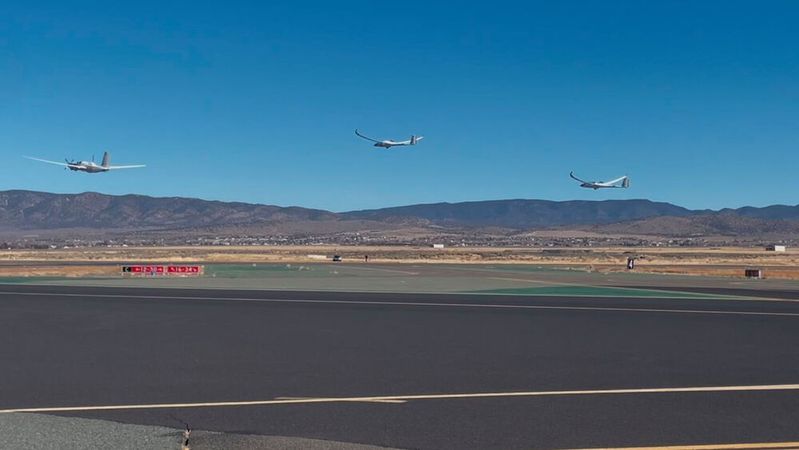
The Blue Condor and the Arcus Glider 7DT towed by the Egrett on their way to the measurement region above nine kilometers (5.6 miles) in altitude.
(Image: DLR (CC BY-NC-ND 3.0))
Contrails form in the upper troposphere when the air is sufficiently cold and moist. They have a significant impact on the climate effect of air traffic. Future technologies like hydrogen-powered airplanes promise not only a reduction in CO2 emissions but also a reduction in the climate impact of contrails. However, there have been no measurements from flight tests to characterize the formation, properties, and effects of contrails from hydrogen direct combustion.
Technically Challenging Flight Experiment
In the Blue Condor project, Airbus, the Perlan team, and the German Aerospace Center (DLR) have now, for the first time worldwide, measured contrails from a hydrogen turbojet engine in flight. The three-week flight test campaign already took place in December 2024 in Minden, Nevada, USA. The DLR equipped a chase plane with instruments for contrail and emission measurements and operated them autonomously at cruising altitude.
The world's first measurements of contrails from hydrogen-powered aircraft are an outstanding milestone for comprehensively understanding the climate compatibility of hydrogen propulsion in aviation.
Dr. Markus Fischer, DLR's Director of Aviation
"The world's first measurements of contrails from hydrogen-powered aircraft are an outstanding milestone for holistically understanding the climate compatibility of hydrogen propulsion in aviation," says Dr. Markus Fischer, DLR's Director of Aviation. "We developed the initial concept ideas and theoretical foundations for such an experiment several years ago in a funded DLR junior research group. This is an example of how we at DLR are laying the groundwork for climate-compatible flying to strengthen the economy and make society future-proof. We are very pleased that it has now been possible, in collaboration with Airbus and the Perlan team, to successfully launch this technically highly challenging flight experiment."
Comparison of Hydrogen Jet Engine and Kerosene-Powered Combustion Engine
The centerpiece of the Blue Condor mission is an Arcus glider. This was modified by Airbus and the Perlan team to accommodate a tank for gaseous hydrogen, a lubricating oil system, and a hydrogen-powered turbojet engine. The engine was developed by AeroDesignWorks in collaboration with RWTH Aachen, Germany.
The Blue Condor aircraft was flown by Jim Payne, a pilot from the Perlan team, who holds the world record in altitude and speed gliding. A second Arcus aircraft operated by the Perlan team was equipped with a conventional kerosene engine. Both gliders were simultaneously towed to an altitude of over nine kilometers by a Grob Egrett, a high-altitude research aircraft operated by AV Experts LLC, where contrail formation was predicted. There, both gliders were released from the tow and the tow plane with the measuring instruments dropped back behind the gliders.
After a one-week integration phase in Denison, Texas, where the Egrett is stationed, the aircraft, instruments, and team were transferred to Minden, Nevada. There, the DLR and AV expert team met with the Perlan and Airbus team, who prepared the Blue Condor for the aircraft measurements.
(Image: DLR (CC BY-NC-ND 3.0))
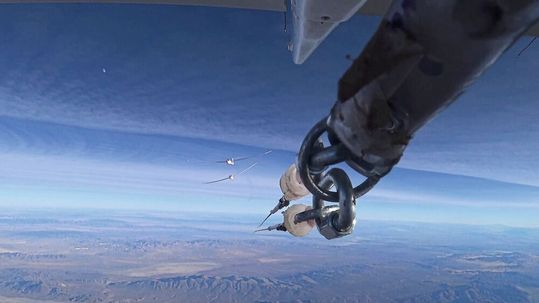
The Blue Condor glider ignited its hydrogen engine. The Egrett chase flight in the exhaust plume began with the measurement of emissions and contrails from the Blue Condor glider. The additional kerosene-powered glider remained in tight formation with its engine ignited. To ensure comparability of the emission data, the respective chase formations were conducted immediately one after the other in the same meteorological conditions. The actual measurement phase using the auxiliary engines lasted about five to ten minutes each.
Microphysical properties of contrails measured under real conditions
Out of a total of seven test flights, four flights took place in which contrails from the hydrogen engine formed. The aim of the investigations was to measure the microphysical properties of contrails from hydrogen direct combustion under real atmospheric conditions. The initial number of ice crystals and the size of the ice crystals forming in the exhaust plume play an important role in the climate impact of contrails. The research team also conducted emission measurements related to nitrogen oxides and aerosol particle formation in the exhaust below the contrail formation region.
Engine tests on the ground provided additional information about the emissions of the hydrogen engine at different power settings. The data is currently being analyzed in detail to publish the results in a scientific publication.
Contrails from hydrogen direct combustion form differently
Contrails from clean hydrogen combustion engines form at higher temperatures and lower altitudes in the atmosphere compared to traditional contrails from kerosene combustion, due to the higher water vapor emissions. Unlike conventional engines, which emit soot and volatile particles as seeds for the ice crystals of contrails during kerosene combustion, the exhaust of a hydrogen combustion engine is ideally free of particle emissions. If the engine is operated without contamination, such as from oil droplets, the aerosol particles present in the surrounding atmosphere theoretically serve as nucleation seeds for the ice crystals in the aircraft's exhaust plume.
Date: 08.12.2025
Naturally, we always handle your personal data responsibly. Any personal data we receive from you is processed in accordance with applicable data protection legislation. For detailed information please see our privacy policy.
Consent to the use of data for promotional purposes
I hereby consent to Vogel Communications Group GmbH & Co. KG, Max-Planck-Str. 7-9, 97082 Würzburg including any affiliated companies according to §§ 15 et seq. AktG (hereafter: Vogel Communications Group) using my e-mail address to send editorial newsletters. A list of all affiliated companies can be found here
Newsletter content may include all products and services of any companies mentioned above, including for example specialist journals and books, events and fairs as well as event-related products and services, print and digital media offers and services such as additional (editorial) newsletters, raffles, lead campaigns, market research both online and offline, specialist webportals and e-learning offers. In case my personal telephone number has also been collected, it may be used for offers of aforementioned products, for services of the companies mentioned above, and market research purposes.
Additionally, my consent also includes the processing of my email address and telephone number for data matching for marketing purposes with select advertising partners such as LinkedIn, Google, and Meta. For this, Vogel Communications Group may transmit said data in hashed form to the advertising partners who then use said data to determine whether I am also a member of the mentioned advertising partner portals. Vogel Communications Group uses this feature for the purposes of re-targeting (up-selling, cross-selling, and customer loyalty), generating so-called look-alike audiences for acquisition of new customers, and as basis for exclusion for on-going advertising campaigns. Further information can be found in section “data matching for marketing purposes”.
In case I access protected data on Internet portals of Vogel Communications Group including any affiliated companies according to §§ 15 et seq. AktG, I need to provide further data in order to register for the access to such content. In return for this free access to editorial content, my data may be used in accordance with this consent for the purposes stated here. This does not apply to data matching for marketing purposes.
Right of revocation
I understand that I can revoke my consent at will. My revocation does not change the lawfulness of data processing that was conducted based on my consent leading up to my revocation. One option to declare my revocation is to use the contact form found at https://contact.vogel.de. In case I no longer wish to receive certain newsletters, I have subscribed to, I can also click on the unsubscribe link included at the end of a newsletter. Further information regarding my right of revocation and the implementation of it as well as the consequences of my revocation can be found in the data protection declaration, section editorial newsletter.
Model simulations show that due to the low concentration of ambient aerosol, potentially fewer and larger ice crystals form in the wake of the hydrogen engine, which can reduce the lifetime of the contrail and its warming effect. A validation of these models is still pending. The comprehensive evaluation of the flight trials remains to be awaited here.
DLR Measurement Instruments on Board
Photo from the rear-facing camera of the Egrett after the Blue Condor glider was detached from the Egrett's towline. The Arcus glider with the hydrogen engine can be seen with an optically thin contrail in the forward position.
(Image: AV Experts LLC)
The instruments integrated on the Egrett were provided by the DLR Institute of Atmospheric Physics and included a range of ice crystal, aerosol, and trace gas measurements such as CO2, nitrogen oxides, and water vapor. All instruments were modified and adapted to the Egrett's cabin. "To obtain untainted data, we measured trace gases and aerosols from a long mast at the front of the aircraft to get out of the influence area of the propeller and exhaust of the Egrett," explains Dr. Tina Jurkat-Witschas, the project leader from the DLR Institute of Atmospheric Physics.
Further modifications to the aircraft carried out by AV Experts included extending the fuselage to enable the integration of the nitrogen oxide measuring device SIOUX. Light scattering spectrometers and specific trace gas inlets were mounted on the landing gear. The DLR scientists operated the instruments autonomously, captured the data via Iridium downlink on the ground, and guided the Egrett pilot via radio into the optimal measurement positions within the contrail.
With the fully analyzed data from the Blue Condor project, it will also be possible in the future to research the climate impact of contrails from a potentially hydrogen-powered fleet using global models. In the meantime, the Blue Condor project was also a finalist for the prestigious Collier Trophy of the National Aeronautic Association (NAA).



:quality(80)/p7i.vogel.de/wcms/f9/7d/f97deef8fde21c8630d76411b18a20a7/0129803665v1.jpeg "Skoda has invested well over 220 million US dollars in the high-tech battery plant that has now opened in Mlada Boleslav. It has now started its work, which is highly automated ... (Image:Skoda)")
:quality(80)/p7i.vogel.de/wcms/f5/61/f561ad7c72ed41fd7a67ad9c481cb15d/0129799343v1.jpeg "Engine-generator units (MGU) from Steyr Motors are at work in the Leopard 2 main battle tank and the Leguan bridge vehicle (pictured). An extended contract is now to secure at least 500 more systems of this type for the Bundeswehr ... (Image:German Armed Forces)")
:quality(80)/p7i.vogel.de/wcms/6c/b5/6cb5ce2155433f6e73b16399adc4c561/0113143253v1.jpeg "In our China Market Insider we regularly provide you with relevant information directly from China. (Image:© Eisenhans - stock.adobe.com)")
:quality(80)/p7i.vogel.de/wcms/7f/fd/7ffd32863352c40f562f4245e4766e61/0129745849v1.jpeg "After US President Donald Trump once again resorted to his favorite weapon, tariffs, concerns rose in the EU that the so-called tariff deal could become invalid. But it looks as if the sea remains relatively calm ... (Image:F. Schneidler)")
:quality(80)/p7i.vogel.de/wcms/9c/ac/9cac6246660e746c5a3989399ac4d250/0128561645v1.jpeg "Artificial intelligence can drive efficiency in smart factories through centralized data management and predictive maintenance. (Picture: ©Fardived - stock.adobe.com)")
:quality(80)/p7i.vogel.de/wcms/6b/e2/6be235b5ad8a442ccd9d164b0b300d8b/0129763992v1.jpeg "As early as 2020, the Zimmer Group announced that it would convert its production to be sustainably CO2-neutral. (Image:Zimmer Group)")
:quality(80)/p7i.vogel.de/wcms/d4/ba/d4bab9481e66f8570f40eb8ef2a90198/0129795613v1.jpeg "A camera inspection during removal ensures that the components are placed correctly in the KLTs. (Image:Yaskawa Europe)")
:quality(80)/p7i.vogel.de/wcms/cb/56/cb56e42b01638b618e8d1b9b38f32faa/0129810132v1.jpeg "From summer 2026, \"AEON\" will support people at the BMW plant in Leipzig. (Image:diephotodesigner.de/BMW)")
:quality(80)/p7i.vogel.de/wcms/b5/5e/b55ed9355e0395ec0caf111d6af6b494/adobestock-495980372--c2-a9-20natali-mis-20-e2-80-93-20stock-adobe-com-6720x3778v1v1.jpeg "Which engineering skills will be in vogue in 2026? (Image:natali_mis - stock.adobe.com)")
:quality(80)/p7i.vogel.de/wcms/bf/a5/bfa5d882e93f159ce93e933742272b00/nord-vibn-cmyk-2196x1235v1v1.jpeg "With digital twins for virtual commissioning, Nord supports customers in ensuring that systems are available more quickly, even with complex drive systems. (Image:Nord Drivesystems)")
:quality(80)/p7i.vogel.de/wcms/f5/7e/f57ef535ee35e7b3b7ff15a8a63cef10/eds-keyvisual-8000x4496v1.jpeg "(Source: European Defence Supply)")
:quality(80)/p7i.vogel.de/wcms/af/a3/afa312176d956068af20491957eef642/newsimage418262-3100x1745v1v1.jpeg "The autonomous shuttle of the Aula AI project during a demonstration of sensor data with artificial fog. (Image:University of Magdeburg)")
:quality(80)/p7i.vogel.de/wcms/cb/23/cb23acd8e9de969d52522692b62b1892/0129680605v1.jpeg "The Z22198 is an extremely compact, three-axis IEPE acceleration sensor for measuring oscillations (vibrations) and shocks in demanding applications. With an edge length of just 0.24 inches and a weight of 0.03 ounces, it is ideal for lightweight structures and confined spaces. (Image:Copyright 2020 ScROGERS,All Rights Reserved)")
:quality(80)/p7i.vogel.de/wcms/c4/40/c44043c61f9dd99b80ccca398c284018/0129795093v1.jpeg "Subaru manufactures the E-Outback at its Yajima plant, marking the first time it has produced an electric vehicle in-house. (Image:Subaru)")
:quality(80)/p7i.vogel.de/wcms/fe/18/fe1824e572677900655c854f6c92c391/0129811281v1.jpeg "BMW and CATL deepen their partnership and work together on the battery pass. (Image:BMW)")
:quality(80)/p7i.vogel.de/wcms/15/54/15546b27b3a679871325ef6d92509a95/0129750872v1.jpeg "Webasto plans to open its third plant for sunroofs in India. (Image:Webasto)")
:quality(80)/p7i.vogel.de/wcms/70/14/70142aa050f8d3f7784c5ddbb2aba5f1/0129778339v1.jpeg "The software investments in production have saved time in Lacon production. (Image:Lacon)")
:quality(80)/p7i.vogel.de/wcms/5c/0f/5c0fee074c4b6c8e8c0993f3217c2f5a/0129773718v1.jpeg "The General Fusion demonstration reactor. (Image:General Fusion)")
:quality(80)/p7i.vogel.de/wcms/7f/c1/7fc1c83b8509df676d27518b82aaef02/0129764984v1.jpeg "China Resources Microelectronics (CR Micro) has announced its intention to increase the prices of its own products. (Image:China Resources Microelectronics)")
:quality(80)/p7i.vogel.de/wcms/eb/4e/eb4e449562174ec95a5b3d30fb0137a2/0129648135v1.jpeg "The III-V germanium PV module with an efficiency of 34.2% is currently the most efficient solar module in the world. (Image:Jacob Forster)")
:fill(fff,0)/p7i.vogel.de/companies/68/a4/68a47beec75ce/logo-cmyk-de.jpeg "logo-cmyk-de (https://www.datatec.eu/)")
:fill(fff,0)/p7i.vogel.de/companies/69/88/69882c428938e/tmts2026-ticec-banner-en-2000px.png "tmts2026-ticec-banner-en-2000px (https://www.tmts.tw/en)")
:fill(fff,0)/p7i.vogel.de/companies/67/eb/67eba621ef6ea/logo2.png "logo2 (Wuxi InfiMotion)")

:quality(80):fill(efefef,0)/p7i.vogel.de/wcms/67/ad/67adf92d254d2/elatec-wp-smart-factory.png "Elatec WP Smart Factory")
:quality(80)/p7i.vogel.de/wcms/ac/cd/accdd8664f205d9f4e91eceebda9f19a/0124225006v1.jpeg "In Project Blue Condor, the research partners conducted the first flight measurements of contrails from a hydrogen-powered turbojet engine. (Image:AV Experts)")
:quality(80)/p7i.vogel.de/wcms/93/fc/93fce00b5565838d294bb627eed833ef/0128226312v1.jpeg "The A4Climate project investigates how contrails can be avoided. (Image:Project A4Climate)")