Image processingContract manufacturer produces more flexibly with AI-based image processing
By
Peter Stiefenhöfer, PS Marcom Services | Translated by AI
5 min Reading Time
Contract manufacturers rely on flexible automation to realize quick product changes while remaining economical. Therefore, the American contract manufacturer Federal Package uses AI-based vision systems from Cognex in its quality control.
Federal Package uses the Cognex In-Sight 2800 smart cameras to inspect personal care products after filling for unwanted drip marks and correct label placement.
(Image: Cognex)
Supermarket shelves around the world are full of products whose manufacturers are well-known, but in many cases, they are not the actual producers of the goods. The reason behind this seemingly paradoxical situation is that many original manufacturers, from sectors such as food, beverages, personal care, or cleaning products, have their products manufactured, filled, or even packaged by contract manufacturers for a fee. This approach offers several advantages compared to complete production on their own facilities and in their own factory halls. Among other things, this strategy allows for greater flexibility regarding production volumes and better scalability with changing demand. In many cases, it is more economical to outsource production capacities to external partners and thus keep the organization lean. For these reasons, numerous larger and smaller manufacturers are increasingly relying on such contract manufacturers.
Essential for brand image is the quality of the goods: defective products or packaging can quickly damage the reputation of the original manufacturer and result in drops in sales and profits in no time. Flawless products are also crucial for contract manufacturers, as otherwise there is a risk of losing orders.
Gallery
Increasingly automated processes
An example of this business model is the American contract manufacturer Federal Package, based in Chanhassen, Minnesota. The company specializes in the development and packaging of a wide range of health, beauty, and personal care products, including deodorants, sunscreens, lip balms, serums, and a variety of lotions and creams.
When filling such materials into their respective containers, overflow can occur at any time because the fill levels often cannot be controlled with 100 percent certainty, or droplets of the content may land on the containers.
Jerry Bilse, Senior Vice President Operations & Engineering, Federal Package
Adding to the challenge is that the company works for many manufacturers, which means that the containers, fill levels, and ingredients frequently change.
We therefore increasingly rely on automated manufacturing processes. This also applies to quality control, which we are implementing more and more frequently using industrial image processing systems.
Jerry Bilse, Senior Vice President Operations & Engineering, Federal Package
The fact that increasingly powerful AI-based vision systems are being used can be easily explained in the case of Federal Package: Overflowing or dripping material during filling results in highly variable defect patterns. In these cases, no contaminated shampoo bottle is like the other.
With the help of artificial intelligence and edge learning tools, we can easily teach such defects to the image processing system, thus achieving reliable detection of incorrectly filled containers and their fully automatic removal from the process.
Jerry Bilse, Senior Vice President Operations & Engineering, Federal Package
Edge learning allows the seamless training of good and bad examples by uploading the corresponding images into the system. "By using such systems, we are now able to switch our production lines to new products much faster than before."
In a recently conducted project, Federal Package received an order to produce deodorants for a personal care company and invested again in industrial image processing. Two tasks within the manufacturing process were particularly suitable for automating quality control: One was checking the plastic packaging on the front and back of each deodorant container for drips, which can result from overfilling and lead to poor product presentation. In the second quality control, the labels were inspected. This involves checking whether the correct label is used and whether it is applied in the correct position and alignment on the packaging. "At the production line selected for this task, the goods were previously inspected manually," recalls Bilse. "To increase productivity and enhance quality, automating the inspection of each individual package on this line was the ideal solution."
Federal Package had previously invested in industrial image processing for various business areas and had corresponding experience with Cognex and other leading providers of industrial image processing technology. "For this deodorant project, we chose Cognex again for various reasons and opted for In-Sight 2800 systems," said Bilse. According to him, essential arguments for Cognex included the hardware's performance, the software's ease of use, and the positive experiences with the manufacturer's support. Particularly, the ability to use the integrated edge learning tools of the In-Sight 2800 systems for defect training was decisive for this decision.
Edge Learning is a subset of artificial intelligence (AI) where processing takes place directly on the device, using a set of pre-trained algorithms. The technology is easy to set up and requires less time and fewer images for training compared to other AI-based solutions, such as deep learning. Choosing the In-Sight 2800 significantly accelerated the commissioning process, Bilse emphasizes.
The image processing component of this system was set up and ready to use within just 20 minutes – previously, such changes took us up to a whole day.
Jerry Bilse, Senior Vice President Operations & Engineering, Federal Package
Such short changeover times are crucial for Federal Package, as the company produces between 30 and 40 different deodorant designs with varying scents, colors, and labels for different manufacturers. The system's edge learning capability is smart enough to filter out features like different colors and labels and focus on the actual defects of the product.
Federal Package uses the monochrome version of the In-Sight 2800 for drip inspection and the color version for label control, as it can better differentiate between the edge of the label and the deodorant container. The line for drip inspection runs at nearly eighty units per minute, while the label inspection operates at about sixty units per minute. In both cases, automation allows for a higher throughput and ensures that all units are checked 100 percent, which would be impossible manually. The accuracy rate for detecting defects is over 99 percent, meaning that the operating personnel only need to intervene in the few cases where defective containers are identified and rejected.
Date: 08.12.2025
Naturally, we always handle your personal data responsibly. Any personal data we receive from you is processed in accordance with applicable data protection legislation. For detailed information please see our privacy policy.
Consent to the use of data for promotional purposes
I hereby consent to Vogel Communications Group GmbH & Co. KG, Max-Planck-Str. 7-9, 97082 Würzburg including any affiliated companies according to §§ 15 et seq. AktG (hereafter: Vogel Communications Group) using my e-mail address to send editorial newsletters. A list of all affiliated companies can be found here
Newsletter content may include all products and services of any companies mentioned above, including for example specialist journals and books, events and fairs as well as event-related products and services, print and digital media offers and services such as additional (editorial) newsletters, raffles, lead campaigns, market research both online and offline, specialist webportals and e-learning offers. In case my personal telephone number has also been collected, it may be used for offers of aforementioned products, for services of the companies mentioned above, and market research purposes.
Additionally, my consent also includes the processing of my email address and telephone number for data matching for marketing purposes with select advertising partners such as LinkedIn, Google, and Meta. For this, Vogel Communications Group may transmit said data in hashed form to the advertising partners who then use said data to determine whether I am also a member of the mentioned advertising partner portals. Vogel Communications Group uses this feature for the purposes of re-targeting (up-selling, cross-selling, and customer loyalty), generating so-called look-alike audiences for acquisition of new customers, and as basis for exclusion for on-going advertising campaigns. Further information can be found in section “data matching for marketing purposes”.
In case I access protected data on Internet portals of Vogel Communications Group including any affiliated companies according to §§ 15 et seq. AktG, I need to provide further data in order to register for the access to such content. In return for this free access to editorial content, my data may be used in accordance with this consent for the purposes stated here. This does not apply to data matching for marketing purposes.
Right of revocation
I understand that I can revoke my consent at will. My revocation does not change the lawfulness of data processing that was conducted based on my consent leading up to my revocation. One option to declare my revocation is to use the contact form found at https://contact.vogel.de. In case I no longer wish to receive certain newsletters, I have subscribed to, I can also click on the unsubscribe link included at the end of a newsletter. Further information regarding my right of revocation and the implementation of it as well as the consequences of my revocation can be found in the data protection declaration, section editorial newsletter.
Bilse is thrilled with the results of the upgraded system: "This image processing system has helped us further optimize our processes and elevate them to an even better level. The production line, where deodorants are now filled, typically runs 24 hours a day, five days a week, without requiring a single manual intervention. This would be impossible without suitable image processing systems."
In addition to increased reliability, Federal Package benefits in another way from using Cognex image processing: "Over time, we have gained more confidence in our systems and know that, due to the high level of automation and powerful image processing, we produce virtually no scrap. On this basis, we now operate the systems at slightly higher speeds, further increasing our throughput and productivity. We owe this success also to the experience of Cognex experts who support us in becoming even better. In this area, I see tremendous added value for the future."



:quality(80)/p7i.vogel.de/wcms/60/eb/60ebe43de41f833157b476b2e1641811/0130090160v1.jpeg "The Surface Control Automotive measuring system from Micro-Epsilon automatically detects dents, scratches and other surface defects on body shells. (Image:Micro-Epsilon)")
:quality(80)/p7i.vogel.de/wcms/26/8a/268aba929d72bd089234bd512aab9b08/0130487474v1.jpeg "The works meeting at Volkswagen is over! Here is a brief overview of the most important aspects ... (Image:VW)")
:quality(80)/p7i.vogel.de/wcms/50/63/5063e5b91e7897c13b882440c7f106d4/0128575929v1.jpeg "How is Edge AI changing the industry? Local data processing meets distributed intelligence to promote sustainability and efficiency. (Picture: ©tippapatt - stock.adobe.com)")
:quality(80)/p7i.vogel.de/wcms/a0/47/a04725ef9bd09fb6c9341a1bea1b5d93/0130443083v1.jpeg "Here, a type of plastic pallet is produced by thermoforming (vacuum forming or deep drawing) at the corresponding division of New England Plastics in the USA. This division, which specializes in so-called liners, is now part of Ringmetall ... (Image:New England Plastics)")
:quality(80)/p7i.vogel.de/wcms/d3/3d/d33d26b35aa1e64f5c41d19d22c5c5dc/0130496518v1.jpeg "(Image:Speedbot)")
:quality(80)/p7i.vogel.de/wcms/f0/ca/f0caaaa9fc2347a5221760a94f92e831/0129880873v1.jpeg "Human-machine collaboration takes on a new quality. This is because the automation task is formulated in natural language and the AI takes over its implementation directly in the project. This allows users to implement Codesys projects more quickly. (Image:Codesys)")
:quality(80)/p7i.vogel.de/wcms/b7/36/b736dfebc16c42d6901d0d0e1f390493/3d-druck-20factory-20--20ki-20generiert-1920x1079v1.png "(Source: AI-generated)")
:quality(80)/p7i.vogel.de/wcms/79/b2/79b21aad663f4a7bd4472afc1c1afc62/0130433994v1.jpeg "Mission Joyride: The free-flying robot (shown here in the rendering) will relieve the ISS crew of logistics tasks from 2027 with its two mechanical arms. (Image:Icarus Robotics)")
:quality(80)/p7i.vogel.de/wcms/59/a2/59a2b11f0aa1b700eff02addd5de8703/adobestock-1788280853--c2-a9-20satria-20-e2-80-93-20stock-adobe-com-5081x2860v1v1.jpeg "Quantum computers require extreme cooling to temperatures close to absolute zero in order to keep qubits stable. (Image:satria - stock.adobe.com)")
:quality(80)/p7i.vogel.de/wcms/49/38/493876a248943456b7e4a6db6edfc454/0130230765v1.jpeg "Safe and reliable in aircraft construction: light-curing adhesive bond combined with universal fastening elements. (Source: Delo)")
:quality(80)/p7i.vogel.de/wcms/c2/57/c257d627beec10e94252cde72830adf6/0130472803v1.jpeg "With the Twingo E-Tech, Renault is now launching a purely electrically powered new edition of the Twingo small car (Image:Renault)")
:quality(80)/p7i.vogel.de/wcms/c1/43/c143c24b62e51b848b2586b52bcd20e2/0130468443v1.jpeg "Jörg Burzer, Head of Development at Mercedes Benz Group AG (Image:Mercedes)")
:quality(80)/p7i.vogel.de/wcms/24/8d/248dccded0abab4dc0a3a7abcc462884/0130497946v1.jpeg "A receiver test for 10BASE-T1S developed by Keysight promotes the testing of function-critical receivers to ensure the reliability and safety of future on-board networks. (Image:Keysight)")
:quality(80)/p7i.vogel.de/wcms/b5/c7/b5c749d16c8a2e789c1469c2c8c1c387/0130452780v1.jpeg "Volvo Trucks completes road tests with its new hydrogen-powered trucks. (Image:Volvo Trucks)")
:quality(80)/p7i.vogel.de/wcms/86/e0/86e09ea9c278d112c55b995b843abfee/0130494578v1.jpeg "PV system on the roof of the Elbfabrik, a Fraunhofer IFF research factory. A sensor system can detect faults in large-scale PV systems at an early stage. (Image:Fraunhofer IFF/Anne Bornkessel)")
:quality(80)/p7i.vogel.de/wcms/ee/09/ee09acbd6dc896df25affaa9e871e6e5/0130440053v1.jpeg "IMS chip module for simple system integration into an ion mobility spectrometer. (Image:Fraunhofer IPMS)")
:quality(80)/p7i.vogel.de/wcms/10/6c/106cd22de5f68a0f74639d654827228c/0130345302v1.jpeg "Made in India: According to the India Electronics and Semiconductor Association (IESA), the country should be able to produce between 75 and 80 million chips by the beginning of 2027, once the plants currently under construction become operational. (Image:Pixabay (Montage: Sebastian Gerstl))")
:quality(80)/p7i.vogel.de/wcms/a5/ed/a5ed6fda029d362732a293d6b19d74c4/0130444216v1.jpeg "Thirteen executives from the Chinese chip industry have drawn up a plan to achieve an 80% self-sufficiency rate for semiconductors by 2030. (Image:Maxim_Kazmin - stock.adobe.com)")
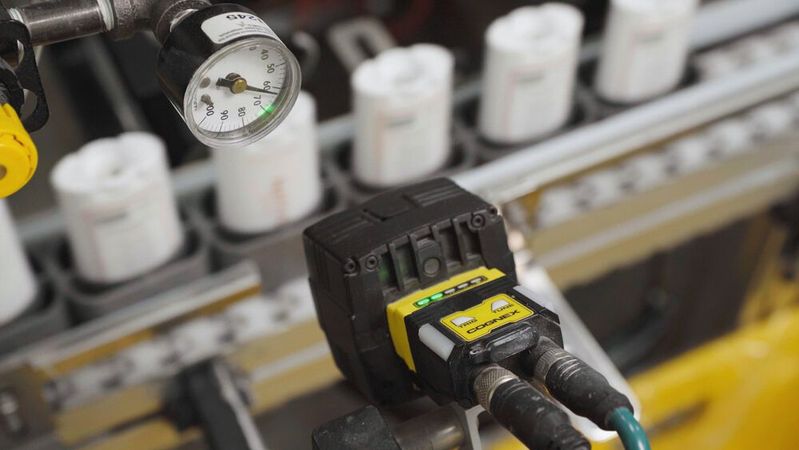
:quality(80)/p7i.vogel.de/wcms/2f/3e/2f3e34fac9c350eb3962aa64ae3e6ead/0122052118v1.jpeg "When filling personal care products into their respective containers, overflow can occur at any time because the fill levels often cannot be controlled with 100 percent certainty.(Image: Cognex)")
:quality(80)/p7i.vogel.de/wcms/90/d2/90d21cd020f03dfccd0d95828de9386b/0122052111v1.jpeg "By using the Edge Learning tools of the In-Sight 2800, Federal Package was able to significantly speed up the commissioning and conversion of production lines and ensure reliable defect detection.(Image: Cognex)")
:quality(80)/p7i.vogel.de/wcms/d1/27/d1270970d077a1763912045a6e6e9b2c/0122052114v1.jpeg "The integrated Edge Learning tools of Cognex's In-Sight 2800 systems are particularly suitable for training defects with constantly changing appearances.(Image: Cognex)")
:quality(80)/p7i.vogel.de/wcms/61/07/6107573de54bcfa28f7a023c1523b4b1/0122076698v1.jpeg "Federal Package uses the Cognex In-Sight 2800 smart cameras to inspect personal care products after filling for unwanted drip marks and correct label placement.(Image: Cognex)")
:quality(80)/p7i.vogel.de/wcms/b3/0f/b30fa47b8a7e4a1703436255600dab10/0127132229v1.jpeg "Deflectometry for defect detection on reflective components (Image:MVTec Software GmbH)")
:quality(80)/p7i.vogel.de/wcms/9c/72/9c7210f208dda74cc52b1fce534ba9a9/0126801474v1.jpeg "DGH developed an automated system for inspecting welds using cameras and lighting mounted on robots. (Image:DGH)")