The compact SoC sensor RLT E527.06 reliably detects rain and darkness. Thanks to the HALIOS principle, it can detect light regardless of external conditions. This is particularly advantageous for the cost-driven automotive industry.
As part of a cooperation, an RLT (rain-light-tunnel) sensor was developed. This SoC is a fully integrated unit with controllers, amplifiers, a LIN transceiver, and an integrated microcontroller for data processing.
(Image: Elmos)
Volodymyr Melnyk is Delivery Director at Intellias.
The trend toward the "Software-Defined Vehicle" is also impacting vehicle sensor technology. More and more functions are shifting to software, while connectivity requirements are becoming higher. How these requirements can be practically implemented is demonstrated by a cooperative project for the redevelopment of an RLT (Rain-Light-Tunnel) sensor as a System-on-a-Chip (SoC). In this, the development service provider Intellias provided comprehensive support for Elmos and its subsidiary Area 21.
Sensor As SoC With Controller, Amplifier, And LIN
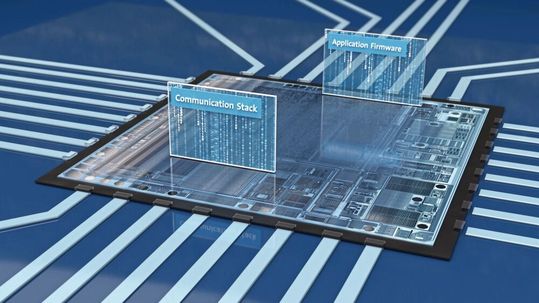
The new sensor is designed as a System on a Chip (SoC), and the software is modularly divided into blocks.
(Image: Elmos)
With the designation RLT E527.06, Area 21 brings to market a sensor specifically offered for Tier 1 in lighting technology and windshield wipers. The sensor features a high level of integration and a compact design. Developed as a System on a Chip (SoC), it combines controllers, amplifiers, a LIN transceiver, and an integrated microcontroller for data processing in a single unit. Users only need to connect transmitting and receiving elements, such as LEDs and photodiodes, and solder the IC onto the circuit board.
The SoC of the Rain-Light-Tunnel sensor is a highly integrated component that stands out due to the smart division of tasks between hardware and software. External photodiode currents are evaluated by the hardware, with signal amplification and filtering performed at the hardware level. The crucial interpretation of the signals, such as detecting rain, is handled by the software running on the integrated 32-bit microprocessor. Through the built-in LIN interface, the data is transmitted to an external control unit, which then decides whether to activate the windshield wipers or turn the low beam on or off.
A Multi-Channel Signal Processing
Configurable algorithms suppress interference when rain needs to be detected.
(Image: Elmos)
In addition to rain detection, ambient light detection is one of the sensor's main functions. These functionalities are essential for controlling low beam lights, climate zone regulation, and brightness adjustment of a head-up display.
Two channels are available for the key function of rain detection. These allow for a flexible distribution of the optical paths to ensure a maximum sensitive area. Configurable algorithms for rain detection and interference suppression further optimize this system.
In ambient light detection, even six channels with logarithmic amplifiers can be used. These amplifiers cover a wide dynamic range. Additionally, two of these channels can be switched to an amplifier with particularly high gain, which is specifically designed for photo-currents in the pA range.
All on Board: High Level of Integration
Benedikt Ehler is Software Segment Lead at Area 21 Software. "The sensor, for example, independently detects whether the vehicle is in a tunnel or not. The necessary measurements are fully automated on the chip."
(Image: Elmos)
Thanks to the integrated concept, a compact design of approximately 0.2 inches x 0.2 inches is possible. Despite the small size, all necessary external components are integrated, including the LIN interface. This enables autonomous signal evaluation.
Benedikt Ehler, Software Segment Lead at Area 21: "The sensor can independently determine whether the vehicle is in a tunnel. The sensor detects this fully automated on the chip, without the need to transmit the data to an external control or evaluation unit." This autonomy enables efficient and streamlined signal evaluation.
For the software, Area 21 offers a Software Development Kit (SDK) that allows users to individually define at what degree of darkness or rain the lighting or windshield wipers are activated. The measurement values provided by the SDK are optimally utilized to implement specific requirements. This solution provides developers with the flexibility to efficiently adapt systems to different scenarios.
Modular Software, High Level of Functional Safety
The RLT sensor is distinguished by another key feature: its modular software architecture. This architecture is structured into functional blocks that enable the complex evaluation of sensor signals. While the integrated circuit (IC) collects data through photodiodes and light sources, the software analyzes these signals using intelligent algorithms. These analyses include channel-based weighting for ambient light interpretation, which is used for detecting tunnels or controlling interior lighting, as well as comprehensive diagnostic functions that ensure a high level of functional safety. The sensor's architecture meets ASIL-B safety requirements for its light and rain functionalities.
Date: 08.12.2025
Naturally, we always handle your personal data responsibly. Any personal data we receive from you is processed in accordance with applicable data protection legislation. For detailed information please see our privacy policy.
Consent to the use of data for promotional purposes
I hereby consent to Vogel Communications Group GmbH & Co. KG, Max-Planck-Str. 7-9, 97082 Würzburg including any affiliated companies according to §§ 15 et seq. AktG (hereafter: Vogel Communications Group) using my e-mail address to send editorial newsletters. A list of all affiliated companies can be found here
Newsletter content may include all products and services of any companies mentioned above, including for example specialist journals and books, events and fairs as well as event-related products and services, print and digital media offers and services such as additional (editorial) newsletters, raffles, lead campaigns, market research both online and offline, specialist webportals and e-learning offers. In case my personal telephone number has also been collected, it may be used for offers of aforementioned products, for services of the companies mentioned above, and market research purposes.
Additionally, my consent also includes the processing of my email address and telephone number for data matching for marketing purposes with select advertising partners such as LinkedIn, Google, and Meta. For this, Vogel Communications Group may transmit said data in hashed form to the advertising partners who then use said data to determine whether I am also a member of the mentioned advertising partner portals. Vogel Communications Group uses this feature for the purposes of re-targeting (up-selling, cross-selling, and customer loyalty), generating so-called look-alike audiences for acquisition of new customers, and as basis for exclusion for on-going advertising campaigns. Further information can be found in section “data matching for marketing purposes”.
In case I access protected data on Internet portals of Vogel Communications Group including any affiliated companies according to §§ 15 et seq. AktG, I need to provide further data in order to register for the access to such content. In return for this free access to editorial content, my data may be used in accordance with this consent for the purposes stated here. This does not apply to data matching for marketing purposes.
Right of revocation
I understand that I can revoke my consent at will. My revocation does not change the lawfulness of data processing that was conducted based on my consent leading up to my revocation. One option to declare my revocation is to use the contact form found at https://contact.vogel.de. In case I no longer wish to receive certain newsletters, I have subscribed to, I can also click on the unsubscribe link included at the end of a newsletter. Further information regarding my right of revocation and the implementation of it as well as the consequences of my revocation can be found in the data protection declaration, section editorial newsletter.
Furthermore, the system architecture offers a variety of diagnostic and calibration functions that ensure robust and safe use during vehicle operation. Oleksandra Zubal, Delivery Manager In-Car at Intellias, highlights another advantage of the modular design: "Users of the RLT sensor can incorporate their own software with individually developed algorithms into the sensor's IC. They often have decades of experience in how, for instance, the lighting system should respond to different brightness conditions. The sensor provides the required measurement data, and we have worked together to enable users to integrate their codes into the sensor as easily as possible and connect them with our measurement system."
This flexibility in software integration ensures that users can effectively leverage and adapt their expertise to optimally meet their specific requirements in vehicle lighting.
Insensitive And Reliable Light Detection
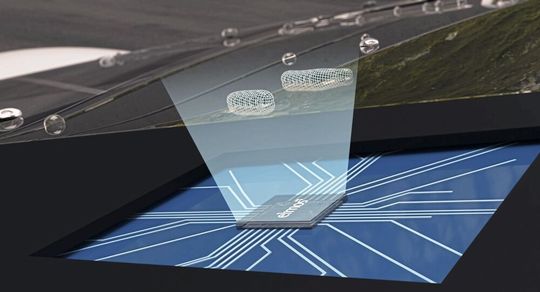
Area 21, together with Intellias, has achieved a remarkable development in light detection: the HALIOS principle of optical measurement technology. Benedikt Ehler explains: "HALIOS stands for High Ambient Light Independent Optical System—a measurement principle distinguished by its unique independence from ambient light." Unlike traditional systems that use absolute light values, HALIOS operates with a differential method, comparing two light sources and their reflections.
The process works as follows: The IC activates a light source, whose beam strikes the windshield at a defined angle. At the correct angle, total reflection occurs within the glass, causing the light to remain trapped. A connected photodiode measures the amount of reflected light. The coupling factor, i.e., the ratio of emitted to received light, determines the amount of reflected light and the corresponding photocurrent. HALIOS uses two light sources or optical paths. A difference is calculated by comparing their photocurrents: if there are no raindrops, the difference in the currents of both paths is nearly zero. When light escapes due to raindrops, a difference value is generated, triggering a rain signal.
What advantages does this measurement principle offer? Through the differential calculation, the system is extremely sensitive and reliably detects even the smallest changes. The high sensitivity allows the use of low LED currents, minimizing energy consumption. Additionally, the method is robust and resistant to changing light conditions: high ambient light does not affect the signal-to-noise ratio, as it impacts both light paths equally and does not produce a difference value. The sensor can therefore distinguish between raindrops and other light sources, such as a low-lying sun.
These properties make HALIOS a particularly efficient and reliable solution for the challenges of modern light and rain detection.
Cost-Effective Rain Sensors
The patented measurement technology from Area 21 and Intellias combines technical sophistication with cost efficiency. This is crucial for the highly competitive rain sensor market. Since the introduction of the first rain sensor by Peugeot in 1994, RLT sensors have also become common in small cars, putting cost considerations at the forefront. The market for rain sensors is extremely cost-driven. "Our highly integrated sensor module offers a solution to save costs. Customers not only reduce external components and thus part and assembly costs, but also gain space on the circuit board," says Benedikt Ehler.
Another cost advantage arises from the standardized concept of the E527.06, which leverages economies of scale. Despite the standardization, the modular software structure allows users to integrate their specific standards and requirements. This flexibility is crucial, as the RLT sensor signals can not only control windshield wipers and lighting systems but also adjust air conditioning based on the measured sunlight intensity.
This hardware-based technology from Elmos demonstrates that hardware continues to play a central role in an increasingly software-dominated world. The integrated development of hardware and software under one roof, as seen with Elmos and Area 21, represents a forward-looking concept that maximizes the chances of success with innovations in the cost-sensitive automotive market.
Thermal And Mechanical Design
The RLT sensor developed by Elmos stands out both technically and cost-wise for its robustness and practical suitability. Particularly regarding electromagnetic compatibility (EMC), the sensor offers significant advantages. It requires no extraordinary EMC measures and still meets all common automotive requirements within the typical frequency range.
The thermal design is also state-of-the-art. The sensor ensures reliable operation within the typical operating temperature ranges for automobiles. Mechanically, the compact housing impresses, allowing discreet integration into the vehicle, typically above the rearview mirror.
A particularly noteworthy feature of the E527.06 represents a significant advancement in RLT sensor technology. The software can perform a test run by simulating a raindrop on the sensor and verifying whether the entire signal chain functions without error. This test can, for instance, be carried out at each vehicle start. If any irregularities are detected, the driver is immediately notified.
This well-thought-out combination of thermal and mechanical design, coupled with innovative functionality, ensures a robust and practical sensor solution that meets the high demands of the automotive market.
Support in Software Development
What specific contributions did Intellias make in the development of the E527.06? Oleksandra Zubal explains: "We support Elmos and Area 21 in their development projects and processes. Our main focus was on bare-metal development, software development directly on the IC hardware, as well as generic processes such as bootloader development." This collaboration is contractually secured and also includes extensive testing tasks, which are carried out in Intellias' software lab in Portugal.
Benedikt Ehler describes the motivation for the cooperation from Area 21's perspective: "Our founding idea was to centralize and enhance the software activities of Elmos, as software constitutes an increasingly significant component of Elmos products. Especially in fully integrated vehicles, software becomes the decisive factor. As a young company, we needed a partner with extensive experience, which we found in Intellias."
Intellias employs around 1,000 specialists in its mobility division, which represents the largest but not the only business area of software development. The company emphasizes various sensor technologies. This diverse expertise supports the development of innovative solutions that are market-oriented and future-focused. (heh)



:quality(80)/p7i.vogel.de/wcms/51/1b/511b420dbcc296aec09e3bffb051b8a8/0133581587v1.jpeg "The cables connect numerous machine components—often in confined spaces. (Image:Helu)")
:quality(80)/p7i.vogel.de/wcms/b5/67/b5676f3bfb36251ed31f9a0cccf650b6/0133167827v1.jpeg "Thanks to JumboFlex Generation 2, employees can effortlessly move wheelchairs weighing as much as 40 kilograms. (Image:Lard)")
:quality(80)/p7i.vogel.de/wcms/5e/c6/5ec615b7a51440f668259f2af9158cb9/0132654694v1.jpeg "Strategic Partnerships in Industry: As buyers and restructuring partners, Chinese investors are increasingly helping to preserve jobs in Germany. (Image: ©Anatolii Rymarchuk - stock.adobe.com)")
:quality(80)/p7i.vogel.de/wcms/eb/2b/eb2bd1b8487afe577b37363cd02f16ff/0113143253v1.jpeg "In our China Market Insider, we regularly provide you with relevant information straight from China. (Image:© Eisenhans - stock.adobe.com)")
:quality(80)/p7i.vogel.de/wcms/c7/05/c70542511e0824ee491f7b55e21fa429/0133598424v1.jpeg "In logistics, AI is often implemented only on a case-by-case basis; data is stored in separate systems, and inventory levels, status values, and priorities are not defined consistently. (Image: ©m-project - stock.adobe.com)")
:quality(80)/p7i.vogel.de/wcms/3a/9c/3a9c1fd546e1f041b86bb1d03cf39101/0133610524v1.jpeg "The Mason W-01 combines industrial-grade humanoid hardware, Physical AI-based perception, and autonomous task planning. (Image:Nova X Robotics)")
:quality(80)/p7i.vogel.de/wcms/d0/74/d074ae5d5d705b841b63107b20f9d8c2/699711-xpeng-iron-01-79661c-original-1788864313v1.png "(Source: XPeng Motors (Germany) GmbH)")
:quality(80)/p7i.vogel.de/wcms/60/ef/60ef4f07e4829b2c2929befc0f353c58/0133511729v1.jpeg "Humanoid robots can match human performance in certain tasks. (Image:Gemini / AI-generated)")
:quality(80)/p7i.vogel.de/wcms/3d/ff/3dff5e51c24b30c8dc37c1d024887157/0133602931v1.jpeg "Just a few years ago, SpaceX specialists were working on the world’s largest rocket—the Starship. Now, Elon Musk’s company has reached a milestone during a test flight: Earth’s orbit! But there was also a downside... (Image: SpaceX)")
:quality(80)/p7i.vogel.de/wcms/55/06/5506709cc56afcc7301c9d3319e19114/2026-03-08-aerospike-09-980x551v1.jpeg "The engine was developed using Noyron, the computer-aided design model for the LEAP 71. Noyron uses fundamental physical principles, engineering logic, and manufacturing specifications to design independently, without human intervention. (Source: LEAP 71)")
:quality(80)/p7i.vogel.de/wcms/b6/1f/b61f4081bab96d308e87eebaeb756c4f/pm4526-1v1.jpeg "Call for Innovative Ideas: The 2027 Manus Award will once again recognize unique projects featuring lubrication-free polymer plain bearings. (Source: Igus SE & Co. KG)")
:quality(80)/p7i.vogel.de/wcms/c0/52/c052f405eb55fc3d08c4837e77206fc0/adobestock-2021845957--aucartstudio-stock-adobe-com-ki-generiertv1.jpeg "An innovation from China to combat extreme summer heat: A novel coating lowers temperatures. (Source: © AucArtStudio – stock.adobe.com_AI-generated)")
:quality(80)/p7i.vogel.de/wcms/78/ab/78abbfbab0565fabb19efe637aea30e8/nio-power-swap-station-4-china-guangzhou-2024-1400x933-jpgv1.webp "Nio and Geely are collaborating on battery replacement for electric cars. (Source: Nio)")
:quality(80)/p7i.vogel.de/wcms/2e/58/2e58c664e733dd182666606f850c5da4/0133400664v1.jpeg "The IM6 is sort of the crossover version of the IM5. (Image:MG Motor)")
:quality(80)/p7i.vogel.de/wcms/40/5f/405f41f4075e8798878011f0932a8195/0133509065v1.jpeg "Caruso has integrated Hyundai into its platform. (Image:Hyundai)")
:quality(80)/p7i.vogel.de/wcms/06/98/06989beb3f95b8fb06d71190c86cffde/tabletv1.jpeg "The cockpit view during a test drive in the simulator. (Source: Uccello et al., IEEE OJITS 2026)")
:quality(80)/p7i.vogel.de/wcms/f6/9f/f69f7aad844f2f2c369ee012505f3e37/0133630806v1.jpeg "Even though prices for DRAM and NAND memory remain high due to strong demand and limited capacity, the market appears to be showing the first signs of a slowing boom. Consequently, investors are becoming increasingly skeptical about how much longer the AI boom can sustain the ongoing upward trend in the memory market. (Image:Dall-E / AI-generated)")
:quality(80)/p7i.vogel.de/wcms/c0/e9/c0e91df681b13f3a8f37badeae0a32b3/0133619268v1.jpeg "AMD CEO Lisa Hsu (left) and World Labs founder Dr. Fei-Fei Li (right) at the signing of the letter of intent. AMD plans to acquire World Labs, a startup specializing in AI “world models,” for $8.2 billion. (Image:World Labs)")
:quality(80)/p7i.vogel.de/wcms/ed/b1/edb1335d07debd3de7ae5a2fb74b571a/0133546658v1.jpeg "Securing digital infrastructure is not just about technical risks, but increasingly also about origin, supply chains, and political requirements. (Image:Dall-E / AI-generated)")
:quality(80)/p7i.vogel.de/wcms/22/f0/22f07d1635c733a29049fff5b1b8ccc8/0133601916v1.jpeg "AI models from various providers have been causing quite a stir lately because they’ve done things they weren’t supposed to—or so they say! Now, in light of recent incidents, the company “OpenAI” has decided against releasing a new AI model... (Image: AI-generated)")
:fill(fff,0)/images.vogel.de/vogelonline/companyimg/76800/76895/65.jpg "FAULHABER_120mm.jpg ()")
:fill(fff,0)/p7i.vogel.de/companies/69/de/69de1b7403b0d/simtos-logo.jpeg "simtos-logo (SIMTOS)")


:quality(80):fill(efefef,0)/p7i.vogel.de/wcms/67/ad/67adf4a647532/elatec-wp-machine-authentication.png "Elatec WP Machine Authentication")
:quality(80)/p7i.vogel.de/wcms/da/e3/dae345342629f75d623ff89cf9d0abf9/0129004948v1.jpeg "Toshiba and Mikroe have presented a motor control unit that simplifies prototype construction in the automotive sector. (Image:Toshiba)")
:quality(80)/p7i.vogel.de/wcms/8d/f0/8df02ef9301116199dd602a1b3ffa976/0133198864v1.jpeg "Open System Protocol: The concept of a vehicle interior with distributed, dynamic RGB lighting. (Image:AMS Osram)")