Chinese people love Chinese technology. This summarizes the current smartphone sales figures. While the iPhone 16 is being sold with a discount, Huawei is struggling to keep up with the production of its foldable flagship, the Mate XT.
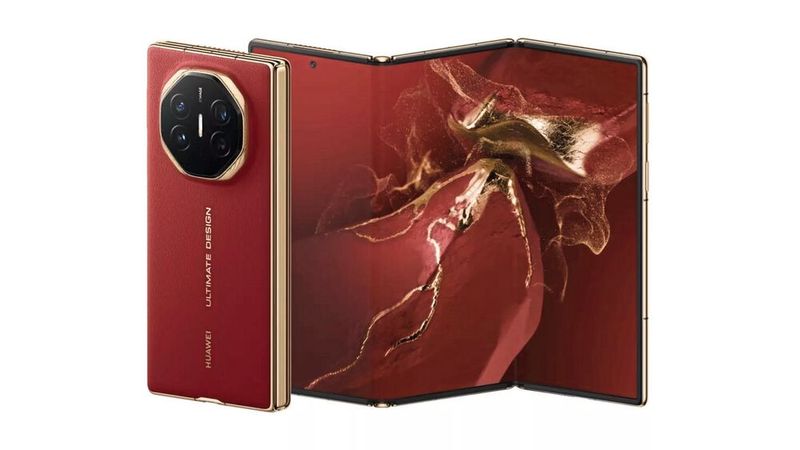
The triple-foldable smartphone Mate XT from Huawei is outselling Apple's current iPhone 16 on the Chinese market.
(Image: Huawei)
Huawei's double-foldable smartphone, the "Huawei Mate XT," has overshadowed the new iPhone in its debut. This innovative device is the first from a major manufacturer that unfolds from both the right and left sides, creating a standout feature in the competitive smartphone market. In China, the phone experienced immediate demand, selling out shortly after its launch, while the iPhone 16 faced a more subdued reception, even being offered at discounted prices. This highlights Huawei's rising prominence in the foldable smartphone sector, challenging the dominance of more established brands like Apple.
The two new flagship models from Apple and Huawei were released a few days ago simultaneously. However, while the iPhone 16 by Apple was already being sold by Chinese retailers with discounts in the days prior, enthusiastic customers offered multiple times the official price for Huawei's Mate XT with its three-part display, eager to get their hands on the new model as soon as possible.
Huawei smartphone quickly sold out
E-commerce platforms in the People's Republic of China had "offered discounts of up to 11 percent on Apple’s latest smartphone," reported the South China Morning Post. Huawei "stole the show from Apple in the market this time," wrote the newspaper from Hong Kong. "As soon as the Huawei Mate XT hit the market it was instantly sold out," reported the state Chinese radio station CNR. More than six million customers had already pre-ordered it when it went on presale on September 7, according to the radio station.
Huawei continues its impressive comeback as a smartphone manufacturer, which began last August with its "Mate 60 Pro" model. It was equipped with its own Kirin 9000 series chip developed by the Chinese technology company, which enables 5G connectivity.
This launch had already caused quite a stir among market observers worldwide because Huawei's smartphone business had previously suffered from chip boycotts from the USA. Washington prohibits the sale of high-performance semiconductors made in the US to Huawei.
Huawei is successful without US semiconductors
Two years ago, Huawei founder Ren Zhengfei reportedly spoke in internal meetings about his company being in "survival" mode. This phase is now definitively over. Instead, Huawei has rapidly evolved into a formidable competitor to Apple in the consumer smartphone market, entirely without semiconductors "Made in USA."
The new foldable Huawei Mate XT looks at first glance like a standard smartphone. However, it can be unfolded from both the left and right sides, expanding to a screen size of 25.9 centimeters (10.2 inches), comparable to the latest iPad model from Apple (10.9 inches), while being only 3.6 millimeters thick. Chinese Huawei fans queued up outside the manufacturer's stores in China on the day of the official sales launch. Such scenes had previously only occurred in front of Apple Stores in China a few years ago.
Prices over 3,000 euros/3,300 USD for Huawei smartphones
The new smartphone sold very well immediately, even though Huawei had positioned it with hefty prices clearly in the upper market segment. Chinese buyers are particularly receptive to new, innovative designs, wrote several analysts. In this competition, the current iPhone clearly lost to the new Mate this time, according to direct comparisons.
The 16 GB + 256 GB version of the Huawei Mate XT costs 19,999 Yuan (around 2,540 Euros/2,800 USD), the 512 GB version costs 21,999 Yuan (around 2,790 Euros/3,077 USD), and finally, the 16 GB + 1 TB RAM version sells for 23,999 Yuan (around 3,050 Euros/3,364 USD). This is a proud price in China, where a smartphone typically costs about 2,000 Yuan (just over 250 Euros/276 USD).
All expectations were exceeded
Despite this, the sales "exceeded expectations," CNR radio quoted Yu Chengdong, a top manager at Huawei, as saying. The company will now "go all out and work overtime to expand production capacity." The novel foldable screen may not immediately convince all mobile phone users, regardless of the phone's price. Only about 3.6 percent of all smartphones sold in China in the first half of this year featured a foldable screen, after several smaller manufacturers had experimented with foldable designs, according to figures from the market research institute CINNO Research.
Yet, the 4.98 million units with foldable screens sold in China from January to July 2024 already represented a growth of 121 percent compared to the same period the previous year. And Huawei has now sold as many smartphones with "accordion screens" within a few days as all other manufacturers combined in the first half of 2024.
Date: 08.12.2025
Naturally, we always handle your personal data responsibly. Any personal data we receive from you is processed in accordance with applicable data protection legislation. For detailed information please see our privacy policy.
Consent to the use of data for promotional purposes
I hereby consent to Vogel Communications Group GmbH & Co. KG, Max-Planck-Str. 7-9, 97082 Würzburg including any affiliated companies according to §§ 15 et seq. AktG (hereafter: Vogel Communications Group) using my e-mail address to send editorial newsletters. A list of all affiliated companies can be found here
Newsletter content may include all products and services of any companies mentioned above, including for example specialist journals and books, events and fairs as well as event-related products and services, print and digital media offers and services such as additional (editorial) newsletters, raffles, lead campaigns, market research both online and offline, specialist webportals and e-learning offers. In case my personal telephone number has also been collected, it may be used for offers of aforementioned products, for services of the companies mentioned above, and market research purposes.
Additionally, my consent also includes the processing of my email address and telephone number for data matching for marketing purposes with select advertising partners such as LinkedIn, Google, and Meta. For this, Vogel Communications Group may transmit said data in hashed form to the advertising partners who then use said data to determine whether I am also a member of the mentioned advertising partner portals. Vogel Communications Group uses this feature for the purposes of re-targeting (up-selling, cross-selling, and customer loyalty), generating so-called look-alike audiences for acquisition of new customers, and as basis for exclusion for on-going advertising campaigns. Further information can be found in section “data matching for marketing purposes”.
In case I access protected data on Internet portals of Vogel Communications Group including any affiliated companies according to §§ 15 et seq. AktG, I need to provide further data in order to register for the access to such content. In return for this free access to editorial content, my data may be used in accordance with this consent for the purposes stated here. This does not apply to data matching for marketing purposes.
Right of revocation
I understand that I can revoke my consent at will. My revocation does not change the lawfulness of data processing that was conducted based on my consent leading up to my revocation. One option to declare my revocation is to use the contact form found at https://contact.vogel.de. In case I no longer wish to receive certain newsletters, I have subscribed to, I can also click on the unsubscribe link included at the end of a newsletter. Further information regarding my right of revocation and the implementation of it as well as the consequences of my revocation can be found in the data protection declaration, section editorial newsletter.
Chinese buy Chinese technology
By 2028, IDC predicts that the market for foldable phones in China will grow from the current ten million to more than 17 million units. Even though the sales volumes of these so-called foldables do not yet match those of traditional smartphones, such growth rates are music to the ears of investors in the stock market. This momentum now works in favor of Huawei, while Apple's stock price has dropped following its latest iPhone launch. Contributing factors include not only the lack of truly groundbreaking new features in the new iPhone 16 but also the observed decline in sales of Apple smartphones in China for months, one of its most important foreign markets. This shift represents a significant environment change in the competitive dynamics between the two technology giants.
In the most recent quarterly comparisons, Apple has fallen out of the top 5 smartphone manufacturers by sales in China for the first time. The California-based company is now ranked sixth, while all five top spots are currently held by Chinese manufacturers, according to IDC statistics. The companies occupying these positions are Vivo, Huawei, Oppo, Honor, and Xiaomi, in that order. This shift highlights the growing dominance of local brands in the Chinese market and reflects changing consumer preferences and the competitive landscape in one of the world's largest markets for smartphones.
The growing national pride in China certainly plays a role, especially since the United States targeted China and specifically Huawei with semiconductor boycotts. Increasingly, well-off Chinese citizens are swapping their iPhones for Huawei smartphones as a demonstration of their patriotic sentiment. However, that is only part of the story. Huawei is now also "leading in terms of foldable technology," Fortune magazine quoted IDC analyst Will Wong as saying. Many observers believe that Chinese companies are currently more innovative than Apple. "Brands like Xiaomi, Huawei, and Honor are devouring Apple's market share in China," Fortune magazine also reports.
*Henrik Bork, long-time China correspondent for German 'Süddeutsche Zeitung' and 'Frankfurter Rundschau', is the Managing Director at Asia Waypoint, a consulting agency specializing in China, based in Beijing.



:quality(80)/p7i.vogel.de/wcms/dd/08/dd086510d9ae7b50181f6070e4463b44/0129363730v1.jpeg "Typical application for ionizing devices: Wrapping films. (Picture: ©Adobe Stock/SMC)")
:quality(80)/p7i.vogel.de/wcms/35/57/3557c819943c53acec41a0ccba87da4f/0130049064v1.jpeg "Researchers at the Fraunhofer IWU in Chemnitz have long known that many typical sheet metal parts can be manufactured more cost-effectively using hollow embossing rollers. Now there is news to report ... (Image:Fraunhofer IWU)")
:quality(80)/p7i.vogel.de/wcms/59/02/590246e3b3f415c65edbee377c14ca77/26-06-pi-fraunhofer-iws-41450-direktplattieren-pic-01-7771x4369v1v1.jpeg "The Fraunhofer IWS has developed the new \"direct laser cladding\" process, which creates a functional layer directly on the base body by applying a strip-shaped metal to rotationally symmetrical components in a spiral and bonding it locally by laser. (Image:Christoph Wilsnack/Fraunhofer IWS)")
:quality(80)/p7i.vogel.de/wcms/73/60/73608418789b1d9c393f5e2fa974eda2/0130209906v1.jpeg "The robots of the X6 generation from b+m enable very high painting quality and are also particularly compact and easy to maintain. (Image:Beckhoff)")
:quality(80)/p7i.vogel.de/wcms/78/e9/78e9188c25a8a94e67c34c9bf8ffe495/visual-agile-20robots-20and-20google-20deepmind-20partner-20to-20bring-20intelligence-20to-20robotics-2500x1406v1v1.jpeg "Together, the partners are developing adaptable, intelligent robots for a wide range of applications (Image:Agile Robots SE)")
:quality(80)/p7i.vogel.de/wcms/e7/66/e7669ecf0260ae8fc54c214e34e4902a/0130316817v1.jpeg "Siemens and Palo Alto Networks offer tested cybersecurity solution for industrial 5G. (Image:Siemens)")
:quality(80)/p7i.vogel.de/wcms/9f/55/9f55324832c4f426958031375124d9de/siemens-20ubtech-20hmnd-1920x1079v1v1.png "Ready for the factory floor: While Ubtech is planning mass production, Siemens is already testing humanoids in real factory applications in Erlangen. (Image:Siemens)")
:quality(80)/p7i.vogel.de/wcms/11/36/113695ed260e29c8c2d9d39dc5f9d869/0130213768v1.jpeg "AI can work cheaply in China and deliver the results rapidly all over the world. (Image:Dall-E / AI-generated)")
:quality(80)/p7i.vogel.de/wcms/62/5f/625f41e87ebfef156a98c8e6393e32fd/0130211654v1.jpeg "Axial flux motors have some advantages over radial flux motor—but their production is currently still expensive. (Image:RWTH Aachen University)")
:quality(80)/p7i.vogel.de/wcms/77/9b/779b0685d010dfe45c9c2cb1cfecd467/0128886425v1.jpeg "The BlueEye is the first \"real\" hyperspectral camera for the UV range and covers the wavelength range from 220 to 380nm. (Image:Inno-spec GmbH)")
:quality(80)/p7i.vogel.de/wcms/e4/51/e451d52ce0182fb0aaa46a5774f832ef/26-04-pi-fraunhofer-iws-21160-bioslide-pic-01-4128x2321v1v1.jpeg "With the BioSlide research project, the Fraunhofer IWS is investigating how sliding systems can be designed to be more sustainable and energy-efficient. New materials can be tested in a particularly application-oriented manner on this plain bearing test stand. (Image:Fraunhofer IWS)")
![Thanks to advanced 3D printing technology, a more efficient use of resources should contribute to lower-emission aviation—this is the goal of ['skai]-lab. (Image:Oleksandr Pashchenko - stock.adobe.com / AI-generated)](https://cdn1.vogel.de/nghHNSbySccfOjG3n1qCA-FVOjQ=/288x162/smart/filters:format(jpg):quality(80)/p7i.vogel.de/wcms/62/64/626424c97a16e69f871bf216c9629c2a/adobestock-1927043193--c2-a9-20oleksandr-20pashchenko-20-e2-80-93-20stock-adobe-com-ki-generiertv1v1.jpeg "Thanks to advanced 3D printing technology, a more efficient use of resources should contribute to lower-emission aviation—this is the goal of ['skai]-lab. (Image:Oleksandr Pashchenko - stock.adobe.com / AI-generated)")
:quality(80)/p7i.vogel.de/wcms/c3/c4/c3c4ce270b083eeac55654148611f064/0130237945v1.jpeg "China is not giving up on hydrogen, but is intensifying its efforts. (Image:freely licensed from Pixabay)")
:quality(80)/p7i.vogel.de/wcms/4e/c0/4ec0bd19390b169edfa23677373dcdf1/0130260089v1.jpeg "Renewable fuels can supply European road traffic, according to a study. (Image:Aral)")
:quality(80)/p7i.vogel.de/wcms/6f/c9/6fc9050301d745cad25585c6780f8f51/0130197341v1.jpeg "Production facilities are a worthwhile target and are therefore at risk. (Image:ABB Robotics)")
:quality(80)/p7i.vogel.de/wcms/b6/62/b662adc2cec8227d8172509bbfb6ee42/25c0207-107-4961x2789v1v1.jpeg "The GLB is the second model based on Mercedes' new MMA platform. Apparently, Geely's platform is better and cheaper, which is why the two companies are negotiating a partnership. (Image:Mercedes-Benz)")
:quality(80)/p7i.vogel.de/wcms/4d/dd/4dddf438e91f394c04a095dbfd109d1c/0130236430v1.jpeg "Measurement modules: The 720301 module in combination with the SL2000 enables RMS and power calculations, among other things. (Image:Yokogawa)")
:quality(80)/p7i.vogel.de/wcms/61/fc/61fcf95f5cca15494ad18343901ae585/0130317237v1.jpeg "With the AGI CPU, Arm says it is taking a \"historic step\": With the processor aimed at AI in data centers, the company is presenting itself for the first time as a provider of its own chips, not just as a pure IP licensor. (Image:Arm)")
:quality(80)/p7i.vogel.de/wcms/82/90/8290dfe3595b6c6b33726ae8b76172c7/0130319587v1.jpeg "The concept image illustrates how the pattern of tiny protrusions and depressions created on the substrate (MgO, bottom) controls the arrangement of atoms in the superconducting material (YBCO, top). At the interface between the two layers, an electronic structure enables superconductivity to occur at higher temperatures than previously possible. (Image:Chalmers University of Technology / Riccardo Arpaia)")
:fill(fff,0)/p7i.vogel.de/companies/67/eb/67eba621ef6ea/logo2.png "logo2 (Wuxi InfiMotion)")
:quality(80)/p7i.vogel.de/wcms/f1/71/f1713ff3513abe87e2c1783e23160fd6/0128423171v1.jpeg "Nubia smartphones come from ZTE's premium brand Nubia Technology and are particularly known for their powerful camera features, gaming models like the \"RedMagic\" series, and good value for money in the upper mid-range and high-end segment. (Image:ZTE)")
:quality(80)/p7i.vogel.de/wcms/de/f7/def7fe592db7bbd4a8baf67f7c59bb1f/0124168597v1.jpeg "The Chinese automaker GAC is bringing its electric brand Aion to Europe. (Image:GAC)")