As hard as steel yet as flexible as rubber: Scientists in China report a new alloy that combines these properties, potentially enabling future technologies.
A new nickel-titanium alloy from China could enable aircraft wings that change and adapt their shape during flight.
(Image: AI-generated)
Chinese researchers have developed an "exotic" material that combines the hardness of steel with the flexibility of plastics. This is reported by a team of material scientists from Xi'an in a paper published in the online edition of the science magazine "Nature." In their otherwise dryly written article, brimming with figures, they themselves use the word "exotic." This is likely due to the fact that the novel metal alloy, because of its properties, is envisaged for a range of applications that extend from deformable airplane wings and super-hard robot muscles to entirely new types of prostheses. This breakthrough represents a significant advancement in materials science, potentially leading to revolutionary changes in various industries by combining previously mutually exclusive properties of strength and flexibility.
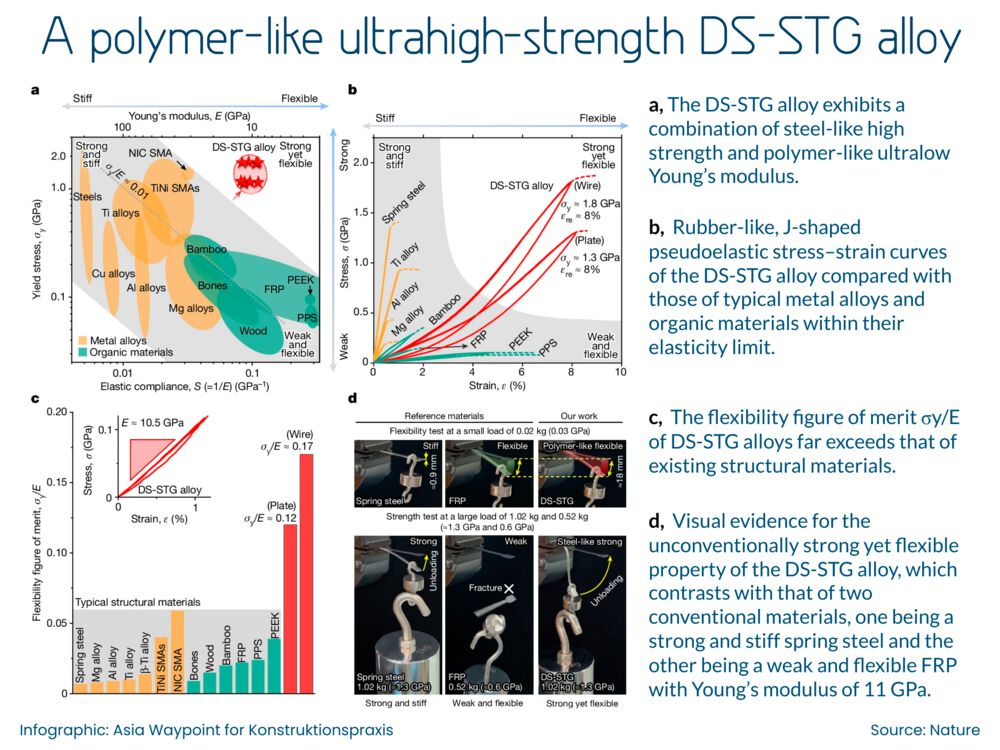
Here we report on a Ti-50.8 at.% Ni strain-glass alloy, which exhibits a combination of an ultra-high yield strength of σy ≈ 1.8 GPa and an ultra-low modulus of elasticity of E ≈ 10.5 GPa, coupled with a super-large elastic strain of about eight percent.
from the essay “A polymer-like metal alloy of ultra-high strength”
Nickel-titanium alloy combines hardness and flexibility
The material is a nickel-titanium alloy consisting precisely of 50.8 percent nickel and 49.2 percent titanium, which is then "kneaded" through a three-stage thermomechanical process. The material properties resulting from the individual steps are detailed by the researchers in Nature, and you can read more about their findings and the potential applications of this "polymer-like ultrahigh-strength behavior" material by following this link: Nature Article.
Morphing conceivable
If this new material can indeed be produced relatively easily in large quantities, as the scientists claim after their initial experiments, it would render a long-standing maxim of materials science obsolete: that the hardness of steel is incompatible with the flexibility and repeated deformability of plastics or rubber.
"The emergence of this new type of metal material, which is as strong as ultra-strong steel yet as flexible as polymer materials, could bring a whole spectrum of future technologies from distant science fiction into reality," quoted the Chinese science newspaper Keji Ribao, citing a researcher from Xian named Xu Zhizhi.
The new alloy and its properties.
(Image:Asia Waypoint)
Although it is still a long journey from the invention of this alloy to its industrial applications, Chinese science magazines are already eagerly debating potential examples of these "science fiction" technologies. One concept being discussed is the construction of futuristic airplane wings that can change shape during flight ("morphing") to enhance aerodynamics or efficiency under different conditions. Such wings would also be highly sought after in space applications. This kind of adaptive technology could revolutionize aviation and space travel, offering new levels of performance and fuel efficiency.
Initial promising tests have been conducted
Indeed, both NASA and manufacturers like Airbus have long been researching wings that can change shape, according to media reports. However, designers require a flexible material that can be transformed into a new shape without using excessive driving energy while maintaining its structural rigidity. Additionally, the process must be repeatable under extreme conditions without leading to material fatigue. The development of materials like the mentioned nickel-titanium alloy could potentially meet these requirements by offering exceptional flexibility and durability, thus advancing the feasibility of morphing wings for aircraft and spacecraft. This innovation could significantly impact the efficiency and functionality of future aerospace designs.
The researchers from Jiaotong University in Xi'an, in the northwest of the People's Republic of China, assert that their new alloy meets precisely these requirements. According to the science portal Zhongguo Keji Xinwen, the material retains its "strong yet flexible" properties within a temperature range from minus 80 to plus 80 degrees Celsius. Furthermore, in initial experiments, even after five million bending tests, the alloy exhibited "no signs of fatigue fractures." This performance highlights the material's potential for applications in environments that require high durability and repeated deformations, such as aerospace engineering, where materials must withstand varied and extreme conditions without failure.
What else is possible
"Imagine this: You are watching a risky rescue operation. A slender, snake-like robot effortlessly winds its way through the twisted remains of a collapsed building. Its muscles, made from this new alloy, are strong enough to lift heavy debris yet flexible enough to squeeze through tight spaces," writes "The China Academy" portal. This scenario illustrates the potential revolutionary applications of the nickel-titanium alloy in robotics, particularly in search and rescue missions where maneuverability and strength are crucial. The alloy's unique properties could significantly enhance the capabilities of robots used in emergency response, making them invaluable tools in disaster recovery and saving lives.
Date: 08.12.2025
Naturally, we always handle your personal data responsibly. Any personal data we receive from you is processed in accordance with applicable data protection legislation. For detailed information please see our privacy policy.
Consent to the use of data for promotional purposes
I hereby consent to Vogel Communications Group GmbH & Co. KG, Max-Planck-Str. 7-9, 97082 Würzburg including any affiliated companies according to §§ 15 et seq. AktG (hereafter: Vogel Communications Group) using my e-mail address to send editorial newsletters. A list of all affiliated companies can be found here
Newsletter content may include all products and services of any companies mentioned above, including for example specialist journals and books, events and fairs as well as event-related products and services, print and digital media offers and services such as additional (editorial) newsletters, raffles, lead campaigns, market research both online and offline, specialist webportals and e-learning offers. In case my personal telephone number has also been collected, it may be used for offers of aforementioned products, for services of the companies mentioned above, and market research purposes.
Additionally, my consent also includes the processing of my email address and telephone number for data matching for marketing purposes with select advertising partners such as LinkedIn, Google, and Meta. For this, Vogel Communications Group may transmit said data in hashed form to the advertising partners who then use said data to determine whether I am also a member of the mentioned advertising partner portals. Vogel Communications Group uses this feature for the purposes of re-targeting (up-selling, cross-selling, and customer loyalty), generating so-called look-alike audiences for acquisition of new customers, and as basis for exclusion for on-going advertising campaigns. Further information can be found in section “data matching for marketing purposes”.
In case I access protected data on Internet portals of Vogel Communications Group including any affiliated companies according to §§ 15 et seq. AktG, I need to provide further data in order to register for the access to such content. In return for this free access to editorial content, my data may be used in accordance with this consent for the purposes stated here. This does not apply to data matching for marketing purposes.
Right of revocation
I understand that I can revoke my consent at will. My revocation does not change the lawfulness of data processing that was conducted based on my consent leading up to my revocation. One option to declare my revocation is to use the contact form found at https://contact.vogel.de. In case I no longer wish to receive certain newsletters, I have subscribed to, I can also click on the unsubscribe link included at the end of a newsletter. Further information regarding my right of revocation and the implementation of it as well as the consequences of my revocation can be found in the data protection declaration, section editorial newsletter.
"Next-generation prosthetics" or innovative suits for astronauts that offer a new dimension of protection and mobility during spacewalks have also become conceivable with this new material, according to Chinese technical media.
*Henrik Bork, long-time China correspondent for the German 'Süddeutsche Zeitung' and the 'Frankfurter Rundschau', is the Managing Director at Asia Waypoint, a consulting agency specializing in China, based in Beijing. "China Market Insider" is a project of the Vogel Communications Group



:quality(80)/p7i.vogel.de/wcms/dd/08/dd086510d9ae7b50181f6070e4463b44/0129363730v1.jpeg "Typical application for ionizing devices: Wrapping films. (Picture: ©Adobe Stock/SMC)")
:quality(80)/p7i.vogel.de/wcms/35/57/3557c819943c53acec41a0ccba87da4f/0130049064v1.jpeg "Researchers at the Fraunhofer IWU in Chemnitz have long known that many typical sheet metal parts can be manufactured more cost-effectively using hollow embossing rollers. Now there is news to report ... (Image:Fraunhofer IWU)")
:quality(80)/p7i.vogel.de/wcms/59/02/590246e3b3f415c65edbee377c14ca77/26-06-pi-fraunhofer-iws-41450-direktplattieren-pic-01-7771x4369v1v1.jpeg "The Fraunhofer IWS has developed the new \"direct laser cladding\" process, which creates a functional layer directly on the base body by applying a strip-shaped metal to rotationally symmetrical components in a spiral and bonding it locally by laser. (Image:Christoph Wilsnack/Fraunhofer IWS)")
:quality(80)/p7i.vogel.de/wcms/73/60/73608418789b1d9c393f5e2fa974eda2/0130209906v1.jpeg "The robots of the X6 generation from b+m enable very high painting quality and are also particularly compact and easy to maintain. (Image:Beckhoff)")
:quality(80)/p7i.vogel.de/wcms/78/e9/78e9188c25a8a94e67c34c9bf8ffe495/visual-agile-20robots-20and-20google-20deepmind-20partner-20to-20bring-20intelligence-20to-20robotics-2500x1406v1v1.jpeg "Together, the partners are developing adaptable, intelligent robots for a wide range of applications (Image:Agile Robots SE)")
:quality(80)/p7i.vogel.de/wcms/e7/66/e7669ecf0260ae8fc54c214e34e4902a/0130316817v1.jpeg "Siemens and Palo Alto Networks offer tested cybersecurity solution for industrial 5G. (Image:Siemens)")
:quality(80)/p7i.vogel.de/wcms/9f/55/9f55324832c4f426958031375124d9de/siemens-20ubtech-20hmnd-1920x1079v1v1.png "Ready for the factory floor: While Ubtech is planning mass production, Siemens is already testing humanoids in real factory applications in Erlangen. (Image:Siemens)")
:quality(80)/p7i.vogel.de/wcms/11/36/113695ed260e29c8c2d9d39dc5f9d869/0130213768v1.jpeg "AI can work cheaply in China and deliver the results rapidly all over the world. (Image:Dall-E / AI-generated)")
:quality(80)/p7i.vogel.de/wcms/62/5f/625f41e87ebfef156a98c8e6393e32fd/0130211654v1.jpeg "Axial flux motors have some advantages over radial flux motor—but their production is currently still expensive. (Image:RWTH Aachen University)")
:quality(80)/p7i.vogel.de/wcms/77/9b/779b0685d010dfe45c9c2cb1cfecd467/0128886425v1.jpeg "The BlueEye is the first \"real\" hyperspectral camera for the UV range and covers the wavelength range from 220 to 380nm. (Image:Inno-spec GmbH)")
:quality(80)/p7i.vogel.de/wcms/e4/51/e451d52ce0182fb0aaa46a5774f832ef/26-04-pi-fraunhofer-iws-21160-bioslide-pic-01-4128x2321v1v1.jpeg "With the BioSlide research project, the Fraunhofer IWS is investigating how sliding systems can be designed to be more sustainable and energy-efficient. New materials can be tested in a particularly application-oriented manner on this plain bearing test stand. (Image:Fraunhofer IWS)")
![Thanks to advanced 3D printing technology, a more efficient use of resources should contribute to lower-emission aviation—this is the goal of ['skai]-lab. (Image:Oleksandr Pashchenko - stock.adobe.com / AI-generated)](https://cdn1.vogel.de/nghHNSbySccfOjG3n1qCA-FVOjQ=/288x162/smart/filters:format(jpg):quality(80)/p7i.vogel.de/wcms/62/64/626424c97a16e69f871bf216c9629c2a/adobestock-1927043193--c2-a9-20oleksandr-20pashchenko-20-e2-80-93-20stock-adobe-com-ki-generiertv1v1.jpeg "Thanks to advanced 3D printing technology, a more efficient use of resources should contribute to lower-emission aviation—this is the goal of ['skai]-lab. (Image:Oleksandr Pashchenko - stock.adobe.com / AI-generated)")
:quality(80)/p7i.vogel.de/wcms/c3/c4/c3c4ce270b083eeac55654148611f064/0130237945v1.jpeg "China is not giving up on hydrogen, but is intensifying its efforts. (Image:freely licensed from Pixabay)")
:quality(80)/p7i.vogel.de/wcms/4e/c0/4ec0bd19390b169edfa23677373dcdf1/0130260089v1.jpeg "Renewable fuels can supply European road traffic, according to a study. (Image:Aral)")
:quality(80)/p7i.vogel.de/wcms/6f/c9/6fc9050301d745cad25585c6780f8f51/0130197341v1.jpeg "Production facilities are a worthwhile target and are therefore at risk. (Image:ABB Robotics)")
:quality(80)/p7i.vogel.de/wcms/b6/62/b662adc2cec8227d8172509bbfb6ee42/25c0207-107-4961x2789v1v1.jpeg "The GLB is the second model based on Mercedes' new MMA platform. Apparently, Geely's platform is better and cheaper, which is why the two companies are negotiating a partnership. (Image:Mercedes-Benz)")
:quality(80)/p7i.vogel.de/wcms/4d/dd/4dddf438e91f394c04a095dbfd109d1c/0130236430v1.jpeg "Measurement modules: The 720301 module in combination with the SL2000 enables RMS and power calculations, among other things. (Image:Yokogawa)")
:quality(80)/p7i.vogel.de/wcms/61/fc/61fcf95f5cca15494ad18343901ae585/0130317237v1.jpeg "With the AGI CPU, Arm says it is taking a \"historic step\": With the processor aimed at AI in data centers, the company is presenting itself for the first time as a provider of its own chips, not just as a pure IP licensor. (Image:Arm)")
:quality(80)/p7i.vogel.de/wcms/82/90/8290dfe3595b6c6b33726ae8b76172c7/0130319587v1.jpeg "The concept image illustrates how the pattern of tiny protrusions and depressions created on the substrate (MgO, bottom) controls the arrangement of atoms in the superconducting material (YBCO, top). At the interface between the two layers, an electronic structure enables superconductivity to occur at higher temperatures than previously possible. (Image:Chalmers University of Technology / Riccardo Arpaia)")
:fill(fff,0)/p7i.vogel.de/companies/67/eb/67eba621ef6ea/logo2.png "logo2 (Wuxi InfiMotion)")
:quality(80)/p7i.vogel.de/wcms/32/99/3299b7c4a33725dee4d85a34b48a4a95/0126221749v1.jpeg "Most fusion facilities on Earth are of the Tokamak type, including the experimental reactor BEST in Hefei. (Image: ©abufahim - stock.adobe.com / AI-generated)")
:quality(80)/p7i.vogel.de/wcms/97/76/9776cde9daa4ca32cfe1e299ac489169/0124806996v1-711x400v1.jpeg "The \"Transformers\" are here: Researchers in China are currently developing transforming robots. Among other things, the team has built a nine-centimeter prototype of a sports car that can transform into a car with wings and a transporter.
(Image: © vectorpocket - stock.adobe.com)")