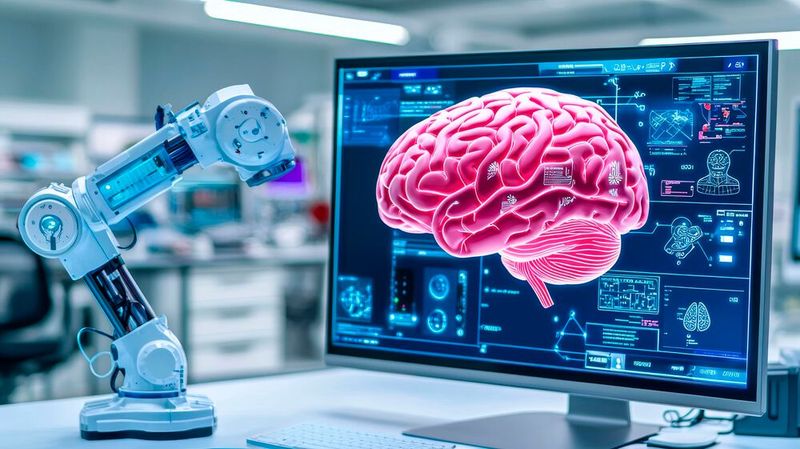
CyberSense is a highly specialized "implanting robot" developed at the Institute of Automation of the Chinese Academy of Sciences (CAS). Its performance goes far beyond that of a conventional surgical aid.
A robot that can accurately implant electrodes in the micrometer range into tissue is very likely the only realistic way forward for the medical technology "Brain-Computer Interface".
Henrik Bork, a longtime China correspondent for the Süddeutsche Zeitung and the Frankfurter Rundschau, is Managing Director at Asia Waypoint, a consulting agency specializing in China, based in Beijing.
The device is reminiscent of a sewing machine threading through a piece of fabric. However, what moves here is finer than any textile. It is a microscopically thin wire, soft and flexible, barely visible to the naked eye. And what is being pierced is not fabric, but the brain of a test animal.
A robot named "CyberSense" controls the process. It was developed at the Institute of Automation of the Chinese Academy of Sciences (CAS), as reported by the Chinese news agency Xinhua.
CyberSense is more than just an ordinary surgical aid. It is a highly specialized "implanting robot," designed for a task that could not previously be reliably accomplished either by human hands or with technical aids.
Comparable to R1 Robot by Elon Musk's Company Neuralink
CyberSense is thus comparable to the "R1 Robot," developed by Elon Musk's company Neuralink for implanting its still experimental, coin-sized "N1 Implant."
This "Brain-Computer Interface" or BCI has already been implanted in initial test subjects with spinal cord injuries and will now also be tested on ALS patients. An initial trial report was published earlier this year in the scientific journal "Nature Medicine."
In China, they are not quite that advanced yet, but CyberSense has already been tested in initial animal experiments on the brains of "rodents and non-human primates" and has achieved initial good results, as the Chinese research director at CAS noted to Xinhua.
Implant Microelectrodes to the Millimeter in the Cerebral Cortex
The millimeter-precise implantation of flexible microelectrodes into the cerebral cortex of laboratory animals is already working in Beijing. Just like with Elon Musk's Neuralink, this allows for some hope for the future that one day the paralyzed could walk again and the blind could see again—at least those with certain types of nerve damage. However, it will still take quite some time until neurosurgery overcomes all other hurdles, regardless of the country.
Under the guidance of intelligent sensors, the robot achieves three-dimensional precision in the micrometer range to implant filaments that are several tens of micrometers thick and 100 micrometers (0.004 inches)wide, actively avoiding blood vessels in the process.
Yu Shan, CAS
Only One-Tenth as Thick as a Human Hair
The technical advancement achieved by the CAS team here is nevertheless remarkable. These implantable electrodes are only about one-tenth as thick as a human hair and much softer. Their flexibility significantly reduces the risk of tissue damage and rejection reactions.
However, the same properties make them extremely difficult to handle. A robot that can accurately implant them into tissue is very likely the only realistic way forward for this medical technology.
"Under the guidance of intelligent sensors, the robot achieves three-dimensional precision in the micrometer range to implant filaments that are several tens of micrometers thick and 100 micrometers (0.004 inches) wide, actively avoiding blood vessels in the process," says Yu Shan, who works at CAS as the director of the "Laboratory for Brain Mapping and Artificial Intelligence at the Academy."
Relay Neural Signals from the Brain to Microchips
According to its developers, the new technology is thus very precise and consequently relatively gentle. CyberSense allows for the targeted implantation of electrodes "with minimal trauma," it is said.
The robot recognizes vessels in real time and automatically avoids them, they say. Once implanted, the flexible microwires then relay neural signals from the brain to microchips. These decode brain activity and can either control devices or send electrical impulses to specific brain areas for therapeutic stimulation.
Enable Implantations With Minimal Safety Risk
"This machine can implant flexible electrodes, still approximately as thick as a hair, precisely into the brain of test animals, providing crucial support for brain-computer interfaces and brain research," the Chinese science newspaper Keji Ribao summarizes the characteristics of CyberSense.
"How to capture large amounts of high-quality neural signals while minimizing the safety risks associated with implantation is one of the main challenges of this technology," said CAS researcher Qin Fangbo to the Chinese newspaper Yangzi Wanbao.
The Chinese implanting robot reportedly supports various electrode formats, which come from the semiconductor institute of the same academy and a startup named "We-Linking," among others.
The new electrodes could not only decode movement signals or thought patterns but theoretically also generate speech or restore lost sensory perceptions.
scientist, CAS
Interdisciplinary Research Essential
CyberSense is the result of targeted interdisciplinary research. Experts from the fields of robotics, semiconductor technology, neurosurgery, materials science, and artificial intelligence have contributed.
Of course, the Chinese researchers are already thinking beyond animal experiments. The new electrodes could not only decode movement signals or thought patterns but theoretically also generate speech or restore lost sensory perceptions, they say in interviews.
Date: 08.12.2025
Naturally, we always handle your personal data responsibly. Any personal data we receive from you is processed in accordance with applicable data protection legislation. For detailed information please see our privacy policy.
Consent to the use of data for promotional purposes
I hereby consent to Vogel Communications Group GmbH & Co. KG, Max-Planck-Str. 7-9, 97082 Würzburg including any affiliated companies according to §§ 15 et seq. AktG (hereafter: Vogel Communications Group) using my e-mail address to send editorial newsletters. A list of all affiliated companies can be found here
Newsletter content may include all products and services of any companies mentioned above, including for example specialist journals and books, events and fairs as well as event-related products and services, print and digital media offers and services such as additional (editorial) newsletters, raffles, lead campaigns, market research both online and offline, specialist webportals and e-learning offers. In case my personal telephone number has also been collected, it may be used for offers of aforementioned products, for services of the companies mentioned above, and market research purposes.
Additionally, my consent also includes the processing of my email address and telephone number for data matching for marketing purposes with select advertising partners such as LinkedIn, Google, and Meta. For this, Vogel Communications Group may transmit said data in hashed form to the advertising partners who then use said data to determine whether I am also a member of the mentioned advertising partner portals. Vogel Communications Group uses this feature for the purposes of re-targeting (up-selling, cross-selling, and customer loyalty), generating so-called look-alike audiences for acquisition of new customers, and as basis for exclusion for on-going advertising campaigns. Further information can be found in section “data matching for marketing purposes”.
In case I access protected data on Internet portals of Vogel Communications Group including any affiliated companies according to §§ 15 et seq. AktG, I need to provide further data in order to register for the access to such content. In return for this free access to editorial content, my data may be used in accordance with this consent for the purposes stated here. This does not apply to data matching for marketing purposes.
Right of revocation
I understand that I can revoke my consent at will. My revocation does not change the lawfulness of data processing that was conducted based on my consent leading up to my revocation. One option to declare my revocation is to use the contact form found at https://contact.vogel.de. In case I no longer wish to receive certain newsletters, I have subscribed to, I can also click on the unsubscribe link included at the end of a newsletter. Further information regarding my right of revocation and the implementation of it as well as the consequences of my revocation can be found in the data protection declaration, section editorial newsletter.
Technically, the Chinese developers emphasize, it is already possible today for a paralyzed person to control a cursor with thoughts alone or for a blind person to recognize visual patterns.
Download Knowledge Directly into the Brain
Even the currently science-fiction realm of cognitive enhancement, where knowledge is downloaded directly into the brain (Neo in the movie Matrix: "I know Kung Fu!"), will become conceivable in perspective.
Privacy experts should start thinking about the implications this has. However, students shouldn't count on such applications being available in the near future.



:quality(80)/p7i.vogel.de/wcms/89/e2/89e2a924bda16e3ad79db4c227d7276d/0130958544v1.jpeg "A TDXU 3E-0.3 multifunctional indexable insert from Ingersoll can be used at Sysbohr for threads in all sizes, replacing several special threaded inserts from another manufacturer. (Image:Ingersoll)")
:quality(80)/p7i.vogel.de/wcms/19/6c/196c2ee687a7bb52439b4fd217eb432a/0131032128v1.jpeg "Hendrick Motorsports manufactures cylinder blocks on the Grob universal machines, among other things. (Image:Grob-Werke)")
:quality(80)/p7i.vogel.de/wcms/9e/9a/9e9af2b4e620ecf3cd71f0b80d1e9fe6/0113143253v1.jpeg "In our China Market Insider, we regularly provide you with relevant information directly from China. (Image:© Eisenhans - stock.adobe.com)")
:quality(80)/p7i.vogel.de/wcms/af/6e/af6e728abeec9ef0868548fce83213be/0130628192v1.jpeg "Electropermanent technology only requires a short current pulse for magnetization, which reduces energy consumption by around 90 percent compared to traditional electromagnets. (Image:Schunk)")
:quality(80)/p7i.vogel.de/wcms/a3/d0/a3d07d650f6bd3a34cc43f251ad7de6f/aiengineeringkeyvisualmaletwoscreens2026-4320x2428v1v1.jpeg "Siemens is bringing AI into the physical world with the \"Eigen Engineering Agent\". (Image:Siemens)")
:quality(80)/p7i.vogel.de/wcms/4e/f4/4ef450a8e710b47e540a15216d554501/screenshot-202026-05-06-20085045-2217x1248v1.png "China has placed robotics at the heart of its modern industrial system.
(Source: Hangzhou Robotphoenix Industrial Robotics)")
:quality(80)/p7i.vogel.de/wcms/66/94/66943e8e39f723797ec73378a62a488f/0130379691v1.jpeg "Business in the critical infrastructure sector places high demands on information security. (Image:Lufthansa Industries/iStock, bjdlzx)")
:quality(80)/p7i.vogel.de/wcms/5e/db/5edb822e9babf4f8c0fce004b97ff630/0130658294v1.jpeg "Condition monitoring via sensors: Bladecontrol collects data from various areas of the wind turbine. (Image:Weidmüller)")
:quality(80)/p7i.vogel.de/wcms/6e/d2/6ed2f5e45cc7dcbde6cccb5d0076b043/0130177635v1.jpeg "Digital twin: The paperless electrical enclosure corresponds 100 percent to the digital twin. At UVP, the digital twin stands above every process - from planning to final testing - and brings all data together as a digital representation of the enclosure. (Image:RRP)")
:quality(80)/p7i.vogel.de/wcms/a1/7f/a17f6b122b3b2c2033e3fe0aaa64fc9f/emc-groundbreaking-photo-2560px-2560x1440v1.jpeg "Celebrating UL Solutions’ continued expansion and investment in Germany, President and CEO Jennifer Scanlon, EVP and CFO Ryan Robinson and other UL Solutions leaders are joined by Dirk Gene Hagelstein, mayor of Neu-Isenburg and Oliver Quilling, district administrator of the District of Offenbach, to mark the groundbreaking of the company’s new testing laboratory, due to open mid-2027. (Source: UL Solutions)")
:quality(80)/p7i.vogel.de/wcms/ab/e9/abe94c44bb91910105d3dd8cfb63cf32/pm0626-1-2675x1504v1v1.jpeg "With Iglidur i190PF, Igus has developed a highly stable filament for the 3D printing of wear-resistant and PTFE-free special parts. (Image:Igus)")
:quality(80)/p7i.vogel.de/wcms/ac/4a/ac4ac41833e4d72d7e5fe55b12291134/0131065166v1.jpeg "Robin Zeng, Chairman and CEO of CATL, is driving forward the development of modern battery technologies. (Image:CATL)")
:quality(80)/p7i.vogel.de/wcms/e2/33/e2335bb83af63d65d124bcfdb29fec72/volvo-svat-hero-5676x3190v1v1.jpeg "The autonomously driving Volvo VNL with \"Aurora Driver\" transports freight from Dallas to Oklahoma City on five working days. (Image:Aurora)")
:quality(80)/p7i.vogel.de/wcms/ab/ec/abec1abc604e177a528af7da6677a0d1/0131024895v1.jpeg "Mercedes-Benz has officially started production of the facelift versions of the S-Class, Mercedes-Maybach S-Class and EQS in Sindelfingen. Head of the Works Council Ergun Lümali (left), Plant Manager Sara Gielen and Board Member for Production Michael Schiebe were present. (Image:Mercedes-Benz)")
:quality(80)/p7i.vogel.de/wcms/63/bf/63bf7e4c7609a792683899c0557c8bda/0130967702v1.jpeg "Joint solution: E.on, Neot and Mitsui offer fast charging stations for e-trucks and suitable charging tariffs as part of Charging-as-a-Service. (Image:E.On)")
:quality(80)/p7i.vogel.de/wcms/48/03/4803e4374f22fab8527db4b0518b0a17/0131062677v1.jpeg "To strengthen its portfolio, particularly with regard to edge cloud infrastructure for AI solutions, low-power FPGA specialist Lattice Semiconductor is acquiring firmware and cloud software developer AMI. (Image:Lattice)")
:quality(80)/p7i.vogel.de/wcms/19/22/1922d66f09ca71f9c5e4260a7bde3b3e/0131025523v1.jpeg "Figure 1: Switched-mode voltage transformer with corresponding compensation components for adjusting the control loop speed and stability. (Image:ADI)")
:quality(80)/p7i.vogel.de/wcms/8c/2f/8c2f742cb71da7b314db3727cd093571/0131025255v1.jpeg "Figure 1: System block diagram of a functionally safe mobile robot. (Image:TI)")
:fill(fff,0)/images.vogel.de/vogelonline/companyimg/76800/76895/65.jpg "FAULHABER_120mm.jpg ()")
:fill(fff,0)/p7i.vogel.de/companies/69/88/69882c428938e/tmts2026-ticec-banner-en-2000px.png "tmts2026-ticec-banner-en-2000px (https://www.tmts.tw/en)")
:fill(fff,0)/p7i.vogel.de/companies/69/de/69de1b7403b0d/simtos-logo.jpeg "simtos-logo (SIMTOS)")
:quality(80):fill(efefef,0)/p7i.vogel.de/wcms/67/ad/67adf4a647532/elatec-wp-machine-authentication.png "Elatec WP Machine Authentication")
:quality(80)/p7i.vogel.de/wcms/ce/ea/ceea07218c1d7db7c1a7edda80b75986/0125769957v1.jpeg "The integration of biological elements optimizes processes such as decision-making in unpredictable environments, which artificial intelligence has struggled with so far. (Image:freely licensed / AI-generated)")
:quality(80)/p7i.vogel.de/wcms/97/76/9776cde9daa4ca32cfe1e299ac489169/0124806996v1-711x400v1.jpeg "The \"Transformers\" are here: Researchers in China are currently developing transforming robots. Among other things, the team has built a nine-centimeter prototype of a sports car that can transform into a car with wings and a transporter.
(Image: © vectorpocket - stock.adobe.com)")