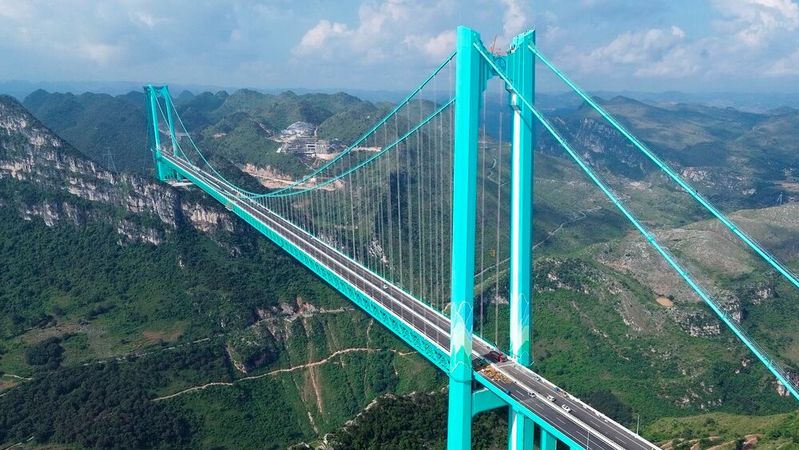
China has opened the world's highest bridge: The "Huajiang Grand Canyon" bridge was recently opened to traffic. The bridge stands 2,050 feet tall, making it almost nine times as high as the Golden Gate Bridge in San Francisco.
The title of the "world's highest bridge" goes to China once again.
It should actually be said, "China has opened the tallest bridge in the world—again," as the previous record holder, the Duge Bridge, is located just over 62 miles away. It has a height of 1,855 feet and was inaugurated in 2016. In both cases, the "clearance height" is meant, that is, the distance between the water surface of the river it spans and the underside of the bridge.
32,000 Bridges Aim to Improve Regional Connectivity
Both bridges span the Beipan River in China's Guizhou Province. Located south of Sichuan Province, this region is rich in karst mountains, deep gorges, and mountain villages, but otherwise is China's poorest province. There is not a single plateau in the entire province, only mountains and remote valleys.
The Chinese government is trying to better connect Guizhou to the rest of the country through the construction of many bridges and gradually increase the income of its residents. This project has been systematically pursued since 2012 with significant resource investment. In the meantime, 32,000 bridges in the province have already been opened or are under construction, including nearly half of the world's hundred tallest bridges.
The construction of the world's highest bridge was driven by engineering necessities rather than the desire to set records.
Yang Jian
Records, however, are not what drives Chinese engineers or planners. "The construction of the world's highest bridge was driven by engineering necessities rather than the desire to set records," quotes the news agency Yang Jian, the chief engineer responsible for the design of the Huajiang Grand Canyon Bridge.
"Since the canyon is surrounded by steep mountains, both bridges and tunnels were necessary. A lower bridge height would have meant longer tunnels, which would have increased the overall costs," Yang explained. "It was only after completing the design that we were astonished to realize that the bridge would be over 1,970 feet high."
Now, not only has a new world record for height been achieved, but also the title of the "world's largest suspension bridge in a mountainous region."
Bridge Construction Leads to 21 New Patents
The construction of the megabridge was not technically simple. Chinese engineers employed a range of high-tech solutions to complete it in just over three years. Among other innovations, they used an "intelligent cable-lifting system" and "2,000-megapascal high-performance steel wires." The suspension cables are equipped with sensors for real-time monitoring. Additionally, "Doppler LiDAR scanning," positioning during assembly using China's Beidou satellite system, "digital assembly," and "intelligent transport" were utilized during construction, according to the Chinese science newspaper Keji Ribao.
During the construction of this bridge, 21 new patents were registered in China. The overall planning of the Huajiang Grand Canyon Bridge was carried out by "Guizhou Communications Investment Group Co., Ltd." For many employees of this company, this bridge construction was more than just a technical challenge. For example, the project manager Wu Chaoming himself grew up in one of the poverty-stricken mountain villages in Guizhou.
From my hometown to the county seat, only one bus ran per day, just like from the county seat to the provincial capital Guiyang.
Wu Chaoming
"From my hometown to the county seat, only one bus ran a day, just like from the county seat to the provincial capital Guiyang," he recalled. The bus was always "packed to the brim." Some passengers always had to climb onto the luggage rack on the roof, the manager remembers. During the construction of the bridge, he now walked 9.3 miles daily for inspections. It is probably fair to say that, in addition to modern high technology, the dedication of highly motivated employees also explains the construction time of only about three years.
Two Minutes Instead of Two Hours: Connectivity Against Poverty
The bridge now reduces the time needed to cross the river at this point from two hours to two minutes. It also completes the new "Liu-An Highway," which winds through the mountains of Guizhou Province. This highway is part of a new west-east corridor connecting China's relatively underdeveloped western provinces with the densely populated eastern coast and its container ports. The improved transportation connectivity is expected to aid poverty alleviation in Guizhou Province, officials in Beijing hope.
Additionally, the planners are also relying on tourism for this purpose. The bridge itself is being marketed as a tourist attraction. In a few days, the "Cloud Summit Café" will open at the top. Visitors will then ascend more than 2,300 feet in a glass elevator to reach it.
There is also a platform for bungee jumping. A few days ago, for the bridge's opening, the world's best base jumpers were invited to leap from the bridge with just a parachute. Among them was Julian Astor Asdurian Bidogia from Italy, the world record holder for jumping from high bridges, who dove into the valley in his wingsuit. "I’m here to defend my title," he said. "China keeps building higher bridges."
Date: 08.12.2025
Naturally, we always handle your personal data responsibly. Any personal data we receive from you is processed in accordance with applicable data protection legislation. For detailed information please see our privacy policy.
Consent to the use of data for promotional purposes
I hereby consent to Vogel Communications Group GmbH & Co. KG, Max-Planck-Str. 7-9, 97082 Würzburg including any affiliated companies according to §§ 15 et seq. AktG (hereafter: Vogel Communications Group) using my e-mail address to send editorial newsletters. A list of all affiliated companies can be found here
Newsletter content may include all products and services of any companies mentioned above, including for example specialist journals and books, events and fairs as well as event-related products and services, print and digital media offers and services such as additional (editorial) newsletters, raffles, lead campaigns, market research both online and offline, specialist webportals and e-learning offers. In case my personal telephone number has also been collected, it may be used for offers of aforementioned products, for services of the companies mentioned above, and market research purposes.
Additionally, my consent also includes the processing of my email address and telephone number for data matching for marketing purposes with select advertising partners such as LinkedIn, Google, and Meta. For this, Vogel Communications Group may transmit said data in hashed form to the advertising partners who then use said data to determine whether I am also a member of the mentioned advertising partner portals. Vogel Communications Group uses this feature for the purposes of re-targeting (up-selling, cross-selling, and customer loyalty), generating so-called look-alike audiences for acquisition of new customers, and as basis for exclusion for on-going advertising campaigns. Further information can be found in section “data matching for marketing purposes”.
In case I access protected data on Internet portals of Vogel Communications Group including any affiliated companies according to §§ 15 et seq. AktG, I need to provide further data in order to register for the access to such content. In return for this free access to editorial content, my data may be used in accordance with this consent for the purposes stated here. This does not apply to data matching for marketing purposes.
Right of revocation
I understand that I can revoke my consent at will. My revocation does not change the lawfulness of data processing that was conducted based on my consent leading up to my revocation. One option to declare my revocation is to use the contact form found at https://contact.vogel.de. In case I no longer wish to receive certain newsletters, I have subscribed to, I can also click on the unsubscribe link included at the end of a newsletter. Further information regarding my right of revocation and the implementation of it as well as the consequences of my revocation can be found in the data protection declaration, section editorial newsletter.
Thanks to such events and similar activities in the fields of extreme sports and educational tourism, the government hopes to provide new opportunities for the local population on both sides of the canyon, such as growing agricultural products, selling souvenirs, or offering services in hotels and restaurants.
That such projects still involve risks today became clear again just this June. After a rockfall triggered by heavy rainfall, the 980 feet-high Houzihe Bridge, also in Guizhou, collapsed. A truck was already hanging over the edge with its cab, but the driver managed to climb out just in time and was rescued. China's media dubbed him the "Luckiest Person of the Year." No one else was harmed.
Henrik Bork, a long-time China correspondent for the Süddeutsche Zeitung and the Frankfurter Rundschau, is Managing Director at Asia Waypoint, a consulting agency specializing in China, based in Beijing.



:quality(80)/p7i.vogel.de/wcms/dd/08/dd086510d9ae7b50181f6070e4463b44/0129363730v1.jpeg "Typical application for ionizing devices: Wrapping films. (Picture: ©Adobe Stock/SMC)")
:quality(80)/p7i.vogel.de/wcms/35/57/3557c819943c53acec41a0ccba87da4f/0130049064v1.jpeg "Researchers at the Fraunhofer IWU in Chemnitz have long known that many typical sheet metal parts can be manufactured more cost-effectively using hollow embossing rollers. Now there is news to report ... (Image:Fraunhofer IWU)")
:quality(80)/p7i.vogel.de/wcms/59/02/590246e3b3f415c65edbee377c14ca77/26-06-pi-fraunhofer-iws-41450-direktplattieren-pic-01-7771x4369v1v1.jpeg "The Fraunhofer IWS has developed the new \"direct laser cladding\" process, which creates a functional layer directly on the base body by applying a strip-shaped metal to rotationally symmetrical components in a spiral and bonding it locally by laser. (Image:Christoph Wilsnack/Fraunhofer IWS)")
:quality(80)/p7i.vogel.de/wcms/73/60/73608418789b1d9c393f5e2fa974eda2/0130209906v1.jpeg "The robots of the X6 generation from b+m enable very high painting quality and are also particularly compact and easy to maintain. (Image:Beckhoff)")
:quality(80)/p7i.vogel.de/wcms/78/e9/78e9188c25a8a94e67c34c9bf8ffe495/visual-agile-20robots-20and-20google-20deepmind-20partner-20to-20bring-20intelligence-20to-20robotics-2500x1406v1v1.jpeg "Together, the partners are developing adaptable, intelligent robots for a wide range of applications (Image:Agile Robots SE)")
:quality(80)/p7i.vogel.de/wcms/e7/66/e7669ecf0260ae8fc54c214e34e4902a/0130316817v1.jpeg "Siemens and Palo Alto Networks offer tested cybersecurity solution for industrial 5G. (Image:Siemens)")
:quality(80)/p7i.vogel.de/wcms/9f/55/9f55324832c4f426958031375124d9de/siemens-20ubtech-20hmnd-1920x1079v1v1.png "Ready for the factory floor: While Ubtech is planning mass production, Siemens is already testing humanoids in real factory applications in Erlangen. (Image:Siemens)")
:quality(80)/p7i.vogel.de/wcms/11/36/113695ed260e29c8c2d9d39dc5f9d869/0130213768v1.jpeg "AI can work cheaply in China and deliver the results rapidly all over the world. (Image:Dall-E / AI-generated)")
:quality(80)/p7i.vogel.de/wcms/62/5f/625f41e87ebfef156a98c8e6393e32fd/0130211654v1.jpeg "Axial flux motors have some advantages over radial flux motor—but their production is currently still expensive. (Image:RWTH Aachen University)")
:quality(80)/p7i.vogel.de/wcms/77/9b/779b0685d010dfe45c9c2cb1cfecd467/0128886425v1.jpeg "The BlueEye is the first \"real\" hyperspectral camera for the UV range and covers the wavelength range from 220 to 380nm. (Image:Inno-spec GmbH)")
:quality(80)/p7i.vogel.de/wcms/e4/51/e451d52ce0182fb0aaa46a5774f832ef/26-04-pi-fraunhofer-iws-21160-bioslide-pic-01-4128x2321v1v1.jpeg "With the BioSlide research project, the Fraunhofer IWS is investigating how sliding systems can be designed to be more sustainable and energy-efficient. New materials can be tested in a particularly application-oriented manner on this plain bearing test stand. (Image:Fraunhofer IWS)")
![Thanks to advanced 3D printing technology, a more efficient use of resources should contribute to lower-emission aviation—this is the goal of ['skai]-lab. (Image:Oleksandr Pashchenko - stock.adobe.com / AI-generated)](https://cdn1.vogel.de/nghHNSbySccfOjG3n1qCA-FVOjQ=/288x162/smart/filters:format(jpg):quality(80)/p7i.vogel.de/wcms/62/64/626424c97a16e69f871bf216c9629c2a/adobestock-1927043193--c2-a9-20oleksandr-20pashchenko-20-e2-80-93-20stock-adobe-com-ki-generiertv1v1.jpeg "Thanks to advanced 3D printing technology, a more efficient use of resources should contribute to lower-emission aviation—this is the goal of ['skai]-lab. (Image:Oleksandr Pashchenko - stock.adobe.com / AI-generated)")
:quality(80)/p7i.vogel.de/wcms/c3/c4/c3c4ce270b083eeac55654148611f064/0130237945v1.jpeg "China is not giving up on hydrogen, but is intensifying its efforts. (Image:freely licensed from Pixabay)")
:quality(80)/p7i.vogel.de/wcms/4e/c0/4ec0bd19390b169edfa23677373dcdf1/0130260089v1.jpeg "Renewable fuels can supply European road traffic, according to a study. (Image:Aral)")
:quality(80)/p7i.vogel.de/wcms/6f/c9/6fc9050301d745cad25585c6780f8f51/0130197341v1.jpeg "Production facilities are a worthwhile target and are therefore at risk. (Image:ABB Robotics)")
:quality(80)/p7i.vogel.de/wcms/b6/62/b662adc2cec8227d8172509bbfb6ee42/25c0207-107-4961x2789v1v1.jpeg "The GLB is the second model based on Mercedes' new MMA platform. Apparently, Geely's platform is better and cheaper, which is why the two companies are negotiating a partnership. (Image:Mercedes-Benz)")
:quality(80)/p7i.vogel.de/wcms/4d/dd/4dddf438e91f394c04a095dbfd109d1c/0130236430v1.jpeg "Measurement modules: The 720301 module in combination with the SL2000 enables RMS and power calculations, among other things. (Image:Yokogawa)")
:quality(80)/p7i.vogel.de/wcms/61/fc/61fcf95f5cca15494ad18343901ae585/0130317237v1.jpeg "With the AGI CPU, Arm says it is taking a \"historic step\": With the processor aimed at AI in data centers, the company is presenting itself for the first time as a provider of its own chips, not just as a pure IP licensor. (Image:Arm)")
:quality(80)/p7i.vogel.de/wcms/82/90/8290dfe3595b6c6b33726ae8b76172c7/0130319587v1.jpeg "The concept image illustrates how the pattern of tiny protrusions and depressions created on the substrate (MgO, bottom) controls the arrangement of atoms in the superconducting material (YBCO, top). At the interface between the two layers, an electronic structure enables superconductivity to occur at higher temperatures than previously possible. (Image:Chalmers University of Technology / Riccardo Arpaia)")
:fill(fff,0)/images.vogel.de/vogelonline/companyimg/76800/76895/65.jpg "FAULHABER_120mm.jpg ()")
:fill(fff,0)/p7i.vogel.de/companies/67/eb/67eba621ef6ea/logo2.png "logo2 (Wuxi InfiMotion)")
:quality(80)/p7i.vogel.de/wcms/f8/ed/f8ed0d40b26a6dc63f17e00a7be5f553/0119515486v1.jpeg "The glacier tunnel is expected to facilitate traffic between the towns of Zhaosu and Wensu in the northern and southern parts of Xinjiang province from 2027 onwards. (Image:Vova - stock.adobe.com)")
:quality(80)/p7i.vogel.de/wcms/c9/df/c9df1f0de984fc1398a40ed8b538345a/0125047937v1.jpeg "0125047937v1 (Image:freely licensed)")
:quality(80)/p7i.vogel.de/wcms/dc/aa/dcaa0f86658e6445e59ada4bd90920ff/0128240938v1.jpeg "The Chinese high-speed train \"Gaotie\" is set to speed through the Karst mountains at 217 mph in the future. The Yangcun Tunnel will be part of the new route. (Image:GPT Image Editor / AI-generated)")