China relies on openness instead of isolation in the global AI race, disrupting an apparently entrenched balance of power. But will China's open approach ultimately tip the scales and threaten the U.S.'s lead in AI development?
AI from China scores with the public through open models and low prices.
(Image: Dall-E / AI-generated)
Is China winning the AI race against the USA with the help of "open-weight" models? Current indications suggest so. While American companies like OpenAI carefully guard their secrets (closed-weight), Chinese companies are making their weights publicly accessible. The result is an even faster, almost universal adoption of models like Doubao, Deepseek, or Yuanbao among the Chinese population and many businesses.
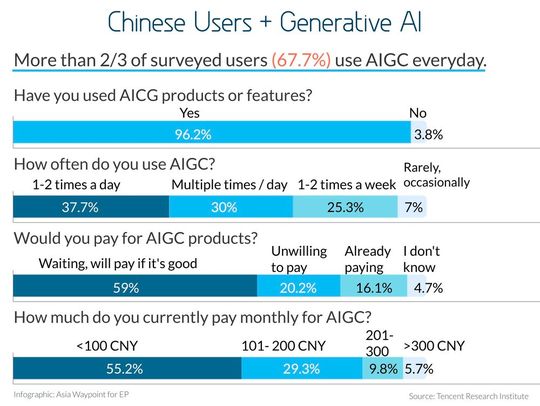
The Tencent Research Institute asked 3,500 Chinese people how often they use Artificial Intelligence Generated Content (AIGC).
(Image: Asia Waypoint)
The Chinese now use generative AI in their daily lives almost every day. Participants include not only computer nerds and well-educated knowledge workers but also elementary school students and retirees. The "penetration" of generative AI in everyday Chinese life is already truly impressive.
The "Tencent Research Institute" recently published the results of a survey. 96.2 percent of the approximately 3,500 Chinese respondents already use the Chinese equivalents of ChatGPT. And not just superficially or occasionally. 67.7 percent use generative AI at least once a day—at work, for learning, or for everyday questions.
"Hey Doubao!"
While this survey might be dismissed as optimistic since Tencent itself has business interests in this field, the adoption of chatbots on mobile devices in everyday Chinese life is undeniable. Hardly any Chinese citizen, regardless of age, goes without saying, “Let’s just ask Doubao” or “Let’s just ask Deepseek,” as it’s called here. Companies, ranging from very large to very small, are also integrating Chinese LLMs into their workflows with astonishing speed.
Leading the applications is Doubao from Bytedance, the parent company of TikTok, followed by Deepseek. In third place is Yuanbao from Tencent. The decision of all these Chinese AI companies to offer their models as "open-weight" contributes to their growing popularity.
Unlike open-source software, where the source code is made available and can be modified by anyone, open-weight LLMs typically only release the numerical parameters or "weights" learned during training online. Anyone can download them and experiment with them. It is a much more transparent way of enabling the use of chatbots and models compared to proprietary, closed models.
Affordable And in Demand
The Chinese also take a different approach to pricing than the Americans. Unlike the expensive closed-weight models from the U.S., such as OpenAI's ChatGPT or Anthropic's Claude, using Chinese AI models is almost free. Rarely is it priced significantly higher than a subscription to a music app on a mobile phone.
Behind all this lies an entirely different business model than that in the USA. Chinese companies are not trying to improve proprietary models with billion-dollar investments to sell them at high prices but are focusing on the rapid adoption of their models. Currently, they are making much less money than their American competitors, but whichever company prevails in this race for market share will be able to earn as much as it wants later.
Open-weight models also encourage different types of adoption compared to closed, secret-weight models. “They can be more easily tailored by businesses, governments, and researchers to the specific requirements of individual use cases and allow users to operate their AI tools locally rather than in the cloud. Revenue can still be generated through accompanying services, such as support with customization,” the Economist recently quoted Percy Liang, an associate professor of computer science at Stanford University and director of the “Center for Research on Foundation Models (CRFM).”
Strategic Differences
Thus, different strategies can be observed. While American companies speculate on huge profits by attempting to develop the best models (and, as seen recently with OpenAI's "gpt-oss," only half-heartedly participate in releasing open-weight models), Chinese companies are primarily focused on spreading their models and "gathering users" for now. Making money comes later.
Date: 08.12.2025
Naturally, we always handle your personal data responsibly. Any personal data we receive from you is processed in accordance with applicable data protection legislation. For detailed information please see our privacy policy.
Consent to the use of data for promotional purposes
I hereby consent to Vogel Communications Group GmbH & Co. KG, Max-Planck-Str. 7-9, 97082 Würzburg including any affiliated companies according to §§ 15 et seq. AktG (hereafter: Vogel Communications Group) using my e-mail address to send editorial newsletters. A list of all affiliated companies can be found here
Newsletter content may include all products and services of any companies mentioned above, including for example specialist journals and books, events and fairs as well as event-related products and services, print and digital media offers and services such as additional (editorial) newsletters, raffles, lead campaigns, market research both online and offline, specialist webportals and e-learning offers. In case my personal telephone number has also been collected, it may be used for offers of aforementioned products, for services of the companies mentioned above, and market research purposes.
Additionally, my consent also includes the processing of my email address and telephone number for data matching for marketing purposes with select advertising partners such as LinkedIn, Google, and Meta. For this, Vogel Communications Group may transmit said data in hashed form to the advertising partners who then use said data to determine whether I am also a member of the mentioned advertising partner portals. Vogel Communications Group uses this feature for the purposes of re-targeting (up-selling, cross-selling, and customer loyalty), generating so-called look-alike audiences for acquisition of new customers, and as basis for exclusion for on-going advertising campaigns. Further information can be found in section “data matching for marketing purposes”.
In case I access protected data on Internet portals of Vogel Communications Group including any affiliated companies according to §§ 15 et seq. AktG, I need to provide further data in order to register for the access to such content. In return for this free access to editorial content, my data may be used in accordance with this consent for the purposes stated here. This does not apply to data matching for marketing purposes.
Right of revocation
I understand that I can revoke my consent at will. My revocation does not change the lawfulness of data processing that was conducted based on my consent leading up to my revocation. One option to declare my revocation is to use the contact form found at https://contact.vogel.de. In case I no longer wish to receive certain newsletters, I have subscribed to, I can also click on the unsubscribe link included at the end of a newsletter. Further information regarding my right of revocation and the implementation of it as well as the consequences of my revocation can be found in the data protection declaration, section editorial newsletter.
Since the Chinese start-up Deepseek, previously almost unknown, released its LLM "R1" in January 2025—which, despite its lower training costs, has greatly impressed many American AI experts—the debate about dominance in the global AI race has shifted. While most observers previously believed that the USA would always remain ahead, many of them are no longer so sure today.
This moment in January has since been referred to as the "Deepseek Shock." In China, Deepseek has now made the leap from an insider tip for AI enthusiasts to a widely used everyday tool for the Chinese population. Other providers, such as Bytedance and Tencent, quickly followed with their own models.
Secret Approach
The fact that affordable language models, which can be even better integrated into one's own processes thanks to open weights, are very popular can be seen not only in China but also in Silicon Valley, California. Even there, many start-ups secretly use Deepseek, although they rarely admit it openly due to the currently widespread China hysteria in politics and media.
"This might be the biggest secret in Silicon Valley that cannot be revealed," writes the Chinese tech portal Huxiu. "Since DeepSeek exists—who would still be willing to pay for OpenAI or Anthropic?" Huxiu quotes Paddy Cosgrave, CEO and founder of "Web Summit."
If adoption truly proves to be a decisive success factor for AI companies and open weights play a role in it, the next "Deepseek Shock" may soon be upon us. (sb)
Secure and Compliant Authentication in Laboratories



:quality(80)/p7i.vogel.de/wcms/d9/43/d943b0ce33bdf921f37f14655bb0c376/cuscinetto-a-sfere-di-leonardo-da-vinci-in-una-mostra-su-leonardo-da-vinci-al-mulino-di-mora-bassa---morabassa-croppedv1.jpeg "Replica of Leonardo da Vinci's ball bearing: The inventor used wooden balls. Spacers prevent the balls from rubbing against each other. (Source: Capricornis crispus)")
:quality(80)/p7i.vogel.de/wcms/17/b8/17b8af0cb725e0e1d3e8d72458bab260/siemens-meet-at-the-machinev1.jpeg "“Meet at the Machine” is Siemens’ new initiative, which aims to bring together machine builders, software, and automation technologies to accelerate innovation in the machine tool industry and help manufacturers become productive more quickly. (Source: Siemens)")
:quality(80)/p7i.vogel.de/wcms/8e/7e/8e7e0cda4c68699bcc48283a38739769/0133316747v1.jpeg "A little-known hidden champion! When people think of laser cutting, the first thing that comes to mind is the power of the laser beam—and it is impressive to see the sparks flying. But Air Liquide—an exhibitor at Euroblech, by the way—wants to make it clear that the process gas is also key to success. (Image:AI-generated)")
:quality(80)/p7i.vogel.de/wcms/20/fa/20fa35e0af203c3464f7e7fdbb57a685/0133281172v1.jpeg "Since 2003, Etzinger AG has been developing and manufacturing high-quality coffee grinders, pepper mills, and grinding mechanisms for professional and home use. (Image:Etzinger)")
:quality(80)/p7i.vogel.de/wcms/b1/06/b106cf44923ce39565c3264982fd20eb/0133414574v1.jpeg "Robots Build Robots: At the new Ubtech factory, automated systems even handle parts of the material supply and logistics for the production of humanoid robots. (Image:Ubtech)")
:quality(80)/p7i.vogel.de/wcms/38/79/38799bfbbccd938b64c67068cfa68780/0133329362v1.jpeg "What exactly enables machines to act on their own? (Image:Shutterstock)")
:quality(80)/p7i.vogel.de/wcms/1b/9f/1b9fc9f113fc66212e2c0e17a3edaf9f/org-blobs-user-response-file-output-f317796f-57b7-483f-9403-5d9ac8a816f5-plugin-output-call-kdigtepb7be7us8xvbota0mh-1672x940v1.png "According to Barclays data, Europe leads the global trade in actuator components. With a 34 percent share, the region ranks ahead of China, which has a 26.3 percent share. (Source: Statista | CC BY-ND 4.0, AI-generated)")
:quality(80)/p7i.vogel.de/wcms/f5/4c/f54c9fc59ccb0604ab9219188469a45f/image1v1.jpeg "Christopher Savoia, Global Head of the UR+ Ecosystem at Universal Robots, presents the new SP7 Smart Panel on a UR17g-1300 robot during the unveiling of Gen 7—UR’s 7th-generation robot platform—at IMTS in Chicago on September 14, 2026. (Image:Image: Teradyne Robotics)")
:quality(80)/p7i.vogel.de/wcms/ca/46/ca462051dfb9a1fb37ca4053762af9df/org-blobs-user-response-file-output-908c701c-3b37-491e-bb5c-35fc3d336575-plugin-output-call-182851v1.png "Through extreme compression, high-energy lasers transform simple plastics into high-purity nanodiamonds. What was once used in planetary physics is now opening up entirely new possibilities for quantum sensors, novel catalysts, and extremely hard materials. (Illustrative image) (Source: VCG / AI-generated)")
:quality(80)/p7i.vogel.de/wcms/7c/7a/7c7a5eada63c7a36a365391c292f76d4/hot-fire-jarvisv1.jpeg "(Developed in record time: A “JARVIS-class” jet engine capable of up to 100 pounds of thrust. It was designed in a four-week sprint using generative AI and established CAD/CAE tools.MIT)")
:quality(80)/p7i.vogel.de/wcms/87/87/87870cf2b30aaef7b8a06212a4ef2c14/0133403885v1.jpeg "A digital twin and a real component demonstrate how closely simulation and manufacturing are converging. Stampack Xpress 2026.1 virtually models forming behavior and supports the validation of process and tool design. (Image:Stampack)")
:quality(80)/p7i.vogel.de/wcms/59/2a/592a7f2d0964e9e6846cae331f5daa3a/0133266065v1.jpeg "Perforated metal sheets are particularly well-suited for balcony railings, as they combine stability, privacy, and design versatility. (Image:Ripo Factory)")
:quality(80)/p7i.vogel.de/wcms/24/d5/24d546b8c00887feaef1cbc207b9e2af/0133433032v1.jpeg "Mahle CEO Arnd Franz was recently asked about his vision for the future of the commercial vehicle business—particularly regarding the industry's transition to electric vehicles... (Image:Kai R. Joachim / Mahle)")
:quality(80)/p7i.vogel.de/wcms/8b/c5/8bc5c0c40b6d706aca4e3f3ddcc99958/0133387335v1.jpeg "At InnoTrans, Stadler is unveiling for the first time its new four-axle EURO DuFour locomotive for freight service, which SBB Cargo has ordered. Compared to the existing fleet, it is expected to be significantly more energy-efficient in operation. (Image:Stadler)")
:quality(80)/p7i.vogel.de/wcms/49/97/49978469e969283ccb68531ebef1f412/klaus-zellmer-1v1.jpeg "Klaus Zellmer will become CEO of Volvo no later than October 2027. (Source: Volvo)")
:quality(80)/p7i.vogel.de/wcms/cf/e1/cfe1f3824102bd030f4fe5e4e13e1e0e/0133433007v1.jpeg "The situation in the German automotive manufacturing industry is not exactly rosy, especially when viewed in the context of global competition. Read here to find out what a recent analysis of the situation reveals ... (Image:AI-generated)")
:quality(80)/p7i.vogel.de/wcms/f3/d9/f3d91ebfd703e24d4065b0ae7898e46b/0133177388v1.jpeg "The Evolution of Coding: In the past, programs were written by hand and fed into the computer using punch cards and switches. Today, in the age of “vibe coding,” computers can largely program themselves. (Image:Dall-E / AI-generated)")
:quality(80)/p7i.vogel.de/wcms/00/cd/00cd7c51cf41652dbb295c14634cd34f/0133438409v1.jpeg "Flash memory from Spansion dating back to 2004, before the company merged with Cypress. Infineon is divesting its NOR flash and FRAM memory business. Winbond, which is acquiring the division for $1.12 billion, plans to continue operating it as a separate company under the Spansion name starting next year. (Image:Raimond Spekking / CC BY-SA 4.0 / Wikimedia Commons)")
:quality(80)/p7i.vogel.de/wcms/09/dc/09dcc37616c3a9d5d7a289c97a352a89/0133428369v1.jpeg "(Image:Gemini / AI-generated)")
:quality(80)/p7i.vogel.de/wcms/4c/53/4c534208d09a9b1ce597938715e7fc19/0133288763v1.jpeg "Logic Folding: In its latest Kirin 9050 Pro, Huawei uses hybrid bonding to distribute the computing units across two silicon layers in order to increase the effective transistor density without resorting to finer manufacturing processes. (Image:Huawei)")
:fill(fff,0)/images.vogel.de/vogelonline/companyimg/76800/76895/65.jpg "FAULHABER_120mm.jpg ()")
:fill(fff,0)/p7i.vogel.de/companies/69/88/69882c428938e/tmts2026-ticec-banner-en-2000px.png "tmts2026-ticec-banner-en-2000px (https://www.tmts.tw/en)")
:fill(fff,0)/p7i.vogel.de/companies/69/de/69de1b7403b0d/simtos-logo.jpeg "simtos-logo (SIMTOS)")

:quality(80):fill(efefef,0)/p7i.vogel.de/wcms/67/ac/67acb931a438c/elatec-wp-gmp.png "Elatec WP GMP")
:quality(80)/p7i.vogel.de/wcms/70/21/7021d732ad7b441d0436592046a25432/0132610698v1.jpeg "Kimi K3 can fundamentally be self-hosted. However, due to its size, it is not a model for just any company: even in a compressed form, extensive storage and computing resources are required. (Image:Moonshot AI)")
:quality(80)/p7i.vogel.de/wcms/c4/ad/c4ada9bb9fe9a3970ff52b5513aeac3a/0127142013v1.jpeg "Cockpit of the Mercedes CLA 250+ Shooting Brake with EQ technology: In China, the all-electric CLA is set to be equipped with an AI agent from ByteDance. (Image:Mercedes-Benz AG)")