When the Chinese Minister of Industry personally visits, something significant must have happened, such as in early October in Shanghai: the ignition of the first heavy gas turbine made domestically.
In the strategic plan "Made in China 2025," the ten key industries are listed in which China intends to particularly push forward the modernization of its industry—including energy and power generation.
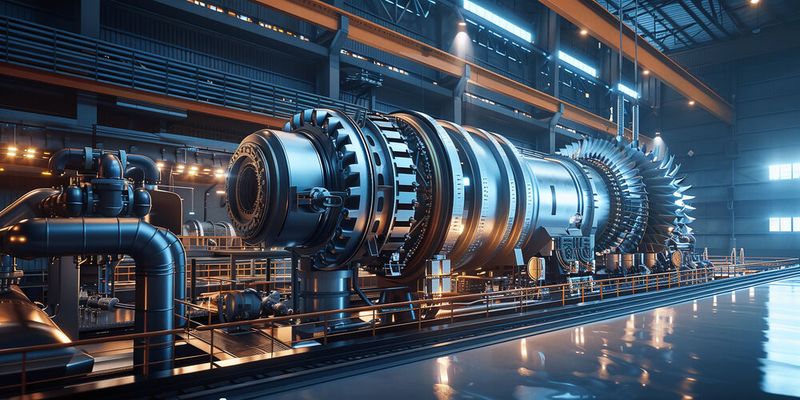
(Image: Oleksandr—stock.adobe.com / AI-generated)
Henrik Bork, long-time China correspondent for "Süddeutsche Zeitung" and "Frankfurter Rundschau" (both German Newspapers), is Managing Director at Asia Waypoint, a consulting agency specialized in China based in Beijing.
The high-performance gas turbine with a capacity of 300 megawatts was developed by "China United Gas Turbine Technology Co." Consisting of 50,000 components and filled to the brim with all kinds of high-tech, it is the new pride of the Chinese manufacturing industry.
The turbine generates one-eighth of Beijing's hourly energy consumption
The keynote speakers at the inauguration of the massive project in the Shanghai district of Lingang spoke of a "milestone" for their country’s advanced manufacturing—and this seems by no means an exaggeration: Until now, only a few companies worldwide were capable of producing such industrial gas turbines, often referred to as the "crown jewels of manufacturing," including Siemens in Germany, General Electric in the USA, and Mitsubishi in Japan. Now, China has carved out a place for itself in this exclusive club through its own efforts.
By burning natural gas, this single F-class heavy-duty turbine can generate 450,000 kilowatts of electricity per hour, said a company manager during the successful ignition test. This corresponds to approximately "one-eighth of the average hourly energy consumption in Beijing."
High energy efficiency
The energy efficiency reaches a level of 55 percent, significantly higher than traditional thermal power plants which operate at 35 to 46 percent, according to the employee. This technology is also highly compatible with wind and solar power installations, aiding in "grid peak shaving," which enhances its importance for climate protection, it was noted further.
The carbon dioxide emissions are about half as high as those from coal-fired power plants, making this cleaner, more sustainable technology essential for China and other nations if they are to achieve their climate goals.
From the China Daily
Technology has two sides
Various models of such gas turbines can be used for power generation, but also to drive warships, such as medium-sized aircraft carriers. For China, it has therefore been a declared goal for many years to be able to build these machines themselves one day and not have to import them from abroad as before.
In the strategic plan "Made in China 2025," the ten key industries are listed in which China intends to particularly push forward the modernization of its industry. Both "energy and power generation" and "high-tech shipbuilding and maritime industry" are included on this list.
Due to their high operating temperatures, the associated susceptibility to corrosion of many components, and the required precision of the rotor blades, gas turbines are considered true masterpieces of engineering.
In this particular case, the challenge was especially formidable because an industrial gas turbine of such magnitude presents a tough nut to crack even for the world's best engineers. Due to their high operating temperatures (in this case, 1400 degrees Celsius), the associated susceptibility to corrosion of many components, and the required precision of the rotor blades, gas turbines are considered true masterpieces of engineering.
China closes technology gap
In 2016, under the supervision of the State Council and key ministries, the special project "Aviation Engine and Gas Turbine" began in China. Nearly 200 state-owned enterprises, research institutions, and some private companies nationwide were involved. At the time, media reports indicated that China was 30 years behind the West in this technology. "The rapid progress of the team has now closed this technology gap in less than a decade," commented the South China Morning Post on the turbine ignition test in Shanghai.
As China's industry always keeps an eye on exporting its products, here again, in a relatively short period of time, a serious competitor in the high-tech sector of advanced German manufacturing has emerged.
Milestone for China, problematic for Germany
In July of this year, officials in Berlin believed they could still delay China's catch-up in this field. German Economy Minister Habeck prohibited the Volkswagen Group from selling the gas turbine business of its subsidiary "MAN Energy Solutions" to a Chinese company. He justified this decision with security concerns, citing the use of gas turbines in warships. The Chinese investor in question reportedly had certain connections to his country's navy.
It is also fair to mention the context, as the Greens generally prefer to have as little to do with China as possible and view its economic rise with suspicion. However, the problem with such "security concerns" backed by military justifications and market interventions, in this specific case, is that it jeopardizes the jobs of 140 employees at MAN in Germany. "We see no future for the business," a VW spokesperson was quoted in the magazine Focus following the Habeck decision. The company now has to completely wind down the gas turbine business.
Date: 08.12.2025
Naturally, we always handle your personal data responsibly. Any personal data we receive from you is processed in accordance with applicable data protection legislation. For detailed information please see our privacy policy.
Consent to the use of data for promotional purposes
I hereby consent to Vogel Communications Group GmbH & Co. KG, Max-Planck-Str. 7-9, 97082 Würzburg including any affiliated companies according to §§ 15 et seq. AktG (hereafter: Vogel Communications Group) using my e-mail address to send editorial newsletters. A list of all affiliated companies can be found here
Newsletter content may include all products and services of any companies mentioned above, including for example specialist journals and books, events and fairs as well as event-related products and services, print and digital media offers and services such as additional (editorial) newsletters, raffles, lead campaigns, market research both online and offline, specialist webportals and e-learning offers. In case my personal telephone number has also been collected, it may be used for offers of aforementioned products, for services of the companies mentioned above, and market research purposes.
Additionally, my consent also includes the processing of my email address and telephone number for data matching for marketing purposes with select advertising partners such as LinkedIn, Google, and Meta. For this, Vogel Communications Group may transmit said data in hashed form to the advertising partners who then use said data to determine whether I am also a member of the mentioned advertising partner portals. Vogel Communications Group uses this feature for the purposes of re-targeting (up-selling, cross-selling, and customer loyalty), generating so-called look-alike audiences for acquisition of new customers, and as basis for exclusion for on-going advertising campaigns. Further information can be found in section “data matching for marketing purposes”.
In case I access protected data on Internet portals of Vogel Communications Group including any affiliated companies according to §§ 15 et seq. AktG, I need to provide further data in order to register for the access to such content. In return for this free access to editorial content, my data may be used in accordance with this consent for the purposes stated here. This does not apply to data matching for marketing purposes.
Right of revocation
I understand that I can revoke my consent at will. My revocation does not change the lawfulness of data processing that was conducted based on my consent leading up to my revocation. One option to declare my revocation is to use the contact form found at https://contact.vogel.de. In case I no longer wish to receive certain newsletters, I have subscribed to, I can also click on the unsubscribe link included at the end of a newsletter. Further information regarding my right of revocation and the implementation of it as well as the consequences of my revocation can be found in the data protection declaration, section editorial newsletter.
Depending on the observer's perspective, the ignition of the 300-MW gas turbine in Shanghai represents either a "milestone" achievement or rather bad news. It is a technology that can be utilized in the energy transition and the decarbonization of the manufacturing industry, and for which there is significant international demand. Its manufacturers in China are supported and favored by politics, while competitors in Germany are forced to shut down. This dichotomy reflects broader global economic and political dynamics, where technological advancements and geopolitical interests often intersect and create complex challenges for international relations and domestic policies.
From an objective perspective, it must be noted that the manufacturing of heavy-duty gas turbines indeed has a future—just less so in Germany and increasingly more so in China.



:quality(80)/p7i.vogel.de/wcms/dd/08/dd086510d9ae7b50181f6070e4463b44/0129363730v1.jpeg "Typical application for ionizing devices: Wrapping films. (Picture: ©Adobe Stock/SMC)")
:quality(80)/p7i.vogel.de/wcms/35/57/3557c819943c53acec41a0ccba87da4f/0130049064v1.jpeg "Researchers at the Fraunhofer IWU in Chemnitz have long known that many typical sheet metal parts can be manufactured more cost-effectively using hollow embossing rollers. Now there is news to report ... (Image:Fraunhofer IWU)")
:quality(80)/p7i.vogel.de/wcms/59/02/590246e3b3f415c65edbee377c14ca77/26-06-pi-fraunhofer-iws-41450-direktplattieren-pic-01-7771x4369v1v1.jpeg "The Fraunhofer IWS has developed the new \"direct laser cladding\" process, which creates a functional layer directly on the base body by applying a strip-shaped metal to rotationally symmetrical components in a spiral and bonding it locally by laser. (Image:Christoph Wilsnack/Fraunhofer IWS)")
:quality(80)/p7i.vogel.de/wcms/73/60/73608418789b1d9c393f5e2fa974eda2/0130209906v1.jpeg "The robots of the X6 generation from b+m enable very high painting quality and are also particularly compact and easy to maintain. (Image:Beckhoff)")
:quality(80)/p7i.vogel.de/wcms/78/e9/78e9188c25a8a94e67c34c9bf8ffe495/visual-agile-20robots-20and-20google-20deepmind-20partner-20to-20bring-20intelligence-20to-20robotics-2500x1406v1v1.jpeg "Together, the partners are developing adaptable, intelligent robots for a wide range of applications (Image:Agile Robots SE)")
:quality(80)/p7i.vogel.de/wcms/e7/66/e7669ecf0260ae8fc54c214e34e4902a/0130316817v1.jpeg "Siemens and Palo Alto Networks offer tested cybersecurity solution for industrial 5G. (Image:Siemens)")
:quality(80)/p7i.vogel.de/wcms/9f/55/9f55324832c4f426958031375124d9de/siemens-20ubtech-20hmnd-1920x1079v1v1.png "Ready for the factory floor: While Ubtech is planning mass production, Siemens is already testing humanoids in real factory applications in Erlangen. (Image:Siemens)")
:quality(80)/p7i.vogel.de/wcms/11/36/113695ed260e29c8c2d9d39dc5f9d869/0130213768v1.jpeg "AI can work cheaply in China and deliver the results rapidly all over the world. (Image:Dall-E / AI-generated)")
:quality(80)/p7i.vogel.de/wcms/62/5f/625f41e87ebfef156a98c8e6393e32fd/0130211654v1.jpeg "Axial flux motors have some advantages over radial flux motor—but their production is currently still expensive. (Image:RWTH Aachen University)")
:quality(80)/p7i.vogel.de/wcms/77/9b/779b0685d010dfe45c9c2cb1cfecd467/0128886425v1.jpeg "The BlueEye is the first \"real\" hyperspectral camera for the UV range and covers the wavelength range from 220 to 380nm. (Image:Inno-spec GmbH)")
:quality(80)/p7i.vogel.de/wcms/e4/51/e451d52ce0182fb0aaa46a5774f832ef/26-04-pi-fraunhofer-iws-21160-bioslide-pic-01-4128x2321v1v1.jpeg "With the BioSlide research project, the Fraunhofer IWS is investigating how sliding systems can be designed to be more sustainable and energy-efficient. New materials can be tested in a particularly application-oriented manner on this plain bearing test stand. (Image:Fraunhofer IWS)")
![Thanks to advanced 3D printing technology, a more efficient use of resources should contribute to lower-emission aviation—this is the goal of ['skai]-lab. (Image:Oleksandr Pashchenko - stock.adobe.com / AI-generated)](https://cdn1.vogel.de/nghHNSbySccfOjG3n1qCA-FVOjQ=/288x162/smart/filters:format(jpg):quality(80)/p7i.vogel.de/wcms/62/64/626424c97a16e69f871bf216c9629c2a/adobestock-1927043193--c2-a9-20oleksandr-20pashchenko-20-e2-80-93-20stock-adobe-com-ki-generiertv1v1.jpeg "Thanks to advanced 3D printing technology, a more efficient use of resources should contribute to lower-emission aviation—this is the goal of ['skai]-lab. (Image:Oleksandr Pashchenko - stock.adobe.com / AI-generated)")
:quality(80)/p7i.vogel.de/wcms/c3/c4/c3c4ce270b083eeac55654148611f064/0130237945v1.jpeg "China is not giving up on hydrogen, but is intensifying its efforts. (Image:freely licensed from Pixabay)")
:quality(80)/p7i.vogel.de/wcms/4e/c0/4ec0bd19390b169edfa23677373dcdf1/0130260089v1.jpeg "Renewable fuels can supply European road traffic, according to a study. (Image:Aral)")
:quality(80)/p7i.vogel.de/wcms/6f/c9/6fc9050301d745cad25585c6780f8f51/0130197341v1.jpeg "Production facilities are a worthwhile target and are therefore at risk. (Image:ABB Robotics)")
:quality(80)/p7i.vogel.de/wcms/b6/62/b662adc2cec8227d8172509bbfb6ee42/25c0207-107-4961x2789v1v1.jpeg "The GLB is the second model based on Mercedes' new MMA platform. Apparently, Geely's platform is better and cheaper, which is why the two companies are negotiating a partnership. (Image:Mercedes-Benz)")
:quality(80)/p7i.vogel.de/wcms/4d/dd/4dddf438e91f394c04a095dbfd109d1c/0130236430v1.jpeg "Measurement modules: The 720301 module in combination with the SL2000 enables RMS and power calculations, among other things. (Image:Yokogawa)")
:quality(80)/p7i.vogel.de/wcms/61/fc/61fcf95f5cca15494ad18343901ae585/0130317237v1.jpeg "With the AGI CPU, Arm says it is taking a \"historic step\": With the processor aimed at AI in data centers, the company is presenting itself for the first time as a provider of its own chips, not just as a pure IP licensor. (Image:Arm)")
:quality(80)/p7i.vogel.de/wcms/82/90/8290dfe3595b6c6b33726ae8b76172c7/0130319587v1.jpeg "The concept image illustrates how the pattern of tiny protrusions and depressions created on the substrate (MgO, bottom) controls the arrangement of atoms in the superconducting material (YBCO, top). At the interface between the two layers, an electronic structure enables superconductivity to occur at higher temperatures than previously possible. (Image:Chalmers University of Technology / Riccardo Arpaia)")
:fill(fff,0)/images.vogel.de/vogelonline/companyimg/76800/76895/65.jpg "FAULHABER_120mm.jpg ()")
:fill(fff,0)/p7i.vogel.de/companies/69/88/69882c428938e/tmts2026-ticec-banner-en-2000px.png "tmts2026-ticec-banner-en-2000px (https://www.tmts.tw/en)")
:fill(fff,0)/p7i.vogel.de/companies/67/eb/67eba621ef6ea/logo2.png "logo2 (Wuxi InfiMotion)")
:quality(80)/p7i.vogel.de/wcms/4f/35/4f352211a68db5d0d86c4685d68d2dc2/0113143253v1.jpeg "In our China Market Insider, we regularly provide you with relevant information directly from China. (Image:© Eisenhans - stock.adobe.com)")
:quality(80)/p7i.vogel.de/wcms/6c/b5/6cb5ce2155433f6e73b16399adc4c561/0113143253v1.jpeg "In our China Market Insider we regularly provide you with relevant information directly from China. (Image:© Eisenhans - stock.adobe.com)")