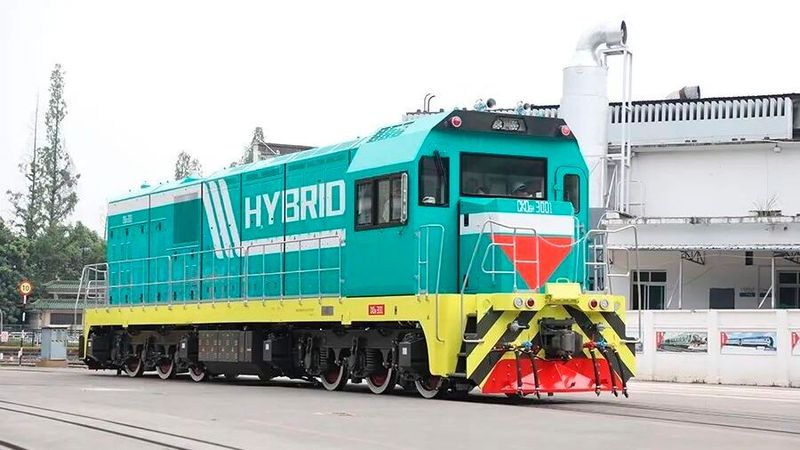
From the outside, the green locomotive looks rather unspectacular, which was presented to the press on the premises of the Chinese locomotive manufacturer CRRC in Sichuan province. However, the interior of the "CKD6H" locomotive is interesting and attracted a number of TV crews and photographers on May 20.
The new locomotive is a "green" hybrid model in both senses, combining a low-emission diesel engine with a lithium-iron phosphate battery.
(Image: crrcgc)
The new locomotive is a "green" hybrid model in both senses, combining a low-emission diesel engine with a lithium-iron phosphate battery. The press conference was called because, for the first time, a locomotive with this drive technology is being delivered abroad as a new series model—to Kazakhstan.
CKD6H is one of several newly developed series with which China's railway industry is trying to move towards an environmentally friendly future. It was developed by CRRC Ziyang in collaboration with Kazakhstan's state railway.
Replace Diesel Locomotives
In Central Asia, winters are bitterly cold. The locomotive is therefore designed for temperatures as low as minus fifty degrees Celsius. It is also suited for heavy loads and rather poor infrastructure. In Kazakhstan, it is intended to be used in freight transport everywhere where only diesel locomotives have been used so far.
The CKD6H hybrid locomotive is to be certified in Kazakhstan according to the EAC standard. This is the "Eurasian Conformity" standard that applies in the Eurasian Economic Union (EAEU), which includes Kazakhstan, Russia, and Belarus.
If all goes well in a few weeks, it would be the first time that Chinese standards are recognized abroad. This would also be a breakthrough for the Chinese railway industry and its new export business. The fuel-efficient diesel engine in the hybrid locomotive is also compliant with the EU IIA standard, as was mentioned at the press conference.
Hybrid Locomotives are Considered Bearers of Hope
China places great expectations on new hybrid locomotives like these. With their help, the Chinese state railway is to become a central vehicle in achieving national climate goals. The phased farewell to diesel propulsion in rail freight transport has long been politically decided in China and is now being implemented step by step. The strategy is twofold. The efficient, lower-emission freight trains are intended to operate both within China and be exported abroad.
The government in Beijing speaks of a "Chinese solution for the green transformation of the transport sector." It is now being vigorously promoted for the countries along the "new Silk Road" in Central Asia. Alongside Kazakhstan, these include Kyrgyzstan, Uzbekistan, Turkmenistan, and Tajikistan.
Less Fuel Consumption
While CRRC Ziyang can now celebrate its first export success with the Kazakh order, more and more similar hybrid locomotives are being put into operation in China itself. The manufacturer claims that the hybrid engine of the "CKD6H" can reduce fuel consumption in operation by more than 45 percent. The emissions that are still produced should be much cleaner than before. Compared to conventional diesel locomotives, nitrogen oxide emissions are expected to decrease by about 45 percent, hydrocarbon emissions by around 73 percent, and carbon monoxide emissions even by about 83 percent, CRRC claims.
Shunting Locomotive Completely Electric
Also, in the spring of this year, CRRC in Dalian introduced a battery-electric shunting locomotive with a 1000-kW battery, designed specifically for industrial plants and mining companies. When using this electric locomotive, no emissions are produced at all, said Sun Rongkun, chairman of CRRC Dalian, in an interview with the Xinhua News Agency.
The locomotive is equipped with a powerful liquid cooling system for its LFP battery, which can be fully recharged with up to 680 kW charging power within 70 minutes. A first unit has been delivered, among others, to the steel company Ansteel, where it has been tested on the factory premises since April. There, fuel consumption has reportedly been reduced by more than 30 percent since then.
Fuel Cell Locomotive in use too
In addition to purely electric and hybrid drives, China is also focusing on fuel cells for its "green" locomotives. In the southwestern Chinese province of Guizhou, the country's first hydrogen-powered locomotive began commercial operation in May. It was developed by a consortium led by Meijin Energy, a company specializing in coke oven gas utilization. The hydrogen locomotive is now used for freight transport in mining in the "coal and steel city" of Liupanshui in Guizhou. The concept involves capturing hydrogen, which is a byproduct of coal production there, purifying it, and then using it to power the locomotives and heavy-duty vehicles. Over a hundred trucks and several bus lines are already being operated with fuel cells there. The locomotive itself can travel up to 800 kilometers (approx. 497 miles) on a single tank, haul over four thousand tons, and is fully refueled in fifteen minutes.
Date: 08.12.2025
Naturally, we always handle your personal data responsibly. Any personal data we receive from you is processed in accordance with applicable data protection legislation. For detailed information please see our privacy policy.
Consent to the use of data for promotional purposes
I hereby consent to Vogel Communications Group GmbH & Co. KG, Max-Planck-Str. 7-9, 97082 Würzburg including any affiliated companies according to §§ 15 et seq. AktG (hereafter: Vogel Communications Group) using my e-mail address to send editorial newsletters. A list of all affiliated companies can be found here
Newsletter content may include all products and services of any companies mentioned above, including for example specialist journals and books, events and fairs as well as event-related products and services, print and digital media offers and services such as additional (editorial) newsletters, raffles, lead campaigns, market research both online and offline, specialist webportals and e-learning offers. In case my personal telephone number has also been collected, it may be used for offers of aforementioned products, for services of the companies mentioned above, and market research purposes.
Additionally, my consent also includes the processing of my email address and telephone number for data matching for marketing purposes with select advertising partners such as LinkedIn, Google, and Meta. For this, Vogel Communications Group may transmit said data in hashed form to the advertising partners who then use said data to determine whether I am also a member of the mentioned advertising partner portals. Vogel Communications Group uses this feature for the purposes of re-targeting (up-selling, cross-selling, and customer loyalty), generating so-called look-alike audiences for acquisition of new customers, and as basis for exclusion for on-going advertising campaigns. Further information can be found in section “data matching for marketing purposes”.
In case I access protected data on Internet portals of Vogel Communications Group including any affiliated companies according to §§ 15 et seq. AktG, I need to provide further data in order to register for the access to such content. In return for this free access to editorial content, my data may be used in accordance with this consent for the purposes stated here. This does not apply to data matching for marketing purposes.
Right of revocation
I understand that I can revoke my consent at will. My revocation does not change the lawfulness of data processing that was conducted based on my consent leading up to my revocation. One option to declare my revocation is to use the contact form found at https://contact.vogel.de. In case I no longer wish to receive certain newsletters, I have subscribed to, I can also click on the unsubscribe link included at the end of a newsletter. Further information regarding my right of revocation and the implementation of it as well as the consequences of my revocation can be found in the data protection declaration, section editorial newsletter.
The fuel cell provides power for the main drive of the locomotive, with excess energy also stored in a lithium battery. This hybrid system is claimed by its developer to be able to operate efficiently at high altitudes. While diesel engines lose power on the plateau due to insufficient oxygen from the thin air, fuel cells continue to function stably, Xinhua quoted a project manager at Meijin Energy.
In this specific application, cost-effectiveness is guaranteed.
Hydrogen, which elsewhere still has to be produced from natural gas or with renewable energies and is relatively expensive, is generated as a byproduct in Liupanshui. Therefore, the conversion costs there are only a third of the usual market price. In the long term, however, it is expected that scaling up hydrogen technology across China will lower the prices for the use of fuel cells.
For plant traffic in such factories, decentralized refueling infrastructure is also useful, according to Chinese trade media. The government of Guizhou province is already planning to expand the model to other industrial plants.
In the long term, there is hope to convert a large part of the province's heavy-duty logistics to hydrogen-powered vehicles, thus contributing to achieving China's climate goals.
Conclusion: As suggested by the export of the CKD6H to Kazakhstan, China's sustainable freight locomotives could develop into another export hit for the Chinese manufacturing industry in the future, similar to solar parks in the United Arab Emirates or hydrogen plants in Saudi Arabia and Pakistan. (se)



:quality(80)/p7i.vogel.de/wcms/72/a0/72a0ffc94f0929c8b193b4bc40638d72/0129755066v1.jpeg "Tens of billions less! After Ford and General Motors, Stellantis is now also feeling the painful consequences of Donald Trump's decision to change its electric car strategy ... (Image:Stellantis)")
:quality(80)/p7i.vogel.de/wcms/7f/fd/7ffd32863352c40f562f4245e4766e61/0129745849v1.jpeg "After US President Donald Trump once again resorted to his favorite weapon, tariffs, concerns rose in the EU that the so-called tariff deal could become invalid. But it looks as if the sea remains relatively calm ... (Image:F. Schneidler)")
:quality(80)/p7i.vogel.de/wcms/53/69/5369bed136061188d873441dfefd6d6e/0129245111v1.jpeg "The company revised the factory layout even though construction work had already begun. (Image:Efeso Management Consultants)")
:quality(80)/p7i.vogel.de/wcms/d2/d7/d2d79e3fb84663cb7e918c88f123989b/0129733908v1.jpeg "Mineral decision! This is how lithium is mined. There is a lot of it in Chile, Australia, Bolivia and also in Zimbabwe. However, the latter country has now announced that the export of all minerals, including lithium concentrate, will be stopped. Read more about the reasons here ... (Image:Largbatt)")
:quality(80)/p7i.vogel.de/wcms/d9/bd/d9bd1bfa7d02f586e092f06c61ee3d9a/0129464423v1.jpeg "This is what the Black Soldier Fly (BSF) looks like. The first impression is of a common two-winged insect. But appearances are deceptive, because its larvae are true protein reactors, whose industriousness is now to be exploited for food ... (Image:Fly Friends)")
:quality(80)/p7i.vogel.de/wcms/13/4d/134dee0c2b8af6b4f28937ca5b586e0d/0129499541v1.jpeg "The industry now needs to build a flexible, powerful and sovereign infrastructure that can exploit the full potential of artificial intelligence while guaranteeing control over data and processes. (Picture: ©Gorodenkoff - stock.adobe.com)")
:quality(80)/p7i.vogel.de/wcms/c6/71/c671ce338f12be49d39d1b04b40a54f7/0129697443v1.jpeg "Claas is working on making its combine harvesters fit for refurbishment. (Image:Claas)")
:quality(80)/p7i.vogel.de/wcms/f2/4b/f24b8f1c3070e7f13e4f0ffd7854e75a/0129653538v1.jpeg "The production of the BMW iX3 is to be taken as far as possible in terms of sustainability. This is also ensured by the climate-friendly Blueprint recycled steel from Thyssenkrupp Steel ... (Image:BMW)")
:quality(80)/p7i.vogel.de/wcms/f5/7e/f57ef535ee35e7b3b7ff15a8a63cef10/eds-keyvisual-8000x4496v1.jpeg "(Source: European Defence Supply)")
:quality(80)/p7i.vogel.de/wcms/af/a3/afa312176d956068af20491957eef642/newsimage418262-3100x1745v1v1.jpeg "The autonomous shuttle of the Aula AI project during a demonstration of sensor data with artificial fog. (Image:University of Magdeburg)")
:quality(80)/p7i.vogel.de/wcms/84/2d/842d51915fa4fe69c72da5cc4ba52ed1/newsimage418103-3408x1917v1v1.jpeg "3 Printing can also be sustainable—if recyclable ink is used. (Image:Hereon/Steffen Niemann)")
:quality(80)/p7i.vogel.de/wcms/b0/78/b078e07634ffd4d5ee6b73af42cc7c55/newsimage418259-1000x563v1v1.jpeg "Magnesium during forming. (Image:TU Bergakademie Freiberg)")
:quality(80)/p7i.vogel.de/wcms/c7/5e/c75e5942cd1d7e6bce973391af6dafe8/0129757614v1.jpeg "Pony.ai is cooperating with Moore Threads to bring Level 4 autonomous driving to the roads in China more quickly. (Image:Pony.ai)")
:quality(80)/p7i.vogel.de/wcms/a8/9f/a89ff7a3e28a19c03a22fd16cf3404b4/0129761837v1.jpeg "KD and Hitachi High-Tech have concluded a distribution agreement. (Image:KD)")
:quality(80)/p7i.vogel.de/wcms/29/b5/29b536a22d9b5ac80387b02620cce554/20260212-sue-60-6000x3372v1v1.jpeg "The People Mover at its world premiere. The large polycarbonate windshield is clearly visible. One of several materials contributed by Covestro. (Image:UE | STUDIOS)")
:quality(80)/p7i.vogel.de/wcms/a0/3e/a03e71cec3a956df095607a0b176a7b0/0129584071v1.jpeg "Andreas Mindt will be Head of Design at the Volkswagen Group from March. (Image:Volkswagen AG)")
:quality(80)/p7i.vogel.de/wcms/eb/4e/eb4e449562174ec95a5b3d30fb0137a2/0129648135v1.jpeg "The III-V germanium PV module with an efficiency of 34.2% is currently the most efficient solar module in the world. (Image:Jacob Forster)")
:quality(80)/p7i.vogel.de/wcms/92/c2/92c23fd5d95286c8c8c634314f6b22f8/0129722027v1.jpeg "The Meta Group has signed a five-year contract for GPU and CPU deliveries to expand its AI capacities. The agreement covers the delivery of up to 6 gigawatts of GPU computing power with a total value of around USD 60 billion. (Image:freely licensed)")
:quality(80)/p7i.vogel.de/wcms/01/77/017742db7d5eb5964c297bb8917df701/0129696639v1.jpeg "Mini-STX K3921-N: The motherboard masters Intel's Core i3 and N-Series processors and can connect multiple monitors with Full HD. (Image:Kontron)")
:quality(80)/p7i.vogel.de/wcms/17/21/1721b98b7580a86c7790f607395878a1/0129697493v1.jpeg "Universal: Motors are used everywhere. (Image:Microchip Technology)")
:fill(fff,0)/p7i.vogel.de/companies/67/eb/67eba621ef6ea/logo2.png "logo2 (Wuxi InfiMotion)")
:quality(80)/p7i.vogel.de/wcms/63/10/6310811f8b2946171683f73834aee760/0123135608v1.jpeg "In China's capital Beijing, on December 29, 2024, the prototype of the world's fastest high-speed train was unveiled. It can reach a top speed of 450 km/h (approx. 280 mph). (Image:Xinhua | Ju Huanzong)")
:quality(80):fill(efefef,0)/p7i.vogel.de/wcms/67/ad/67adf4a647532/elatec-wp-machine-authentication.png "Elatec WP Machine Authentication")
:quality(80)/p7i.vogel.de/wcms/a9/6e/a96e80603d2fbc37cf78bb7ce2dc10f0/0123940273v1.jpeg "Farizon, the commercial vehicle division of Geely, and vehicle manufacturer Jinbei are working on methanol-hydrogen-electric drive systems for heavy commercial vehicles. (Image:Farizon)")
:quality(80)/p7i.vogel.de/wcms/d7/70/d7701664f79783eb568e20551818070e/0125540160v1.jpeg "The hydrogen-electric tugboat \"Qing Dian Tuo 1\" has been commissioned at the port of Qingdao. (Image:CSSC Ship Electric Technology (Wuxi) Co., Ltd.)")