Heavy road transport remains a key economic factor in Germany—many industries rely on it. This makes it all the more important to reduce CO₂ emissions in this sector as well. A key to this is the electrification of heavy-duty fleets. However, conventional charging solutions from the passenger car sector quickly reach their limits here.
About one-third of traffic-related greenhouse gas emissions in Germany is attributed to truck traffic. In light of increasing pressure for climate protection, heavy transport is increasingly coming into focus—not least because transportation to remote regions or by industrial companies outside cities economically cannot be avoided. However, reliance on fossil fuels can be: Heavy transport can also be made climate-friendly with electricity from renewable energy sources.
A study by the Fraunhofer ISI and the Öko-Institut shows that the electrification of heavy-duty transport offers enormous potential. Around 87 percent of all truck journeys are regional and cover a total distance of less than 150 kilometers (approx. 90 miles). The targeted expansion of charging infrastructure for e-trucks at logistics locations could, therefore, have a rapid impact. However, implementation remains technically challenging.
Why Car Technology is not Enough
Unlike passenger cars, electrified trucks, buses, and vans require significantly higher charging capacities. While electric cars typically need 11 to 22 kilowatts (kW) overnight or up to 150 kW for fast charging, large commercial vehicles currently require charging capacities of up to 500 kW for fast charging. This applies to intermediate charging on long routes as well as regional trips.
Complicating matters further is the need to consider fundamental differences in operating conditions. Fleet vehicles are almost constantly in use, leaving very narrow time windows for charging. Charging cycles must therefore be closely aligned with rest periods, route planning, and logistics processes. Environmental conditions such as ports, highway rest areas, or logistics centers also pose significant demands. In these locations, charging infrastructure must be robust against dust, moisture, salt, or temperature fluctuations.
High-Power Charging and Ultra-Fast Chargers as a Basis
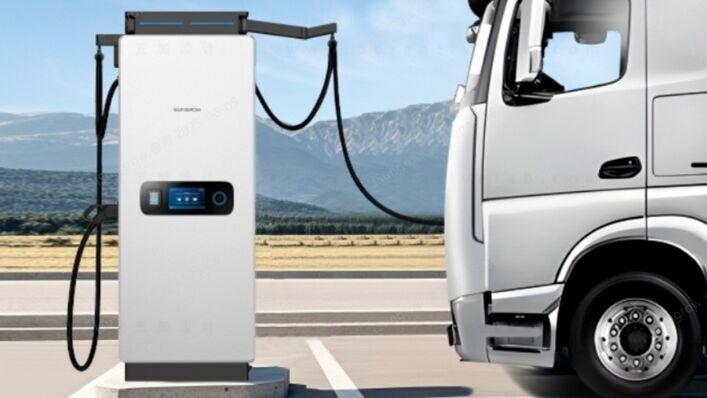
To meet these requirements, special direct current (DC) charging solutions are needed. Ultra-fast chargers make it possible to quickly charge heavy-duty vehicles and are designed for continuous operation under high loads.
However, these high-performance chargers bring new challenges along with their advantages: depending on the location, complex approval and grid connection procedures are required. In addition, high charging capacities (from around 480 kW) can significantly strain the local power grid. In many countries, the grid is already at capacity in many areas, making the connection of new charging parks very difficult.
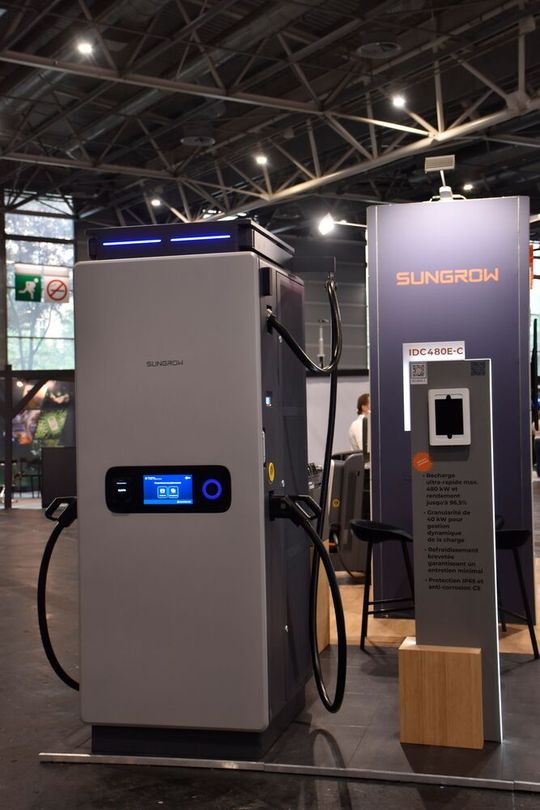
DC fast charging station IDC480
(Image: Sungrow)
Hybrid Solutions as a Bridging Technology
One solution approach is hybrid charging systems, which combine PV systems with stationary battery storage and electric charging stations. The battery systems are placed between the grid and the charging infrastructure, buffering the electricity and balancing peak loads. This offers the advantage that vehicles can be continuously charged with self-generated green electricity, even when grid availability is weak.
In combination with efficient DC charging infrastructure, scalable systems with low operating costs and clean energy are created. The goal is a grid-relieving, robust, and flexible charging infrastructure for fleets. Sungrow has already implemented initial projects in Greece, Italy, and Bulgaria. The hybrid systems demonstrate that economic efficiency, scalability, and sustainability can be successfully combined.
Satellite-Based Charging Infrastructure as a Flexible Concept
Another approach is the so-called satellite-based charging systems. Here, a central power unit of up to 500 kW supplies several decentralized charging points, the so-called satellites. The central unit contains all the power electronics such as rectifiers, controls, and cooling. From there, the satellites are supplied with electricity.
This intelligently distributes the charging power to the connected vehicles, increasing the efficiency of the charging system, especially with varying utilization. At the same time, it saves costs in operation: the technology only needs to be centrally installed once, and the satellites are cost-effective and low-maintenance. Additionally, they can be flexibly positioned, making location planning easier. This is a significant advantage, especially for fleet owners who need to keep an eye on their operational and site costs, as it allows investments and running costs to be significantly optimized.
Date: 08.12.2025
Naturally, we always handle your personal data responsibly. Any personal data we receive from you is processed in accordance with applicable data protection legislation. For detailed information please see our privacy policy.
Consent to the use of data for promotional purposes
I hereby consent to Vogel Communications Group GmbH & Co. KG, Max-Planck-Str. 7-9, 97082 Würzburg including any affiliated companies according to §§ 15 et seq. AktG (hereafter: Vogel Communications Group) using my e-mail address to send editorial newsletters. A list of all affiliated companies can be found here
Newsletter content may include all products and services of any companies mentioned above, including for example specialist journals and books, events and fairs as well as event-related products and services, print and digital media offers and services such as additional (editorial) newsletters, raffles, lead campaigns, market research both online and offline, specialist webportals and e-learning offers. In case my personal telephone number has also been collected, it may be used for offers of aforementioned products, for services of the companies mentioned above, and market research purposes.
Additionally, my consent also includes the processing of my email address and telephone number for data matching for marketing purposes with select advertising partners such as LinkedIn, Google, and Meta. For this, Vogel Communications Group may transmit said data in hashed form to the advertising partners who then use said data to determine whether I am also a member of the mentioned advertising partner portals. Vogel Communications Group uses this feature for the purposes of re-targeting (up-selling, cross-selling, and customer loyalty), generating so-called look-alike audiences for acquisition of new customers, and as basis for exclusion for on-going advertising campaigns. Further information can be found in section “data matching for marketing purposes”.
In case I access protected data on Internet portals of Vogel Communications Group including any affiliated companies according to §§ 15 et seq. AktG, I need to provide further data in order to register for the access to such content. In return for this free access to editorial content, my data may be used in accordance with this consent for the purposes stated here. This does not apply to data matching for marketing purposes.
Right of revocation
I understand that I can revoke my consent at will. My revocation does not change the lawfulness of data processing that was conducted based on my consent leading up to my revocation. One option to declare my revocation is to use the contact form found at https://contact.vogel.de. In case I no longer wish to receive certain newsletters, I have subscribed to, I can also click on the unsubscribe link included at the end of a newsletter. Further information regarding my right of revocation and the implementation of it as well as the consequences of my revocation can be found in the data protection declaration, section editorial newsletter.
Intelligent Control and Artificial Intelligence
To ensure that satellite-based and hybrid charging systems function reliably even under high utilization, software plays a crucial role. Artificial intelligence (AI) is increasingly being used to efficiently manage the operation and maintenance of the infrastructure.
An example of this is AI-supported systems that continuously analyze the condition of the technology and detect early signs of component wear or impending malfunctions. Maintenance operations can thus be planned strategically, reducing downtime and ensuring stable operation.
In addition, the software enables automatic fault prediction. If a technical problem occurs or is imminent, responsible technicians or the service team are immediately notified. This improves response time and ensures greater operational safety.
Strategic Partnerships for Individual Solutions
To plan and implement such systems precisely, Sungrow works closely with fleet operators, municipal companies, and transportation firms. Direct collaboration is essential to enable adjustments to specific operational processes and ensure flexible project implementation. Particularly with depot solutions consisting of a combination of PV, battery storage, and DC charging technology, such close cooperation is a key success factor.
Conclusion: Charging Infrastructure Must be Capable of Intelligent Thinking
The electrification of heavy-duty fleets offers enormous potential to reduce CO₂ emissions in transportation. However, for the transition to succeed, more than conventional charging stations from the passenger car sector is needed. What is required are powerful systems that meet the specific demands of transport and logistics operations.
Hybrid charging solutions with buffer storage, centrally controlled satellite systems, and intelligent software for control and maintenance form the technical backbone for this transition. The key is that these systems are scalable, robust, and capable of being operated economically.
Those who invest early in well-designed charging infrastructure that not only provides energy but also thinks ahead can actively shape the transformation process in heavy-duty transport. This pays off in the long term for both businesses and the climate. (se)
*Robert von Wahl is Director of EV Charging Europe at Sungrow.



:quality(80)/p7i.vogel.de/wcms/53/f7/53f7dadbe4d656a3fd4f4077445f29f6/0129828707v1.jpeg "Thanks to its compact design and drilling/unscrewing function, the Fire Birdie is suitable for applications with limited installation space and frequent tool changes. (Image:Marcel Kraibühler)")
:quality(80)/p7i.vogel.de/wcms/95/97/95976dbaac68b249eb65e74c5aad5300/0129651893v1.jpeg "The C2.0 centric clamps, the S2 fixed jaw clamps and the \"gredoc\" zero-point clamping systems are used for machining the raw parts. Fastening is carried out with width across flats 27. (Image:Gressel)")
:quality(80)/p7i.vogel.de/wcms/57/1b/571b8895efb299d70846bbdbd7af2338/0130043886v1.jpeg "Servo hydraulics independent of the control system: The servo hydraulics software module is integrated directly into the b Maxx 5500 servo drive (pictured: Mehmet Sari, Export Sales Manager at Hürsan Pres (left), Özgür Deniz Demirbaş, Country Manager at Baumüller Turkey) (Image:Baumüller)")
:quality(80)/p7i.vogel.de/wcms/c2/57/c257474faf6095a24bacfd98524bc7f8/0130090188v1.jpeg "With the Coromill MR20 milling system, the cutting tool specialist Sandvik Coromant is bringing a product that should make a name for itself in tool and mold making, as well as in aerospace components, to what the manufacturer claims it can do ... (Image:Sandvik Coromant)")
:quality(80)/p7i.vogel.de/wcms/fd/93/fd93e01c16f5a4709278499d981a459c/0130061090v1.jpeg "Revealed: These servo drives are assembled at Aerotech in Fürth. (Image:Aerotech)")
:quality(80)/p7i.vogel.de/wcms/ad/9d/ad9d709c690b7420468ea3d935a1c97f/fairground1-webp-2560-2560x1440v1.jpeg "(Source: Messe Frankfurt (HK) Ltd Taiwan Branch)")
:quality(80)/p7i.vogel.de/wcms/ab/23/ab2371c186380215b8311d1aeb4e47df/0130095643v1.jpeg "Geointelligent supply chain management provides valuable information, for example, about which control unit a microchip is installed in. (Picture: ©Aleksandr Matveev - stock.adobe.com)")
:quality(80)/p7i.vogel.de/wcms/b4/01/b401c197e3591f2bec3fb84ae810ac80/0130096280v1.jpeg "Only prophecies of doom! Jensen Huang, the head of chip giant Nvidia, dismisses any concerns that the huge sums currently being invested in AI data centers will not turn a profit one day ... (Image:Nvidia)")
:quality(80)/p7i.vogel.de/wcms/da/4d/da4da8d34671dc6bce80e496212de877/0129850788v1.jpeg "Mate-XT Go supports the arms and shoulders during overhead work and repetitive tasks and is designed to significantly reduce muscle strain in everyday working life. (Image:Comau)")
:quality(80)/p7i.vogel.de/wcms/3f/cc/3fccb748b0fe16f1f61249d94c72f126/0130149439v1.jpeg "Requirements for integrated power supply systems: Precise AC and DC power supply systems that not only provide energy, but also reliably combine measurement, analysis and system integration. (Image:Schulz Electronic)")
:quality(80)/p7i.vogel.de/wcms/cb/8a/cb8ae7f5205365efce3e7285154fc3cf/0130132198v1.jpeg "Markus Huber (left) and Nicolai Friis from TU Wien know how to make quantum computers multidimensional in order to perform computing operations even better. (Image:TU Vienna / A. Rommel)")
:quality(80)/p7i.vogel.de/wcms/94/7a/947ac066b98cbcd3470e83ff9da3e25f/0130096114v1.jpeg "The use of amorphous steels in the stator enables a significant reduction in losses and increases the efficiency of modern electric motors in vehicle drives. (Image:Horse Powertrain)")
:quality(80)/p7i.vogel.de/wcms/90/db/90db3087d3af0560fcdb4dbc42443ce1/0130157448v1.jpeg "The switch to SDV is the most complex transformation the industry has ever had to master. The end consumer gets a vehicle that gains rather than loses value over its lifetime. (Image:Sonatus)")
:quality(80)/p7i.vogel.de/wcms/73/f0/73f00bb99a23197db05bb584fe78f20f/0130080581v1.jpeg "The \"China Speed\" analysis by Roland Berger shows that the speed of development has only a limited connection with labor costs. (Image:freely licensed at Pexels)")
:quality(80)/p7i.vogel.de/wcms/2f/5b/2f5ba6a150b52c2b8efada560c5cdafe/0130143442v1.jpeg "Automotive suppliers are facing a severe crisis, which is primarily due to a combination of structural change and economic problems. (Image:freely licensed at Pexels)")
:quality(80)/p7i.vogel.de/wcms/22/d0/22d03cd48e992435338b59464c428d41/0129739814v1.jpeg "More electric vehicles on the roads mean a higher demand for electricity - which should ideally be covered by renewable energies. (Image:BMW)")
:quality(80)/p7i.vogel.de/wcms/3b/27/3b27f6c5848be73acecb04054bf0a146/0130115209v1.jpeg "Spectroscopic glucose measurement with infrared spectroscopy enables more regular measurements without physical strain. (Image:Endrich)")
:quality(80)/p7i.vogel.de/wcms/e5/f1/e5f171d3d7ae021332cc0aeae4d6e299/0130127049v1.jpeg "In collaboration with Shanghai Jiao Tong University, Lenovo has presented a silicon anode battery under the name \"ED1000\" as a proof of concept for mobile workstations. (Image:Lenovo)")
:quality(80)/p7i.vogel.de/wcms/fa/69/fa696e59706b96fff02283dd74cc2398/0130129635v1.jpeg "Samsung Co-CEO Jun Young-hyun wants to respond to the AI-driven boom in demand in the memory market with contracts for up to five years. This should provide more planning security in the traditionally volatile storage business. At the same time, however, this is likely to increase the pressure on customers to secure precise long-term requirements, prices and supply chains. (Image:Samsung)")
:quality(80)/p7i.vogel.de/wcms/31/a8/31a883a47b86634c382923e78fd9a4c9/0130133225v1.jpeg "Figure 1: GMSL-capable point-to-point connection. (Image:ADI)")
:fill(fff,0)/images.vogel.de/vogelonline/companyimg/76800/76895/65.jpg "FAULHABER_120mm.jpg ()")
:fill(fff,0)/p7i.vogel.de/companies/67/eb/67eba621ef6ea/logo2.png "logo2 (Wuxi InfiMotion)")
:quality(80):fill(efefef,0)/p7i.vogel.de/wcms/67/ad/67adf92d254d2/elatec-wp-smart-factory.png "Elatec WP Smart Factory")
:quality(80)/p7i.vogel.de/wcms/5e/39/5e3951345b3503d78f8a9e335f0f663d/0129069312v1.jpeg "The Scienlab Charging Discovery System SL1047A—High-Power Series (left). The Megawatt Charging Discovery System SL2600A (right) and its hardware expansion systems for electric vehicles and charging stations (far right). (Image:Keysight Technologies)")
:quality(80)/p7i.vogel.de/wcms/29/18/29183430a1f02c59158a77e1d4517996/0126042099v1.jpeg "The swapping of batteries could play a role in the future not only for electric cars but also for cargo ships (symbol image). (Image:freely licensed under Pixabay)")