CERN expels RussiaWhen Does Scientific Neutrality Give Way to Political Responsibility?
From
Manuel Christa
| Translated by AI
6 min Reading Time
CERN ends its collaboration with Russia and Belarus as a consequence of the war in Ukraine. The decision triggers controversial discussions in the international scientific community.
CERN ends its collaboration with Russia.
(Image: AI-generated)
As of November 30, it is over: The European Organization for Nuclear Research (CERN) has officially ended its cooperation with Russia and Belarus. This decision was made in response to the Russian war of aggression against Ukraine taken a year ago and marks the end of a collaboration that spanned over 70 years.
With the expiration of the agreements, CERN makes it clear that it is targeting state institutions and not individuals. At the same time, CERN emphasizes that the scientific community remains dependent on cooperation even in difficult times, which has led to controversial discussions among the member states.
End of a 70-year-old partnership
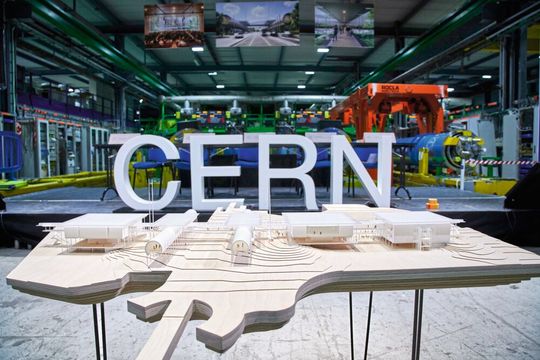
Without Russia and Belarus, only 24 countries are involved in CERN.
(Image: CERN)
CERN, the operator of the world's largest particle accelerator, the Large Hadron Collider (LHC), had already decided in March 2022, as an initial reaction, not to enter into any new collaborations with Russia and Belarus. The new agreement, which took effect at the end of 2024, is a direct continuation of this line and now also ends all existing scientific agreements with the two countries. The aim of this measure is to draw political and moral consequences from the war in Ukraine without completely abandoning scientific neutrality.
CERN emphasized that the measure is not directed against individual researchers. Scientists from Russia who are affiliated with CERN through other institutions can continue to participate in international projects. However, the decision affects around 500 researchers from Russia and Belarus who previously worked directly at CERN or were involved in projects. This gap in the scientific workforce poses new challenges for the organization.
Impacts on international research
By excluding Russia and Belarus, CERN not only loses financial contributions but also significant scientific expertise. Russia previously contributed about 4.5 percent of the annual budget, which amounts to around 11 million Swiss francs (approximately 10.2 million euros). This funding gap is now to be filled by contributions from other member states. Nevertheless, it remains unclear how quickly the financial and structural impacts can be compensated.
The loss of Russian engineering expertise, which plays a key role in numerous areas of high-energy physics, is particularly painful. Russian specialists had developed and maintained components of the Large Hadron Collider. Experts pointed out that the loss of expertise will cripple ongoing and future projects. Initial delays in newly started experiments have already been reported.
In addition, the political decision could have long-term consequences for international scientific collaboration. Researchers warn that permanently isolating Russia could sustainably weaken the global research community. At the same time, the measure shows that scientific institutions are increasingly taking political stances, which was less common in the past.
However, this is also observed in Russian research institutions: For example, Russia has voluntarily withdrawn from several international collaborations. These include projects in Arctic research, which have been partly discontinued in favor of national strategies, as well as reduced participation in the ITER fusion project. In space exploration, Russia has also limited its cooperation with western partners such as ESA, while simultaneously prioritizing its own programs.
Historical connection between CERN and Russia
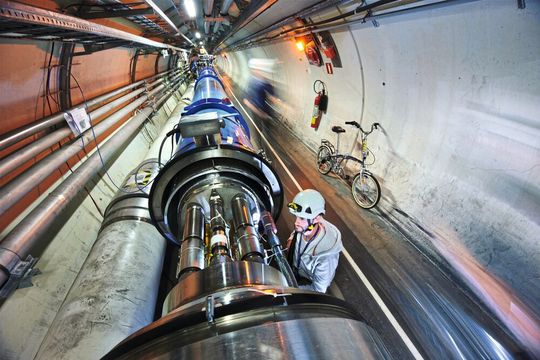
The Large Hadron Collider (LHC) at CERN is the world's largest and most powerful particle accelerator.
(Image: Brice, Maximilien; CERN)
Since the 1960s, Russia has been closely associated with CERN. Russian researchers have significantly contributed both scientifically and technologically to numerous successes at CERN, including the discovery of the Higgs boson in 2012, which was a milestone in particle physics. Russian engineers also developed important technologies, including superconducting magnet coils, precision cooling systems for the Large Hadron Collider, and highly sensitive detector elements used in particle detectors and accelerators.
Belarus also played a role in CERN's international research cooperation, particularly through the provision of highly specialized components and collaboration in the development of detector technologies. This close partnership made it possible to achieve significant advances in basic research and to decisively shape CERN's scientific infrastructure.
Both countries have contributed to groundbreaking developments in high-energy physics over the decades. However, the current development marks the end of a phase of close collaboration that lasted over seven decades despite political tensions. The conflict in Ukraine has now permanently shaken this foundation.
Date: 08.12.2025
Naturally, we always handle your personal data responsibly. Any personal data we receive from you is processed in accordance with applicable data protection legislation. For detailed information please see our privacy policy.
Consent to the use of data for promotional purposes
I hereby consent to Vogel Communications Group GmbH & Co. KG, Max-Planck-Str. 7-9, 97082 Würzburg including any affiliated companies according to §§ 15 et seq. AktG (hereafter: Vogel Communications Group) using my e-mail address to send editorial newsletters. A list of all affiliated companies can be found here
Newsletter content may include all products and services of any companies mentioned above, including for example specialist journals and books, events and fairs as well as event-related products and services, print and digital media offers and services such as additional (editorial) newsletters, raffles, lead campaigns, market research both online and offline, specialist webportals and e-learning offers. In case my personal telephone number has also been collected, it may be used for offers of aforementioned products, for services of the companies mentioned above, and market research purposes.
Additionally, my consent also includes the processing of my email address and telephone number for data matching for marketing purposes with select advertising partners such as LinkedIn, Google, and Meta. For this, Vogel Communications Group may transmit said data in hashed form to the advertising partners who then use said data to determine whether I am also a member of the mentioned advertising partner portals. Vogel Communications Group uses this feature for the purposes of re-targeting (up-selling, cross-selling, and customer loyalty), generating so-called look-alike audiences for acquisition of new customers, and as basis for exclusion for on-going advertising campaigns. Further information can be found in section “data matching for marketing purposes”.
In case I access protected data on Internet portals of Vogel Communications Group including any affiliated companies according to §§ 15 et seq. AktG, I need to provide further data in order to register for the access to such content. In return for this free access to editorial content, my data may be used in accordance with this consent for the purposes stated here. This does not apply to data matching for marketing purposes.
Right of revocation
I understand that I can revoke my consent at will. My revocation does not change the lawfulness of data processing that was conducted based on my consent leading up to my revocation. One option to declare my revocation is to use the contact form found at https://contact.vogel.de. In case I no longer wish to receive certain newsletters, I have subscribed to, I can also click on the unsubscribe link included at the end of a newsletter. Further information regarding my right of revocation and the implementation of it as well as the consequences of my revocation can be found in the data protection declaration, section editorial newsletter.
Political and scientific tensions
CERN's decision has met with mixed reactions in the international community. While many member countries welcome the clear stance against the war, there are also voices warning of the politicization of science. Particularly controversial is the ongoing collaboration with the Joint Institute for Nuclear Research (JINR) based in Russia. This institution is considered one of the most important centers for nuclear research and traditionally maintains close ties with international partners.
The JINR is an international research institution based in Dubna and maintains close ties with CERN. Critics argue that continuing cooperation with JINR despite the war sends a mixed message. Supporters, on the other hand, argue that this helps maintain the separation of science and politics. Another aspect is the uncertainty about how the conflict will affect JINR's funding and its scientific agenda.
"Science as a bridge between conflicting parties"
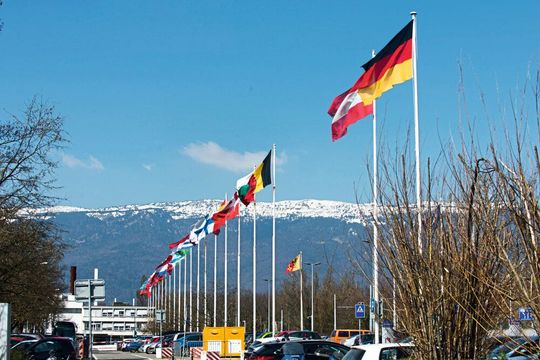
Since 30.11.2024, no Russian flag flies in front of CERN anymore.
(Image: Brice, Maximilien: CERN)
At the same time, there are growing voices calling for scientific contacts in other areas to be maintained to build bridges for future collaboration. For instance, former CERN Director Rolf-Dieter Heuer stated that science should always be a bridge between conflicting parties. Heuer emphasized in several interviews that science speaks a universal language that enables understanding across political and cultural boundaries. Especially in times of conflict, it is important to maintain scientific dialogues to restore trust and cooperation in the long term.
International research networks such as the SESAME project (Synchrotron-Light for Experimental Science and Applications in the Middle East) demonstrate cross-border cooperation, even in politically difficult times. SESAME, the synchrotron project in the Middle East, was developed under extremely challenging conditions and unites countries with sometimes tense political relationships such as Israel, Iran, and Palestine. The project stands as a symbol of the possibility of using scientific collaboration as a basis for dialogue and rapprochement, regardless of geopolitical tensions.
Future cooperation with Asia and America
CERN faces the challenge of closing the financial and scientific gaps caused by the exclusion of Russia and Belarus. Some member states have already pledged to increase their contributions to balance the budget. Additionally, CERN is increasingly relying on collaborations with other international partners to compensate for the loss of Russian expertise. In particular, partnerships with Asian and American research institutes are coming into sharper focus.
The scientific community is intensely discussing how to manage the long-term consequences of the decision. Both technical questions and how to deal with researchers from the affected countries are in focus. Some experts suggest creating special programs to integrate affected researchers to avoid completely losing their expertise. Despite the tense situation, CERN emphasizes its willingness to resume collaboration with Russian researchers once the political situation calms down.
Science in times of political crises
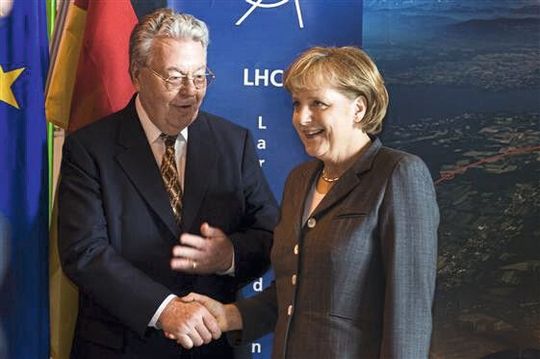
Merkel 2008 visiting CERN: Can science be entirely apolitical?
(Image: Maximilien Brice, CERN)
CERN's decision highlights the complex relationship between science and politics in times of international conflict. Many organizations strive to position themselves neutrally: for example, the International Red Cross, which operates in crisis areas such as Syria, Afghanistan, or Ukraine despite geopolitical tensions. Or the SESAME project, which enables cooperation between conflicting parties.
CERN's expulsion of Russia exemplifies a trend of suspended or terminated collaborations between Russian and Western research organizations. For instance, the European Space Agency (ESA) originally planned to send a rover to Mars in cooperation with the Russian space agency Roscosmos as part of the ExoMars program. However, due to geopolitical tensions and resulting sanctions against Russia, the mission was postponed. ESA ended its collaboration with Roscosmos in 2022 and plans to independently launch the Rosalind Franklin Rover. The launch is scheduled for 2028, with arrival on Mars in 2030. With Russian rockets, the rover was supposed to launch in 2022.
CERN's move illustrates that scientific institutions increasingly have to balance scientific neutrality and political responsibility. This development is driven by geopolitical tensions and the pressure from member states to send clear signals against violations of international law. However, it's not only Russia that is penalized, but also science itself. (mc)



:quality(80)/p7i.vogel.de/wcms/dd/08/dd086510d9ae7b50181f6070e4463b44/0129363730v1.jpeg "Typical application for ionizing devices: Wrapping films. (Picture: ©Adobe Stock/SMC)")
:quality(80)/p7i.vogel.de/wcms/35/57/3557c819943c53acec41a0ccba87da4f/0130049064v1.jpeg "Researchers at the Fraunhofer IWU in Chemnitz have long known that many typical sheet metal parts can be manufactured more cost-effectively using hollow embossing rollers. Now there is news to report ... (Image:Fraunhofer IWU)")
:quality(80)/p7i.vogel.de/wcms/59/02/590246e3b3f415c65edbee377c14ca77/26-06-pi-fraunhofer-iws-41450-direktplattieren-pic-01-7771x4369v1v1.jpeg "The Fraunhofer IWS has developed the new \"direct laser cladding\" process, which creates a functional layer directly on the base body by applying a strip-shaped metal to rotationally symmetrical components in a spiral and bonding it locally by laser. (Image:Christoph Wilsnack/Fraunhofer IWS)")
:quality(80)/p7i.vogel.de/wcms/73/60/73608418789b1d9c393f5e2fa974eda2/0130209906v1.jpeg "The robots of the X6 generation from b+m enable very high painting quality and are also particularly compact and easy to maintain. (Image:Beckhoff)")
:quality(80)/p7i.vogel.de/wcms/78/e9/78e9188c25a8a94e67c34c9bf8ffe495/visual-agile-20robots-20and-20google-20deepmind-20partner-20to-20bring-20intelligence-20to-20robotics-2500x1406v1v1.jpeg "Together, the partners are developing adaptable, intelligent robots for a wide range of applications (Image:Agile Robots SE)")
:quality(80)/p7i.vogel.de/wcms/e7/66/e7669ecf0260ae8fc54c214e34e4902a/0130316817v1.jpeg "Siemens and Palo Alto Networks offer tested cybersecurity solution for industrial 5G. (Image:Siemens)")
:quality(80)/p7i.vogel.de/wcms/9f/55/9f55324832c4f426958031375124d9de/siemens-20ubtech-20hmnd-1920x1079v1v1.png "Ready for the factory floor: While Ubtech is planning mass production, Siemens is already testing humanoids in real factory applications in Erlangen. (Image:Siemens)")
:quality(80)/p7i.vogel.de/wcms/11/36/113695ed260e29c8c2d9d39dc5f9d869/0130213768v1.jpeg "AI can work cheaply in China and deliver the results rapidly all over the world. (Image:Dall-E / AI-generated)")
:quality(80)/p7i.vogel.de/wcms/62/5f/625f41e87ebfef156a98c8e6393e32fd/0130211654v1.jpeg "Axial flux motors have some advantages over radial flux motor—but their production is currently still expensive. (Image:RWTH Aachen University)")
:quality(80)/p7i.vogel.de/wcms/77/9b/779b0685d010dfe45c9c2cb1cfecd467/0128886425v1.jpeg "The BlueEye is the first \"real\" hyperspectral camera for the UV range and covers the wavelength range from 220 to 380nm. (Image:Inno-spec GmbH)")
:quality(80)/p7i.vogel.de/wcms/e4/51/e451d52ce0182fb0aaa46a5774f832ef/26-04-pi-fraunhofer-iws-21160-bioslide-pic-01-4128x2321v1v1.jpeg "With the BioSlide research project, the Fraunhofer IWS is investigating how sliding systems can be designed to be more sustainable and energy-efficient. New materials can be tested in a particularly application-oriented manner on this plain bearing test stand. (Image:Fraunhofer IWS)")
![Thanks to advanced 3D printing technology, a more efficient use of resources should contribute to lower-emission aviation—this is the goal of ['skai]-lab. (Image:Oleksandr Pashchenko - stock.adobe.com / AI-generated)](https://cdn1.vogel.de/nghHNSbySccfOjG3n1qCA-FVOjQ=/288x162/smart/filters:format(jpg):quality(80)/p7i.vogel.de/wcms/62/64/626424c97a16e69f871bf216c9629c2a/adobestock-1927043193--c2-a9-20oleksandr-20pashchenko-20-e2-80-93-20stock-adobe-com-ki-generiertv1v1.jpeg "Thanks to advanced 3D printing technology, a more efficient use of resources should contribute to lower-emission aviation—this is the goal of ['skai]-lab. (Image:Oleksandr Pashchenko - stock.adobe.com / AI-generated)")
:quality(80)/p7i.vogel.de/wcms/c3/c4/c3c4ce270b083eeac55654148611f064/0130237945v1.jpeg "China is not giving up on hydrogen, but is intensifying its efforts. (Image:freely licensed from Pixabay)")
:quality(80)/p7i.vogel.de/wcms/4e/c0/4ec0bd19390b169edfa23677373dcdf1/0130260089v1.jpeg "Renewable fuels can supply European road traffic, according to a study. (Image:Aral)")
:quality(80)/p7i.vogel.de/wcms/6f/c9/6fc9050301d745cad25585c6780f8f51/0130197341v1.jpeg "Production facilities are a worthwhile target and are therefore at risk. (Image:ABB Robotics)")
:quality(80)/p7i.vogel.de/wcms/b6/62/b662adc2cec8227d8172509bbfb6ee42/25c0207-107-4961x2789v1v1.jpeg "The GLB is the second model based on Mercedes' new MMA platform. Apparently, Geely's platform is better and cheaper, which is why the two companies are negotiating a partnership. (Image:Mercedes-Benz)")
:quality(80)/p7i.vogel.de/wcms/4d/dd/4dddf438e91f394c04a095dbfd109d1c/0130236430v1.jpeg "Measurement modules: The 720301 module in combination with the SL2000 enables RMS and power calculations, among other things. (Image:Yokogawa)")
:quality(80)/p7i.vogel.de/wcms/61/fc/61fcf95f5cca15494ad18343901ae585/0130317237v1.jpeg "With the AGI CPU, Arm says it is taking a \"historic step\": With the processor aimed at AI in data centers, the company is presenting itself for the first time as a provider of its own chips, not just as a pure IP licensor. (Image:Arm)")
:quality(80)/p7i.vogel.de/wcms/82/90/8290dfe3595b6c6b33726ae8b76172c7/0130319587v1.jpeg "The concept image illustrates how the pattern of tiny protrusions and depressions created on the substrate (MgO, bottom) controls the arrangement of atoms in the superconducting material (YBCO, top). At the interface between the two layers, an electronic structure enables superconductivity to occur at higher temperatures than previously possible. (Image:Chalmers University of Technology / Riccardo Arpaia)")

:quality(80)/p7i.vogel.de/wcms/4a/fc/4afc30771f753638231c295763076227/0128254291v1.jpeg "The global situation is causing many countries to feel more threatened than just a few years ago. As a result, defense spending is also increasing to ensure protection. The world's 100 leading defense companies, such as Lockheed Martin with the new F-35 fighter jet, are benefiting. (Image:Lockheed Martin)")
:quality(80)/p7i.vogel.de/wcms/c9/07/c90759646ad50fd0080ce1bc840fa614/0128524691v1.jpeg "A prerequisite for the challenge was a robot that can process at least 15 kg of moon rock, weighs a maximum of 60 kg, and generates as little dust as possible during operation. (Image:FZI)")