Bluetooth 6 introduces channel sounding, a precise and secure distance-measuring technology, that significantly enhances device interaction. Damon Barnes, Director of Technical Marketing at the Bluetooth SIG, highlights in an interview with our sisterbrand ELEKTRONIKPRAXIS how this advancement impacts IoT and embedded applications. This development enables more accurate, secure, and efficient device-to-device positioning, an essential feature for emerging IoT solutions, from indoor navigation to proximity-based services.
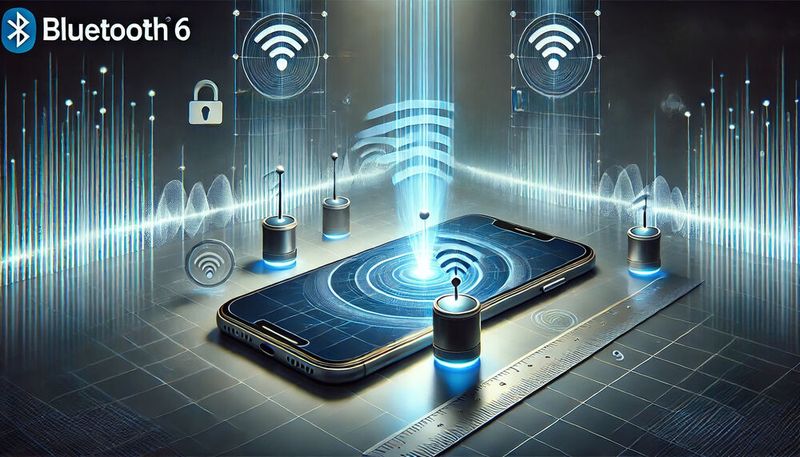
Channel Sounding: The new Bluetooth standard combines various proven methods for wireless distance measurement.
(Image: AI-generated / DALL-E)
With Bluetooth specification 6.0, the Bluetooth Special Interest Group (SIG) is introducing a new core feature to the wireless connectivity standard, which should be of particular interest to IoT applications: Channel Sounding should enable developers to measure distances in the centimeter range while meeting the highest security requirements.
This innovation centers on phase-based ranging (PBR) and round-trip time (RTT) technologies, which not only deliver high-precision measurements but also enhance security by countering cyber threats. In this interview with ELEKTRONIKPRAXIS, Damon Barnes, Director of Technical Marketing at the Bluetooth SIG, outlines how channel sounding enhances device interactions in practical settings. He also addresses the challenges involved in integrating these advancements into existing infrastructures, emphasizing both the opportunities and technical complexities that Bluetooth 6’s channel sounding brings to IoT and embedded systems.
Mr. Barnes, how does Bluetooth Channel Sounding fit into the overall trends in IoT and smart device development, especially in terms of accuracy and security?
Damon Barnes, Director of Technical Marketing at the Bluetooth SIG.
(Image:Bluetooth SIG)
The performance of smart IoT devices has increased continuously. Bluetooth Channel Sounding is an example of this trend. For more than a decade, developers have been using Bluetooth RSSI to estimate the distance between two devices so that Bluetooth devices can better recognize each other and thus work more intelligently, responsively and intuitively.
Channel Sounding now offers centimeter-accurate measurements over considerable distances. This meets the requirements of most applications. Key examples include more secure digital keys and Bluetooth locks as well as Bluetooth-based industrial HMI solutions to increase personnel safety.
Channel Sounding is introducing two new distance estimation methods into the Bluetooth specification: phase-based ranging (PBR) and round-trip time (RTT). Can you briefly explain these two methods?
Damon Barnes, Bluetooth SIG: With Bluetooth Channel Sounding, devices such as IoT devices can find each other with significantly higher accuracy than with the classic RSSI (Received Signal Strength Indicator). This relative indicator for the received field strength of an incoming signal is more susceptible to interference from external factors.
Imagine searching for your lost keys in a cluttered room. In the past, using the Bluetooth signal strength indicator RSSI was like using a flashlight with a very weak beam. You could only vaguely see the area where your keys might be located. It was difficult or impossible to determine the exact position.
Bluetooth now uses two proven distance measurement methods, phase-based ranging (PBR) and round trip time (RTT), for precise and reliable distance measurement between two devices with Bluetooth functionality. This is called Bluetooth Channel Sounding.
With PBR, an initiator device sends a signal to a reflector device, which sends it back. This process is repeated over several frequencies. The exact distance between the two devices is then calculated using the phase difference between the transmitted and received signals of the frequencies.
In addition, Bluetooth Channel Sounding uses a secondary distance measurement that also provides IT protection and cyber security. Round-Trip-Time (RTT) is a defense against sophisticated Man-in-the-Middle (MITM) relay attacks. With RTT, a Bluetooth-enabled initiator device sends cryptographically encrypted packets to a reflector device, which sends these packets back. The distance between the devices is then calculated based on the time it took for the packets to travel back and forth.
For which applications and in which scenarios would you prefer phase-based ranging (PBR) to round trip time (RTT) or vice versa?
The use of PBR and RTT in Bluetooth channel sounding is not an either-or decision. The two methods complement each other. Phase-based ranging (PBR) is used for precise distance measurement between two devices, while the main purpose of round-trip time (RTT) is attack-proof distance measurement. Data and information transmission via Bluetooth is thus secured against criminal eavesdropping and cyber data attacks, threats and leaks.
Which specific applications in the areas of IoT, industrial automation or embedded systems will benefit from the higher accuracy of distance detection through Bluetooth Channel Sounding?
Bluetooth RSSI already enabled developers to equip a so-called "Find My Device" with distance awareness. With PBR and RTT, the distance measurement between two Bluetooth products is no longer based on an approximate accuracy that deviates from the actual distance, but on an exact location. This enables companies and organizations to develop compelling location solutions, including the current "Find My" network functions for end users. These search for car keys, for example. Companies benefit from asset tracking systems, for example, which are already used in many commercial and industrial contexts.
Date: 08.12.2025
Naturally, we always handle your personal data responsibly. Any personal data we receive from you is processed in accordance with applicable data protection legislation. For detailed information please see our privacy policy.
Consent to the use of data for promotional purposes
I hereby consent to Vogel Communications Group GmbH & Co. KG, Max-Planck-Str. 7-9, 97082 Würzburg including any affiliated companies according to §§ 15 et seq. AktG (hereafter: Vogel Communications Group) using my e-mail address to send editorial newsletters. A list of all affiliated companies can be found here
Newsletter content may include all products and services of any companies mentioned above, including for example specialist journals and books, events and fairs as well as event-related products and services, print and digital media offers and services such as additional (editorial) newsletters, raffles, lead campaigns, market research both online and offline, specialist webportals and e-learning offers. In case my personal telephone number has also been collected, it may be used for offers of aforementioned products, for services of the companies mentioned above, and market research purposes.
Additionally, my consent also includes the processing of my email address and telephone number for data matching for marketing purposes with select advertising partners such as LinkedIn, Google, and Meta. For this, Vogel Communications Group may transmit said data in hashed form to the advertising partners who then use said data to determine whether I am also a member of the mentioned advertising partner portals. Vogel Communications Group uses this feature for the purposes of re-targeting (up-selling, cross-selling, and customer loyalty), generating so-called look-alike audiences for acquisition of new customers, and as basis for exclusion for on-going advertising campaigns. Further information can be found in section “data matching for marketing purposes”.
In case I access protected data on Internet portals of Vogel Communications Group including any affiliated companies according to §§ 15 et seq. AktG, I need to provide further data in order to register for the access to such content. In return for this free access to editorial content, my data may be used in accordance with this consent for the purposes stated here. This does not apply to data matching for marketing purposes.
Right of revocation
I understand that I can revoke my consent at will. My revocation does not change the lawfulness of data processing that was conducted based on my consent leading up to my revocation. One option to declare my revocation is to use the contact form found at https://contact.vogel.de. In case I no longer wish to receive certain newsletters, I have subscribed to, I can also click on the unsubscribe link included at the end of a newsletter. Further information regarding my right of revocation and the implementation of it as well as the consequences of my revocation can be found in the data protection declaration, section editorial newsletter.
The advantages of channel sounding are obvious: developers use it to ensure that a lock only opens when the authorized device is within a defined close range. This significantly reduces the risk of unauthorized access through man-in-the-middle (MITM) relay attacks on digital access solutions and keys. End customers can find their Bluetooth-enabled devices—such as hearing aids, keys or headphones—more quickly. Precise localization gives customers greater user convenience and a better device experience. Bluetooth Channel Sounding therefore offers significant added value.
In addition to Find My and Digital Key solutions, Bluetooth Channel Sounding has the potential to support many other systems on networked IoT devices. For example, Bluetooth Human Interface Devices (HID) such as computer mice, keyboards or game controllers can now automatically switch between active and inactive states depending on how far away they are from a Bluetooth-connected smartphone or tablet. This offers completely new, user-friendly and simplified interactions in our networked world of work and leisure with embedded systems, hybrid workstations and seamless Bluetooth connectivity of keyboards or when gaming.
For Bluetooth Human-Machine Interface (HMI) solutions in industrial environments, Channel Sounding increases the safety of personnel by only allowing the use of certain equipment from a safe distance. Similarly, Bluetooth device networks, such as for wireless lighting control, can use this new standard to self-optimize their configuration to improve system performance or save energy. These are just a few of the countless application scenarios.
How do multipath reflections affect the accuracy of distance estimation in conventional Bluetooth implementations? How are these effects mitigated by channel probing?
Challenging RF environments, including multipath, interference and back-pocket scenarios, typically affect the accuracy of distance measurement, regardless of the wireless technology used. For example, Wi-Fi, UWB and even GPS exhibit some performance degradation in challenging RF environments.
Adaptive Frequency Hopping (AFH) enables Bluetooth transmission, including Bluetooth Channel Sounding, to work reliably in difficult RF environments. This is because Bluetooth includes standardized functions and techniques for overcoming interference and for finding and using the clearest transmission path in the presence of various interferences such as multipath reflections.
For example, Bluetooth uses the frequency hopping spread spectrum (FHSS) method as AFH. Bluetooth divides the frequency band into smaller channels and quickly hops back and forth between these channels when transmitting packets. AFH can also adapt the hopping sequence. Channels that are noisy and busy are dynamically tracked and avoided when sending packets.
Bluetooth Channel Sounding can support devices with multiple antennas. More antennas provide alternative path options for interference mitigation. This helps to identify the shortest, most stable and secure path for exchanging communication signals even when multipath reflections are present. The use of multiple antennas also helps to maintain the accuracy of distance measurements in difficult RF environments with Bluetooth Channel Sounding.
What challenges can arise when integrating Bluetooth Channel Sounding into existing Bluetooth Low Energy (BLE) devices, especially in terms of power consumption, hardware functions or security implementation?
Bluetooth Channel Sounding has a completely new protocol stack, including a physical layer (PHY). This means that end devices may require an upgrade of the Bluetooth LE integrated circuit (IC) to support Bluetooth Channel Sounding. The power consumption is not significantly increased by Bluetooth Channel Sounding.
How does Bluetooth Channel Sounding improve security for applications such as digital keys and asset tracking?
The use of the second measurement method RTT provides an additional layer of security. The verification of PBR measurements increases IT protection against complex man-in-the-middle relay attacks. Security experts consider breaking through both protection methods undetected with a threat to be very complex. App engineers, developers and IT security architects who rely on this combined approach increase company and asset protection and improve the user experience (UX) at the same time. Security, process optimization and simpler workflows now go hand in hand with Bluetooth Channel Sounding.
How does the integration of cryptographically encrypted packets in RTT increase the security of Bluetooth Channel Sounding?
The integration of encrypted packets into round-trip time increases the security of Bluetooth channel probing by protecting the time data exchanged between devices from potential attacks and making it much more difficult for an attacker to compromise the RTT packet exchange between two Bluetooth devices. Scrambling encrypts the packets with a cryptographic key so that the data is unintelligible to anyone without the correct decryption key. This process prevents attackers from intercepting, delaying or manipulating the data packets to compromise the distance measurement between the devices—a common criminal technique in relay attacks.
Cryptographic encryption ensures that only the intended Bluetooth devices can decrypt and accurately use the time information. This preserves the integrity of the distance measurements and makes the Bluetooth connection much more secure. This applies in particular to sensitive data transfers with application scenarios such as digital keys and access control.
The Bluetooth core specification 6.0, which includes channel sounding, was introduced in September this year. When can we expect the first major implementations?
The first products such as chips, modules and stacks from Rohde & Schwarz or Nordic Semiconductor are expected to be launched on the market this year. The new Channel Sounding standard should then be available for Bluetooth-enabled end products such as cell phones, tags and trailers from 2025.
(sg)
This interview was first published on our sisterbrand www.ELEKTRONIKPRAXIS.de (German language)



:quality(80)/p7i.vogel.de/wcms/eb/2b/eb2bd1b8487afe577b37363cd02f16ff/0113143253v1.jpeg "In our China Market Insider, we regularly provide you with relevant information straight from China. (Image:© Eisenhans - stock.adobe.com)")
:quality(80)/p7i.vogel.de/wcms/dd/b8/ddb8edc98c49b384734ab2432b297eb5/adobestock-1913662309--irene-stock-adobe-com-ki-generiertv1.jpeg "Rotary joints are used in grippers and swivel mechanisms to allow assemblies to rotate or swivel smoothly relative to one another, even under very high loads (illustrative image). (Source: Irene - stock.adobe.com / KI-generiert)")
:quality(80)/p7i.vogel.de/wcms/d1/ef/d1ef6b6f7d4543f7999980bacccaf22b/0133499261v1.jpeg "As the growing imbalance in trade relations with China continues to widen, the EU Chamber of Commerce foresees a day when trade with China will have to be seriously reevaluated ... (Image: AI-generated)")
:quality(80)/p7i.vogel.de/wcms/fe/1f/fe1fa5ee713f94deaba963dc24c3abc5/0133299273v1.jpeg "The Flexistar enables highly flexible production of laser-welded tubes thanks to its tool-free clamping system. (Image:Because Technology, LLC)")
:quality(80)/p7i.vogel.de/wcms/60/ef/60ef4f07e4829b2c2929befc0f353c58/0133511729v1.jpeg "Humanoid robots can match human performance in certain tasks. (Image:Gemini / AI-generated)")
:quality(80)/p7i.vogel.de/wcms/2e/99/2e99726b522e4b35b690e25eb6a42643/0133463991v1.jpeg "Robotics: In AMR applications, connection technology must reliably transmit power, signals, and data despite vibration and shock loads—in very confined spaces and in a way that allows for regular maintenance. (Image:Hyperever)")
:quality(80)/p7i.vogel.de/wcms/d0/18/d01801e3d5dbd7bc9d0b4f60408b630c/0133468429v1.jpeg "Quality requirements for film packaging are on the rise. At the same time, many companies are turning to recyclable film materials, which, however, have their own challenges. Fraunhofer researchers have therefore developed a fast system that detects problems in real time. (Image:Fraunhofer IKTS)")
:quality(80)/p7i.vogel.de/wcms/b1/06/b106cf44923ce39565c3264982fd20eb/0133414574v1.jpeg "Robots Build Robots: At the new Ubtech factory, automated systems even handle parts of the material supply and logistics for the production of humanoid robots. (Image:Ubtech)")
:quality(80)/p7i.vogel.de/wcms/c0/52/c052f405eb55fc3d08c4837e77206fc0/adobestock-2021845957--aucartstudio-stock-adobe-com-ki-generiertv1.jpeg "An innovation from China to combat extreme summer heat: A novel coating lowers temperatures. (Source: © AucArtStudio – stock.adobe.com_AI-generated)")
:quality(80)/p7i.vogel.de/wcms/66/a7/66a7b78159caeacce57136529688799f/0133503398v1.jpeg "Sunlight Makes Stone! These stone blocks weren't made the traditional way. Instead, they were additively manufactured from sand using a laser. In the future, however, the laser is set to be replaced by concentrated sunlight—if the startup Addisol is successful... (Image:Addisol / F. Fiedler)")
:quality(80)/p7i.vogel.de/wcms/72/b9/72b995c2c8d812c5e2115cbef31e035a/0133462727v1.jpeg "Eggl manufactures center hoods that are precisely tailored to each cooking island—whether standard size or custom shape. They are made entirely of stainless steel and are individually customized in terms of size and filter arrangement. (Image:SPI)")
:quality(80)/p7i.vogel.de/wcms/13/5d/135dfae6229ceaf5c55467a43e8f7257/adobestock-1879961393--ardi-stock-adobe-com-ki-generiertv1.jpeg "Annoying chatterboxes or awkward silences in response to questions—a moderator should specifically prepare for difficult situations in order to navigate them effectively. (Image:ardi - stock.adobe.com_AI-generated)")
:quality(80)/p7i.vogel.de/wcms/3e/2f/3e2f1ec6c4e1a24eac32957acebd0901/0133601693v1.jpeg "From the boule (bottom) to the wafer to the chip (on top of the boule). Transistors are used as switches in power electronics. (Image:Bosch)")
:quality(80)/p7i.vogel.de/wcms/8f/99/8f9956e7dce99d1b28c27fb1c30ea236/04-dsc-2230v1.jpeg "Bosch is cutting jobs in Nuremberg. (Source: Bosch)")
:quality(80)/p7i.vogel.de/wcms/aa/a2/aaa2c6dd2daa24b485cddbf9297590c0/0133467318v1.jpeg "Battery Monitoring: Battery monitoring using electrochemical impedance spectroscopy offers several advantages. (Image:TI)")
:quality(80)/p7i.vogel.de/wcms/39/b2/39b21bf03be1683831862239a369987c/0133469638v1.jpeg "Data from autonomous vehicles and robots operating autonomously is in high demand, and Ruqi wants to capitalize on this. (Image:Ruqi Mobility)")
:quality(80)/p7i.vogel.de/wcms/28/28/2828c5261714321afb0bab67bf771823/0133353387v1.jpeg "The 130-meter-long China Zorrilla draws its power from a battery system with a capacity of more than 40 MWh. Eight electric motors drive an equal number of water jets. (Image:Incat Australia Pty Ltd)")
:quality(80)/p7i.vogel.de/wcms/48/15/4815da27c45973ca629a99b375ac3aef/0133509585v1.jpeg "Ventuno Q RoadTest: Designed to help the Element14 community gain practical insights from real-world tests using the Ventuno Q. (Image:Farnell/Element14)")
:quality(80)/p7i.vogel.de/wcms/17/2b/172bd132f9febdfcbcedba292ad0504d/aufmacherv1.jpeg "Micro-Epsilon offers a wide range of IO-Link-compatible sensors. (Source: Micro-Epsilon Messtechnik GmbH & Co. KG)")
:quality(80)/p7i.vogel.de/wcms/ca/b4/cab46fd26d19d6a2febca032048200b6/0133471827v1.jpeg "Photonics SDK for C and Python: Computational operations are now abstracted as standard mathematical functions. (Image:Q.ANT)")

:quality(80)/p7i.vogel.de/wcms/c8/0a/c80aeec79db9cd126901b4180ed65013/0130942000v1.jpeg "Vital wearables can be protected with a special security ASIC. (Image:Christine Danloff)")
:quality(80)/p7i.vogel.de/wcms/db/01/db0155d9e7ca9fd069bd9bd4161f4d1b/0127315728v1.jpeg "Hackers have become the mafia of the digital age. They block systems, steal sensitive data, and extort money. They no longer operate as individuals in backrooms but as professionally organized groups equipped with top-notch technology. Their targets include both international corporations and medium-sized and small businesses. (Image:Bystronic/Justin Wood)")