With the first electrically pumped semiconductor laser for continuous operation, the previously missing piece of the silicon photonics puzzle sees the light of day. An international team at the Jülich Research Center has crafted the technological marvel from elements of the fourth main group.
Research Center Jülich has announced a breakthrough in silicon photonics.
(Image: Filipe Martins and Anna Kobylinska)
This groundbreaking advancement in silicon photonics enables the seamless integration of optical and electronic components on a single chip.
A breakthrough at the nanoscale
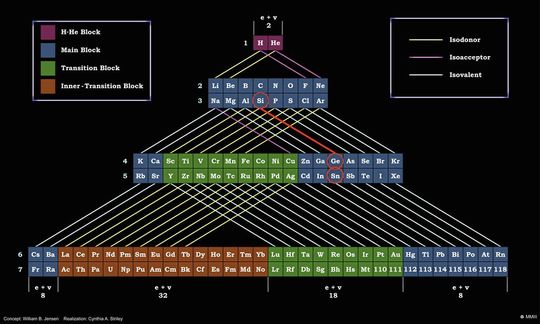
An electrically pumped laser uses electrical signals (i.e., current) to excite electrons and holes in quantum wells. This triggers light emission without needing an external light source. Unlike an optically pumped laser, which requires additional laser sources or lamps, this electrically pumped laser can be fully integrated into a microchip. Made exclusively from group IV materials—the so-called "silicon group"—this laser can be produced on standard silicon wafers in existing semiconductor processes.
Since the laser from Jülich is made from materials of the fourth main group—specifically silicon-germanium-tin—it is fully compatible with existing CMOS technology.
(Image: William B. Jensen)
With the electrically pumped laser, Jülich has overcome a significant obstacle in on-chip photonics. Essential photonic components such as high-performance modulators, photodetectors, and waveguides have already been successfully integrated into silicon chips. However, an efficient light source for photonic chips was missing until now. The new laser fills this gap.
"For almost a decade, we have been exploring the fascinating possibilities of germanium-tin alloys (GeSn)," says Dr. Dan Buca, research director at the Peter Grünberg Institute—Semiconductor Nanoelectronics (PGI-9) at the Jülich Research Center.
(Image: Jülich Research Center)
The research group led by Dr. Dan Buca at the Peter Grünberg Institute (PGI-9) of Forschungszentrum Jülich, in collaboration with partners such as IHP, the University of Stuttgart (Germany) CEA-Leti, C2N-Université Paris-Sud (France), and Politecnico di Milano (Italy), has demonstrated the versatility of GeSn alloys in applications ranging from photonics and electronics to thermoelectrics and spintronics. "We have been exploring the fascinating possibilities of germanium-tin alloys (GeSn) for almost a decade," says Dr. Dan Buca.
With this new laser, the vision of fully integrated silicon photonics, combining optical and electronic functionalities on a single chip, is within reach. Although the new laser represents a significant technological breakthrough, the task is not yet complete. On the to-do list are tasks such as lowering the laser threshold and ensuring stable operation at room temperature. The advances with optically pumped germanium-tin lasers, which can now be operated at room temperature, demonstrate the potential for future developments.
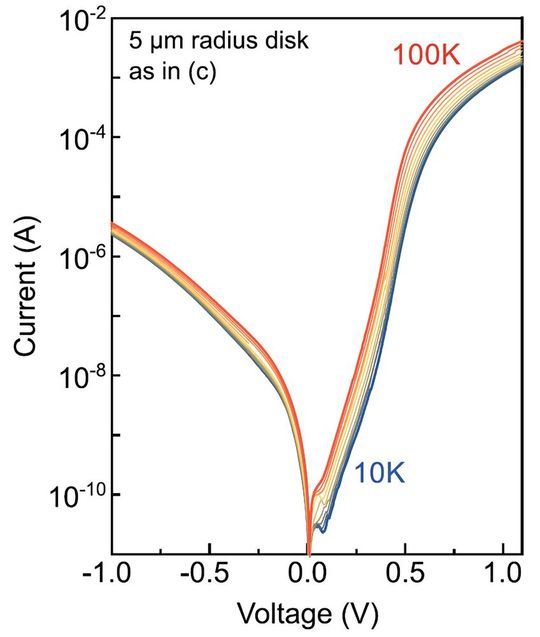
Current-voltage characteristics of the microdisk laser for temperatures ranging from 10 K to 100 K.
(Image: Jülich Research Center)
An optically pumped laser is excited by an external light source to produce light emission. This means that the laser light is initiated by supplying energy in the form of light of other wavelengths (e.g., with another laser or a lamp). While this method is technically feasible, it is not efficient enough for many practical applications, especially when integrating the laser directly into chips.
The ability to operate optically pumped GeSn lasers at room temperature demonstrates that the germanium-tin material system is fundamentally capable of achieving high efficiency and stability even under standard conditions. This is a promising indication that electrically pumped GeSn lasers, like the one from Jülich (Germany), could also be operated at room temperature with further material and structural improvements.
Quantum mechanical effects in different bandgaps
The operation of the laser is based on a multi-quantum well structure (MQW). An MQW structure is a central design in semiconductor physics that improves the efficiency and performance of lasers and other optoelectronic devices.
A multi-quantum well structure consists of alternating ultrathin layers of two materials with different band gaps. Layers with a smaller band gap— the so-called quantum wells—trap electrons and holes, while the intervening layers with a larger band gap serve as barriers that enclose these particles and keep them in the quantum wells. The laser from Jülich combines ultrathin layers of silicon-germanium-tin (SiGeSn) and germanium-tin (GeSn) for this purpose.
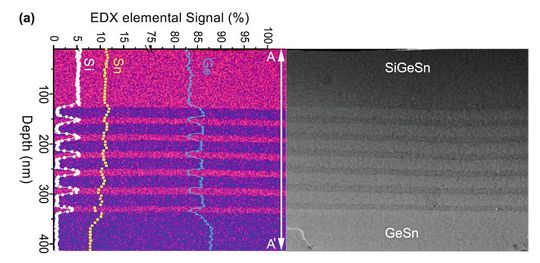
MQW structure in SiGeSn/GeSn: A cross-section of the MQW in transmission electron microscopy (TEM) with a Ge and Sn elemental 2D map in energy-dispersive X-ray spectroscopy (EDX), overlaid with a diagram of the elemental concentrations of silicon (Si), germanium (Ge), and tin (Sn).
(Image: Jülich Research Center)
GeSn exhibits a smaller band gap than pure germanium, making light emission in the technologically important wavelengths of the infrared range (for example, between 2 and 3 micrometers wavelength) more efficient, which reduces energy consumption. These wavelengths are particularly suitable for data transmission and sensing. Since SiGeSn and GeSn are fully compatible with silicon wafers, they can be directly integrated into CMOS manufacturing, simplifying production and reducing costs.
In semiconductor physics, the term "holes" refers to missing electrons in an otherwise fully occupied valence band of a semiconductor material. These holes behave like positively charged particles. The extremely thin layers (only a few nanometers thick) generate quantum mechanical effects that allow precise control of the electronic and optical properties, including efficient light emission.
Date: 08.12.2025
Naturally, we always handle your personal data responsibly. Any personal data we receive from you is processed in accordance with applicable data protection legislation. For detailed information please see our privacy policy.
Consent to the use of data for promotional purposes
I hereby consent to Vogel Communications Group GmbH & Co. KG, Max-Planck-Str. 7-9, 97082 Würzburg including any affiliated companies according to §§ 15 et seq. AktG (hereafter: Vogel Communications Group) using my e-mail address to send editorial newsletters. A list of all affiliated companies can be found here
Newsletter content may include all products and services of any companies mentioned above, including for example specialist journals and books, events and fairs as well as event-related products and services, print and digital media offers and services such as additional (editorial) newsletters, raffles, lead campaigns, market research both online and offline, specialist webportals and e-learning offers. In case my personal telephone number has also been collected, it may be used for offers of aforementioned products, for services of the companies mentioned above, and market research purposes.
Additionally, my consent also includes the processing of my email address and telephone number for data matching for marketing purposes with select advertising partners such as LinkedIn, Google, and Meta. For this, Vogel Communications Group may transmit said data in hashed form to the advertising partners who then use said data to determine whether I am also a member of the mentioned advertising partner portals. Vogel Communications Group uses this feature for the purposes of re-targeting (up-selling, cross-selling, and customer loyalty), generating so-called look-alike audiences for acquisition of new customers, and as basis for exclusion for on-going advertising campaigns. Further information can be found in section “data matching for marketing purposes”.
In case I access protected data on Internet portals of Vogel Communications Group including any affiliated companies according to §§ 15 et seq. AktG, I need to provide further data in order to register for the access to such content. In return for this free access to editorial content, my data may be used in accordance with this consent for the purposes stated here. This does not apply to data matching for marketing purposes.
Right of revocation
I understand that I can revoke my consent at will. My revocation does not change the lawfulness of data processing that was conducted based on my consent leading up to my revocation. One option to declare my revocation is to use the contact form found at https://contact.vogel.de. In case I no longer wish to receive certain newsletters, I have subscribed to, I can also click on the unsubscribe link included at the end of a newsletter. Further information regarding my right of revocation and the implementation of it as well as the consequences of my revocation can be found in the data protection declaration, section editorial newsletter.
When electrons in the semiconductor material are excited from the valence band to the conduction band through the input of energy—such as heat or light—vacancies, known as holes, are created at the original positions in the valence band. The holes behave like positive charge carriers at the locations of the missing electrons.
Such a hole can move in the crystal lattice when neighboring electrons jump into the gap. This creates an effect that appears as if a positive charge is moving through the material. This behavior plays a central role in electrical conductivity and light emission in semiconductors.
In a multi-quantum well structure (MQW), as used in the GeSn laser, quantized energy states for electrons and holes occur.
Quantum wells are made of materials with a smaller band gap, such as germanium-tin (GeSn). They act as traps for electrons in the conduction band and holes in the valence band by using the energy barrier to the adjacent layers (those with a larger band gap) to prevent particles from escaping. Electrons are confined in the lower energy states of the conduction band, while holes are held in the quantized states of the valence band.
The confinement of electrons and holes in the quantum wells increases the likelihood that they will recombine and generate photons.
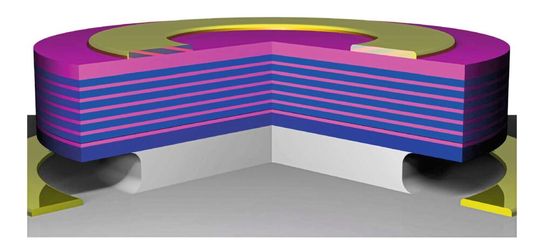
3D schematic of an undercut microdisk laser without passivation
(Image: Jülich Research Center)
An electron drops from a higher energy level in the conduction band to a lower energy level in the valence band. During this process, it recombines with a hole, and the energy difference is emitted as a photon. This recombination is the core process in a semiconductor laser.
In the structure of the laser, electrons and holes can only occupy discrete energy levels. This phenomenon enhances the interactions between light and matter, making light emission more efficient. In the quantum wells of the MQW structure, electrons and holes are spatially confined, significantly increasing the laser's efficiency in light emission. Without these holes, recombination and thus light emission could not occur.
The use of silicon-germanium-tin (SiGeSn) and germanium-tin (GeSn) enables efficient light emission in the mid-infrared range. An innovative ring geometry of the laser contributes to reducing energy consumption.
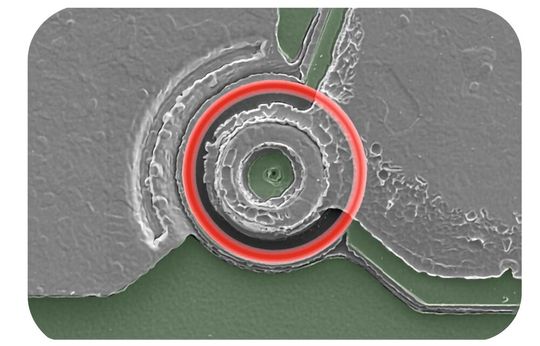
Scanning electron microscopy of a top view with the WGM region marked in red.
(Image: Jülich Research Center)
The microdisk resonator employs a ring structure instead of conventional linear or Fabry-Pérot geometries. This ring geometry forms the physical basis for generating Whispering Gallery Modes (WGM), where light is continuously guided and amplified within the ring. The close connection between the ring structure and the WGMs is a central aspect of the technological innovation of the new technological marvel from Jülich.
In the microdisk laser, light waves circulate along the inner boundary of the resonator, located near the outer edge of the ring. This is where the light is guided through total internal reflection, preventing it from escaping. Thus, the resonator amplifies the light intensity to maximize interaction with the multi-quantum well structure.
Pioneers for photonic integrated circuits (PICs)
Photonic integrated circuits (PICs) combine optical and electronic components on a single chip. An electrically pumped semiconductor laser acts as a link between the optical and electronic domains by converting electrical signals into light. This allows for the efficient integration of light sources directly on the chip, leading to higher transmission speeds and lower energy losses.
The newly developed electrically pumped semiconductor laser from the Jülich Research Center enables the seamless integration of electronic and photonic components in a photonic chip and can be manufactured in conventional semiconductor processes. This addresses a central issue of on-chip photonics and paves the way for more powerful and energy-efficient photonic systems.
The laser from Jülich operates stably with minimal heat generation under cryogenic conditions of 90 Kelvin (-183.15 degrees Celsius)—colder than liquid nitrogen. In continuous wave (CW) operation at temperatures up to a maximum of 35 Kelvin, the laser exhibits low lasing threshold currents.
A laser with low threshold currents requires less energy to initiate laser activity. The microdisk laser from the Jülich Research Center starts laser operation at a low current of about 5 milliamperes and a voltage of only 2 volts. These values are comparable to the requirements of a light-emitting diode (LED).
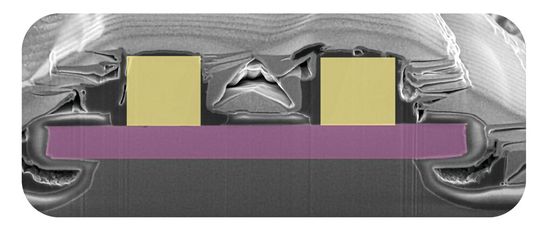
Scanning electron microscopy of a fabricated device in cross-section.
(Image: Jülich Research Center)
Conventional semiconductor lasers based on III-V materials (e.g., gallium arsenide GaAs or indium phosphide InP) typically require threshold currents in the range of 10 to 100 milliamperes for continuous wave (CW) operation, depending on the design and specific operating conditions. Although III-V semiconductors have good optical properties, they still require higher charge carrier concentrations to reach the laser threshold. As the operating temperature increases, the threshold current rises due to increasing thermal losses.
The low threshold currents are partly due to the multi-quantum well structure (MQW) used. In this structure, electrons and holes are efficiently confined in the quantum wells, increasing the probability of stimulated emission. As a result, fewer charge carriers (electrons and holes) are needed to exceed the lasing threshold.
For applications at higher temperatures, including room temperature, there is still a need for optimization, particularly regarding heat dissipation and improvement of material properties.
Future challenges include:
Increasing the operating temperature through material modifications, such as adjusting the tin and silicon content in the alloys;
Optimization of the multi-quantum well structure to achieve better carrier confinement and a higher energy band offset;
More effective cooling through changes in the laser cavity design, such as using ring cavities to reduce heat generation.
These improvements are the focus of future research efforts.
Conclusion
With the advent of artificial intelligence and IoT, the demand for hardware that can process large amounts of data quickly and energy-efficiently is growing. Optical data transmission offers significant advantages here, as it provides high bandwidths with minimal energy loss.
The laser from Jülich represents a groundbreaking advancement in silicon photonics. The electrically pumped laser provides light sources for optical communication directly on the chip. Made entirely from group IV materials—the so-called "silicon group"—this laser is directly integrable into silicon chips and can be manufactured on standard silicon wafers in existing semiconductor fabrication processes. This eliminates the complex and costly integration of III-V semiconductors. (mbf)
*Anna Kobylinska and Filipe Pereira Martins work for McKinley Denali, Inc., USA.



:quality(80)/p7i.vogel.de/wcms/8e/7a/8e7a8d7cd0b947550da99f3d888a57a6/maas-blechnetbeitrag-20blechnext-2563x1440v1v1.png "Blechnext shows that the future of sheet metal processing lies not only in better machines, but also in smarter business models. \"Machine-as-a-Service\" is not just a financing tool; it is an accelerator for digital transformation. (Image:Blechnext)")
:quality(80)/p7i.vogel.de/wcms/d3/b7/d3b76d4685cc7167034912cdc4f6ca7c/0129496821v1.jpeg "According to an Allensbach study, the majority of German machine and plant manufacturers expect to lose their technological leadership to foreign countries. (Picture: ©Photocreo Bednarek - stock.adobe.com)")
:quality(80)/p7i.vogel.de/wcms/8e/fa/8efad6aa006fcf624d07c645b774d8ce/screenshot-202026-01-21-20113324-764x430v1v1.png "The system processes heavy sheets weighing up to 200 kg fully automatically, without programming or teaching. (Image:Teqram)")
:quality(80)/p7i.vogel.de/wcms/0c/58/0c587c8221ae96052b5dcc0f40eb3dcd/0128880879v1.jpeg "A chip surfer with a solid carbide head is used for finishing in the third operation. (Image:Ingersoll)")
:quality(80)/p7i.vogel.de/wcms/93/33/93337b12f88eb2c776c80d4f9e49d323/0129247650v1.jpeg "Isolated IoT data becomes connected real-time personalization. (Image: ©PB Studio Photo - stock.adobe.com)")
:quality(80)/p7i.vogel.de/wcms/4d/74/4d745446555110ca9797db1eabb7c9d3/0129551585v1.jpeg "Jochen Gemeinhardt is responsible for NTT Data's AI business in the DACH region as Head of Production & Supply Chain and Head of Industry Line Global Business. (Image:NTT Data)")
:quality(80)/p7i.vogel.de/wcms/bc/8c/bc8c831daa7f85dbd1e44ea8fbd8089b/open-source-bild5-406x228v1v1.png "Four steps to an open source crash simulation - find out how here. (Image:Alsado)")
:quality(80)/p7i.vogel.de/wcms/af/9d/af9dc917a1eb91fd0e201d5bf8b7a57c/0129614075v1.jpeg "The future of manufacturing will be determined by demonstrable productivity gains - with more digitalization, networked data streams and simulation-based decisions. (Image:Visual Components)")
:quality(80)/p7i.vogel.de/wcms/63/c9/63c9b33f58938f4ffc2a3cefddd924e3/0129599881v1.jpeg "View of the manual casting process of a magnesium part. Apart from a few exceptions, the light metal actually leads a shadowy existence as an industrial material. However, researchers in Freiberg are now in the process of making magnesium much more attractive in terms of costs and sustainability. (Image:Metal Master)")
:quality(80)/p7i.vogel.de/wcms/6b/6f/6b6fff754fedf05375e5255460743297/0129197850v1.jpeg "A new core-shell design for anodes aims to reduce storage losses during the first charge cycle of sodium-ion batteries. (Image:BAM)")
:quality(80)/p7i.vogel.de/wcms/53/6b/536be1966f279ef2cd99509d00e79fca/0129693994v1.jpeg "Elektrobit is working on a new architecture for cockpit systems. (Image:Elektrobit)")
:quality(80)/p7i.vogel.de/wcms/b0/95/b09529a8952b5b03f1fa096af571967c/0129618836v1.jpeg "The Aurora Botnia ferry currently has the largest battery capacity of any RoPax ship in the world. (Image:Wasaline)")
:quality(80)/p7i.vogel.de/wcms/f9/12/f9126b5a89a1d631b8de7da6775583be/0129663582v1.jpeg "Audi appoints Rouven Mohr as new CTO as of March 01, 2026. (Image:Audi)")
:quality(80)/p7i.vogel.de/wcms/37/23/372374e00db2f1803ae5cde2f00aff31/0129599814v1.jpeg "The new Euro 7 standard sets requirements for the wear of service brakes. These can be met with some technical methods. (Image:Aumovio)")
:quality(80)/p7i.vogel.de/wcms/0f/b2/0fb28656d39754b67a76b90b42243cda/0129655768v1.jpeg "Driven by GaN wafer production at 300 millimeters, Infineon's GaN products deliver outstanding performance with clear application benefits. (Image:Infineon Technologies AG)")
:quality(80)/p7i.vogel.de/wcms/98/c7/98c77993453c1edf3d2bd54b0028fa6a/0129630827v1.jpeg "Left: High Bandwidth Flash (HBF) stacks multiple layers of NAND chips to significantly increase storage capacity; Right: Concept of the \"hybrid\" H³ architecture presented in the IEEE study. (Image:Sandisk (left) / Sk hynix (right))")
:quality(80)/p7i.vogel.de/wcms/ae/cf/aecf874a057676aa69b3b5e4c7b52411/0129609464v1.jpeg "Glass storage in action: Microsoft has stored map data from the Flight Simulator on this piece of glass. (Image:Microsoft Research)")
:quality(80)/p7i.vogel.de/wcms/2c/8d/2c8da4b72e35ded278178929afb94d55/0129561713v1.jpeg "Change in direction: The shift away from PFAS in semiconductor manufacturing and the move toward sustainable chip production is demonstrated by the trilateral collaboration between Fraunhofer ENAS, the Paul Scherrer Institute PSI, and Memsstar Limited, which rely on the environmentally friendly Gas-MacEtch technology. (Image:andreyarmyagov/Canva)")
:fill(fff,0)/images.vogel.de/vogelonline/companyimg/76800/76895/65.jpg "FAULHABER_120mm.jpg ()")


:quality(80)/p7i.vogel.de/wcms/cc/b7/ccb7dc654b353a3a027e5dabd8c7421f/0125723793v1.jpeg "Four in one: New semiconductor for the chips of the future The coated wafer is visually indistinguishable from a conventional one. (Image:Forschungszentrum Jülich / Jenö Gellinek)")
:quality(80)/p7i.vogel.de/wcms/6f/8f/6f8ff5bf9b81829ef22736bc790cecca/0129224894v1.jpeg "View of the quantum optics laboratory at the University of Stuttgart: here, researchers are experimenting with new photon sources for quantum computing and quantum networks. (Image:Barz Group, University of Stuttgart)")