With the PLM Portal@Bosch Rexroth, Bosch Rexroth consolidates all data of each product on a single platform: Using the digital twin technology of the Bosch Semantic Stack, a digital twin is created during product development, which accompanies the physical products throughout their entire life cycle. Uwe Haas from Bosch Rexroth explains the advantages of this.
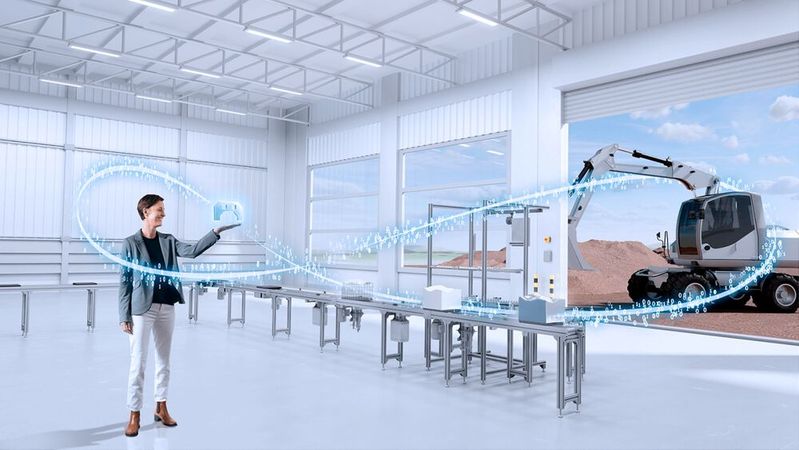
Transparent data ecosystem: Since the introduction of the PLM Portal at the beginning of 2020, about 300 million digital twins for Bosch Rexroth products have already been created and made available.
(Image: Bosch)
Mr. Haas, how did the development of the "PLM Portal@Bosch Rexroth" come about?
The idea emerged when our development leaders discussed future topics and strategic objectives. We wanted to cover skills that go beyond pure change management in digital transformation. The PLM Portal is designed to help overcome the challenges of digitalization – especially introducing powerful digital product twins at Bosch Rexroth, which will secure competitiveness in the long run.
Gallery
Uwe Haas, Head of Enabling Digital Products and Chief Product Owner for Digital Product Twin at Bosch Rexroth: "In general, all departments can benefit from the fact that data and information are centrally accessible."
(Image:Bosch)
How does the solution differ from conventional PLM systems?
PLM represents an approach to handling data throughout the entire product lifecycle. Experience has shown that a single tool cannot reflect this. Therefore, the PLM Portal is a “window into the world of data”. It is important here that access is made possible to data from different systems and information sources without the need to copy or store them separately. Thus, the domain-specific systems continue to serve their purpose and are linked together by the introduction of the PLM Portal.
So, does this mean that all data are continuously available?
Data is collected transparently and traceably across all phases of the product lifecycle, uniformly orchestrated, and made centrally accessible. The PLM Portal thus forms a digital platform for all product knowledge. Thanks to the unified access to information, not only product development benefits but also downstream domains benefit from the PLM Portal, such as service, which usually has to obtain information from various data sources.
When is the digital twin of the components created?
The digital product twin represents a digital representation of a physical product and reflects the different phases of the product lifecycle. Here, a distinction is made between a type twin and an instance twin. The type twin is created as soon as a first material number is available. It represents further information such as CAD models, bill of materials, simulation models, and customer specifications. The specific instance twin is created with the release of the manufacturing order and is the virtual representation of a product in operation, collecting all data from production through use to the end of the product life.
Does the solution offer advantages for product development?
In general, all departments can benefit from the fact that data and information are centrally accessible. This creates a so-called "single point of truth". The digital product twin enables the flow back of product usage data from the field. This allows the use of information from the instance twins (with the customer) to draw conclusions from the feedback and to identify potential improvements (in development).
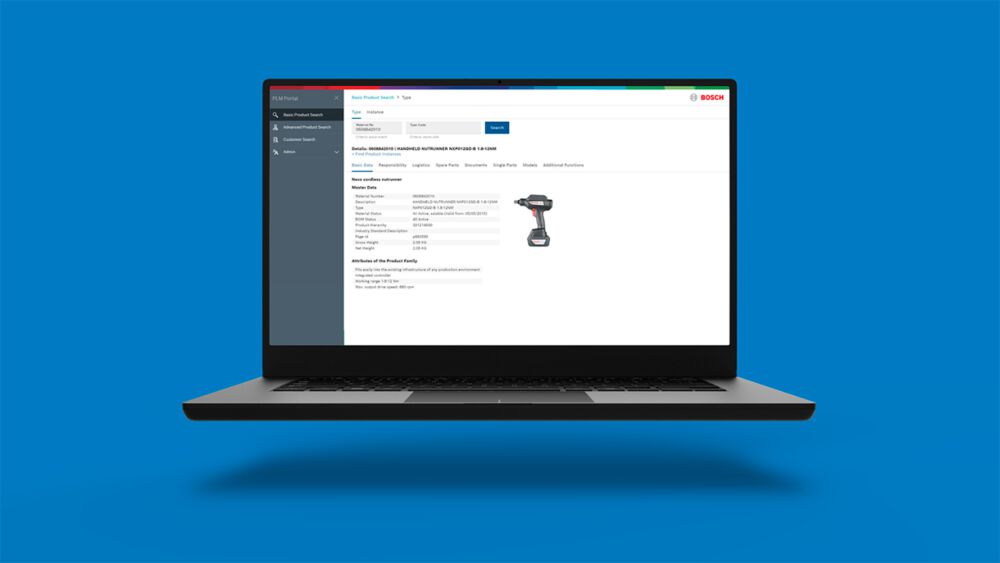
To make the data easily accessible, they are provided with generally understandable, machine-readable descriptions and their semantic context. All information about a specific product can be found in one central location, bundled into aspects such as master data, malfunctions, or maintenance history.
(Image:Bosch)
What advantages does the PLM Portal offer your design departments, for example, in the development of drive technology components?
Our designers gain comprehensive insights into all products and components from Bosch Rexroth. This way, already generated knowledge is not lost, and designers can build on it. All collected data are structured in the PLM Portal and are easily accessible. For example, designers have access to models of existing components, which they can incorporate into the design of new products. This reuse of existing knowledge results in significant time and cost advantages. Additionally, the validation process is shortened by being able to use simulation models and test results. Furthermore, designers benefit from the engineering feedback of data generated in the field.
And how do designers and developers from Rexroth customers benefit?
The standardization of data and models offers a not to be underestimated advantage in cross-company collaboration. An important driver for this standardization is the Asset Administration Shell (AAS), which is developed and published by the IDTA. Bosch and Bosch Rexroth have been involved as active members from the beginning. The AAS provides the information package, for example, the simulation model, needed for the digital representation of products and the uniform exchange of information. This decreases manual efforts as well as coordination and communication – and significantly reduces integration effort.
Do you have an example ready?
Date: 08.12.2025
Naturally, we always handle your personal data responsibly. Any personal data we receive from you is processed in accordance with applicable data protection legislation. For detailed information please see our privacy policy.
Consent to the use of data for promotional purposes
I hereby consent to Vogel Communications Group GmbH & Co. KG, Max-Planck-Str. 7-9, 97082 Würzburg including any affiliated companies according to §§ 15 et seq. AktG (hereafter: Vogel Communications Group) using my e-mail address to send editorial newsletters. A list of all affiliated companies can be found here
Newsletter content may include all products and services of any companies mentioned above, including for example specialist journals and books, events and fairs as well as event-related products and services, print and digital media offers and services such as additional (editorial) newsletters, raffles, lead campaigns, market research both online and offline, specialist webportals and e-learning offers. In case my personal telephone number has also been collected, it may be used for offers of aforementioned products, for services of the companies mentioned above, and market research purposes.
Additionally, my consent also includes the processing of my email address and telephone number for data matching for marketing purposes with select advertising partners such as LinkedIn, Google, and Meta. For this, Vogel Communications Group may transmit said data in hashed form to the advertising partners who then use said data to determine whether I am also a member of the mentioned advertising partner portals. Vogel Communications Group uses this feature for the purposes of re-targeting (up-selling, cross-selling, and customer loyalty), generating so-called look-alike audiences for acquisition of new customers, and as basis for exclusion for on-going advertising campaigns. Further information can be found in section “data matching for marketing purposes”.
In case I access protected data on Internet portals of Vogel Communications Group including any affiliated companies according to §§ 15 et seq. AktG, I need to provide further data in order to register for the access to such content. In return for this free access to editorial content, my data may be used in accordance with this consent for the purposes stated here. This does not apply to data matching for marketing purposes.
Right of revocation
I understand that I can revoke my consent at will. My revocation does not change the lawfulness of data processing that was conducted based on my consent leading up to my revocation. One option to declare my revocation is to use the contact form found at https://contact.vogel.de. In case I no longer wish to receive certain newsletters, I have subscribed to, I can also click on the unsubscribe link included at the end of a newsletter. Further information regarding my right of revocation and the implementation of it as well as the consequences of my revocation can be found in the data protection declaration, section editorial newsletter.
An example is the product specification. During the pre-design phase, it allows the customer to make data-driven decisions on the configuration of, for example, drive technology or hydraulic components. For this purpose, information of the type twin such as documentation, CAD, and simulation models are provided in a standardized format to facilitate the overall process surrounding product selection.
Another example is virtual commissioning using simulations. This supports the development of preliminary designs, reduces subsequent iterations, and results in time savings. Thus, test runs of the entire machinery can be simulated and optimizations can be made before costly and expensive investments have been made.
Can the solution also be considered a knowledge management solution?
It is not a classic knowledge management solution. However, it covers certain areas of knowledge management, such as the collection of data and products from various information sources (usage, manufacturing, service orders, etc.), and provides a semantic description. Product knowledge is consistently depicted in the PLM Portal, always provides the current information, and is accessible with just a few clicks. Thus, the PLM Portal is a kind of knowledge cockpit and entry point for all employees, such as from customer service or design. Moreover, the collection of aggregated data from the digital product twins serves as a knowledge base for data-driven decisions.
How does Bosch's approach to digital twins differ from the solutions of the IDTA?
There is no difference. On the contrary, Bosch is an active member of the IDTA board, leads among others the "Open Technology" working group, and is heavily involved in the further development of the Administration Shell (AAS). We advocate for the use of open technologies. Therefore, we consistently rely on the IDTA standard. On this basis, we have developed highly scalable solutions that can process several hundred million digital twins.
Which products from Bosch Semantic Stack are behind it?
The PLM Portal is a Software-as-a-Service (SaaS) solution specifically developed for Bosch Rexroth. It includes the following components from the Bosch Semantic Stack portfolio: In the Digital Twin Registry, the control center for digital twins, all data from the various phases of the product life cycle converge. Aspect models describe the professional context and meaning of these related data, group them, and define the data structure specific to the domain. In order for the aspect models to be easily found and reused for new use cases, a digital library or central storage location is needed: the Aspect Model Catalog. Moreover, open-source components from the Eclipse Semantic Modeling Framework (ESMF) are used, such as an editor for aspect models. Bosch actively continues to develop these open-source components together with other companies.
Are the solutions from Bosch Semantic Stack also available externally?
Like all solutions from Bosch, the solutions from the Bosch Semantic Stack portfolio were first extensively tested internally and then rolled out externally. Currently, the Digital Twin Registry, the Aspect Model Catalog, and a comprehensive service offering for our customers are available.
Does the Digital Product Twin open up further opportunities for Rexroth for the future? Where can the journey go?
With the implementation of the digital product twin, Bosch Rexroth can further increase internal efficiency. Moreover, the twin is an essential basis for data-driven products and services, which could not be implemented without extensive structuring and collection of data.
Digital product twins play an important role in addressing current challenges in the context of sustainability, recycling, and the circular economy. The information provided by the twins is an important starting point for developing and establishing solutions for these challenges. For example, requirements regarding the traceability of products, such as the Digital Product Passport (DPP), can only be met based on this informational foundation.
And for your customers and users?
This diversity of use cases continues to open up the opportunity to develop new business models, such as the sale of simulation models and services to end customers and OEMs. Customers thus have the opportunity to simulate their machines and systems and carry out a virtual commissioning before making extensive investments in physical products. Through the Digital Service Assistant (DSA) app, customers already have round-the-clock access to their digital product twins. They can access all service tools and get an overview of the status of their products at any time.
Thank you for the interview, Mr. Haas!
The Bosch Semantic Stack Tools form the user-friendly development and management environment for the Bosch Semantic Stack. They enable the optimal adaptation of the technologies to the company's own use cases. With these tools, digital twins and their associated aspects can be created and managed.
Currently, the following tools are available:
Digital Twin Registry: Depending on the manufacturing company, thousands of new Digital Twins can be "born" daily. They are digital representatives of exactly identifiable, real products such as a vehicle drive or a pump. A digital twin is often created during product development and accompanies its physical counterpart throughout the entire lifecycle up to its use by customers. All data from the different phases of the lifecycle converge here – in the phone book of digital twins.
Aspect Model Catalog: Aspect models are the main prerequisite for a new use case: They describe the professional context and the meaning of related data, group them, and determine the data structure specific to the domain. Once created, they can be reused for similar use cases – provided they are findable. This is where the Aspect Model Catalog comes in. Already elaborated aspect models are stored there in such a way that they can be quickly and easily found by all authorized groups of people and applications.
Open-Source Tools: The Bosch Semantic Stack is based on the open-source approach, for which Bosch has been advocating in committees and associations for years. This led to the creation of the Aspect Model Editor, for example, a graphical no-code editor that enables the intuitive creation of aspect models.



:quality(80)/p7i.vogel.de/wcms/53/f7/53f7dadbe4d656a3fd4f4077445f29f6/0129828707v1.jpeg "Thanks to its compact design and drilling/unscrewing function, the Fire Birdie is suitable for applications with limited installation space and frequent tool changes. (Image:Marcel Kraibühler)")
:quality(80)/p7i.vogel.de/wcms/da/4d/da4da8d34671dc6bce80e496212de877/0129850788v1.jpeg "Mate-XT Go supports the arms and shoulders during overhead work and repetitive tasks and is designed to significantly reduce muscle strain in everyday working life. (Image:Comau)")
:quality(80)/p7i.vogel.de/wcms/95/97/95976dbaac68b249eb65e74c5aad5300/0129651893v1.jpeg "The C2.0 centric clamps, the S2 fixed jaw clamps and the \"gredoc\" zero-point clamping systems are used for machining the raw parts. Fastening is carried out with width across flats 27. (Image:Gressel)")
:quality(80)/p7i.vogel.de/wcms/57/1b/571b8895efb299d70846bbdbd7af2338/0130043886v1.jpeg "Servo hydraulics independent of the control system: The servo hydraulics software module is integrated directly into the b Maxx 5500 servo drive (pictured: Mehmet Sari, Export Sales Manager at Hürsan Pres (left), Özgür Deniz Demirbaş, Country Manager at Baumüller Turkey) (Image:Baumüller)")
:quality(80)/p7i.vogel.de/wcms/3b/27/3b27f6c5848be73acecb04054bf0a146/0130115209v1.jpeg "Spectroscopic glucose measurement with infrared spectroscopy enables more regular measurements without physical strain. (Image:Endrich)")
:quality(80)/p7i.vogel.de/wcms/3f/cc/3fccb748b0fe16f1f61249d94c72f126/0130149439v1.jpeg "Requirements for integrated power supply systems: Precise AC and DC power supply systems that not only provide energy, but also reliably combine measurement, analysis and system integration. (Image:Schulz Electronic)")
:quality(80)/p7i.vogel.de/wcms/fd/93/fd93e01c16f5a4709278499d981a459c/0130061090v1.jpeg "Revealed: These servo drives are assembled at Aerotech in Fürth. (Image:Aerotech)")
:quality(80)/p7i.vogel.de/wcms/cb/8a/cb8ae7f5205365efce3e7285154fc3cf/0130132198v1.jpeg "Markus Huber (left) and Nicolai Friis from TU Wien know how to make quantum computers multidimensional in order to perform computing operations even better. (Image:TU Vienna / A. Rommel)")
:quality(80)/p7i.vogel.de/wcms/63/21/6321beb732bf7d92640df46d7aa77573/0130125122v1.jpeg "As part of the Carbon Lab Factory Lausitz, a pilot plant for the production of sustainable, cost-effective and competitive carbon fibers will be built at the Guben site. (Image:Fraunhofer IAP / Kristin Stein)")
:quality(80)/p7i.vogel.de/wcms/53/4f/534fe0f168f6ee070ded4a48faca4cef/business-wire-main-image-1103x620v1.jpeg "The new UR AI Trainer, developed by Universal Robots and Scale AI, is the first direct lab-to-factory solution for AI model training.
(Source: Universal Robots)")
:quality(80)/p7i.vogel.de/wcms/08/70/087062e2e1a9b9add5777410dd746ee9/adobestock-1923991605-5607x3156v1v1.jpeg "A new type of tactile sensor, inspired by human skin, even recognizes grains of sand. (Image:Curioso.Photography - stock.adobe.com)")
:quality(80)/p7i.vogel.de/wcms/7f/08/7f087d7013424d123ab7275cd2e3fe55/adobestock-809456218--c2-a9-20degimages-20-e2-80-93-20stock-adobe-com-ki-generiert-4179x2351v1v1.jpeg "The digital upgrading of existing machines conserves resources, saves energy and reduces the need for new production. (Image:Degimages - stock.adobe.com/AI-generated)")
:quality(80)/p7i.vogel.de/wcms/90/db/90db3087d3af0560fcdb4dbc42443ce1/0130157448v1.jpeg "The switch to SDV is the most complex transformation the industry has ever had to master. The end consumer gets a vehicle that gains rather than loses value over its lifetime. (Image:Sonatus)")
:quality(80)/p7i.vogel.de/wcms/73/f0/73f00bb99a23197db05bb584fe78f20f/0130080581v1.jpeg "The \"China Speed\" analysis by Roland Berger shows that the speed of development has only a limited connection with labor costs. (Image:freely licensed at Pexels)")
:quality(80)/p7i.vogel.de/wcms/2f/5b/2f5ba6a150b52c2b8efada560c5cdafe/0130143442v1.jpeg "Automotive suppliers are facing a severe crisis, which is primarily due to a combination of structural change and economic problems. (Image:freely licensed at Pexels)")
:quality(80)/p7i.vogel.de/wcms/22/d0/22d03cd48e992435338b59464c428d41/0129739814v1.jpeg "More electric vehicles on the roads mean a higher demand for electricity - which should ideally be covered by renewable energies. (Image:BMW)")
:quality(80)/p7i.vogel.de/wcms/94/7a/947ac066b98cbcd3470e83ff9da3e25f/0130096114v1.jpeg "The use of amorphous steels in the stator enables a significant reduction in losses and increases the efficiency of modern electric motors in vehicle drives. (Image:Horse Powertrain)")
:quality(80)/p7i.vogel.de/wcms/e5/f1/e5f171d3d7ae021332cc0aeae4d6e299/0130127049v1.jpeg "In collaboration with Shanghai Jiao Tong University, Lenovo has presented a silicon anode battery under the name \"ED1000\" as a proof of concept for mobile workstations. (Image:Lenovo)")
:quality(80)/p7i.vogel.de/wcms/fa/69/fa696e59706b96fff02283dd74cc2398/0130129635v1.jpeg "Samsung Co-CEO Jun Young-hyun wants to respond to the AI-driven boom in demand in the memory market with contracts for up to five years. This should provide more planning security in the traditionally volatile storage business. At the same time, however, this is likely to increase the pressure on customers to secure precise long-term requirements, prices and supply chains. (Image:Samsung)")
:quality(80)/p7i.vogel.de/wcms/31/a8/31a883a47b86634c382923e78fd9a4c9/0130133225v1.jpeg "Figure 1: GMSL-capable point-to-point connection. (Image:ADI)")
:fill(fff,0)/images.vogel.de/vogelonline/companyimg/76800/76895/65.jpg "FAULHABER_120mm.jpg ()")
:fill(fff,0)/p7i.vogel.de/companies/69/88/69882c428938e/tmts2026-ticec-banner-en-2000px.png "tmts2026-ticec-banner-en-2000px (https://www.tmts.tw/en)")
:fill(fff,0)/p7i.vogel.de/companies/67/eb/67eba621ef6ea/logo2.png "logo2 (Wuxi InfiMotion)")
:quality(80)/p7i.vogel.de/wcms/f4/63/f463f039bb7ddfc505f25abb36780bb3/0117276578.jpeg "Uwe Haas, Head of Enabling Digital Products and Chief Product Owner for Digital Product Twin at Bosch Rexroth: \"In general, all departments can benefit from the fact that data and information are centrally accessible.\"(Image: Bosch)")
:quality(80)/p7i.vogel.de/wcms/51/51/51512436ba5a530d6f574f25c1d09955/0116742100.jpeg "To make the data easily accessible, they are provided with generally understandable, machine-readable descriptions and their semantic context. All information about a specific product can be found in one central location, bundled into aspects such as master data, malfunctions, or maintenance history.(Image: Bosch)")

:quality(80)/p7i.vogel.de/wcms/82/e1/82e16f091de3198fd428db965f34a2a9/0124487900v1.jpeg "The growing information demand poses increasing challenges for manufacturers and operators of products and resources. (Image:Phoenix Contact)")
:quality(80)/p7i.vogel.de/wcms/ef/1e/ef1e248f58a3697ec1384f6849762d5a/0129842086v1.jpeg "Bodo will soon be hitting it off smart! Signing the memorandum of understanding in Las Vegas: Steffen Haack, Member of the Board of Bosch Rexroth, and Yoshimoto Matsuda, Managing Director of Precision Machinery & Robot Company, Kawasaki Heavy Industries. Here's what it's all about ... (Image:Bosch Rexroth)")