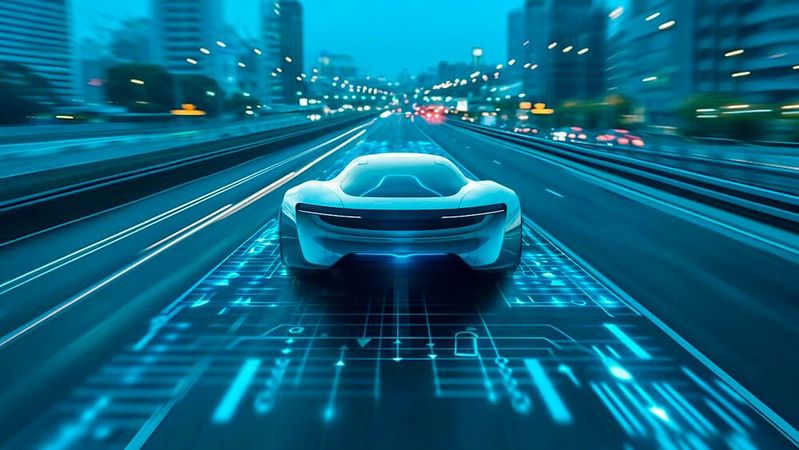
The megatrends known as Connected, Autonomous, Shared, and Electrified, or CASE for short, have triggered a global transformation in the automotive industry and are driving the shift towards software-defined vehicles. Software is no longer an "add-on" that ensures the functionality of hardware. It is the driving force that will shape the future of the automotive industry.
In an SDV, software is the central product. It enables functions such as over-the-air updates, personalized driving experiences, and automated driving. To make this possible, the way vehicles are developed and designed must be fundamentally reimagined.
(Image: Intellias)
Analysts predict exponential growth in the market for software-defined vehicles (SDVs) in the coming years, driven by advancements in artificial intelligence (AI), connectivity, and especially the increasing consumer demand for intelligent and seamlessly upgradeable vehicles. Three main factors shape this global transformation: technical foundations, organizational transformation, and changing market expectations.
Rethinking Vehicle Development
In an SDV, software is the central product. It enables functions such as over-the-air updates, personalized driving experiences, and autonomous driving (AD). To facilitate this, the way vehicles are developed and constructed must be fundamentally rethought—from the initial concept to after-sales service. Specifically, this means replacing traditional E/E architectures with zonal architectures that use high-performance computers (HPCs) to manage entire vehicle zones. This architecture increases scalability while reducing system complexity. Essentially, SDVs become adaptable digital platforms that evolve through cloud-driven software updates. This continuous evolution allows vehicles to be improved even after sale, preserving or even increasing their value over time.
Technical Fundamentals: Zonal Architectures and HPCs
With the transition from vehicles to software-defined platforms, the hardware backbone is also changing. Dozens or even hundreds of individual electronic control units (ECUs) are being replaced by centralized computing nodes that manage entire vehicle zones. This zonal architecture reduces wiring complexity by up to 30 percent, lowers vehicle weight, and simplifies the integration of key systems such as advanced driver assistance systems (ADAS), in-vehicle infotainment (IVI), and telematics.
But this transformation is not just technical. It also requires a rethink in how a vehicle is developed. Development teams in the automotive industry are called upon to adopt cross-functional, agile practices and collaborate in a manner similar to start-ups.
It should also be noted that software development no longer ends with the start of production (SOP) as it did in the past. In the SDV era, software requires continuous maintenance and iterative improvements. This ongoing development cycle enables the delivery of updates and new features, ideally throughout the entire lifecycle of the vehicle.
Software Runs on Robust Hardware
The system-on-chips (SoCs) that will be used in the next vehicle generations are designed to handle multiple, potentially critical workloads on a single chip. Manufacturers like Qualcomm, Nvidia, and Renesas have introduced SoCs such as Snapdragon Ride Flex, Nvidia Drive Thor, and Renesas R-Car X5H. These support centralized computing platforms and functions like automated driving, driver assistance systems, digital cockpits, and in-vehicle infotainment. These components create the foundation on which automakers can develop robust SDV ecosystems. Isolation mechanisms ensure that failures in one area do not affect others. The development of such systems requires a co-design approach for hardware and software, which offers several advantages:
Hardware forms the foundation for isolation, performance, and safety certification.
Software facilitates dynamic resource management, safety, and compliance with regulations.
Ultimately, software cannot ensure the required level of safety without robust hardware. Therefore, the industry's transition to software-defined vehicles depends on advancements in both areas – hardware and software.
The new SoCs enable powerful, energy-efficient solutions specifically tailored to SDVs. While hardware innovations form the basis for mixed-critical systems, software frameworks are essential for mapping the required complexity and ensuring transferability to other platforms.
Shift Left: Virtualization as a Game Changer
In the development of software-defined vehicles, virtualization has proven to be a crucial factor. It sets new standards for how software is developed, tested, and deployed. The current cloud-first engineering approaches, coupled with the "big-loop cycle," a continuous feedback loop from concept to production and back, are summarized under the term shift left. This approach accelerates development times by moving testing and validation to earlier phases of the software lifecycle. This means that even when prototype hardware is not yet available, development loops can already be conducted. With virtual electronic control units (vECUs), hardware interactions can be simulated, saving time and costs.
Through virtualization and containerization technologies, developers can create and refine software in parallel with hardware design. This is where the digital twin comes into play: a virtual replica of a vehicle or system that allows the simulation, analysis, and optimization of a real vehicle's behavior.
Date: 08.12.2025
Naturally, we always handle your personal data responsibly. Any personal data we receive from you is processed in accordance with applicable data protection legislation. For detailed information please see our privacy policy.
Consent to the use of data for promotional purposes
I hereby consent to Vogel Communications Group GmbH & Co. KG, Max-Planck-Str. 7-9, 97082 Würzburg including any affiliated companies according to §§ 15 et seq. AktG (hereafter: Vogel Communications Group) using my e-mail address to send editorial newsletters. A list of all affiliated companies can be found here
Newsletter content may include all products and services of any companies mentioned above, including for example specialist journals and books, events and fairs as well as event-related products and services, print and digital media offers and services such as additional (editorial) newsletters, raffles, lead campaigns, market research both online and offline, specialist webportals and e-learning offers. In case my personal telephone number has also been collected, it may be used for offers of aforementioned products, for services of the companies mentioned above, and market research purposes.
Additionally, my consent also includes the processing of my email address and telephone number for data matching for marketing purposes with select advertising partners such as LinkedIn, Google, and Meta. For this, Vogel Communications Group may transmit said data in hashed form to the advertising partners who then use said data to determine whether I am also a member of the mentioned advertising partner portals. Vogel Communications Group uses this feature for the purposes of re-targeting (up-selling, cross-selling, and customer loyalty), generating so-called look-alike audiences for acquisition of new customers, and as basis for exclusion for on-going advertising campaigns. Further information can be found in section “data matching for marketing purposes”.
In case I access protected data on Internet portals of Vogel Communications Group including any affiliated companies according to §§ 15 et seq. AktG, I need to provide further data in order to register for the access to such content. In return for this free access to editorial content, my data may be used in accordance with this consent for the purposes stated here. This does not apply to data matching for marketing purposes.
Right of revocation
I understand that I can revoke my consent at will. My revocation does not change the lawfulness of data processing that was conducted based on my consent leading up to my revocation. One option to declare my revocation is to use the contact form found at https://contact.vogel.de. In case I no longer wish to receive certain newsletters, I have subscribed to, I can also click on the unsubscribe link included at the end of a newsletter. Further information regarding my right of revocation and the implementation of it as well as the consequences of my revocation can be found in the data protection declaration, section editorial newsletter.
Additionally, virtualization ensures better quality and higher safety. Early detection of errors leads to more stable versions, and system isolation ensures that safety-critical areas like ADAS are protected from potential vulnerabilities in non-critical areas like infotainment.
With this set of features, virtualization is not just a supportive tool but a strategic enabler. It transforms SDV development into an agile, scalable, and cost-effective process that bridges the gap between concept and production.
Middleware: The Backbone of SDV Development
The development of an SDV is based on a diverse middleware ecosystem. The foundation is formed by real-time operating systems (RTOS) such as QNX RTOS, Green Hills Integrity RTOS, or the increasingly popular open-source system Zephyr RTOS, which offers deterministic performance and robust partitioning, making it ideal for safety-critical functions. Standards like Autosar Classic and Adaptive further enable modular, scalable development for both embedded ECUs and high-performance computing domains, supporting a wide range of applications—from body electronics to automated driving.
Building on this, various Linux-based operating systems expand flexibility and scalability to broader use cases. The EB corbos Linux, developed by Elektrobit, and the Red Hat In-Vehicle Operating System provide open-source, safety-certified platforms optimized for containerization and cloud integration. Other systems like Android Automotive OS (AAOS) and Automotive Grade Linux (AGL) bring Linux into the realm of infotainment and connected services, enabling rapid development and app integration.
At the highest level of abstraction, comprehensive SDV stacks are being developed. The Eclipse SDV initiative, with projects like Safe Open Vehicle Core (S-CORE), provides open-source foundations for embedded high-performance control units. The SDV stack from AGL expands its scope to include virtualization and cloud-native functions. Additionally, Li Auto's Halo OS offers a chip-agnostic, modular software platform for intelligent vehicles.
Together, these middleware technologies form the backbone of the SDV revolution: they enable modularity, over-the-air upgradeability, security compliance, and cross-domain integration in increasingly complex vehicle architectures.
Strategic Decision: Collaboration or Competition?
The ecosystem of the software-defined vehicle is characterized by a complex interplay of actors, each bringing unique strengths and facing different challenges. Traditional automakers have production capacities but sometimes struggle with software development and integration. IT technology leaders excel in cloud infrastructure and AI expertise but do not necessarily have experience with automotive-grade hardware and embedded systems. Automotive suppliers contribute deep expertise and key components but need to overcome fragmented software stacks and integration hurdles.
In this fragmented landscape, collaboration is crucial. Open-source platforms, shared middleware standards, and cross-industry alliances prove to be powerful tools. They help bridge gaps, accelerate development, and drive innovation on a large scale.
Against this backdrop, automakers face a strategic crossroads: either they build proprietary software platforms in-house, which are expensive and complex but allow full control, or they rely on collaborative ecosystems that offer shared infrastructure, faster deployment, and standardization. There is no one-size-fits-all solution. Success lies in the clarity of the goal, execution, and alignment with a long-term strategic vision.
Generative AI, Multimedia, and UX Developments
Generative AI is set to revolutionize in-vehicle interaction. Solutions from SoundHound and Cerence enable natural voice commands, transforming how drivers interact with their vehicles. These systems not only respond to requests but also proactively adapt to user behavior, optimizing vehicle settings and preferences in real-time. Intellias has integrated SoundHound AI as a voice-based generative AI assistant into their IntelliKit demo as part of a collaboration.
Multimedia platforms are evolving to support personalized entertainment and connectivity. The company is collaborating with 3SS to integrate the 3Ready multimedia platform into the IntelliKit demo, showcasing new infotainment capabilities.
Augmented Reality (AR) is also making its way into vehicle cockpits, enhancing driver perception and interaction. Companies like Basemark and Harman are working on AR-based solutions that overlay context-based information directly onto the windshield or display surfaces.
In the field of UI/UX and human-machine interfaces (HMI), competition is intensifying between traditional providers and new market entrants from the gaming and software industries. In addition to platforms like Kanzi, Qt, Altia, CGI, and DISTI, Unity and Unreal Engine are also relevant. They offer immersive graphics and real-time rendering capabilities. For example, Unreal Engine, in collaboration with Qualcomm, enables innovative in-vehicle experiences. Together, these developments redefine the in-vehicle experience, making SDVs more intuitive, immersive, and responsive to the individual needs of drivers and passengers. As SDVs evolve into intelligent digital platforms, user experience (UX) and multimedia capabilities become central factors for differentiation and value creation. (se)
*Adam Konopa is Technology Director Automotive at Intellias.



:quality(80)/p7i.vogel.de/wcms/53/f7/53f7dadbe4d656a3fd4f4077445f29f6/0129828707v1.jpeg "Thanks to its compact design and drilling/unscrewing function, the Fire Birdie is suitable for applications with limited installation space and frequent tool changes. (Image:Marcel Kraibühler)")
:quality(80)/p7i.vogel.de/wcms/da/4d/da4da8d34671dc6bce80e496212de877/0129850788v1.jpeg "Mate-XT Go supports the arms and shoulders during overhead work and repetitive tasks and is designed to significantly reduce muscle strain in everyday working life. (Image:Comau)")
:quality(80)/p7i.vogel.de/wcms/95/97/95976dbaac68b249eb65e74c5aad5300/0129651893v1.jpeg "The C2.0 centric clamps, the S2 fixed jaw clamps and the \"gredoc\" zero-point clamping systems are used for machining the raw parts. Fastening is carried out with width across flats 27. (Image:Gressel)")
:quality(80)/p7i.vogel.de/wcms/57/1b/571b8895efb299d70846bbdbd7af2338/0130043886v1.jpeg "Servo hydraulics independent of the control system: The servo hydraulics software module is integrated directly into the b Maxx 5500 servo drive (pictured: Mehmet Sari, Export Sales Manager at Hürsan Pres (left), Özgür Deniz Demirbaş, Country Manager at Baumüller Turkey) (Image:Baumüller)")
:quality(80)/p7i.vogel.de/wcms/3b/27/3b27f6c5848be73acecb04054bf0a146/0130115209v1.jpeg "Spectroscopic glucose measurement with infrared spectroscopy enables more regular measurements without physical strain. (Image:Endrich)")
:quality(80)/p7i.vogel.de/wcms/3f/cc/3fccb748b0fe16f1f61249d94c72f126/0130149439v1.jpeg "Requirements for integrated power supply systems: Precise AC and DC power supply systems that not only provide energy, but also reliably combine measurement, analysis and system integration. (Image:Schulz Electronic)")
:quality(80)/p7i.vogel.de/wcms/fd/93/fd93e01c16f5a4709278499d981a459c/0130061090v1.jpeg "Revealed: These servo drives are assembled at Aerotech in Fürth. (Image:Aerotech)")
:quality(80)/p7i.vogel.de/wcms/cb/8a/cb8ae7f5205365efce3e7285154fc3cf/0130132198v1.jpeg "Markus Huber (left) and Nicolai Friis from TU Wien know how to make quantum computers multidimensional in order to perform computing operations even better. (Image:TU Vienna / A. Rommel)")
:quality(80)/p7i.vogel.de/wcms/63/21/6321beb732bf7d92640df46d7aa77573/0130125122v1.jpeg "As part of the Carbon Lab Factory Lausitz, a pilot plant for the production of sustainable, cost-effective and competitive carbon fibers will be built at the Guben site. (Image:Fraunhofer IAP / Kristin Stein)")
:quality(80)/p7i.vogel.de/wcms/53/4f/534fe0f168f6ee070ded4a48faca4cef/business-wire-main-image-1103x620v1.jpeg "The new UR AI Trainer, developed by Universal Robots and Scale AI, is the first direct lab-to-factory solution for AI model training.
(Source: Universal Robots)")
:quality(80)/p7i.vogel.de/wcms/08/70/087062e2e1a9b9add5777410dd746ee9/adobestock-1923991605-5607x3156v1v1.jpeg "A new type of tactile sensor, inspired by human skin, even recognizes grains of sand. (Image:Curioso.Photography - stock.adobe.com)")
:quality(80)/p7i.vogel.de/wcms/7f/08/7f087d7013424d123ab7275cd2e3fe55/adobestock-809456218--c2-a9-20degimages-20-e2-80-93-20stock-adobe-com-ki-generiert-4179x2351v1v1.jpeg "The digital upgrading of existing machines conserves resources, saves energy and reduces the need for new production. (Image:Degimages - stock.adobe.com/AI-generated)")
:quality(80)/p7i.vogel.de/wcms/90/db/90db3087d3af0560fcdb4dbc42443ce1/0130157448v1.jpeg "The switch to SDV is the most complex transformation the industry has ever had to master. The end consumer gets a vehicle that gains rather than loses value over its lifetime. (Image:Sonatus)")
:quality(80)/p7i.vogel.de/wcms/73/f0/73f00bb99a23197db05bb584fe78f20f/0130080581v1.jpeg "The \"China Speed\" analysis by Roland Berger shows that the speed of development has only a limited connection with labor costs. (Image:freely licensed at Pexels)")
:quality(80)/p7i.vogel.de/wcms/2f/5b/2f5ba6a150b52c2b8efada560c5cdafe/0130143442v1.jpeg "Automotive suppliers are facing a severe crisis, which is primarily due to a combination of structural change and economic problems. (Image:freely licensed at Pexels)")
:quality(80)/p7i.vogel.de/wcms/22/d0/22d03cd48e992435338b59464c428d41/0129739814v1.jpeg "More electric vehicles on the roads mean a higher demand for electricity - which should ideally be covered by renewable energies. (Image:BMW)")
:quality(80)/p7i.vogel.de/wcms/94/7a/947ac066b98cbcd3470e83ff9da3e25f/0130096114v1.jpeg "The use of amorphous steels in the stator enables a significant reduction in losses and increases the efficiency of modern electric motors in vehicle drives. (Image:Horse Powertrain)")
:quality(80)/p7i.vogel.de/wcms/e5/f1/e5f171d3d7ae021332cc0aeae4d6e299/0130127049v1.jpeg "In collaboration with Shanghai Jiao Tong University, Lenovo has presented a silicon anode battery under the name \"ED1000\" as a proof of concept for mobile workstations. (Image:Lenovo)")
:quality(80)/p7i.vogel.de/wcms/fa/69/fa696e59706b96fff02283dd74cc2398/0130129635v1.jpeg "Samsung Co-CEO Jun Young-hyun wants to respond to the AI-driven boom in demand in the memory market with contracts for up to five years. This should provide more planning security in the traditionally volatile storage business. At the same time, however, this is likely to increase the pressure on customers to secure precise long-term requirements, prices and supply chains. (Image:Samsung)")
:quality(80)/p7i.vogel.de/wcms/31/a8/31a883a47b86634c382923e78fd9a4c9/0130133225v1.jpeg "Figure 1: GMSL-capable point-to-point connection. (Image:ADI)")
:fill(fff,0)/images.vogel.de/vogelonline/companyimg/76800/76895/65.jpg "FAULHABER_120mm.jpg ()")
:fill(fff,0)/p7i.vogel.de/companies/67/eb/67eba621ef6ea/logo2.png "logo2 (Wuxi InfiMotion)")
:quality(80)/p7i.vogel.de/wcms/a8/d7/a8d748a29612695eec22e0fad4cbf61a/0128735143v1.jpeg "The CES takes place in Las Vegas from January 6 to 9, 2026. (Image:Consumer Technology Association (CTA))")
:quality(80)/p7i.vogel.de/wcms/90/db/90db3087d3af0560fcdb4dbc42443ce1/0130157448v1.jpeg "The switch to SDV is the most complex transformation the industry has ever had to master. The end consumer gets a vehicle that gains rather than loses value over its lifetime. (Image:Sonatus)")