Beijing's priorities for its economic course have just been readjusted. Among other things, it involves more artificial intelligence and even more green transformation.
In our China Market Insider, we regularly provide you with relevant information directly from China.
At the annual plenary session of the National People's Congress (NPC) in Beijing, which began on March 5, the key trends that are important for foreign companies in the People's Republic this year are recognizable. From the perspective of the German and European industry, its opportunities and challenges due to China's economic development, three trends are particularly relevant.
Trend 1: Even stronger focus on future technologies
First, it is clearly evident that the Chinese leadership feels validated by the "Deepseek moment" in its decision to focus even more than before on science and technology, new future technologies, and simultaneously the modernization of its traditional manufacturing industry.
The new concept of "high-quality productive forces" was already presented at the NPC session. This concept relates to key growth areas of the economy, such as artificial intelligence, biotechnology, and big data, which are driven by high-tech. The release of the LLM "R1" by Deepseek has further strengthened this development while simultaneously placing a stronger emphasis on AI and the rapid digitalization of traditional industries.
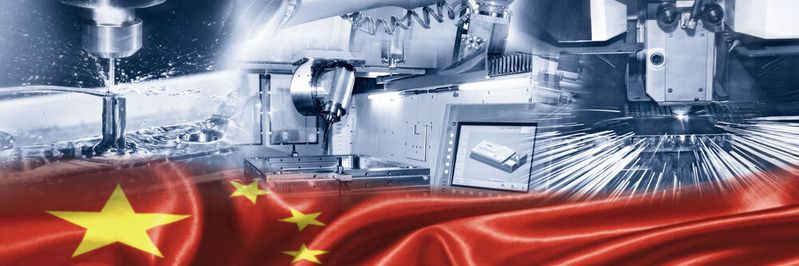
In his government report at the opening of the NPC session in the Great Hall of the People in Beijing, China's Premier Li Qiang spoke a lot about AI, but also about other strategies to modernize China's manufacturing industry, including further expansion of the 5G and 6G communication networks, the Internet of Things (IoT), as well as more digitalization, automation, and robotics.
In all these areas, there are new opportunities for German and European providers who offer strong products and services in the mentioned fields. The further, gradual opening of the Chinese economy to foreign investors, especially in the mentioned areas, was another "talking point" of the Chinese premier.
On the same day, China's Head of State and Party Leader Xi Jinping emphasized in a speech the new development model of the People's Republic—exploring new growth areas through more productivity with the help of modern science and technology.
Xi Jinping announced a "better integration of technology and industry," emphasizing the "need for qualitative improvement of traditional sectors" as well as the promotion of future technologies, state media in China reported.
These are good news for German machinery manufacturers in the high-tech sector, software providers in the areas of automation and process technology, or suppliers to the robotics industry, to name just a few examples. Overall, it's good news for all those who have cutting-edge industrial technology in their portfolio.
Trend 2: Domestic consumption is being promoted more strongly
The second, clearly discernible trend is the promotion of domestic consumption in China. The growth target for GDP in the current year has again been set at around five percent. At the NPC session, a slight easing of financial and fiscal policy toward government support for the economy was indicated.
Both internal issues such as the debt burden of local governments and the stabilizing crisis of the real estate market, as well as external issues like the trade and high-tech sanctions by the US government, were openly addressed at the NPC session.
However, what was evident at this year's NPC meeting, where thousands of delegates from all parts of the country and important government advisors such as Xiaomi founder Lei Jun gathered, was a "new wave of optimism," as the South China Morning Post in Hong Kong aptly noted in a commentary.
China's "Sputnik moment" with Deepseek not only caused a stir at home and fueled national pride but also ignites a new debate in the circles of foreign investment funds and strategic investors about the "investability in China."
Date: 08.12.2025
Naturally, we always handle your personal data responsibly. Any personal data we receive from you is processed in accordance with applicable data protection legislation. For detailed information please see our privacy policy.
Consent to the use of data for promotional purposes
I hereby consent to Vogel Communications Group GmbH & Co. KG, Max-Planck-Str. 7-9, 97082 Würzburg including any affiliated companies according to §§ 15 et seq. AktG (hereafter: Vogel Communications Group) using my e-mail address to send editorial newsletters. A list of all affiliated companies can be found here
Newsletter content may include all products and services of any companies mentioned above, including for example specialist journals and books, events and fairs as well as event-related products and services, print and digital media offers and services such as additional (editorial) newsletters, raffles, lead campaigns, market research both online and offline, specialist webportals and e-learning offers. In case my personal telephone number has also been collected, it may be used for offers of aforementioned products, for services of the companies mentioned above, and market research purposes.
Additionally, my consent also includes the processing of my email address and telephone number for data matching for marketing purposes with select advertising partners such as LinkedIn, Google, and Meta. For this, Vogel Communications Group may transmit said data in hashed form to the advertising partners who then use said data to determine whether I am also a member of the mentioned advertising partner portals. Vogel Communications Group uses this feature for the purposes of re-targeting (up-selling, cross-selling, and customer loyalty), generating so-called look-alike audiences for acquisition of new customers, and as basis for exclusion for on-going advertising campaigns. Further information can be found in section “data matching for marketing purposes”.
In case I access protected data on Internet portals of Vogel Communications Group including any affiliated companies according to §§ 15 et seq. AktG, I need to provide further data in order to register for the access to such content. In return for this free access to editorial content, my data may be used in accordance with this consent for the purposes stated here. This does not apply to data matching for marketing purposes.
Right of revocation
I understand that I can revoke my consent at will. My revocation does not change the lawfulness of data processing that was conducted based on my consent leading up to my revocation. One option to declare my revocation is to use the contact form found at https://contact.vogel.de. In case I no longer wish to receive certain newsletters, I have subscribed to, I can also click on the unsubscribe link included at the end of a newsletter. Further information regarding my right of revocation and the implementation of it as well as the consequences of my revocation can be found in the data protection declaration, section editorial newsletter.
"2025 is the year when the world of investors realizes that China has outpaced the rest of the world in competition," Deutsche Bank wrote in a report a few weeks ago. "China's 'bull market' may have just begun," Bank of America also writes in a recent report.
This new confidence in the Chinese economy is precisely the tenor of many debates in the Great Hall of the People—regardless of Donald Trump's sanctions and tariffs.
Trend 3: China remains committed to its climate policy goals
The third clear trend at this year's NPC session is not new, but its reaffirmation is all the more noticeable due to the various challenges in the domestic economy and the geopolitical tensions: China remains committed to its climate policy goals and continues to strongly focus on decarbonization, renewable energies, and all "green" industries and measures that can reduce emissions and promise more sustainability.
The "promotion of green development and transformation" is one of "ten main tasks" that Premier Li Qiang mentioned in his government report at the opening of the NPC session.
The specific, explicitly stated goals for China's "green transformation," from which concrete opportunities for German and European industrial companies can be discerned, include
the promotion of climate-friendly, energy-saving new buildings,
further support for the expansion of industrial clusters with green future industries,
more recycling and circular economy, as well as
further expansion of solar and wind energy in the People's Republic.
Secure and Compliant Authentication in Laboratories
*Henrik Bork is Managing Director at Asia Waypoint, a consultancy specializing in China, based in Beijing. "China Market Insider" is a joint project of Vogel Communications Group, Würzburg, and Jigong Vogel Media Advertising in Beijing.



:quality(80)/p7i.vogel.de/wcms/51/1b/511b420dbcc296aec09e3bffb051b8a8/0133581587v1.jpeg "The cables connect numerous machine components—often in confined spaces. (Image:Helu)")
:quality(80)/p7i.vogel.de/wcms/b5/67/b5676f3bfb36251ed31f9a0cccf650b6/0133167827v1.jpeg "Thanks to JumboFlex Generation 2, employees can effortlessly move wheelchairs weighing as much as 40 kilograms. (Image:Lard)")
:quality(80)/p7i.vogel.de/wcms/5e/c6/5ec615b7a51440f668259f2af9158cb9/0132654694v1.jpeg "Strategic Partnerships in Industry: As buyers and restructuring partners, Chinese investors are increasingly helping to preserve jobs in Germany. (Image: ©Anatolii Rymarchuk - stock.adobe.com)")
:quality(80)/p7i.vogel.de/wcms/eb/2b/eb2bd1b8487afe577b37363cd02f16ff/0113143253v1.jpeg "In our China Market Insider, we regularly provide you with relevant information straight from China. (Image:© Eisenhans - stock.adobe.com)")
:quality(80)/p7i.vogel.de/wcms/aa/3e/aa3e2603a812f8e7d33c00ba8ae28c9f/0133507886v1.jpeg "With the Iggy Rob, igus is bringing a humanoid robot into factories for a price of 47,999 euros ($54,718). (Image: igus)")
:quality(80)/p7i.vogel.de/wcms/92/64/92645c64ffbb6980976d39102388d120/0113143253v1.jpeg "In our China Market Insider, we regularly provide you with relevant information straight from China. (Image:© Eisenhans - stock.adobe.com)")
:quality(80)/p7i.vogel.de/wcms/c7/05/c70542511e0824ee491f7b55e21fa429/0133598424v1.jpeg "In logistics, AI is often implemented only on a case-by-case basis; data is stored in separate systems, and inventory levels, status values, and priorities are not defined consistently. (Image: ©m-project - stock.adobe.com)")
:quality(80)/p7i.vogel.de/wcms/3a/9c/3a9c1fd546e1f041b86bb1d03cf39101/0133610524v1.jpeg "The Mason W-01 combines industrial-grade humanoid hardware, Physical AI-based perception, and autonomous task planning. (Image:Nova X Robotics)")
:quality(80)/p7i.vogel.de/wcms/e7/94/e794290f265afbd0ffc7a06c4fe9d425/adobestock-1887113836--hypnotics-14-stock-adobe-com-ki-generiertv1.jpeg "In both autonomous driving and industrial production, there is growing skepticism as to whether full autonomy is always desirable. (Source: © Hypnotics 14 – stock.adobe.com / AI-generated)")
:quality(80)/p7i.vogel.de/wcms/a8/71/a8712e5c6ef536228444ab5275cedfe2/adobestock-340905887--gorodenkoff-stock-adobe-comv1.jpeg "A new position paper outlines the conditions that the business community, academia, and policymakers must jointly establish in order to ensure the long-term viability of industry in Germany and Europe. (Source: © Gorodenkoff – stock.adobe.com)")
:quality(80)/p7i.vogel.de/wcms/7d/eb/7deb25ca674fa4c781a9d1fab083f7cf/parker-entwicklungszentrum-hresv1.jpeg "The centerpiece of the Parker Center for Drive and Control Technology in Offenbach is the exhibition area. (Source: Parker Hannifin)")
:quality(80)/p7i.vogel.de/wcms/3d/ff/3dff5e51c24b30c8dc37c1d024887157/0133602931v1.jpeg "Just a few years ago, SpaceX specialists were working on the world’s largest rocket—the Starship. Now, Elon Musk’s company has reached a milestone during a test flight: Earth’s orbit! But there was also a downside... (Image: SpaceX)")
:quality(80)/p7i.vogel.de/wcms/78/ab/78abbfbab0565fabb19efe637aea30e8/nio-power-swap-station-4-china-guangzhou-2024-1400x933-jpgv1.webp "Nio and Geely are collaborating on battery replacement for electric cars. (Source: Nio)")
:quality(80)/p7i.vogel.de/wcms/2e/58/2e58c664e733dd182666606f850c5da4/0133400664v1.jpeg "The IM6 is sort of the crossover version of the IM5. (Image:MG Motor)")
:quality(80)/p7i.vogel.de/wcms/40/5f/405f41f4075e8798878011f0932a8195/0133509065v1.jpeg "Caruso has integrated Hyundai into its platform. (Image:Hyundai)")
:quality(80)/p7i.vogel.de/wcms/06/98/06989beb3f95b8fb06d71190c86cffde/tabletv1.jpeg "The cockpit view during a test drive in the simulator. (Source: Uccello et al., IEEE OJITS 2026)")
:quality(80)/p7i.vogel.de/wcms/40/34/4034915f85470ad8264659267e4f02d0/0133655653v1.jpeg "Cariad, Volkswagen's software subsidiary, continues to struggle. Now, another round of layoffs has been announced, which will result in the loss of many jobs ... (Image:Cariad)")
:quality(80)/p7i.vogel.de/wcms/e4/2a/e42af12e2a0816bb3d25fac9932903e9/0133646920v1.jpeg "TSMC's U.S. headquarters in Arizona: According to various media reports, the world's largest contract semiconductor manufacturer may be planning to build up to six additional fabs in the state of Texas. (Image:TSMC)")
:quality(80)/p7i.vogel.de/wcms/de/8c/de8c694e560ce8e8d7d43fa5b91917b3/0133668420v1.jpeg "Open-source AI tools: DeepSeek and Huawei are making programming tools for Ascend processors available, with the aim of simplifying development, chip communication, and AI computations on Huawei's hardware—and thereby intensifying competition with Nvidia. (Image:Dall-E / AI-generated)")
:quality(80)/p7i.vogel.de/wcms/86/25/8625a62499a6e70e629a2ddde2f01dcb/0133671173v1.jpeg "\"OpenAI\" has repeatedly experienced problems in which AI models have accessed the internet without authorization in order to carry out their tasks. The company has now fired three people whom it no longer trusts ... (Image:AI-generated)")
:fill(fff,0)/images.vogel.de/vogelonline/companyimg/76800/76895/65.jpg "FAULHABER_120mm.jpg ()")
:fill(fff,0)/p7i.vogel.de/companies/69/de/69de1b7403b0d/simtos-logo.jpeg "simtos-logo (SIMTOS)")
:quality(80):fill(efefef,0)/p7i.vogel.de/wcms/67/ac/67acb931a438c/elatec-wp-gmp.png "Elatec WP GMP")
:quality(80)/p7i.vogel.de/wcms/30/7e/307e71ec64f7c52c29458544ca29adf1/org-blobs-user-response-file-output-799034cb-2ad7-4031-859a-15013f5b78e3-plugin-output-toolu-01vwfuenhw3cadvud7pddgyq-1536x864v1v1.png "China's government is debating the contents of the 15th five-year plan. The focus will change for the automotive industry. (Image:AI-generated)")
:quality(80)/p7i.vogel.de/wcms/28/7c/287ccc5ac565d6e6041bebb1e3e073f0/0113143253v1.jpeg "In our China Market Insider, we regularly provide you with relevant information directly from China. (Image:© Eisenhans - stock.adobe.com)")