Electric vehicle batteries are mature and suitable for everyday use. However, there is still considerable potential for improvement, especially in terms of range and charging speed. Why it's not worth waiting for.
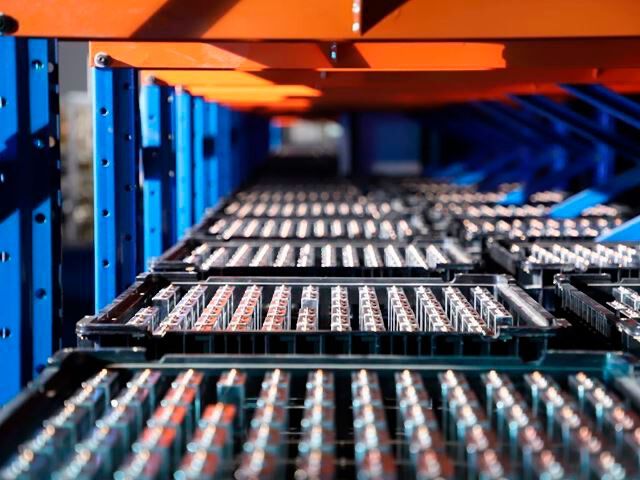
The Chinese battery manufacturer Gotion High-Tech is working on lithium-manganese-iron-phosphate (LMFP) cells, which are expected to enable electric cars to cover distances of more than 1,000 kilometers.
(Image: Gotion High-Tech)
One of the reasons for the currently sluggish demand for electric cars is likely uncertainty about the battery. This is not necessarily in the sense that the current technology cannot be trusted. But rather due to the fear that a much better technology could be available in the near future. In many cases, however, it is not worth waiting a long time.
Indeed, e-car technology is currently developing very quickly. While there are only small potentials left to be exploited in the optimization of the combustion engine, electric drive and battery are making great strides. However, huge leaps are rather unlikely in the short term. Since the market launch of the lithium-ion battery, costs have fallen by a factor of 30 to 50. The energy density has tripled since then. This pace will not be sustainable. So rather than revolution, evolution is the order of the day.
Sudden breakthroughs with new battery technologies are not to be expected. While researchers regularly report major advances, especially in materials research, it may take years or even decades before these can be realized in production cars. The announcements of the major battery manufacturers are closer to deployment than the technologies of basic research. Especially the Chinese suppliers like to advertise their new products with some lead time. However, it is not always clear when, in which cars and at what cost they are supposed to come on the market. A few basic considerations can help with the classification.
An important criterion in the further development of battery technology is the volumetric energy density, given in Wh per liter of battery volume. The larger this value, the smaller the space required for a battery or the range that can be achieved with a certain size. Currently, the value for classic lithium-ion batteries based on nickel is about 450 Wh per liter. Therefore, an e-car battery with a capacity of 50 kWh requires a design space of about 111 liters—slightly more than twice the average fuel tank volume of a compact car with a combustion engine. The problem with assessing this is that in some cases energy densities per cell are also given. These are higher than for the complete battery, since housing, wiring and electronics do not have to be taken into account.
A small car with a range of 1,000 kilometers will not be available anytime soon
However, much more important to the end customer than such relative values is the range. Even in the next few years, most cars are likely to remain roughly within today's range. A small e-car with a range of 1,000 kilometers (approx. 620 miles) is not foreseeable. Waiting for this is a waste of time from a customer's perspective. Extreme improvements can only be expected for models with solid-state batteries. With this battery variant, which is not yet ready for series production, energy densities above 700 Wh per liter are possible. The first series cars are announced for the end of the decade, although the technology will certainly initially be used in expensive luxury or niche vehicles.
However, the range of even the inexpensive cars is likely to increase in the coming years as the drives and the total vehicles become more efficient, battery packs are mounted more cleverly, and the cost per kWh for cells decreases. However, here too it applies that huge leaps are unlikely. Therefore, by itself, this is not a reason to refrain from buying a current model today if all other conditions fit the personal requirements.
Those who need significantly greater ranges than are currently possible should not only look at the energy content, but also consider the charging speed. After all, those who can refuel quickly do not necessarily need a large battery with a high energy content. How fast a specific electric car charges is indicated by the "C-number". A C-number of 1 means that the battery could be fully charged once per hour, with a C-number of 2 this works twice. And so forth. Currently, most production cars have C-numbers between 1.5 and 2.5—so they can be filled two and half times per hour at best. That corresponds to about 24 minutes. This is a very theoretical value, which mainly serves for comparability - not least because charging from 0 to 100 percent never occurs in practice.
The C-number is also really meaningful only if you know the battery size. A 100 kWh battery, typical for long-distance electric cars, can be fully charged at a C-rate of 2 in 30 minutes. The industry's goal in such a case would be a C-rate of 4—which corresponds to a charging time of 15 minutes. However, this is only achievable with vehicles equipped with an 800-volt battery system. Some manufacturers like Hyundai, Kia, Porsche, and Lucid already have corresponding models, others are likely to follow. So, it might be worth waiting a bit longer if you have high demands on the charging capacity. Initially, however, the technology remains reserved for the higher-priced models. Extreme leaps in charging performance for 400-volt models are not to be expected for now.
Date: 08.12.2025
Naturally, we always handle your personal data responsibly. Any personal data we receive from you is processed in accordance with applicable data protection legislation. For detailed information please see our privacy policy.
Consent to the use of data for promotional purposes
I hereby consent to Vogel Communications Group GmbH & Co. KG, Max-Planck-Str. 7-9, 97082 Würzburg including any affiliated companies according to §§ 15 et seq. AktG (hereafter: Vogel Communications Group) using my e-mail address to send editorial newsletters. A list of all affiliated companies can be found here
Newsletter content may include all products and services of any companies mentioned above, including for example specialist journals and books, events and fairs as well as event-related products and services, print and digital media offers and services such as additional (editorial) newsletters, raffles, lead campaigns, market research both online and offline, specialist webportals and e-learning offers. In case my personal telephone number has also been collected, it may be used for offers of aforementioned products, for services of the companies mentioned above, and market research purposes.
Additionally, my consent also includes the processing of my email address and telephone number for data matching for marketing purposes with select advertising partners such as LinkedIn, Google, and Meta. For this, Vogel Communications Group may transmit said data in hashed form to the advertising partners who then use said data to determine whether I am also a member of the mentioned advertising partner portals. Vogel Communications Group uses this feature for the purposes of re-targeting (up-selling, cross-selling, and customer loyalty), generating so-called look-alike audiences for acquisition of new customers, and as basis for exclusion for on-going advertising campaigns. Further information can be found in section “data matching for marketing purposes”.
In case I access protected data on Internet portals of Vogel Communications Group including any affiliated companies according to §§ 15 et seq. AktG, I need to provide further data in order to register for the access to such content. In return for this free access to editorial content, my data may be used in accordance with this consent for the purposes stated here. This does not apply to data matching for marketing purposes.
Right of revocation
I understand that I can revoke my consent at will. My revocation does not change the lawfulness of data processing that was conducted based on my consent leading up to my revocation. One option to declare my revocation is to use the contact form found at https://contact.vogel.de. In case I no longer wish to receive certain newsletters, I have subscribed to, I can also click on the unsubscribe link included at the end of a newsletter. Further information regarding my right of revocation and the implementation of it as well as the consequences of my revocation can be found in the data protection declaration, section editorial newsletter.
Reducing weight is not a priority
Improvements in two other dimensions are less interesting for car drivers. One of these is weight. As with volume, this is also related to energy density—so it has the form "watt-hour per kilogram". Currently, values between 150 and 170 Wh/kg are standard, with solid-state batteries it is heading towards 300 Wh/kg. The higher the value, the lighter batteries with a certain range become.
While less weight is always good in principle in an electric car, reducing it is by no means a priority in the manufacturers' development departments. This is because the current electric drives are powerful enough to cope with many kilos. And the mass does not have such a big negative impact on consumption as it does with a combustion engine. However, weight reduction is of interest for airplanes or air taxis. Therefore, the industry is working on the appropriate technology. As a car driver, however, you do not need to wait for this.
Waiting is also not worth it when it comes to lifespan. Current car batteries with nickel-based lithium-ion technology are designed for 1,000 to 2,000 charging cycles. An average electric car with a real range of 350 kilometers (approx. 217 miles) will therefore drive at least 350,000 kilometers (approx.217,000 miles). The average driver needs almost three decades for this - in many cases this is longer than the rest of the car lasts. The consumer hardly feels any further improvements in the charging cycles— this point is therefore far down on the manufacturers' priority lists. However, a longer lifespan can be interesting for truck traffic, as tractor units cover almost 100,000 kilometers (approx. 62,000 miles) a year. So there will be further developments in this regard as well. But potential buyers of an electric passenger car certainly do not need to wait for this.
For those who absolutely don't suit the current electric cars, they can certainly wait for shorter charging times. Especially in the higher-priced classes, the holding time at the charging station is likely to decrease further in the future. But extreme leaps are initially not to be expected there, as with the range. Also, the necessary infrastructure, i.e. charging stations with 350 kW charging power and more, still needs to be built.
However, at least the number of models with fast charging technology and ample battery capacity is increasing. On the other hand, potential e-car drivers should rather not count on progress in terms of weight and lifespan.



:quality(80)/p7i.vogel.de/wcms/a0/47/a04725ef9bd09fb6c9341a1bea1b5d93/0130443083v1.jpeg "Here, a type of plastic pallet is produced by thermoforming (vacuum forming or deep drawing) at the corresponding division of New England Plastics in the USA. This division, which specializes in so-called liners, is now part of Ringmetall ... (Image:New England Plastics)")
:quality(80)/p7i.vogel.de/wcms/e3/42/e342b3c593ea92d56604d3be969e9c9a/0130437231v1.jpeg "Daimler Truck will be building even more trucks at its Czech plant in Cheb in the future. This is because it is now being expanded for strategic cost-saving reasons ... (Image:Daimler Truck)")
:quality(80)/p7i.vogel.de/wcms/23/99/23992bf2dcdc432c9b7209c34a4a7c48/0129733089v1.jpeg "Stork relies on the modular Neoswiss turning system from Iscar to shorten the set-up times for its sliding headstock lathes and work more productively. (Image:Iscar)")
:quality(80)/p7i.vogel.de/wcms/7d/e2/7de2923434b2f1a78ba5482d8d335269/0113143253v1.jpeg "In our China Market Insider we regularly provide you with relevant information directly from China. (Image:© Eisenhans - stock.adobe.com)")
:quality(80)/p7i.vogel.de/wcms/b7/36/b736dfebc16c42d6901d0d0e1f390493/3d-druck-20factory-20--20ki-20generiert-1920x1079v1.png "(Source: AI-generated)")
:quality(80)/p7i.vogel.de/wcms/79/b2/79b21aad663f4a7bd4472afc1c1afc62/0130433994v1.jpeg "Mission Joyride: The free-flying robot (shown here in the rendering) will relieve the ISS crew of logistics tasks from 2027 with its two mechanical arms. (Image:Icarus Robotics)")
:quality(80)/p7i.vogel.de/wcms/6b/45/6b4546fa6ebf305c3660326909363f32/0130437089v1.jpeg "Industrial AI in action: Rockwell Automation presents practical solutions for self-controlling production systems at the Hannover Messe. (Image:Rainer Jensen, Deutsche Messe)")
:quality(80)/p7i.vogel.de/wcms/78/e9/78e9188c25a8a94e67c34c9bf8ffe495/visual-agile-20robots-20and-20google-20deepmind-20partner-20to-20bring-20intelligence-20to-20robotics-2500x1406v1v1.jpeg "Together, the partners are developing adaptable, intelligent robots for a wide range of applications (Image:Agile Robots SE)")
:quality(80)/p7i.vogel.de/wcms/59/a2/59a2b11f0aa1b700eff02addd5de8703/adobestock-1788280853--c2-a9-20satria-20-e2-80-93-20stock-adobe-com-5081x2860v1v1.jpeg "Quantum computers require extreme cooling to temperatures close to absolute zero in order to keep qubits stable. (Image:satria - stock.adobe.com)")
:quality(80)/p7i.vogel.de/wcms/62/5f/625f41e87ebfef156a98c8e6393e32fd/0130211654v1.jpeg "Axial flux motors have some advantages over radial flux motor—but their production is currently still expensive. (Image:RWTH Aachen University)")
:quality(80)/p7i.vogel.de/wcms/f6/ae/f6aec4f6241b36ed5e3a990ac9176b42/0130429460v1.jpeg "Verne, Pony.ai and Uber want to launch a robotaxi service in Europe. (Image:Verne)")
:quality(80)/p7i.vogel.de/wcms/d7/88/d788699f2974708a332baa4e7a62fa9e/0130438967v1.jpeg "Skoda is withdrawing from China. The brand has produced well over three million vehicles there. (Image:Skoda car)")
:quality(80)/p7i.vogel.de/wcms/b0/43/b043b86899837532aad62d63368a917a/0130371361v1.jpeg "Skoda leaves the chinese market.
(Image:Skoda)")
:quality(80)/p7i.vogel.de/wcms/c3/c4/c3c4ce270b083eeac55654148611f064/0130237945v1.jpeg "China is not giving up on hydrogen, but is intensifying its efforts. (Image:freely licensed from Pixabay)")
:quality(80)/p7i.vogel.de/wcms/ee/09/ee09acbd6dc896df25affaa9e871e6e5/0130440053v1.jpeg "IMS chip module for simple system integration into an ion mobility spectrometer. (Image:Fraunhofer IPMS)")
:quality(80)/p7i.vogel.de/wcms/10/6c/106cd22de5f68a0f74639d654827228c/0130345302v1.jpeg "Made in India: According to the India Electronics and Semiconductor Association (IESA), the country should be able to produce between 75 and 80 million chips by the beginning of 2027, once the plants currently under construction become operational. (Image:Pixabay (Montage: Sebastian Gerstl))")
:quality(80)/p7i.vogel.de/wcms/a5/ed/a5ed6fda029d362732a293d6b19d74c4/0130444216v1.jpeg "Thirteen executives from the Chinese chip industry have drawn up a plan to achieve an 80% self-sufficiency rate for semiconductors by 2030. (Image:Maxim_Kazmin - stock.adobe.com)")
:quality(80)/p7i.vogel.de/wcms/31/a6/31a646018b34d8e0a44bfc8bf17837f6/0130361632v1.jpeg "For many companies, PFAS are considered indispensable in electronics production. (Image:freely licensed)")
:fill(fff,0)/images.vogel.de/vogelonline/companyimg/76800/76895/65.jpg "FAULHABER_120mm.jpg ()")
:quality(80)/p7i.vogel.de/wcms/5e/ea/5eeadf2ea183a98c9b67a072f8165ea9/0118162369.jpeg "CATL continues to work on its LFP battery. (Image:CATL)")
:quality(80)/p7i.vogel.de/wcms/2d/47/2d47148421a92c46227bf41a06428478/0123872708v1.jpeg "The electric midsize SUV C10 is now also available with a range extender. (Image:Leapmotor)")
:quality(80)/p7i.vogel.de/wcms/6e/b1/6eb167fde07444684634d4de51ec4f68/0125731800v1.jpeg "Hyundai has a new electric flagship with the Ioniq 9. (Image:Hyundai)")