LifespanBatteries in electric cars are more reliable than their reputation suggests
From
Mario Hommen/SP-X | Translated by AI
7 min Reading Time
The possibly short lifespan of the batteries was often the reason for skepticism towards electric cars. This is outdated. Data shows: The battery is a reliable component.
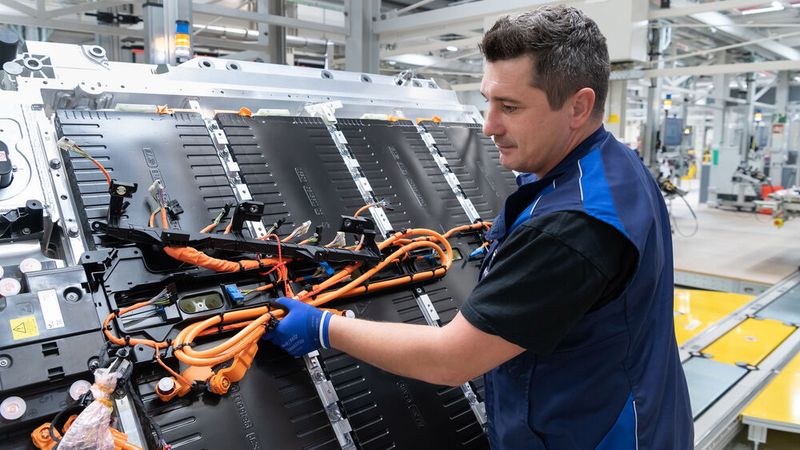
A look into the manufacturing of high-voltage batteries at BMW in the Regensburg location.
(Image: Stefan Hanke/BMW)
In the automotive world, the engine was long considered the most expensive component. With proper maintenance, 200,000 kilometers (124,274 miles) to 300,000 kilometers (186,411 miles) were seen as the limit of durability. Its expected or presumed reliability was a particularly important purchasing criterion for car customers. In electric cars, however, the battery is the biggest cost factor.
Its condition is crucial for the lifespan of the car. If the traction battery is defective, this can lead to a total loss, which is not only annoying but also expensive. Unfortunately, the sudden battery death is not a myth spread by petrolheads, but a bitter reality for some electric vehicle drivers.
Meanwhile, the durability of batteries has become more predictable, and their expected lifespan is even extraordinarily high. In many cases, it is likely to exceed the lifespan of the vehicle itself. This is ensured by continuously improving software and cell chemistry. Regardless of the state of technology, however, the user and their usage profile will continue to have a significant impact on the condition and lifespan of the battery.
High mileage of used electric cars
There are several indications that batteries are no longer capricious and error-prone components. One indicator is the high mileage of used electric cars. Of the approximately 75,000 electric vehicles currently listed on the used car platform mobile.de, 450 have a mileage of 150,000 kilometers (93,205 miles). About 150 have more than 200,000 kilometers (124,274 miles) on the odometer. Some, exclusively Tesla vehicles, even exceed 300,000 kilometers (186,411 miles). Therefore, high mileage and electric drive are not mutually exclusive.
Another indicator of the reliability of batteries is the increasingly generous warranty services offered by automakers. When the first mass-produced electric cars hit the market, the fear of battery fiasco was often addressed with rental models. In this arrangement, only the car is purchased, and the battery is not owned but rented for a monthly fee. Should the battery seriously degrade or completely fail, the manufacturer bears the financial risk, not the car owner.
Eight or ten years warranty on electric car batteries
However, generous warranty services are now explicitly provided for batteries. The confidence of manufacturers and insurers in their reliability has significantly increased with growing practical experience, and so has the extent of the warranty commitments. Today, eight years or 160,000 kilometers (99,419 miles) specifically for the battery is the norm. In individual cases, ten years or up to 250,000 kilometers (155,342 miles) are also offered. Lexus, for example, offers a warranty extension for the UX 300e to ten years or one million kilometers (621,371 miles).
From the customer's perspective, these are strong statements. However, one is not always on the safe side. If the battery is subjected to excessive stress factors, it can fall out of warranty. A deep discharge, a service not carried out, or a charging behavior that overly strains the battery could provide the manufacturer with the appropriate arguments to deny warranty service to the customer. Those who want to be on the safe side should pay attention to the exact conditions and usage recommendations associated with the warranty by the manufacturer. The same applies to vehicles with combustion engines.
Warranty already at reduced charging capacity
The warranty claim does not only arise when a battery completely fails, but already when the charging capacity drops below a certain level. Information about this can be obtained from the so-called SoH value, the State of Health. It indicates in percentage how much of the original capacity is still available. If the capacity falls below about 80 percent within the warranty period—in some cases, the warranty limit is at 70 percent—of the original storage capacity, then the warranty case occurs.
If it is only 79 percent, the battery is not defective, but the range has significantly decreased. For cars with strong range, this does not preclude everyday use for a long time. However, for city cars with small batteries, the loss can lead to an annoying limitation of the action radius.
Several factors influence the State of Health. One of these is time, as a battery ages because the anode and cathode are subjected to chemical decomposition processes. In addition to this calendar aging, the number of charging cycles is probably the most important aging factor.
Date: 08.12.2025
Naturally, we always handle your personal data responsibly. Any personal data we receive from you is processed in accordance with applicable data protection legislation. For detailed information please see our privacy policy.
Consent to the use of data for promotional purposes
I hereby consent to Vogel Communications Group GmbH & Co. KG, Max-Planck-Str. 7-9, 97082 Würzburg including any affiliated companies according to §§ 15 et seq. AktG (hereafter: Vogel Communications Group) using my e-mail address to send editorial newsletters. A list of all affiliated companies can be found here
Newsletter content may include all products and services of any companies mentioned above, including for example specialist journals and books, events and fairs as well as event-related products and services, print and digital media offers and services such as additional (editorial) newsletters, raffles, lead campaigns, market research both online and offline, specialist webportals and e-learning offers. In case my personal telephone number has also been collected, it may be used for offers of aforementioned products, for services of the companies mentioned above, and market research purposes.
Additionally, my consent also includes the processing of my email address and telephone number for data matching for marketing purposes with select advertising partners such as LinkedIn, Google, and Meta. For this, Vogel Communications Group may transmit said data in hashed form to the advertising partners who then use said data to determine whether I am also a member of the mentioned advertising partner portals. Vogel Communications Group uses this feature for the purposes of re-targeting (up-selling, cross-selling, and customer loyalty), generating so-called look-alike audiences for acquisition of new customers, and as basis for exclusion for on-going advertising campaigns. Further information can be found in section “data matching for marketing purposes”.
In case I access protected data on Internet portals of Vogel Communications Group including any affiliated companies according to §§ 15 et seq. AktG, I need to provide further data in order to register for the access to such content. In return for this free access to editorial content, my data may be used in accordance with this consent for the purposes stated here. This does not apply to data matching for marketing purposes.
Right of revocation
I understand that I can revoke my consent at will. My revocation does not change the lawfulness of data processing that was conducted based on my consent leading up to my revocation. One option to declare my revocation is to use the contact form found at https://contact.vogel.de. In case I no longer wish to receive certain newsletters, I have subscribed to, I can also click on the unsubscribe link included at the end of a newsletter. Further information regarding my right of revocation and the implementation of it as well as the consequences of my revocation can be found in the data protection declaration, section editorial newsletter.
With each charge, a part of the capacity is lost. For lithium-ion batteries, it is assumed that the capacity only falls below 80 percent after more than 1,000 complete charging cycles. This number itself is impressive, as, considering the average range of electric cars in 2023 of around 400 kilometers (249 miles), rough calculations, without accounting for dynamic degradation, suggest that mileages of 400,000 kilometers (248,548 miles) are possible.
Battery degradation also depends on user behavior
However, this is a theoretical value, as the degradation of a battery is influenced by additional factors that depend on individual user behavior. Those who travel at a brisk pace will place greater demands on the battery since it is subject to greater thermal stress with high power output. Extreme outside temperatures can also affect the battery cells. Parking an electric car in a consistently air-conditioned garage, rather than in direct sunlight or on frosty days outdoors, slows the downward trend of the degradation curve.
Charging behavior also has a significant impact. Predominantly charging at fast-charging stations will cause the degradation curve to move downwards more quickly on the timeline—because fast charging means thermal stress for the power storage. Slow and gentle charging overnight at a home wallbox, i.e., gentle AC charging, allows the battery to age more slowly, as laboratory tests at the cell level and real-life examples from electric vehicle users show.
This does not mean that the fast-charging station is off-limits. Occasional visits will have only a minor impact on the long-term SoH development when considering the entire aging process of the battery.
The State of Charge, the SoC, meaning the battery's charge level, also has a significant impact. Frequently discharging the battery to a SoC close to zero percent and then fully charging it to 100 percent accelerates aging. Avoiding extreme charge levels slows down degradation.
If charging mainly occurs in partial cycles within the SoC range between 60 and 80 percent, experts estimate a three to five times higher lifespan. It is more practical to keep the charge level between 20 and 80 percent.
Practical battery life between 250,000 and 300,000 kilometers
The scientist and YouTuber known as "Battery Doctor," Andreas Schmitz, pointed out two extremes of different battery aging in a recent video about the lifespan of electric car batteries. A Tesla Model 3, used as a taxi in Norway, reached the critical SoH value of 80 percent after an estimated 110,000 kilometers (68,350 miles) due to a fast charging rate of 93 percent.
Hansjörg-Eberhard Freiherr von Gemmingen-Hornberg, on the other hand, has already traveled more than two million kilometers with a Tesla Model S P90, and although he has worn out several batteries, they have lasted almost 500,000 kilometers (310,685 miles) on average.
These examples demonstrate a range in usage duration. However, Andreas Schmitz wanted to know how many kilometers could be expected on average until reaching the SoH value of 80 percent. For this purpose, he collected data from surveys in his community and forums to generate models for calculating wear. The statement, smoothed out from uncertainties, indicates that 250,000 kilometers (155,342 miles) to 300,000 kilometers (186,411 miles) should definitely be achievable with normal usage, as of today.
State of Health crucial in resale
Other cell chemistries like Nickel-Manganese-Cobalt (NMC), Sodium-Ion, and especially Lithium-Iron-Phosphate (LFP), are considered particularly cycle-resistant and are therefore expected to enable significantly higher ranges than the currently common lithium-ion batteries. The Chinese conglomerate Svolt promises that its Short-Blade battery (LFP), available from the end of 2024, will have a lifespan of more than 2,500 charging cycles and over one million kilometers (621,371 miles).
Those who use their electric vehicles in a battery-preserving manner not only benefit from greater range but potentially also from a higher resale value. Interest in battery certificates, which provide information about the SoH, is likely to greatly increase in the used car market. With a high SoH value, a seller is in a good negotiating position, which of course allows for higher prices. As the used electric car market becomes more economically significant, forging battery certificates could one day become an attractive business model.
Upgrade used electric cars with better batteries
This also applies to retrofitting batteries. A heavily worn car battery does not have to mean the end for the electric car. There are now several providers of retrofit solutions that equip older electric vehicles with new batteries. Mandrill Automotive from Göppingen (Germany), for example, offers this for the electric pioneer BMW i3.
A new power storage in the high-range 120-Ah format costs about 13,600 Euros (approx. 15,088 USD), offering significantly more capacity than the originally installed BMW versions with 60 or 94 amp-hours. In a report by the German magazine 'Auto Motor & Sport', Mandrill announced a new battery format with different cells and cell chemistry with 147 Ah, which could increase the range of the i3 to 400 kilometers (249 miles). The currently available battery tuning for the i3 even comes with a ten-year warranty.
In practice, the lifespan of the batteries will be significantly longer anyway. Because retired traction batteries do not end up in the scrapyard right away but are given a second life as stationary storage, for example, for solar power. This second life can last another ten years. (thg)
This article was first published on our sister website www.automobil-industrie.de (German language), Vogel Communications Group



:quality(80)/p7i.vogel.de/wcms/a0/47/a04725ef9bd09fb6c9341a1bea1b5d93/0130443083v1.jpeg "Here, a type of plastic pallet is produced by thermoforming (vacuum forming or deep drawing) at the corresponding division of New England Plastics in the USA. This division, which specializes in so-called liners, is now part of Ringmetall ... (Image:New England Plastics)")
:quality(80)/p7i.vogel.de/wcms/23/99/23992bf2dcdc432c9b7209c34a4a7c48/0129733089v1.jpeg "Stork relies on the modular Neoswiss turning system from Iscar to shorten the set-up times for its sliding headstock lathes and work more productively. (Image:Iscar)")
:quality(80)/p7i.vogel.de/wcms/7d/e2/7de2923434b2f1a78ba5482d8d335269/0113143253v1.jpeg "In our China Market Insider we regularly provide you with relevant information directly from China. (Image:© Eisenhans - stock.adobe.com)")
:quality(80)/p7i.vogel.de/wcms/9d/2b/9d2b802f800e5caf17b2831e74228cd3/screenshot-202026-03-03-20103822-609x343v1v1.png "Visual comparison: on the left, a clean, burr-free cut edge; on the right, typical burr formation with oxidation discoloration. This illustrates how strongly parameter control and gas management influence the quality of the result. (CO₂ laser, oxygen cutting gas, sheet thickness approx. 15 mm). (Image:Picture: Rime)")
:quality(80)/p7i.vogel.de/wcms/b7/36/b736dfebc16c42d6901d0d0e1f390493/3d-druck-20factory-20--20ki-20generiert-1920x1079v1.png "(Source: AI-generated)")
:quality(80)/p7i.vogel.de/wcms/79/b2/79b21aad663f4a7bd4472afc1c1afc62/0130433994v1.jpeg "Mission Joyride: The free-flying robot (shown here in the rendering) will relieve the ISS crew of logistics tasks from 2027 with its two mechanical arms. (Image:Icarus Robotics)")
:quality(80)/p7i.vogel.de/wcms/6b/45/6b4546fa6ebf305c3660326909363f32/0130437089v1.jpeg "Industrial AI in action: Rockwell Automation presents practical solutions for self-controlling production systems at the Hannover Messe. (Image:Rainer Jensen, Deutsche Messe)")
:quality(80)/p7i.vogel.de/wcms/78/e9/78e9188c25a8a94e67c34c9bf8ffe495/visual-agile-20robots-20and-20google-20deepmind-20partner-20to-20bring-20intelligence-20to-20robotics-2500x1406v1v1.jpeg "Together, the partners are developing adaptable, intelligent robots for a wide range of applications (Image:Agile Robots SE)")
:quality(80)/p7i.vogel.de/wcms/59/a2/59a2b11f0aa1b700eff02addd5de8703/adobestock-1788280853--c2-a9-20satria-20-e2-80-93-20stock-adobe-com-5081x2860v1v1.jpeg "Quantum computers require extreme cooling to temperatures close to absolute zero in order to keep qubits stable. (Image:satria - stock.adobe.com)")
:quality(80)/p7i.vogel.de/wcms/62/5f/625f41e87ebfef156a98c8e6393e32fd/0130211654v1.jpeg "Axial flux motors have some advantages over radial flux motor—but their production is currently still expensive. (Image:RWTH Aachen University)")
:quality(80)/p7i.vogel.de/wcms/e3/42/e342b3c593ea92d56604d3be969e9c9a/0130437231v1.jpeg "Daimler Truck will be building even more trucks at its Czech plant in Cheb in the future. This is because it is now being expanded for strategic cost-saving reasons ... (Image:Daimler Truck)")
:quality(80)/p7i.vogel.de/wcms/f6/ae/f6aec4f6241b36ed5e3a990ac9176b42/0130429460v1.jpeg "Verne, Pony.ai and Uber want to launch a robotaxi service in Europe. (Image:Verne)")
:quality(80)/p7i.vogel.de/wcms/d7/88/d788699f2974708a332baa4e7a62fa9e/0130438967v1.jpeg "Skoda is withdrawing from China. The brand has produced well over three million vehicles there. (Image:Skoda car)")
:quality(80)/p7i.vogel.de/wcms/b0/43/b043b86899837532aad62d63368a917a/0130371361v1.jpeg "Skoda leaves the chinese market.
(Image:Skoda)")
:quality(80)/p7i.vogel.de/wcms/ee/09/ee09acbd6dc896df25affaa9e871e6e5/0130440053v1.jpeg "IMS chip module for simple system integration into an ion mobility spectrometer. (Image:Fraunhofer IPMS)")
:quality(80)/p7i.vogel.de/wcms/10/6c/106cd22de5f68a0f74639d654827228c/0130345302v1.jpeg "Made in India: According to the India Electronics and Semiconductor Association (IESA), the country should be able to produce between 75 and 80 million chips by the beginning of 2027, once the plants currently under construction become operational. (Image:Pixabay (Montage: Sebastian Gerstl))")
:quality(80)/p7i.vogel.de/wcms/a5/ed/a5ed6fda029d362732a293d6b19d74c4/0130444216v1.jpeg "Thirteen executives from the Chinese chip industry have drawn up a plan to achieve an 80% self-sufficiency rate for semiconductors by 2030. (Image:Maxim_Kazmin - stock.adobe.com)")
:quality(80)/p7i.vogel.de/wcms/31/a6/31a646018b34d8e0a44bfc8bf17837f6/0130361632v1.jpeg "For many companies, PFAS are considered indispensable in electronics production. (Image:freely licensed)")
:quality(80)/p7i.vogel.de/wcms/eb/fd/ebfdf7b748a009f330e66a5e8b23dead/0125959847v1.jpeg "Bidirectional charging has negligible effects on the battery of an electric vehicle. This was revealed in a joint study by RWTH Aachen and The Mobility House. (Image:BMW)")
:quality(80)/p7i.vogel.de/wcms/2b/78/2b78c2ff6781704ed63902b59c22e195/0128897323v1.jpeg "The battery refreshers! Lithium-ion batteries for electric vehicles become unbalanced over time, causing a significant drop in performance. However, Battery X Metals knows how to restore the balance. The Canadians have now been able to prove this through tests. (Image:Power Boy)")