Vertical Aerospace, a global aerospace and technology company that is pioneering electric aviation, announced it has made European aviation history with the first-ever piloted wingborne flight of a winged electric vertical take-off and landing (eVTOL) aircraft in open airspace.
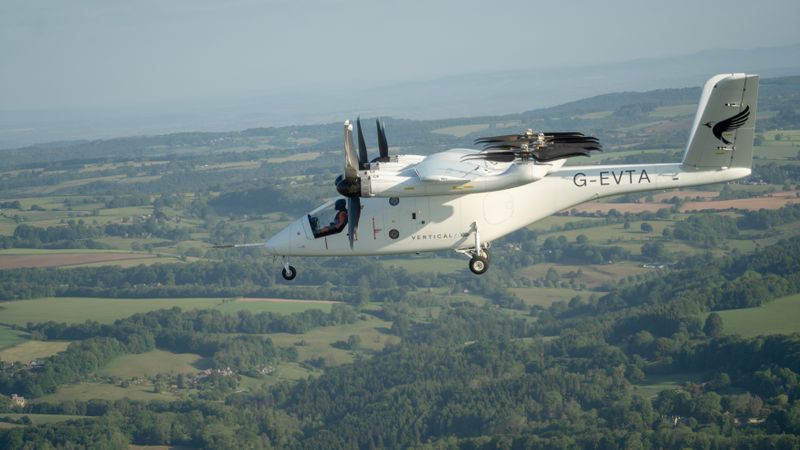
The VX4 prototype soars across the UK countryside from Cotswold Airport, following approval from the UK Civil Aviation Authority to fly in open airspace.
(Image: VERTICAL)
The landmark flight of the VX4 prototype, piloted by Chief Test Pilot Simon Davies, saw the aircraft take-off, fly and land like a conventional aircraft, with lift generated by the wing.Soaring across the UK countryside from Cotswold Airport, the VX4 prototype demonstrated controlled wingborne flight in open airspace for the first time, marking a critical step toward commercial deployment as part of Vertical’s Flightpath 2030 strategy.
The UK Civil Aviation Authority (CAA) approved the flight through open airspace at Cotswold Airport, the UK’s largest private airport, by extending Vertical’s Permit to Fly. This followed a rigorous review of tens of thousands of pages of safety and technical documentation.
Chief Test Pilot, Simon Davies, said: "Taking the aircraft beyond the airfield and cruising over the Cotswolds for the first time was truly special and a career highlight for me. Our performance predictions were absolutely spot on, and the aircraft took off as a natural extension of all the ground tests and preparation we've done. There are aircraft which are safe and capable but not always enjoyable to fly. The VX4 was not only safe but was an absolute pleasure. It is responsive, smooth, simple to operate and the sound level from the propellers is quiet and pleasant in the cockpit. An honour to fly, and a real testament to the incredible team behind it.”
Vertical is currently the only company globally flying a piloted winged eVTOL prototype that’s been developed under a Design Organisation Approval (DOA) from the CAA – a DOA is required to hold a Type Certificate, required for commercial passenger operations. The CAA is working closely with the European Union Aviation Safety Agency (EASA) for their concurrent validation and certifying the VX4 to the highest safety standards required for commercial use.
Stuart Simpson, CEO, Vertical Aerospace, said: "Achieving piloted wingborne flight in open airspace under the oversight of the UK CAA is an important moment in our certification journey. Operating under the UK’s rigorous regulatory framework means we share the burden of safety with our regulator - every step must be approved, and that’s by design. It amounts to a mini certification of our prototype and gives us a clearer, faster path to type certification. Our decision to put a pilot into the VX4 early was deliberate - real-world piloted flight delivers insights no simulation can. This milestone proves the capability of the aircraft and the maturity of our programme as we move toward commercial operations."
Advancing the UK’s world-class aerospace sector
This achievement has also been supported by early UK government investment through programmes including the Aerospace Technology Institute and the Future Flight Challenge. These initiatives have contributed to the development of Vertical’s technology and flight test campaign, and form part of wider efforts to advance the UK’s net zero and aerospace ambitions.
This is a fantastic milestone for Vertical and for the UK’s world-class aerospace sector. Breakthroughs like this show how government and business can work together to keep the UK at the cutting edge of innovation. Our modern Industrial Strategy will double down on this success by giving investors the confidence they need to back UK advanced manufacturing for the long term, bringing good, green jobs and growth across the UK as part of our Plan for Change.
Jonathan Reynolds, UK Secretary of State for Business and Trade
What is the Significance of Wingborne Flight?
During Phase 1, the VX4 prototype performed stabilized hover while loosely tethered to the ground, while Phase 2 encompassed the prototype taking off and landing vertically and conducting low-speed flight maneuvers with lift generated by the propellers. In Phase 3 of testing – wingborne flight – the VX4 operates like a conventional aircraft using lift generated by its wings, rather than relying solely on rotor thrust. This low-power, quiet, and range-efficient mode of flight is key to making electric air travel practical, scalable, and economically viable.
Jim Currier, President and CEO, Honeywell Aerospace Technologies, said: “This significant achievement underscores the ability of our partnership to unlock new and innovative modes of transport, and we are proud Honeywell Anthem avionics and flight control computers and software could play a key role in supporting such a defining moment for the industry.”
David Stepanek, EVP & CTO, Bristow Group, said: “The VX4’s successful demonstration of wingborne flight marks a significant step towards commercial readiness. As the global leader in innovative and sustainable vertical lift, we look forward to continuing to partner with Vertical to unleash the disruptive advantages of this aircraft.”
Jill Blickstein, Vice President of Sustainability, at American Airlines, said: "This milestone is a key step toward safely scaling electric aviation, which we believe will play a key role in the future of our industry. We’re proud of Vertical’s progress toward sustainable travel.”
Date: 08.12.2025
Naturally, we always handle your personal data responsibly. Any personal data we receive from you is processed in accordance with applicable data protection legislation. For detailed information please see our privacy policy.
Consent to the use of data for promotional purposes
I hereby consent to Vogel Communications Group GmbH & Co. KG, Max-Planck-Str. 7-9, 97082 Würzburg including any affiliated companies according to §§ 15 et seq. AktG (hereafter: Vogel Communications Group) using my e-mail address to send editorial newsletters. A list of all affiliated companies can be found here
Newsletter content may include all products and services of any companies mentioned above, including for example specialist journals and books, events and fairs as well as event-related products and services, print and digital media offers and services such as additional (editorial) newsletters, raffles, lead campaigns, market research both online and offline, specialist webportals and e-learning offers. In case my personal telephone number has also been collected, it may be used for offers of aforementioned products, for services of the companies mentioned above, and market research purposes.
Additionally, my consent also includes the processing of my email address and telephone number for data matching for marketing purposes with select advertising partners such as LinkedIn, Google, and Meta. For this, Vogel Communications Group may transmit said data in hashed form to the advertising partners who then use said data to determine whether I am also a member of the mentioned advertising partner portals. Vogel Communications Group uses this feature for the purposes of re-targeting (up-selling, cross-selling, and customer loyalty), generating so-called look-alike audiences for acquisition of new customers, and as basis for exclusion for on-going advertising campaigns. Further information can be found in section “data matching for marketing purposes”.
In case I access protected data on Internet portals of Vogel Communications Group including any affiliated companies according to §§ 15 et seq. AktG, I need to provide further data in order to register for the access to such content. In return for this free access to editorial content, my data may be used in accordance with this consent for the purposes stated here. This does not apply to data matching for marketing purposes.
Right of revocation
I understand that I can revoke my consent at will. My revocation does not change the lawfulness of data processing that was conducted based on my consent leading up to my revocation. One option to declare my revocation is to use the contact form found at https://contact.vogel.de. In case I no longer wish to receive certain newsletters, I have subscribed to, I can also click on the unsubscribe link included at the end of a newsletter. Further information regarding my right of revocation and the implementation of it as well as the consequences of my revocation can be found in the data protection declaration, section editorial newsletter.
By achieving stable and controlled wingborne flight, Vertical has taken a significant step toward the next major milestone: a full piloted transition flight, expected in the second half of 2025. This will demonstrate the VX4’s ability to shift seamlessly between vertical lift and forward cruise – the operating mode it will use in passenger service
During the wingborne flight phase, the VX4 will reach speeds of up to 150 mph (120 knots) and altitudes close to 2,000 ft under real-world conditions. Engineers captured more than 30,000 in-flight data parameters, confirming the aircraft performed exceptionally across stability, control, and energy usage.
A Foundation Built on Rigorous Testing
To prepare for piloted wingborne flights, Vertical completed thousands of hours of lab, simulation, and high speed ground testing, including:
7.2 million fatigue cycles on each propeller blade to simulate lifespan loads over the flight test campaign
15.2 metre battery pack drop test, comparable to fuel-tank testing in traditional rotorcraft
Full-scale thermal runaway propagation test on a VX4 sub-pack, indicating safe flight and landing is possible even in the event of a battery fire
Over 3,000 hours of component and integration testing on flight control computers to ensure system reliability and performance



:quality(80)/p7i.vogel.de/wcms/dd/08/dd086510d9ae7b50181f6070e4463b44/0129363730v1.jpeg "Typical application for ionizing devices: Wrapping films. (Picture: ©Adobe Stock/SMC)")
:quality(80)/p7i.vogel.de/wcms/35/57/3557c819943c53acec41a0ccba87da4f/0130049064v1.jpeg "Researchers at the Fraunhofer IWU in Chemnitz have long known that many typical sheet metal parts can be manufactured more cost-effectively using hollow embossing rollers. Now there is news to report ... (Image:Fraunhofer IWU)")
:quality(80)/p7i.vogel.de/wcms/59/02/590246e3b3f415c65edbee377c14ca77/26-06-pi-fraunhofer-iws-41450-direktplattieren-pic-01-7771x4369v1v1.jpeg "The Fraunhofer IWS has developed the new \"direct laser cladding\" process, which creates a functional layer directly on the base body by applying a strip-shaped metal to rotationally symmetrical components in a spiral and bonding it locally by laser. (Image:Christoph Wilsnack/Fraunhofer IWS)")
:quality(80)/p7i.vogel.de/wcms/73/60/73608418789b1d9c393f5e2fa974eda2/0130209906v1.jpeg "The robots of the X6 generation from b+m enable very high painting quality and are also particularly compact and easy to maintain. (Image:Beckhoff)")
:quality(80)/p7i.vogel.de/wcms/78/e9/78e9188c25a8a94e67c34c9bf8ffe495/visual-agile-20robots-20and-20google-20deepmind-20partner-20to-20bring-20intelligence-20to-20robotics-2500x1406v1v1.jpeg "Together, the partners are developing adaptable, intelligent robots for a wide range of applications (Image:Agile Robots SE)")
:quality(80)/p7i.vogel.de/wcms/e7/66/e7669ecf0260ae8fc54c214e34e4902a/0130316817v1.jpeg "Siemens and Palo Alto Networks offer tested cybersecurity solution for industrial 5G. (Image:Siemens)")
:quality(80)/p7i.vogel.de/wcms/9f/55/9f55324832c4f426958031375124d9de/siemens-20ubtech-20hmnd-1920x1079v1v1.png "Ready for the factory floor: While Ubtech is planning mass production, Siemens is already testing humanoids in real factory applications in Erlangen. (Image:Siemens)")
:quality(80)/p7i.vogel.de/wcms/11/36/113695ed260e29c8c2d9d39dc5f9d869/0130213768v1.jpeg "AI can work cheaply in China and deliver the results rapidly all over the world. (Image:Dall-E / AI-generated)")
:quality(80)/p7i.vogel.de/wcms/62/5f/625f41e87ebfef156a98c8e6393e32fd/0130211654v1.jpeg "Axial flux motors have some advantages over radial flux motor—but their production is currently still expensive. (Image:RWTH Aachen University)")
:quality(80)/p7i.vogel.de/wcms/77/9b/779b0685d010dfe45c9c2cb1cfecd467/0128886425v1.jpeg "The BlueEye is the first \"real\" hyperspectral camera for the UV range and covers the wavelength range from 220 to 380nm. (Image:Inno-spec GmbH)")
:quality(80)/p7i.vogel.de/wcms/e4/51/e451d52ce0182fb0aaa46a5774f832ef/26-04-pi-fraunhofer-iws-21160-bioslide-pic-01-4128x2321v1v1.jpeg "With the BioSlide research project, the Fraunhofer IWS is investigating how sliding systems can be designed to be more sustainable and energy-efficient. New materials can be tested in a particularly application-oriented manner on this plain bearing test stand. (Image:Fraunhofer IWS)")
![Thanks to advanced 3D printing technology, a more efficient use of resources should contribute to lower-emission aviation—this is the goal of ['skai]-lab. (Image:Oleksandr Pashchenko - stock.adobe.com / AI-generated)](https://cdn1.vogel.de/nghHNSbySccfOjG3n1qCA-FVOjQ=/288x162/smart/filters:format(jpg):quality(80)/p7i.vogel.de/wcms/62/64/626424c97a16e69f871bf216c9629c2a/adobestock-1927043193--c2-a9-20oleksandr-20pashchenko-20-e2-80-93-20stock-adobe-com-ki-generiertv1v1.jpeg "Thanks to advanced 3D printing technology, a more efficient use of resources should contribute to lower-emission aviation—this is the goal of ['skai]-lab. (Image:Oleksandr Pashchenko - stock.adobe.com / AI-generated)")
:quality(80)/p7i.vogel.de/wcms/c3/c4/c3c4ce270b083eeac55654148611f064/0130237945v1.jpeg "China is not giving up on hydrogen, but is intensifying its efforts. (Image:freely licensed from Pixabay)")
:quality(80)/p7i.vogel.de/wcms/4e/c0/4ec0bd19390b169edfa23677373dcdf1/0130260089v1.jpeg "Renewable fuels can supply European road traffic, according to a study. (Image:Aral)")
:quality(80)/p7i.vogel.de/wcms/6f/c9/6fc9050301d745cad25585c6780f8f51/0130197341v1.jpeg "Production facilities are a worthwhile target and are therefore at risk. (Image:ABB Robotics)")
:quality(80)/p7i.vogel.de/wcms/b6/62/b662adc2cec8227d8172509bbfb6ee42/25c0207-107-4961x2789v1v1.jpeg "The GLB is the second model based on Mercedes' new MMA platform. Apparently, Geely's platform is better and cheaper, which is why the two companies are negotiating a partnership. (Image:Mercedes-Benz)")
:quality(80)/p7i.vogel.de/wcms/4d/dd/4dddf438e91f394c04a095dbfd109d1c/0130236430v1.jpeg "Measurement modules: The 720301 module in combination with the SL2000 enables RMS and power calculations, among other things. (Image:Yokogawa)")
:quality(80)/p7i.vogel.de/wcms/61/fc/61fcf95f5cca15494ad18343901ae585/0130317237v1.jpeg "With the AGI CPU, Arm says it is taking a \"historic step\": With the processor aimed at AI in data centers, the company is presenting itself for the first time as a provider of its own chips, not just as a pure IP licensor. (Image:Arm)")
:quality(80)/p7i.vogel.de/wcms/82/90/8290dfe3595b6c6b33726ae8b76172c7/0130319587v1.jpeg "The concept image illustrates how the pattern of tiny protrusions and depressions created on the substrate (MgO, bottom) controls the arrangement of atoms in the superconducting material (YBCO, top). At the interface between the two layers, an electronic structure enables superconductivity to occur at higher temperatures than previously possible. (Image:Chalmers University of Technology / Riccardo Arpaia)")
:fill(fff,0)/images.vogel.de/vogelonline/companyimg/76800/76895/65.jpg "FAULHABER_120mm.jpg ()")
:fill(fff,0)/p7i.vogel.de/companies/68/a4/68a47beec75ce/logo-cmyk-de.jpeg "logo-cmyk-de (https://www.datatec.eu/)")
:fill(fff,0)/p7i.vogel.de/companies/67/eb/67eba621ef6ea/logo2.png "logo2 (Wuxi InfiMotion)")
:quality(80)/p7i.vogel.de/wcms/8a/d5/8ad513715cbc54c7f6e8fc7ae2bf6327/0125852462v1.jpeg "The VX4 from Vertical Aerospace during takeoff: The electric vertical take-off aircraft combines rotor and fixed-wing flight technology. (Image:Vertical Aerospace Group Ltd.)")
:quality(80)/p7i.vogel.de/wcms/c7/87/c787b3f37d56123822f44f74afdccc04/0125447172v1.jpeg "As early as this summer, the first commercial routes for eVTOLs are set to launch in China. (Image:EHang)")