Modern vehicles can already contain up to 150 million lines of software code today, distributed across up to 100 electronic control units. The innovation of Software-Defined Vehicles (SDV) not only changes the way vehicles are designed and used. It also changes the relationship between vehicles and their users. What exactly are the key components and the actual benefits of SDV? What role does the software architecture and product line development play? And what does the integration of these vehicles into the ecosystem of networked mobility and smart cities mean?
Huge potentials of Software-Defined Vehicles
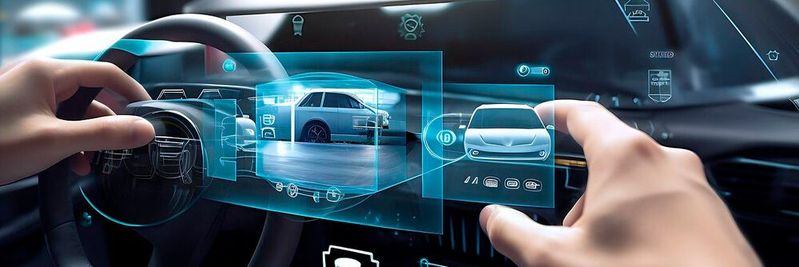
Software-Defined Vehicles represent a significant evolution in the automotive and its supplier industry. They transform traditional vehicles into highly intelligent, software-controlled platforms. This transformation allows vehicles to be continuously equipped with new features and to optimize their performance. The advantages of SDVs are manifold: from increased safety through advanced driver assistance systems, improved comfort through innovative infotainment solutions, to more efficient maintenance and lower operating costs through precise diagnostic tools.
In addition to the benefits already mentioned, many SDVs as electric vehicles contribute to more sustainable mobility. By integrating electric drives, the CO2 footprint is reduced and the dependence on fossil fuels is decreased. This leads to an improved environmental balance in the transport sector in the long term. Software-Defined Vehicles also have the advantage that the configuration of a vehicle can be changed and improved even after delivery through software updates. This makes it possible to keep vehicles in the field up to date and optimize them continuously without the need for physical interventions. In addition, services can be activated flexibly and temporarily. They aim to meet the needs of the users and provide a personalized driving experience.
However, this approach requires close cooperation between car manufacturers (OEMs) and tier-1 suppliers. This is to ensure the continuous integration and management of the software updates. This challenge underlines the need for strong coordination and the exchange of information. This is to ensure the compatibility and safety of the systems and enable a seamless driving experience.
Product line development creates the technological basis
The architecture of SDV is organized into four levels, which together form a highly integrated and modular system. At the top are user applications, such as infotainment systems, which provide a direct interface to the users. Below this are the instrumentation systems, which include Advanced Driver Assistance Systems (ADAS) that operate autonomously and increase safety. The heart of the vehicle is the embedded operating system. It controls the various components and ensures their smooth interaction. The foundation of the architecture is formed by the hardware, which encompasses all physical components such as sensors and control units. This hierarchical structure allows for efficient, flexible, and scalable development and maintenance of vehicle functions.
Product line development, also known as Product Line Engineering (PLE), plays a central role in the strategic direction of SDV development. PLE focuses on the creation of a product family that is based on a common platform. This allows for the utilization of synergies and significantly shortened development times. This methodical approach enables a quick response to (new) market requirements while preserving the consistency and quality of the product architecture. PLE makes complexity manageable and facilitates the transition to software-controlled production processes. This is done in conjunction with measures such as standardization of components and modularization of systems. It is particularly advantageous when introducing new technologies such as autonomous driving functions. PLE enables efficient reuse of software and hardware components, thus shortening innovation cycles. This is true for both automakers and tier one suppliers.
The application of product line development in the development of SDV requires close collaboration between different departments such as
Software development,
Electrical engineering and
Vehicle design
. This interdisciplinary approach is crucial for the successful implementation of the complex systems used in SDV. The integration of feedback loops and agile development practices into the PLE process also promotes continuous improvement and adaptation of vehicle platforms to changing market requirements and technological advances.
Connected Vehicles and Smart Cities
SDVs are a crucial part of the ecosystem of connected vehicles and smart cities. They contribute to increasing the efficiency of urban services and promoting smooth traffic flow. Integration into smart city infrastructures allows for improved navigation, energy management, and ultimately, a higher quality of life in urban areas.
Date: 08.12.2025
Naturally, we always handle your personal data responsibly. Any personal data we receive from you is processed in accordance with applicable data protection legislation. For detailed information please see our privacy policy.
Consent to the use of data for promotional purposes
I hereby consent to Vogel Communications Group GmbH & Co. KG, Max-Planck-Str. 7-9, 97082 Würzburg including any affiliated companies according to §§ 15 et seq. AktG (hereafter: Vogel Communications Group) using my e-mail address to send editorial newsletters. A list of all affiliated companies can be found here
Newsletter content may include all products and services of any companies mentioned above, including for example specialist journals and books, events and fairs as well as event-related products and services, print and digital media offers and services such as additional (editorial) newsletters, raffles, lead campaigns, market research both online and offline, specialist webportals and e-learning offers. In case my personal telephone number has also been collected, it may be used for offers of aforementioned products, for services of the companies mentioned above, and market research purposes.
Additionally, my consent also includes the processing of my email address and telephone number for data matching for marketing purposes with select advertising partners such as LinkedIn, Google, and Meta. For this, Vogel Communications Group may transmit said data in hashed form to the advertising partners who then use said data to determine whether I am also a member of the mentioned advertising partner portals. Vogel Communications Group uses this feature for the purposes of re-targeting (up-selling, cross-selling, and customer loyalty), generating so-called look-alike audiences for acquisition of new customers, and as basis for exclusion for on-going advertising campaigns. Further information can be found in section “data matching for marketing purposes”.
In case I access protected data on Internet portals of Vogel Communications Group including any affiliated companies according to §§ 15 et seq. AktG, I need to provide further data in order to register for the access to such content. In return for this free access to editorial content, my data may be used in accordance with this consent for the purposes stated here. This does not apply to data matching for marketing purposes.
Right of revocation
I understand that I can revoke my consent at will. My revocation does not change the lawfulness of data processing that was conducted based on my consent leading up to my revocation. One option to declare my revocation is to use the contact form found at https://contact.vogel.de. In case I no longer wish to receive certain newsletters, I have subscribed to, I can also click on the unsubscribe link included at the end of a newsletter. Further information regarding my right of revocation and the implementation of it as well as the consequences of my revocation can be found in the data protection declaration, section editorial newsletter.
Smart Cars, also known as Connected Cars, play a central role in the vision of the Smart City - a city that is made more efficient, sustainable and livable through the integration of digital technologies. These connected vehicles are connected to the internet and are equipped with a multitude of sensors that allow them to collect and share data in real time. They communicate not only with each other, but also with urban infrastructure such as traffic light systems, parking management and other road users. This connectivity enables a wide range of applications that increase traffic safety, reduce traffic jams and contribute to more efficient energy management.
In Smart Cities, Connected Cars (or autonomously driving delivery vehicles) can use real-time traffic information, for example, to calculate the fastest route and thus not only shorten the travel time for individuals, but also reduce overall traffic volume. In addition, they can receive information about available parking spaces, which simplifies the search for a parking space and avoids unnecessary driving. This leads to a reduction in fuel consumption and CO₂ emissions, which in turn improves urban air quality. Furthermore, Connected Cars enable innovative services such as carsharing and ridehailing, which contribute to reducing vehicle density in cities.
The integration of smart cars into the concept of the smart city thus constitutes an important building block for sustainable urban mobility. It supports the goals of the smart city by
increasing traffic efficiency,
minimizing environmental impact and
improving the quality of life for city dwellers.
. By using data and connecting vehicles and infrastructure, an intelligent, flexible and connected traffic area is created. This lays the foundation for the city of the future.
Software-Defined Vehicles as a pioneer for a new mobility.
The international business consultancy Deloitte assumes that Software-Defined Vehicles will drive the development of the automotive industry in the next five to ten years. SDVs represent a profound change in the automotive industry, promising a new level of safety, efficiency, and user comfort. By continuously evolving and adapting to new requirements, they offer the potential for a sustainable, flexible, and customer-oriented future of mobility.
The integration of SDVs into the concept of connected vehicles and smart cities also opens up new business opportunities and markets. The industry faces exciting challenges and opportunities in shaping forward-looking technologies that continuously extend the boundaries of what is possible with vehicles. But new opportunities and new challenges also require new approaches in engineering. Product Line Engineering is one of the key elements on the path to the mobility of the future.
*Robert Hellebrand works at Pure Variants from PTC as Director Solution Engineering and leads a team of Solutions Engineers.
This article was first published on our sisterbrand 'Industry of Things' (German Edition) , Vogel Communications Group



:quality(80)/p7i.vogel.de/wcms/dd/08/dd086510d9ae7b50181f6070e4463b44/0129363730v1.jpeg "Typical application for ionizing devices: Wrapping films. (Picture: ©Adobe Stock/SMC)")
:quality(80)/p7i.vogel.de/wcms/35/57/3557c819943c53acec41a0ccba87da4f/0130049064v1.jpeg "Researchers at the Fraunhofer IWU in Chemnitz have long known that many typical sheet metal parts can be manufactured more cost-effectively using hollow embossing rollers. Now there is news to report ... (Image:Fraunhofer IWU)")
:quality(80)/p7i.vogel.de/wcms/59/02/590246e3b3f415c65edbee377c14ca77/26-06-pi-fraunhofer-iws-41450-direktplattieren-pic-01-7771x4369v1v1.jpeg "The Fraunhofer IWS has developed the new \"direct laser cladding\" process, which creates a functional layer directly on the base body by applying a strip-shaped metal to rotationally symmetrical components in a spiral and bonding it locally by laser. (Image:Christoph Wilsnack/Fraunhofer IWS)")
:quality(80)/p7i.vogel.de/wcms/73/60/73608418789b1d9c393f5e2fa974eda2/0130209906v1.jpeg "The robots of the X6 generation from b+m enable very high painting quality and are also particularly compact and easy to maintain. (Image:Beckhoff)")
:quality(80)/p7i.vogel.de/wcms/78/e9/78e9188c25a8a94e67c34c9bf8ffe495/visual-agile-20robots-20and-20google-20deepmind-20partner-20to-20bring-20intelligence-20to-20robotics-2500x1406v1v1.jpeg "Together, the partners are developing adaptable, intelligent robots for a wide range of applications (Image:Agile Robots SE)")
:quality(80)/p7i.vogel.de/wcms/e7/66/e7669ecf0260ae8fc54c214e34e4902a/0130316817v1.jpeg "Siemens and Palo Alto Networks offer tested cybersecurity solution for industrial 5G. (Image:Siemens)")
:quality(80)/p7i.vogel.de/wcms/9f/55/9f55324832c4f426958031375124d9de/siemens-20ubtech-20hmnd-1920x1079v1v1.png "Ready for the factory floor: While Ubtech is planning mass production, Siemens is already testing humanoids in real factory applications in Erlangen. (Image:Siemens)")
:quality(80)/p7i.vogel.de/wcms/11/36/113695ed260e29c8c2d9d39dc5f9d869/0130213768v1.jpeg "AI can work cheaply in China and deliver the results rapidly all over the world. (Image:Dall-E / AI-generated)")
:quality(80)/p7i.vogel.de/wcms/62/5f/625f41e87ebfef156a98c8e6393e32fd/0130211654v1.jpeg "Axial flux motors have some advantages over radial flux motor—but their production is currently still expensive. (Image:RWTH Aachen University)")
:quality(80)/p7i.vogel.de/wcms/77/9b/779b0685d010dfe45c9c2cb1cfecd467/0128886425v1.jpeg "The BlueEye is the first \"real\" hyperspectral camera for the UV range and covers the wavelength range from 220 to 380nm. (Image:Inno-spec GmbH)")
:quality(80)/p7i.vogel.de/wcms/e4/51/e451d52ce0182fb0aaa46a5774f832ef/26-04-pi-fraunhofer-iws-21160-bioslide-pic-01-4128x2321v1v1.jpeg "With the BioSlide research project, the Fraunhofer IWS is investigating how sliding systems can be designed to be more sustainable and energy-efficient. New materials can be tested in a particularly application-oriented manner on this plain bearing test stand. (Image:Fraunhofer IWS)")
![Thanks to advanced 3D printing technology, a more efficient use of resources should contribute to lower-emission aviation—this is the goal of ['skai]-lab. (Image:Oleksandr Pashchenko - stock.adobe.com / AI-generated)](https://cdn1.vogel.de/nghHNSbySccfOjG3n1qCA-FVOjQ=/288x162/smart/filters:format(jpg):quality(80)/p7i.vogel.de/wcms/62/64/626424c97a16e69f871bf216c9629c2a/adobestock-1927043193--c2-a9-20oleksandr-20pashchenko-20-e2-80-93-20stock-adobe-com-ki-generiertv1v1.jpeg "Thanks to advanced 3D printing technology, a more efficient use of resources should contribute to lower-emission aviation—this is the goal of ['skai]-lab. (Image:Oleksandr Pashchenko - stock.adobe.com / AI-generated)")
:quality(80)/p7i.vogel.de/wcms/c3/c4/c3c4ce270b083eeac55654148611f064/0130237945v1.jpeg "China is not giving up on hydrogen, but is intensifying its efforts. (Image:freely licensed from Pixabay)")
:quality(80)/p7i.vogel.de/wcms/4e/c0/4ec0bd19390b169edfa23677373dcdf1/0130260089v1.jpeg "Renewable fuels can supply European road traffic, according to a study. (Image:Aral)")
:quality(80)/p7i.vogel.de/wcms/6f/c9/6fc9050301d745cad25585c6780f8f51/0130197341v1.jpeg "Production facilities are a worthwhile target and are therefore at risk. (Image:ABB Robotics)")
:quality(80)/p7i.vogel.de/wcms/b6/62/b662adc2cec8227d8172509bbfb6ee42/25c0207-107-4961x2789v1v1.jpeg "The GLB is the second model based on Mercedes' new MMA platform. Apparently, Geely's platform is better and cheaper, which is why the two companies are negotiating a partnership. (Image:Mercedes-Benz)")
:quality(80)/p7i.vogel.de/wcms/4d/dd/4dddf438e91f394c04a095dbfd109d1c/0130236430v1.jpeg "Measurement modules: The 720301 module in combination with the SL2000 enables RMS and power calculations, among other things. (Image:Yokogawa)")
:quality(80)/p7i.vogel.de/wcms/61/fc/61fcf95f5cca15494ad18343901ae585/0130317237v1.jpeg "With the AGI CPU, Arm says it is taking a \"historic step\": With the processor aimed at AI in data centers, the company is presenting itself for the first time as a provider of its own chips, not just as a pure IP licensor. (Image:Arm)")
:quality(80)/p7i.vogel.de/wcms/82/90/8290dfe3595b6c6b33726ae8b76172c7/0130319587v1.jpeg "The concept image illustrates how the pattern of tiny protrusions and depressions created on the substrate (MgO, bottom) controls the arrangement of atoms in the superconducting material (YBCO, top). At the interface between the two layers, an electronic structure enables superconductivity to occur at higher temperatures than previously possible. (Image:Chalmers University of Technology / Riccardo Arpaia)")
:fill(fff,0)/images.vogel.de/vogelonline/companyimg/76800/76895/65.jpg "FAULHABER_120mm.jpg ()")
:fill(fff,0)/p7i.vogel.de/companies/67/eb/67eba621ef6ea/logo2.png "logo2 (Wuxi InfiMotion)")
:quality(80)/p7i.vogel.de/wcms/88/ab/88ab6d4b558675f308771c48002c5110/0108588089.jpeg "Datenschutz wird als eine Hauptaufgabe bei Smart-City-Diensten angesehen. (Bild: gemeinfrei)")
:quality(80)/p7i.vogel.de/wcms/af/7c/af7cd87cd9c99f3ec21442f192992bae/0128044433v1.jpeg "In an SDV, software is the central product. It enables functions such as over-the-air updates, personalized driving experiences, and automated driving. To make this possible, the way vehicles are developed and designed must be fundamentally reimagined. (Image:Intellias)")
:quality(80)/p7i.vogel.de/wcms/bb/6e/bb6e230f8c1580fb1843b0de7d5abcf1/0124522783v1.jpeg "The AI Assurance in Mobility Conference Europe, which took place on April 1st and 2nd, 2025, in Berlin, focused on one question: How can we build trust in AI-based driving systems? (Image:AI Assurance in Mobility)")