Inserting threads into thousands of thick sheet metal parts is not trivial. It becomes even trickier when tight cycle times have to be met and there is a lack of space in the pressing tool.
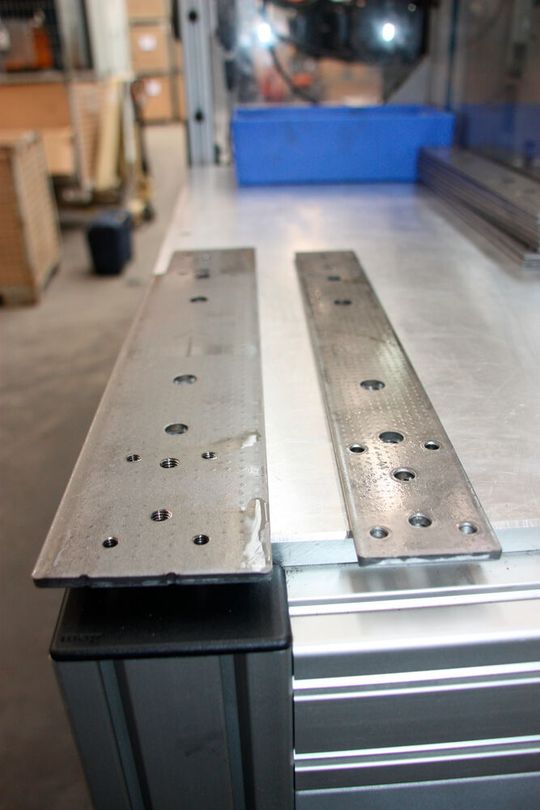
What you see here are components for armrests, as manufactured by the office furniture maker Interstuhl. Previously, the required threads were inserted with a great deal of effort. However, Fibro-Technik has turned this bottleneck into a source of productivity.
(Image: Itasse / Fibro)
More automation! This demand comes from many company managements. After all, it's about increasing process reliability, reducing costs, and tackling the shortage of skilled workers. This was also the case at Interstuhl in Meßstetten-Tieringen (Germany). The company was founded in 1961 when Wilhelm and Werner Link developed the first work chair with the Bi-Regulette.
From their village smithy, they have since become a manufacturer of chairs for office and home office, in production and in the lab, as well as for gaming. The independent, family-run company employs around 1,000 people worldwide and yet remains committed to its headquarters in Meßstetten-Tieringen. Added to this is a high level of production depth, which is unique in the industry. For example, Interstuhl manufactures all metal parts themselves.
Gallery
There is potential for optimization in the bottleneck process
The location in Germany certainly has its own requirements. Among other things, more and more automation is necessary to remain competitive. An automation project focused on how to incorporate threads more efficiently into armrest carriers. Such an armrest carrier is found in about every second chair. The armrests are screwed onto it—if desired. Until now, punching and thread forming were two separate production steps. "Punching took 2.5 seconds and thread forming, which was done manually, took eleven seconds."
"This led to bottlenecks in production, creating a bottleneck," reports Michael Maier, tool designer at Interstuhl. When it became clear what potential lay behind the project, his department quickly took over the former trainee project for developing automation technology.
This is how to form threads safely and automatically
The implementation was not quite simple! "Thread forming was not possible with the existing press tools. Therefore, we had to build a completely new facility," said Torsten Dinser, head of toolmaking/prototype construction/fixture design at Interstuhl. The new facility is connected to the punching press via a good-part conveyor belt. A gripper independently detects when an armrest carrier arrives via the conveyor belt and positions it precisely on a transverse part conveyor. This guides the workpieces made of five-millimeter-thick sheet metal under a total of twelve electronic thread forming units of the Fetu type (for Fibro Electronic Tapping Unit)—six in a row from the left and six from the right side. Fibro specifically developed this electronic thread forming unit for punching and forming processes. It can be used independently in progressive and compound tools, presses, or punching and bending machines to introduce threads in a process-secure and controlled manner. This improves thread quality, increases process security, and enables faster and more cost-effective production. "The autonomous system allows for versatile and flexible use," explains Matthias Jörg, technical consultant in Fibro's field service. The achievable thread sizes range from M0.8 to M12. Additional sizes are available upon request. The electronic thread forming unit is easy to program and control. It also comes with its own process monitoring. The high forming speed ensures that the sheet metal processing operations continue to run economically and safely.
"We equipped the system with a total of 46 sensors for monitoring," explains Maier. The thread formers insert a total of twelve threads at 24 strokes per minute. "A part with twelve threads falls out of the system every 2.5 seconds," adds Sascha Seemann, who also works in fixture design at Interstuhl. Achieving this productivity was indeed associated with some work. "We gradually increased the number of strokes until the process still ran safely," Dinser recalls. Because Interstuhl reduced the armrest carrier variants to only two in the course of the project, the system can be retooled in less than 30 minutes if necessary. The employees almost daily retool the punching press itself because production is characterized by a high variety of parts.
Learned a lot for the next automation
From the initial ideas to the finished facility, the project took about a year and a half. Partly, this was due to delivery difficulties after the Corona pandemic—the necessary servomotors were simply not available. But that was not the only reason, as some things take time. Seemann: "It was a learning process for us in the field of automation technology." Therefore, it was clear from the start that the project would take time. Not least, it was complex to properly coordinate all the automation components. But after about three months of pure production time, all parties involved are very satisfied. So far, Interstuhl has manufactured approximately 136,000 armrest carriers with the new facility. The first 100,000 pieces were with M6 threads. "Meanwhile, production is also proceeding securely and reliably with M8 threads," Maier notes. Because some manual labor can be saved, the facility will pay for itself in just over two years. And Maier also praises the cooperation with Fibro: "Throughout the project, we always had good collaboration and could always openly discuss how to solve this or that problem."
Date: 08.12.2025
Naturally, we always handle your personal data responsibly. Any personal data we receive from you is processed in accordance with applicable data protection legislation. For detailed information please see our privacy policy.
Consent to the use of data for promotional purposes
I hereby consent to Vogel Communications Group GmbH & Co. KG, Max-Planck-Str. 7-9, 97082 Würzburg including any affiliated companies according to §§ 15 et seq. AktG (hereafter: Vogel Communications Group) using my e-mail address to send editorial newsletters. A list of all affiliated companies can be found here
Newsletter content may include all products and services of any companies mentioned above, including for example specialist journals and books, events and fairs as well as event-related products and services, print and digital media offers and services such as additional (editorial) newsletters, raffles, lead campaigns, market research both online and offline, specialist webportals and e-learning offers. In case my personal telephone number has also been collected, it may be used for offers of aforementioned products, for services of the companies mentioned above, and market research purposes.
Additionally, my consent also includes the processing of my email address and telephone number for data matching for marketing purposes with select advertising partners such as LinkedIn, Google, and Meta. For this, Vogel Communications Group may transmit said data in hashed form to the advertising partners who then use said data to determine whether I am also a member of the mentioned advertising partner portals. Vogel Communications Group uses this feature for the purposes of re-targeting (up-selling, cross-selling, and customer loyalty), generating so-called look-alike audiences for acquisition of new customers, and as basis for exclusion for on-going advertising campaigns. Further information can be found in section “data matching for marketing purposes”.
In case I access protected data on Internet portals of Vogel Communications Group including any affiliated companies according to §§ 15 et seq. AktG, I need to provide further data in order to register for the access to such content. In return for this free access to editorial content, my data may be used in accordance with this consent for the purposes stated here. This does not apply to data matching for marketing purposes.
Right of revocation
I understand that I can revoke my consent at will. My revocation does not change the lawfulness of data processing that was conducted based on my consent leading up to my revocation. One option to declare my revocation is to use the contact form found at https://contact.vogel.de. In case I no longer wish to receive certain newsletters, I have subscribed to, I can also click on the unsubscribe link included at the end of a newsletter. Further information regarding my right of revocation and the implementation of it as well as the consequences of my revocation can be found in the data protection declaration, section editorial newsletter.



:quality(80)/p7i.vogel.de/wcms/f9/7d/f97deef8fde21c8630d76411b18a20a7/0129803665v1.jpeg "Skoda has invested well over 220 million US dollars in the high-tech battery plant that has now opened in Mlada Boleslav. It has now started its work, which is highly automated ... (Image:Skoda)")
:quality(80)/p7i.vogel.de/wcms/f5/61/f561ad7c72ed41fd7a67ad9c481cb15d/0129799343v1.jpeg "Engine-generator units (MGU) from Steyr Motors are at work in the Leopard 2 main battle tank and the Leguan bridge vehicle (pictured). An extended contract is now to secure at least 500 more systems of this type for the Bundeswehr ... (Image:German Armed Forces)")
:quality(80)/p7i.vogel.de/wcms/6c/b5/6cb5ce2155433f6e73b16399adc4c561/0113143253v1.jpeg "In our China Market Insider we regularly provide you with relevant information directly from China. (Image:© Eisenhans - stock.adobe.com)")
:quality(80)/p7i.vogel.de/wcms/7f/fd/7ffd32863352c40f562f4245e4766e61/0129745849v1.jpeg "After US President Donald Trump once again resorted to his favorite weapon, tariffs, concerns rose in the EU that the so-called tariff deal could become invalid. But it looks as if the sea remains relatively calm ... (Image:F. Schneidler)")
:quality(80)/p7i.vogel.de/wcms/9c/ac/9cac6246660e746c5a3989399ac4d250/0128561645v1.jpeg "Artificial intelligence can drive efficiency in smart factories through centralized data management and predictive maintenance. (Picture: ©Fardived - stock.adobe.com)")
:quality(80)/p7i.vogel.de/wcms/6b/e2/6be235b5ad8a442ccd9d164b0b300d8b/0129763992v1.jpeg "As early as 2020, the Zimmer Group announced that it would convert its production to be sustainably CO2-neutral. (Image:Zimmer Group)")
:quality(80)/p7i.vogel.de/wcms/d4/ba/d4bab9481e66f8570f40eb8ef2a90198/0129795613v1.jpeg "A camera inspection during removal ensures that the components are placed correctly in the KLTs. (Image:Yaskawa Europe)")
:quality(80)/p7i.vogel.de/wcms/cb/56/cb56e42b01638b618e8d1b9b38f32faa/0129810132v1.jpeg "From summer 2026, \"AEON\" will support people at the BMW plant in Leipzig. (Image:diephotodesigner.de/BMW)")
:quality(80)/p7i.vogel.de/wcms/b5/5e/b55ed9355e0395ec0caf111d6af6b494/adobestock-495980372--c2-a9-20natali-mis-20-e2-80-93-20stock-adobe-com-6720x3778v1v1.jpeg "Which engineering skills will be in vogue in 2026? (Image:natali_mis - stock.adobe.com)")
:quality(80)/p7i.vogel.de/wcms/bf/a5/bfa5d882e93f159ce93e933742272b00/nord-vibn-cmyk-2196x1235v1v1.jpeg "With digital twins for virtual commissioning, Nord supports customers in ensuring that systems are available more quickly, even with complex drive systems. (Image:Nord Drivesystems)")
:quality(80)/p7i.vogel.de/wcms/f5/7e/f57ef535ee35e7b3b7ff15a8a63cef10/eds-keyvisual-8000x4496v1.jpeg "(Source: European Defence Supply)")
:quality(80)/p7i.vogel.de/wcms/af/a3/afa312176d956068af20491957eef642/newsimage418262-3100x1745v1v1.jpeg "The autonomous shuttle of the Aula AI project during a demonstration of sensor data with artificial fog. (Image:University of Magdeburg)")
:quality(80)/p7i.vogel.de/wcms/c4/40/c44043c61f9dd99b80ccca398c284018/0129795093v1.jpeg "Subaru manufactures the E-Outback at its Yajima plant, marking the first time it has produced an electric vehicle in-house. (Image:Subaru)")
:quality(80)/p7i.vogel.de/wcms/fe/18/fe1824e572677900655c854f6c92c391/0129811281v1.jpeg "BMW and CATL deepen their partnership and work together on the battery pass. (Image:BMW)")
:quality(80)/p7i.vogel.de/wcms/15/54/15546b27b3a679871325ef6d92509a95/0129750872v1.jpeg "Webasto plans to open its third plant for sunroofs in India. (Image:Webasto)")
:quality(80)/p7i.vogel.de/wcms/70/14/70142aa050f8d3f7784c5ddbb2aba5f1/0129778339v1.jpeg "The software investments in production have saved time in Lacon production. (Image:Lacon)")
:quality(80)/p7i.vogel.de/wcms/5c/0f/5c0fee074c4b6c8e8c0993f3217c2f5a/0129773718v1.jpeg "The General Fusion demonstration reactor. (Image:General Fusion)")
:quality(80)/p7i.vogel.de/wcms/7f/c1/7fc1c83b8509df676d27518b82aaef02/0129764984v1.jpeg "China Resources Microelectronics (CR Micro) has announced its intention to increase the prices of its own products. (Image:China Resources Microelectronics)")
:quality(80)/p7i.vogel.de/wcms/eb/4e/eb4e449562174ec95a5b3d30fb0137a2/0129648135v1.jpeg "The III-V germanium PV module with an efficiency of 34.2% is currently the most efficient solar module in the world. (Image:Jacob Forster)")
:fill(fff,0)/images.vogel.de/vogelonline/companyimg/76800/76895/65.jpg "FAULHABER_120mm.jpg ()")
:quality(80)/p7i.vogel.de/wcms/5c/cc/5ccc4e90119393cf31ee810e4946cdeb/0123255621v1.jpeg "This system was built by the tool designers at Interstuhl themselves. It is used to insert threads into the armrest supports.(Image: Itasse / Fibro)")
:quality(80)/p7i.vogel.de/wcms/98/40/9840694fec77364a65103846febaab3a/0123255628v1.jpeg "On the right, you can see the gripper. It positions the armrest supports onto the conveyor belt. The electronic thread forming units Fetu from Fibro then equip it with threads from the left and right.(Image: Itasse / Fibro)")
:quality(80)/p7i.vogel.de/wcms/94/91/94918901132e13b81c053cb49bc9dd8c/0123257003v1.jpeg "They have managed to put an automated thread forming facility into operation. From left: Torsten Dinser, head of toolmaking/prototype construction/fixture design at Interstuhl, the fixture design employees Michael Maier (center) and Sascha Seemann, Matthias Jörg, technical consultant in field service at Fibro, and Stefan Schröder, head of thread application, also from Fibro.(Image: Itasse / Fibro)")
:quality(80)/p7i.vogel.de/wcms/8a/07/8a074a62788c3ef35a32074f19473560/0123256268v1.jpeg "The productivity of the system with Fibro systems at Interstuhl is so high that every 2.5 seconds an armrest support with all necessary threads is completed. This is followed by powder coating.(Image: Itasse / Fibro)")
:quality(80):fill(efefef,0)/p7i.vogel.de/wcms/67/ad/67adf4a647532/elatec-wp-machine-authentication.png "Elatec WP Machine Authentication")
:quality(80)/p7i.vogel.de/wcms/1c/b8/1cb84b2e2813dca2b941c856dca46479/0125965722v1.jpeg "Gritec in Waghäusel (Germany) is a complete provider of system-relevant infrastructure solutions. These so-called station technical buildings house electricity, gas, water, mobile communications, and broadband. (Image:VCG/Finus)")
:quality(80)/p7i.vogel.de/wcms/e5/b9/e5b94eb3b77975e034e32ee84520f554/0125747872v1.jpeg "With the new bending center, Bedrunka + Hirth has reduced cycle times by 33 percent. (Image:RAS)")