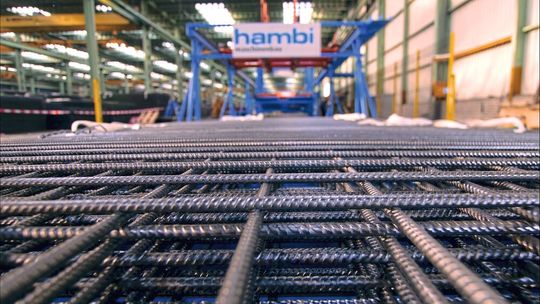
The construction industry requires many diligent hands, as manual labor remains standard in many areas. Terhoeven has automated the cutting of reinforcement steel mats using Mitsubishi Electric technology and Orgassa's expertise.
Handling reinforcement steel mats is a demanding task for automation technology.
(Image: hambi mechanical engineering)
In the production of welded wire mesh, steel wire is first uncoiled and straightened. During this process, the wires also receive their characteristic ribbing. An automated machine then welds the wires into a mesh with transverse and longitudinal rods. To achieve optimal machine utilization, the welding machine produces the meshes in the maximum format. Since smaller formats are typically used on construction sites, the meshes must be cut to the appropriate size. In the past, this process was very labor-intensive as there was no automated solution.
Up to six people are needed to lift the heavy meshes and position them on the cutting machine. During subsequent stacking, every second mesh must be flipped to reduce the stack height. It is becoming increasingly difficult to find personnel for this strenuous and monotonous work. The company van Merksteijn International B.V., which processes 3,400 tons of concrete steel daily, therefore sought an automated solution.
Mechanical Engineer Specialized in Reinforcement Steel Mats
The company found its solution with Terhoeven GmbH & Co. KG, which offers solutions for this sector under the hambi Maschinenbau (engl.: Mechanical engineering) brand. Originally founded in 1908 as a village smithy, the company is now run by Stephan Terhoeven in its fourth generation. He explains: "Since 2006, we have focused entirely on mechanical engineering and have given up our other business areas in agricultural and farming technology." With around 30 employees, hambi offers various machines for handling, cutting, and bending welded wire mesh. The range extends from small bending benches used on construction sites to large machines for rebar bending facilities and mesh manufacturers.
On behalf of van Merksteijn International, the machine manufacturer developed a system that fully automates the handling, cutting, and stacking of welded wire mesh. The ASA (Automatic Cutting System) first separates the top mesh from the stack, lifts it, and transports it to the feeder unit. The feeder unit pushes the mesh into the guillotine until the set length is reached. The guillotine then cuts the mesh, and the mesh discharge transports the cut section to the mesh turner. In the final step, the system stacks the mesh. The mesh turner rotates every second mesh during this process. This rotation minimizes stack height by interlocking the sections.
Separating and Lifting the Mats as a Challenge
Lifting the top mesh from the stack initially seems relatively simple. "For automation, however, this step is a major challenge," explains Stefan Broeckmann, responsible for design and development at Terhoeven. The manufacturing tolerances of welded wire mesh are in the centimeter range, but handling requires an accuracy of less than a millimeter. Additionally, the individual meshes are not neatly stacked. For the automation process, the company commissioned Orgassa GmbH. "We share a long-standing, trusting collaboration," says Terhoeven. The first crucial step is determining the actual position of the mesh and, thus, the gripping points where the grippers can lift the mesh. Marc Orgassa, managing director of Orgassa, explains the procedure: "A combination of image processing with modern camera technology and laser sensors detects the actual position of the gripping points, allowing the meshes to be grabbed with precision." The 3D image processing used for this was entirely programmed by Orgassa.
When the six grippers lift the welded wire mesh, the next challenge arises. As the mesh is lifted, it bends, creating horizontal forces on the lifting devices. "To compensate for this," explains Orgassa, "the distances between the individual gripping points need to be adjusted." Therefore, three separately operating drives are required for each of the six points to move the grippers in all three spatial directions. During operation, the drives must be precisely and synchronously controlled.
Drive and Automation Technology from a Single Source
To compensate for the deformation of the meshes during lifting, 18 drives are required for the lifting mechanism, along with four additional drives for transporting the meshes within the system and for turning them before stacking. Servo drives from Mitsubishi Electric, along with corresponding servo amplifiers, are used for this purpose. The motors of the MR-J5 series are very compact and offer high dynamics. The associated servo amplifiers can be linked via intermediate circuits—allowing the braking energy of one drive to be directly used by another. The servo amplifiers also enable power regeneration back into the grid. This achieves a high level of energy efficiency in the system overall. "With the Motion Controller, we can optimally implement the required synchronization of the drives," says Orgassa, highlighting an important reason for choosing this system.
All other components of the automation technology also come from Mitsubishi Electric. In addition to the servo-equipped drives, frequency inverters of the FR-E800 type are used for simple conveyor tasks. A safety PLC from the MELSEC iQ-R series controls all processes in the system. This is complemented by three C-Controllers equipped with a Linux operating system. These separate CPUs primarily run the image processing that, using cameras and sensors, determines the gripping points of the welded wire meshes. "The communication via CC Link IE TSN is particularly important for us," explains Orgassa, "as it ensures the synchronization of the various system components and the controllers with the drives."
Date: 08.12.2025
Naturally, we always handle your personal data responsibly. Any personal data we receive from you is processed in accordance with applicable data protection legislation. For detailed information please see our privacy policy.
Consent to the use of data for promotional purposes
I hereby consent to Vogel Communications Group GmbH & Co. KG, Max-Planck-Str. 7-9, 97082 Würzburg including any affiliated companies according to §§ 15 et seq. AktG (hereafter: Vogel Communications Group) using my e-mail address to send editorial newsletters. A list of all affiliated companies can be found here
Newsletter content may include all products and services of any companies mentioned above, including for example specialist journals and books, events and fairs as well as event-related products and services, print and digital media offers and services such as additional (editorial) newsletters, raffles, lead campaigns, market research both online and offline, specialist webportals and e-learning offers. In case my personal telephone number has also been collected, it may be used for offers of aforementioned products, for services of the companies mentioned above, and market research purposes.
Additionally, my consent also includes the processing of my email address and telephone number for data matching for marketing purposes with select advertising partners such as LinkedIn, Google, and Meta. For this, Vogel Communications Group may transmit said data in hashed form to the advertising partners who then use said data to determine whether I am also a member of the mentioned advertising partner portals. Vogel Communications Group uses this feature for the purposes of re-targeting (up-selling, cross-selling, and customer loyalty), generating so-called look-alike audiences for acquisition of new customers, and as basis for exclusion for on-going advertising campaigns. Further information can be found in section “data matching for marketing purposes”.
In case I access protected data on Internet portals of Vogel Communications Group including any affiliated companies according to §§ 15 et seq. AktG, I need to provide further data in order to register for the access to such content. In return for this free access to editorial content, my data may be used in accordance with this consent for the purposes stated here. This does not apply to data matching for marketing purposes.
Right of revocation
I understand that I can revoke my consent at will. My revocation does not change the lawfulness of data processing that was conducted based on my consent leading up to my revocation. One option to declare my revocation is to use the contact form found at https://contact.vogel.de. In case I no longer wish to receive certain newsletters, I have subscribed to, I can also click on the unsubscribe link included at the end of a newsletter. Further information regarding my right of revocation and the implementation of it as well as the consequences of my revocation can be found in the data protection declaration, section editorial newsletter.
This is an important prerequisite, as the image processing naturally requires the exact positions of the grippers. The CC Link IE TSN protocol is used, which enables both real-time capability and the necessary safety-oriented communication. With the gigabit bandwidth provided by the open CC-Link IE TSN standard, the communication of control, motion control, and safety can easily be integrated into one network. The electrical supply protection for the entire system is also ensured with a component from Mitsubishi Electric: a contactor of the SD-T100 type is used here.
Work Safety is a Top Priority
When handling the heavy welded wire meshes, the automation technology must ensure the safety of the operating personnel. Therefore, all components of the drive and automation technology are used in safety versions. This applies not only to the safety PLC but also to the servo drives, which are also monitored for safety. In the event of a power failure in the system, the drive will remain in a safe position in any case. The position is additionally monitored with encoders—also in safety versions. The same applies to the compact digital I/O modules of the NZ2GN type, which connect various switches and sensors in the system to the PLC. To prevent potentially dangerous access to the system during operation, a safety fence, including a safety door and two light curtains, has been installed. "Overall, with all safety measures, we achieve Performance Level c and, in some areas, Performance Level d," emphasizes Broeckmann.
Operation by one Person
The operation of the ASA is carried out via a GOT operating device from Mitsubishi Electric. In addition to the touch display, it also integrates some buttons and switches to facilitate operation with gloves. The programming of the user interface and visualization was done by Marc Orgassa in the iQ Works programming environment. The software package enables efficient cross-system programming of all automation components, from the drives and safety PLC to the operating device. "Only the software for image processing was programmed in C," notes Orgassa as an exception.
The user interface offers four different levels for various users. In addition to using the active program and operating in routine mode, there is a setup mode for entering parameters for a new mesh size. In the fourth level, basic settings can be adjusted or errors can be diagnosed. Retrofitting the system, for example, to accommodate a new mesh size, is very simple with the GOT operating device. Only a few tasks need to be performed manually during setup, such as adjusting the width stop in the storage area or changing the grippers for two different rod diameter ranges. To operate the system within the safety fence during setup or troubleshooting, a mobile GOT operating device is provided. This allows the system to be moved only in safe operation at reduced speed.
System Successfully Commissioned
After a development period of nearly two years, the first system was commissioned at the customer's site in spring 2024. "The ASA is 6 meters high and over 40 meters long," emphasizes Stefan Broeckmann, highlighting its impressive dimensions. When explaining why they chose Mitsubishi Electric for the drive and automation technology, Terhoeven states simply, "We have been using Mitsubishi Electric products in our machines and systems for many years and have consistently had good experiences." Orgassa adds, "Using all components from a single source is, in our experience, very practical. With Mitsubishi Electric's current portfolio, we can easily implement real-time communication, drive synchronization, and safety requirements."
After presenting a world-first with the successful automation of cutting welded wire mesh, the machine manufacturer is already working on the next steps. A machine is planned that can bend welded wire mesh into cages of various geometries and sizes, which are used on construction sites for the production of columns, beams, or lintels—once again fully automated. "For the automation technology, we will certainly rely on Orgassa and the systems from Mitsubishi Electric again," says Stephan Terhoeven. (st)
Secure and Compliant Authentication in Laboratories



:quality(80)/p7i.vogel.de/wcms/dd/08/dd086510d9ae7b50181f6070e4463b44/0129363730v1.jpeg "Typical application for ionizing devices: Wrapping films. (Picture: ©Adobe Stock/SMC)")
:quality(80)/p7i.vogel.de/wcms/35/57/3557c819943c53acec41a0ccba87da4f/0130049064v1.jpeg "Researchers at the Fraunhofer IWU in Chemnitz have long known that many typical sheet metal parts can be manufactured more cost-effectively using hollow embossing rollers. Now there is news to report ... (Image:Fraunhofer IWU)")
:quality(80)/p7i.vogel.de/wcms/59/02/590246e3b3f415c65edbee377c14ca77/26-06-pi-fraunhofer-iws-41450-direktplattieren-pic-01-7771x4369v1v1.jpeg "The Fraunhofer IWS has developed the new \"direct laser cladding\" process, which creates a functional layer directly on the base body by applying a strip-shaped metal to rotationally symmetrical components in a spiral and bonding it locally by laser. (Image:Christoph Wilsnack/Fraunhofer IWS)")
:quality(80)/p7i.vogel.de/wcms/73/60/73608418789b1d9c393f5e2fa974eda2/0130209906v1.jpeg "The robots of the X6 generation from b+m enable very high painting quality and are also particularly compact and easy to maintain. (Image:Beckhoff)")
:quality(80)/p7i.vogel.de/wcms/78/e9/78e9188c25a8a94e67c34c9bf8ffe495/visual-agile-20robots-20and-20google-20deepmind-20partner-20to-20bring-20intelligence-20to-20robotics-2500x1406v1v1.jpeg "Together, the partners are developing adaptable, intelligent robots for a wide range of applications (Image:Agile Robots SE)")
:quality(80)/p7i.vogel.de/wcms/e7/66/e7669ecf0260ae8fc54c214e34e4902a/0130316817v1.jpeg "Siemens and Palo Alto Networks offer tested cybersecurity solution for industrial 5G. (Image:Siemens)")
:quality(80)/p7i.vogel.de/wcms/9f/55/9f55324832c4f426958031375124d9de/siemens-20ubtech-20hmnd-1920x1079v1v1.png "Ready for the factory floor: While Ubtech is planning mass production, Siemens is already testing humanoids in real factory applications in Erlangen. (Image:Siemens)")
:quality(80)/p7i.vogel.de/wcms/11/36/113695ed260e29c8c2d9d39dc5f9d869/0130213768v1.jpeg "AI can work cheaply in China and deliver the results rapidly all over the world. (Image:Dall-E / AI-generated)")
:quality(80)/p7i.vogel.de/wcms/62/5f/625f41e87ebfef156a98c8e6393e32fd/0130211654v1.jpeg "Axial flux motors have some advantages over radial flux motor—but their production is currently still expensive. (Image:RWTH Aachen University)")
:quality(80)/p7i.vogel.de/wcms/77/9b/779b0685d010dfe45c9c2cb1cfecd467/0128886425v1.jpeg "The BlueEye is the first \"real\" hyperspectral camera for the UV range and covers the wavelength range from 220 to 380nm. (Image:Inno-spec GmbH)")
:quality(80)/p7i.vogel.de/wcms/e4/51/e451d52ce0182fb0aaa46a5774f832ef/26-04-pi-fraunhofer-iws-21160-bioslide-pic-01-4128x2321v1v1.jpeg "With the BioSlide research project, the Fraunhofer IWS is investigating how sliding systems can be designed to be more sustainable and energy-efficient. New materials can be tested in a particularly application-oriented manner on this plain bearing test stand. (Image:Fraunhofer IWS)")
![Thanks to advanced 3D printing technology, a more efficient use of resources should contribute to lower-emission aviation—this is the goal of ['skai]-lab. (Image:Oleksandr Pashchenko - stock.adobe.com / AI-generated)](https://cdn1.vogel.de/nghHNSbySccfOjG3n1qCA-FVOjQ=/288x162/smart/filters:format(jpg):quality(80)/p7i.vogel.de/wcms/62/64/626424c97a16e69f871bf216c9629c2a/adobestock-1927043193--c2-a9-20oleksandr-20pashchenko-20-e2-80-93-20stock-adobe-com-ki-generiertv1v1.jpeg "Thanks to advanced 3D printing technology, a more efficient use of resources should contribute to lower-emission aviation—this is the goal of ['skai]-lab. (Image:Oleksandr Pashchenko - stock.adobe.com / AI-generated)")
:quality(80)/p7i.vogel.de/wcms/c3/c4/c3c4ce270b083eeac55654148611f064/0130237945v1.jpeg "China is not giving up on hydrogen, but is intensifying its efforts. (Image:freely licensed from Pixabay)")
:quality(80)/p7i.vogel.de/wcms/4e/c0/4ec0bd19390b169edfa23677373dcdf1/0130260089v1.jpeg "Renewable fuels can supply European road traffic, according to a study. (Image:Aral)")
:quality(80)/p7i.vogel.de/wcms/6f/c9/6fc9050301d745cad25585c6780f8f51/0130197341v1.jpeg "Production facilities are a worthwhile target and are therefore at risk. (Image:ABB Robotics)")
:quality(80)/p7i.vogel.de/wcms/b6/62/b662adc2cec8227d8172509bbfb6ee42/25c0207-107-4961x2789v1v1.jpeg "The GLB is the second model based on Mercedes' new MMA platform. Apparently, Geely's platform is better and cheaper, which is why the two companies are negotiating a partnership. (Image:Mercedes-Benz)")
:quality(80)/p7i.vogel.de/wcms/4d/dd/4dddf438e91f394c04a095dbfd109d1c/0130236430v1.jpeg "Measurement modules: The 720301 module in combination with the SL2000 enables RMS and power calculations, among other things. (Image:Yokogawa)")
:quality(80)/p7i.vogel.de/wcms/61/fc/61fcf95f5cca15494ad18343901ae585/0130317237v1.jpeg "With the AGI CPU, Arm says it is taking a \"historic step\": With the processor aimed at AI in data centers, the company is presenting itself for the first time as a provider of its own chips, not just as a pure IP licensor. (Image:Arm)")
:quality(80)/p7i.vogel.de/wcms/82/90/8290dfe3595b6c6b33726ae8b76172c7/0130319587v1.jpeg "The concept image illustrates how the pattern of tiny protrusions and depressions created on the substrate (MgO, bottom) controls the arrangement of atoms in the superconducting material (YBCO, top). At the interface between the two layers, an electronic structure enables superconductivity to occur at higher temperatures than previously possible. (Image:Chalmers University of Technology / Riccardo Arpaia)")
:fill(fff,0)/images.vogel.de/vogelonline/companyimg/76800/76895/65.jpg "FAULHABER_120mm.jpg ()")
:fill(fff,0)/p7i.vogel.de/companies/67/eb/67eba621ef6ea/logo2.png "logo2 (Wuxi InfiMotion)")
:quality(80)/p7i.vogel.de/wcms/8f/50/8f5043b2eab188580d4c20b562d33fd0/0125046035v1.jpeg "A mobile GOT operating device is installed for system setup and troubleshooting.(Image: hambi mechanical engineering)")
:quality(80)/p7i.vogel.de/wcms/a9/31/a9314ac7589f0b6795649aefa2bb68ac/0125046027v1.jpeg "Good collaboration was crucial for the success of the project. Jörg Springsguth from Mitsubishi Electric in conversation with Stefan Broeckmann, Stephan Terhoeven, and Marc Orgassa (from left to right).(Image: hambi mechanical engineering)")
:quality(80)/p7i.vogel.de/wcms/21/39/2139daa0e64d5772ad780511acd52b18/0125046021v1.jpeg "The system for cutting and handling the steel mats requires a lot of space; it is six meters high and over 40 meters (approx. 130 ft) long.(Image: hambi mechanical engineering)")
:quality(80)/p7i.vogel.de/wcms/70/ec/70ecad945fb9040462e944c9647c609e/0125051220v1.jpeg "Six grippers lift the reinforcement steel mat, while servo drives from Mitsubishi Electric enable its movement in all three spatial directions.(Image: hambi mechanical engineering)")
:quality(80):fill(efefef,0)/p7i.vogel.de/wcms/67/ac/67acb931a438c/elatec-wp-gmp.png "Elatec WP GMP")
:quality(80)/p7i.vogel.de/wcms/ac/1f/ac1f27b65202bb8f3bce4d38154764bf/0125519997v1.jpeg "Bystronic was looking for an economical drive solution for the ByCut Eco laser cutting machine that meets all requirements for dynamics and accuracy. (Image:Bystronic)")
:quality(80)/p7i.vogel.de/wcms/48/0b/480b3b4573d1aa96eb6b0393750375c0/0125459101v1.jpeg "The automated laser system at B&H CNC sheet metal processing: The Fiber Laser 3015 with portal loader from Boschert. (Image:Boschert)")