In metallography, metal samples are meticulously prepared, and their microstructure is examined during structural analysis. A grinding and polishing machine can also automate the sample preparation.
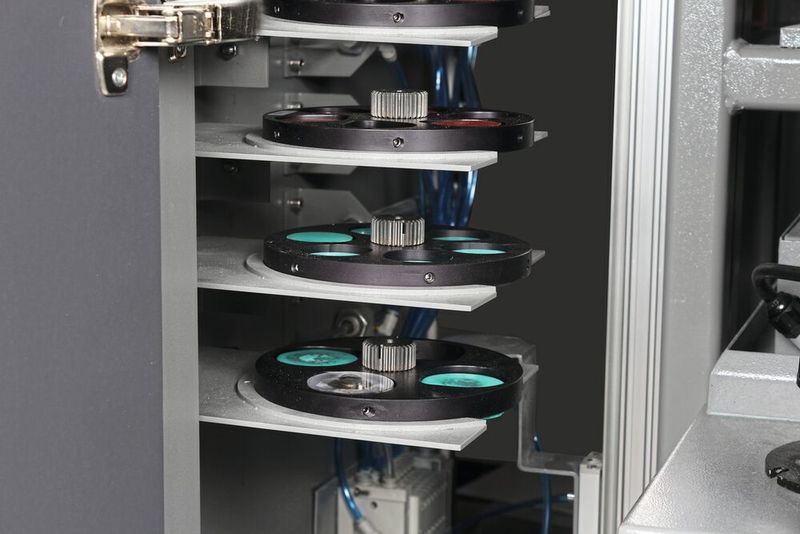
Magazine sample holder
(Image: Schütz+Licht Prüftechnik GmbH)
In the steel mill, a temperature sensor is defective, causing the oven temperature to be too low and the heat treatment of the material to be incorrect. As a result, the metal's structure is flawed, despite the raw material being in good condition. The issue goes unnoticed, the components pass the visual inspection, and are installed in vehicle suspension systems. Months later, cracks appear: the consequences are tens of thousands of recalls, a damaged reputation for the manufacturer, and massive costs. To avoid such a scenario, all process steps in metal production are monitored, as every processing stage has the potential to cause errors.
The supplier must provide proof of quality assurance, for example, as part of audits. Quality testing of metals not only includes tensile and tearing tests; metallography (microstructure analysis) is used to verify that the crystalline basic structure of the material meets the requirements after different manufacturing steps or whether a faulty heat treatment has caused undesirable changes.
Technically used metals are alloys, mixtures with varying proportions of different elements. These are crucial for quality. Metallography examines whether the metal has solidified in the correct structure or specific arrangement, ensuring that iron has become qualified steel and successful hardening can be verified. For this purpose, the microstructure of the metal is analyzed under a microscope, including the type and size of grains, their number and boundaries, and the structure types. The analysis provides insights into manufacturing processes and material properties and detects defects such as cracks, segregations, shrinkage cavities, or inclusions.
The Sample Preparation
For metallography, metal samples must be prepared. In the first step, the metal sample is divided using a special cut-off grinding machine. To prevent spark formation and the extreme heat released from affecting the material properties, special cutting discs and a cooling system are used to keep the surface cool.
Afterward, the sample, roughly the size of a sugar cube or with an edge length of about ten millimeters, is embedded in plastic for fixation, ground, polished, and then treated with acids, meaning etched. The acid removes particles such as carbon, making the grain boundaries of the metal visible under the light microscope.
The manual preparation of samples entails potential errors: the human hand is not a stand, and for grinding, the operator must hold the sample in their hand, which is not an exact position. Each employee works differently, applies more or less pressure, and doses the suspensions needed for grinding differently.
If the sample is ground at an angle, the grind is not flat but convex, this affects the evaluation. The metallographer works with a magnification of 500 to 1000 times. The depth of field is correspondingly tiny and less than a micron. If the sample is convex because of unsteady hand movement during preparation, the necessary image sharpness is not achieved. A sample prepared in this way leads to incorrect results in the examination. The metallography is then not reliable.
Machine Sample Preparation
The grinding and polishing of metal samples can be automated with the Velox 102 and 102-JR grinding and polishing systems from Schütz+Licht Prüftechnik GmbH. It takes over all process steps from planar to fine grinding, polishing and fine polishing, cleaning, and drying.
The samples embedded in plastic are placed in the sample holder of the machine, which, depending on its configuration, holds four or six samples. This allows the processing to begin. The clamped samples go through various grinding steps, from 180 to 320 to 800 grit. The necessary discs are changed automatically, and the cleaning of the samples is also part of the process: the particles from the coarse grinding must not contaminate the sample, so the samples are cleaned with spray water and immersed.
Date: 08.12.2025
Naturally, we always handle your personal data responsibly. Any personal data we receive from you is processed in accordance with applicable data protection legislation. For detailed information please see our privacy policy.
Consent to the use of data for promotional purposes
I hereby consent to Vogel Communications Group GmbH & Co. KG, Max-Planck-Str. 7-9, 97082 Würzburg including any affiliated companies according to §§ 15 et seq. AktG (hereafter: Vogel Communications Group) using my e-mail address to send editorial newsletters. A list of all affiliated companies can be found here
Newsletter content may include all products and services of any companies mentioned above, including for example specialist journals and books, events and fairs as well as event-related products and services, print and digital media offers and services such as additional (editorial) newsletters, raffles, lead campaigns, market research both online and offline, specialist webportals and e-learning offers. In case my personal telephone number has also been collected, it may be used for offers of aforementioned products, for services of the companies mentioned above, and market research purposes.
Additionally, my consent also includes the processing of my email address and telephone number for data matching for marketing purposes with select advertising partners such as LinkedIn, Google, and Meta. For this, Vogel Communications Group may transmit said data in hashed form to the advertising partners who then use said data to determine whether I am also a member of the mentioned advertising partner portals. Vogel Communications Group uses this feature for the purposes of re-targeting (up-selling, cross-selling, and customer loyalty), generating so-called look-alike audiences for acquisition of new customers, and as basis for exclusion for on-going advertising campaigns. Further information can be found in section “data matching for marketing purposes”.
In case I access protected data on Internet portals of Vogel Communications Group including any affiliated companies according to §§ 15 et seq. AktG, I need to provide further data in order to register for the access to such content. In return for this free access to editorial content, my data may be used in accordance with this consent for the purposes stated here. This does not apply to data matching for marketing purposes.
Right of revocation
I understand that I can revoke my consent at will. My revocation does not change the lawfulness of data processing that was conducted based on my consent leading up to my revocation. One option to declare my revocation is to use the contact form found at https://contact.vogel.de. In case I no longer wish to receive certain newsletters, I have subscribed to, I can also click on the unsubscribe link included at the end of a newsletter. Further information regarding my right of revocation and the implementation of it as well as the consequences of my revocation can be found in the data protection declaration, section editorial newsletter.
A sample surface that is so smooth it reflects is not sufficient—therefore, the next step involves polishing, for which differently woven cloths are used. Depending on the type of metal, up to six polishing agents are used in the process. The next processing step before microscopy, etching, is then carried out manually again.
The Advantages
Foundries and steel mills must prepare and examine numerous metal samples for quality assurance. If approximately 30 to 40 grinding samples are produced daily, machine preparation saves significant time and costs: preparing samples individually takes about 15 minutes per sample. While the machine prepares multiple samples simultaneously, the employee can already begin microscopy; their working time is no longer tied up with simple tasks.
This allows the machine to partially compensate for the shortage of skilled workers. It can operate during an unmanned night shift, and in the morning, the desired number of samples is ready for use. Preparation can thus be automated, and sample preparation standardized, which halves the costs of quality assurance. With daily utilization, the investment in a grinding and polishing station pays off within two years at the latest.
Additionally, the reproducibility of the grinding quality no longer requires a highly skilled operator—the machine reliably produces the same sample quality. As a result, the outcomes are no longer dependent on the individual but are defined by the input parameters—everyone has the same conditions, ensuring identical surface quality. The machine also contributes to sustainability by optimizing the use of consumables and grinding materials and minimizing water consumption. Only as many resources as necessary are used, thereby reducing pollutants to a minimum.
Quality assurance of metal samples is a central component of industrial manufacturing, as any defect in the microstructure or material properties can lead to significant follow-up costs. The combination of precise sample preparation, microscopic analysis, and machine assistance ensures reproducible results, reduces sources of error, and helps use resources more efficiently. In times of labor shortages and increasing demands for sustainability, the automation of metallography offers an economically and qualitatively viable solution.
Secure and Compliant Authentication in Laboratories



:quality(80)/p7i.vogel.de/wcms/68/a5/68a5ce0896756c1dcf48dbeceefafbd3/0132300990v1.jpeg "Christoph Geigges is President and CEO of Walter AG. Headquartered in Tübingen (Germany), the company is one of the world’s leading suppliers of precision tools for metalworking. Under Geigges’ leadership, this long-established company is increasingly transforming itself from a tool manufacturer into an engineering partner that supports the entire manufacturing process. (Image: Walter AG)")
:quality(80)/p7i.vogel.de/wcms/3e/7c/3e7c26f44c68545fc7318597b6b65903/0133649650v1.jpeg "The flexible Heller circular storage system can store and process pallets measuring both 630 millimeters by 630 millimeters and 800 millimeters by 800 millimeters—even in mixed-mode operation. This makes the entire production line particularly flexible. (Image:Brighter)")
:quality(80)/p7i.vogel.de/wcms/16/29/162983885950ec1df27ab441bfe88613/0133132549v1.jpeg "Bernd Hermeler is the CEO of Cemecon AG. He studied mechanical engineering at RWTH Aachen University (Germany)—the very university from which the company emerged as a spin-off 40 years ago. Today, Hermeler is responsible for the global strategy of the coating specialist, which, with branches in Europe, the U.S., China, Japan, and India, is considered the global technology leader in the coating of cutting tools. (Image: Cemecon AG)")
:quality(80)/p7i.vogel.de/wcms/af/81/af81b53cb4926dcadc20ba369a29d412/0132695968v1.jpeg "International venture capital is increasingly flowing into the machining industry. Here are the players that entrepreneurs and CEOs should keep an eye on right now. (Image: ©NDABCREATIVITY - stock.adobe.com)")
:quality(80)/p7i.vogel.de/wcms/88/dc/88dc38a1a0b5e016192ab83b0850fbd0/0133514708v1.jpeg "Scalable data sovereignty is the foundation for the transition from computationally intensive AI processing and growing data streams to sustainable, energy-efficient storage systems. (Image:Gemini / AI-generated)")
:quality(80)/p7i.vogel.de/wcms/1c/ef/1cef66e13c5cc02c5731fefcc99c00d2/0133697754v1.jpeg "Embodied AI in Industry: FMC³ Robotics combines AI-based perception and adaptation with traditional robot control to prepare robots for use in industrial manufacturing. (Image:FMC³/processed by AI)")
:quality(80)/p7i.vogel.de/wcms/db/ca/dbcae78eb8853b53fe122832fe3b2cba/0132914918v1.jpeg "Robotics in Flexible Manufacturing: As connectivity increases, so do the requirements for functional safety. (Image: Delta Electronics)")
:quality(80)/p7i.vogel.de/wcms/ea/18/ea18e84aed24bbe1c91937f30c2f7301/image1v1.jpeg "Kassow Robots' new product portfolio now includes seven 7-axis cobots. (Image: Kassow Robots (Image:)")
:quality(80)/p7i.vogel.de/wcms/90/30/90300137452b00d22f95113eff065ac3/fliehkraftkupplungen-und-bremsen-montage-centrifugal-clutches-and-brakes-assembly-1v1.jpeg "Installation: Centrifugal clutches should always be precisely matched to the machine. (Source: Amsbeck Machine Technology)")
:quality(80)/p7i.vogel.de/wcms/93/84/9384230e840a99a2015fdd3e0af11e2b/newsimage428236v1.jpeg "The crutch replicates the natural, biomechanical movement pattern of the human body. (Source: Leon Kast)")
:quality(80)/p7i.vogel.de/wcms/5b/a2/5ba21b3e5fcdd91f6bfe806f745ea723/isc-physioink-bild-3v1.jpeg "In the PhysioINK project, Fraunhofer researchers are developing bio-printing inks from the most common tissue proteins. Under the microscope, the living tissue cells (fibroblasts) are visible in the printed lattice structure: blue represents the cell nucleus, and green represents the cytoskeleton. (Source: Tobias Weigel/Fraunhofer ISC)")
:quality(80)/p7i.vogel.de/wcms/9c/16/9c16e4aa02594fe4bf82ead736562b07/directhop1-scaledv1.jpeg "Light as a feather, but without feathers: The University of Washington's robot, which weighs just one gram, uses a bionic direct-drive system to catapult itself into the air with centimeter-level precision. (Source: Mark Stone/University of Washington)")
:quality(80)/p7i.vogel.de/wcms/0a/50/0a50938be0b598b36efc4e5457ed56dd/forvia-siege-zen-massage-16-9-06v1.jpeg "Seat with massage function by Forvia. (Source: Forvia)")
:quality(80)/p7i.vogel.de/wcms/99/61/9961719acb89bc87fdecb1bba140481c/0133725593v1.jpeg "Ultrason (PSU, PESU, PPSU) is suitable for E&E components used in electric mobility or AI infrastructure, such as connectors for fiber-optic cables. (Image:BASF)")
:quality(80)/p7i.vogel.de/wcms/42/9b/429badd88cd4a74edb6491d10310349c/wayve-london-05v1.jpeg "Wayve is developing an AI software stack for automated driving. It appears that the Volkswagen Group has now opted for this technology. (Source: Wayve)")
:quality(80)/p7i.vogel.de/wcms/14/9f/149f934f87e5418748fa41a611586a4f/rawdon-gloverv1.jpeg "Rowdon Glover, Managing Director of Jaguar: “We are willing to accept polarization.” (Image:JLR)")
:quality(80)/p7i.vogel.de/wcms/36/f0/36f0472d20227013871aa790f4d48ac6/0133726018v1.jpeg "Ion beams can ablate, coat, or smooth surfaces down to the atomic level. Such processes are used, among other things, in optical chips, precision optics, and superconducting materials. (Image:AI-generated)")
:quality(80)/p7i.vogel.de/wcms/1f/47/1f47da6ee12c38a745eb478a04157a65/0133726100v1.jpeg "The schematic diagram shows the structure of a 3D NAND memory device with memory cells stacked on top of one another and vertical connections for high storage density. (Image:Dall-E / AI-generated)")
:quality(80)/p7i.vogel.de/wcms/70/59/7059db055d4eeb8dea752651a071f360/geralt-handshake-4608297v1.jpeg "The deal between Schneider Electric and PTC is intended to create end-to-end data flows for the industry. (Source: )")
:quality(80)/p7i.vogel.de/wcms/67/3d/673d8f6f14bd030b53b61800a0aeb06d/0133548286v1.jpeg "Overview: If even a single critical component is missing, the entire production process can come to a standstill. Proactive procurement is intended to mitigate such bottlenecks early on. (Image:Dall-E / AI-generated)")
:fill(fff,0)/p7i.vogel.de/companies/69/88/69882c428938e/tmts2026-ticec-banner-en-2000px.png "tmts2026-ticec-banner-en-2000px (https://www.tmts.tw/en)")
:fill(fff,0)/p7i.vogel.de/companies/69/de/69de1b7403b0d/simtos-logo.jpeg "simtos-logo (SIMTOS)")
:quality(80)/p7i.vogel.de/wcms/54/5e/545e474d816a2518d6c8263a2db34dbd/0127191529v1.jpeg "The Velox grinding and polishing machine.(Image: Schütz+Licht Prüftechnik GmbH)")
:quality(80)/p7i.vogel.de/wcms/cf/3f/cf3f64035ad0ef53f2c2c6e02564c9c3/0127192463v1.jpeg "Work area grinding + polishing(Image: Schütz+Licht Prüftechnik GmbH)")
:quality(80)/p7i.vogel.de/wcms/07/5f/075feafeed0565e38089e33a91f45f44/0127191717v1.jpeg "Loading of the grinding disc magazine.(Image: Schütz+Licht Prüftechnik GmbH)")
:quality(80)/p7i.vogel.de/wcms/89/19/8919615fa9bf36548296e013b63a1092/0127192487v1.jpeg "Velox 102JR automated system for a sample holder with 6 samples(Image: Schütz+Licht Prüftechnik GmbH)")
:quality(80):fill(efefef,0)/p7i.vogel.de/wcms/67/ac/67acb931a438c/elatec-wp-gmp.png "Elatec WP GMP")
:quality(80)/p7i.vogel.de/wcms/3e/1a/3e1aa402d388556f6d8e4da140e00876/0128339770v1.jpeg "Frank Mücklich, Professor of Functional Materials at Saarland University and Head of the Steinbeis Research Center for Materials Engineering (MECS) (Image:Saarland University)")
:quality(80)/p7i.vogel.de/wcms/4d/74/4d740870522ccda3ca36efbbfd6f2b47/0127899702v1.jpeg "Comparison of tools before and after vibratory finishing. (Image:Anca)")