In the Auto-Smooth research project, the participants AM Solutions, Neue Materialien Bayreuth, and Headmade Materials aim to create a seamless process chain for an automated post-processing method for (CMF) components, perfectly tailored to the Cold Metal Fusion (CMF) process.
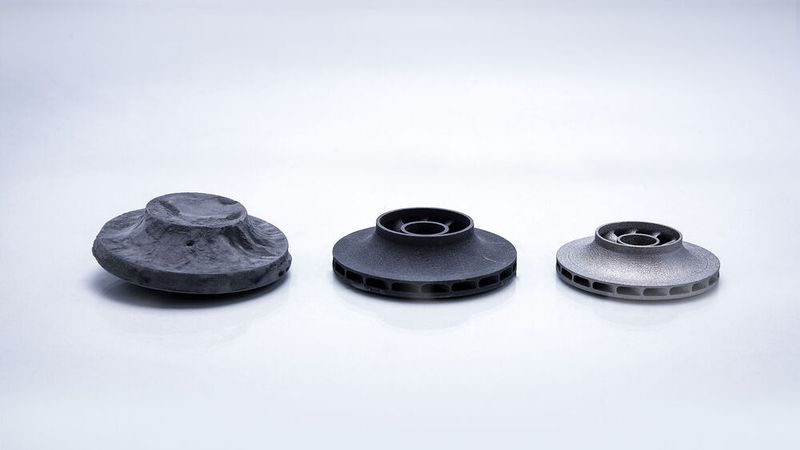
From the green part to the perfect surface: Auto-Smooth automates the entire post-processing in the Cold Metal Fusion process, including depowdering, smoothing, and complete feedstock reuse—as a seamless 3-in-1 process.
(Image: Rösler Surface Technology)
The initial Auto-Smooth results have already caused a stir in the 3D printing industry: thanks to a technology developed in the first project phase for depowdering and surface treatment in the green state, the post-processing of CMF components was significantly shortened compared to conventional methods. New studies now confirm the potential of the technology and enhance it with the crucial factor of feedstock reuse. A key focus of current research is the automated processing and reusability of feedstock, which is the metal powder mixed with a polymer binder that forms the material base in the CMF process. Previous analyses had already demonstrated that this material is fundamentally recyclable. However, the latest results go far beyond that.
Recycling Rate 100 Percent: Feedstock Reuse As An Economic And Ecological Breakthrough
"At present, everything points to a complete, 100% possible reuse of the feedstock," explains Sven Amon, project engineer at Rösler, who leads the Auto-Smooth project and has been researching and working on the automation and industrial applications of additive manufacturing for almost a decade. "This is a milestone because, until now, manual depowdering or fine depowdering only allowed partial reuse of the feedstock, depending on the component geometry."
Currently, Neue Materialien Bayreuth is conducting detailed investigations into how the reuse of material processed through the Auto-Smooth method affects its long-term performance. A comprehensive lifecycle analysis of the processing material is expected by the middle of next year. Simultaneously, test series are underway to determine the mechanical properties of components made from recycled feedstock, with a particular focus on static load capacity, fatigue strength, and flexural fatigue strength. These studies are being closely supported by Headmade Materials, the inventor of Cold Metal Fusion technology.
The complete recyclability of the feedstock opens up enormous savings potential: what was previously considered waste is now turned into a valuable resource. The closed material cycle drastically reduces material costs, as the excess metal powder feedstock, which is not printed, remains practically indefinitely usable. Combined with significantly reduced disposal costs, this creates an economic leverage effect that makes 3D metal printing with CMF even more attractive for series production.
Fully Recycle And Reuse Process Materials
The ecological impact is also enormous: the 100% reuse significantly reduces the carbon footprint of the entire process chain and ensures a sustainable, resource-efficient manufacturing system. Even the process medium, specially tailored to the technology, can be completely recycled and reused after cleaning and sieving. This represents another lever for cost reduction and environmental relief.
With this dual effect of cost efficiency and sustainability, Auto-Smooth sets new standards in industrial 3D metal printing. The ability to circulate valuable raw materials with almost no loss could prove to be one of the greatest breakthroughs for the profitability of additive metal manufacturing.
Patented Workpiece Holder for the Most Delicate Components
In addition to post-processing, the handling of particularly complex green parts is also a focus of research. Complex green parts cannot be fixed using conventional clamping methods. These parts are so delicate that they would be damaged in a conventional blasting process with a rotating basket. Sven Amon's team has developed a clever solution for this: the delicate components are embedded in a specially printed mesh, which is clamped into the post-processing system. This patented handling system is fully automatable and enables serial processing even for highly complex structures—another step towards complete automation.
"The interest in CMF technology is steadily growing—contrary to the general trend in the additive industry," reports project manager Sven Amon. "This is because CMF makes metal printing economical, especially in prototyping and serial production. With the new post-processing method Auto-Smooth, the process can now reach its full potential."
The Production of Highly Demanding Components Becomes Industrially Scalable
The project, which runs until summer 2026, forms the basis for a new fully automated post-processing system from AM Solutions. Initial test processing in a pilot plant is already delivering promising results. In the coming months, the findings from the feedstock analysis will be incorporated into the pilot system. "With the system that we plan to develop based on the research results, we are expanding our proven 2-in-1 approach—depowdering and smoothing—to include the aspect of sustainability. The result is a 3-in-1 process precisely tailored to the needs of metal printing customers," says Amon. "This will make the production of highly demanding components—such as impellers—economical and industrially scalable. A decisive step through which CMF will finally establish itself as the leading 3D metal printing process."
Date: 08.12.2025
Naturally, we always handle your personal data responsibly. Any personal data we receive from you is processed in accordance with applicable data protection legislation. For detailed information please see our privacy policy.
Consent to the use of data for promotional purposes
I hereby consent to Vogel Communications Group GmbH & Co. KG, Max-Planck-Str. 7-9, 97082 Würzburg including any affiliated companies according to §§ 15 et seq. AktG (hereafter: Vogel Communications Group) using my e-mail address to send editorial newsletters. A list of all affiliated companies can be found here
Newsletter content may include all products and services of any companies mentioned above, including for example specialist journals and books, events and fairs as well as event-related products and services, print and digital media offers and services such as additional (editorial) newsletters, raffles, lead campaigns, market research both online and offline, specialist webportals and e-learning offers. In case my personal telephone number has also been collected, it may be used for offers of aforementioned products, for services of the companies mentioned above, and market research purposes.
Additionally, my consent also includes the processing of my email address and telephone number for data matching for marketing purposes with select advertising partners such as LinkedIn, Google, and Meta. For this, Vogel Communications Group may transmit said data in hashed form to the advertising partners who then use said data to determine whether I am also a member of the mentioned advertising partner portals. Vogel Communications Group uses this feature for the purposes of re-targeting (up-selling, cross-selling, and customer loyalty), generating so-called look-alike audiences for acquisition of new customers, and as basis for exclusion for on-going advertising campaigns. Further information can be found in section “data matching for marketing purposes”.
In case I access protected data on Internet portals of Vogel Communications Group including any affiliated companies according to §§ 15 et seq. AktG, I need to provide further data in order to register for the access to such content. In return for this free access to editorial content, my data may be used in accordance with this consent for the purposes stated here. This does not apply to data matching for marketing purposes.
Right of revocation
I understand that I can revoke my consent at will. My revocation does not change the lawfulness of data processing that was conducted based on my consent leading up to my revocation. One option to declare my revocation is to use the contact form found at https://contact.vogel.de. In case I no longer wish to receive certain newsletters, I have subscribed to, I can also click on the unsubscribe link included at the end of a newsletter. Further information regarding my right of revocation and the implementation of it as well as the consequences of my revocation can be found in the data protection declaration, section editorial newsletter.



:quality(80)/p7i.vogel.de/wcms/ef/1e/ef1e248f58a3697ec1384f6849762d5a/0129842086v1.jpeg "Bodo will soon be hitting it off smart! Signing the memorandum of understanding in Las Vegas: Steffen Haack, Member of the Board of Bosch Rexroth, and Yoshimoto Matsuda, Managing Director of Precision Machinery & Robot Company, Kawasaki Heavy Industries. Here's what it's all about ... (Image:Bosch Rexroth)")
:quality(80)/p7i.vogel.de/wcms/f9/7d/f97deef8fde21c8630d76411b18a20a7/0129803665v1.jpeg "Skoda has invested well over 220 million US dollars in the high-tech battery plant that has now opened in Mlada Boleslav. It has now started its work, which is highly automated ... (Image:Skoda)")
:quality(80)/p7i.vogel.de/wcms/f5/61/f561ad7c72ed41fd7a67ad9c481cb15d/0129799343v1.jpeg "Engine-generator units (MGU) from Steyr Motors are at work in the Leopard 2 main battle tank and the Leguan bridge vehicle (pictured). An extended contract is now to secure at least 500 more systems of this type for the Bundeswehr ... (Image:German Armed Forces)")
:quality(80)/p7i.vogel.de/wcms/6c/b5/6cb5ce2155433f6e73b16399adc4c561/0113143253v1.jpeg "In our China Market Insider we regularly provide you with relevant information directly from China. (Image:© Eisenhans - stock.adobe.com)")
:quality(80)/p7i.vogel.de/wcms/9c/ac/9cac6246660e746c5a3989399ac4d250/0128561645v1.jpeg "Artificial intelligence can drive efficiency in smart factories through centralized data management and predictive maintenance. (Picture: ©Fardived - stock.adobe.com)")
:quality(80)/p7i.vogel.de/wcms/6b/e2/6be235b5ad8a442ccd9d164b0b300d8b/0129763992v1.jpeg "As early as 2020, the Zimmer Group announced that it would convert its production to be sustainably CO2-neutral. (Image:Zimmer Group)")
:quality(80)/p7i.vogel.de/wcms/d4/ba/d4bab9481e66f8570f40eb8ef2a90198/0129795613v1.jpeg "A camera inspection during removal ensures that the components are placed correctly in the KLTs. (Image:Yaskawa Europe)")
:quality(80)/p7i.vogel.de/wcms/cb/56/cb56e42b01638b618e8d1b9b38f32faa/0129810132v1.jpeg "From summer 2026, \"AEON\" will support people at the BMW plant in Leipzig. (Image:diephotodesigner.de/BMW)")
:quality(80)/p7i.vogel.de/wcms/b5/5e/b55ed9355e0395ec0caf111d6af6b494/adobestock-495980372--c2-a9-20natali-mis-20-e2-80-93-20stock-adobe-com-6720x3778v1v1.jpeg "Which engineering skills will be in vogue in 2026? (Image:natali_mis - stock.adobe.com)")
:quality(80)/p7i.vogel.de/wcms/bf/a5/bfa5d882e93f159ce93e933742272b00/nord-vibn-cmyk-2196x1235v1v1.jpeg "With digital twins for virtual commissioning, Nord supports customers in ensuring that systems are available more quickly, even with complex drive systems. (Image:Nord Drivesystems)")
:quality(80)/p7i.vogel.de/wcms/f5/7e/f57ef535ee35e7b3b7ff15a8a63cef10/eds-keyvisual-8000x4496v1.jpeg "(Source: European Defence Supply)")
:quality(80)/p7i.vogel.de/wcms/af/a3/afa312176d956068af20491957eef642/newsimage418262-3100x1745v1v1.jpeg "The autonomous shuttle of the Aula AI project during a demonstration of sensor data with artificial fog. (Image:University of Magdeburg)")
:quality(80)/p7i.vogel.de/wcms/40/b3/40b38efc9eae25e69d644512a2dc4b7c/0129806862v1.jpeg "This is one of the new MDA power clamping nuts from Jakob Antriebstechnik from various angles. It is described as particularly durable and powerful. Here are a few specific data ... (Image:Jakob Drive Technology)")
:quality(80)/p7i.vogel.de/wcms/29/3a/293a6a8483f59bc2fa65a7e1a4d9a703/0129822140v1.jpeg "The Fraunhofer IDMT, Mercedes-Benz and Burmester have developed the 3D audio technology \"Audiofields\". (Image:Thomas Günnel - Automotive Industry)")
:quality(80)/p7i.vogel.de/wcms/cb/23/cb23acd8e9de969d52522692b62b1892/0129680605v1.jpeg "The Z22198 is an extremely compact, three-axis IEPE acceleration sensor for measuring oscillations (vibrations) and shocks in demanding applications. With an edge length of just 0.24 inches and a weight of 0.03 ounces, it is ideal for lightweight structures and confined spaces. (Image:Copyright 2020 ScROGERS,All Rights Reserved)")
:quality(80)/p7i.vogel.de/wcms/c4/40/c44043c61f9dd99b80ccca398c284018/0129795093v1.jpeg "Subaru manufactures the E-Outback at its Yajima plant, marking the first time it has produced an electric vehicle in-house. (Image:Subaru)")
:quality(80)/p7i.vogel.de/wcms/8f/48/8f48b0ed0d6c5c4f299b1310a7b577e9/0129830738v1.jpeg "Data centers in orbit are indeed dreams of the future, while data centers under water are already being tested. (Image:Dall-E / AI-generated)")
:quality(80)/p7i.vogel.de/wcms/36/ec/36ec46b311c3fb2cf9759ba4843047c5/0129831604v1.jpeg "Keysight and Ericsson enable validation of pre-6G interoperability with real network infrastructure and devices. (Image:Keysight)")
:quality(80)/p7i.vogel.de/wcms/c5/7a/c57ab05221defbbcaf6bddc346d21464/0129752421v1.jpeg "(Image:concept electronic GmbH)")
:quality(80)/p7i.vogel.de/wcms/12/e4/12e428b994a4f83779ce72d333964fcf/wth1pi1740-01-2048x1152v1v1.jpeg "Würth Elektronik has developed a customized transformer for the intelligent Motion Mate orthosis from Powered Orthotics, which was presented at DLD. (Image:Philipp Guelland for DLD Hubert Burda Media)")
:fill(fff,0)/images.vogel.de/vogelonline/companyimg/76800/76895/65.jpg "FAULHABER_120mm.jpg ()")
:fill(fff,0)/p7i.vogel.de/companies/67/eb/67eba621ef6ea/logo2.png "logo2 (Wuxi InfiMotion)")
:quality(80):fill(efefef,0)/p7i.vogel.de/wcms/67/ad/67adf92d254d2/elatec-wp-smart-factory.png "Elatec WP Smart Factory")
:quality(80)/p7i.vogel.de/wcms/72/90/729036d87240425efd471d4796174b44/polystar-k-202025-2028x1141v1v1.jpeg "At Polystar's booth at K 2025 in Düsseldorf: Expert discussions on efficient recycling solutions and new technologies for plastic processing. (Image:Polystar)")
:quality(80)/p7i.vogel.de/wcms/61/07/6107d45e2aea279583620f86991596b6/0126197636v1.jpeg "Using a disassembly demonstrator developed at Fraunhofer IWU, the scientists demonstrate how disassembly can be automated and carried out efficiently. (Image:Fraunhofer IWU)")