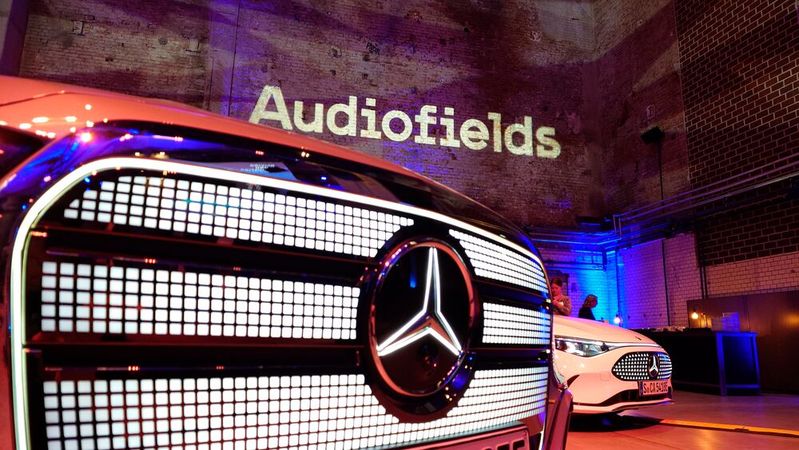
Mercedes-Benz, the Fraunhofer IDMT and Burmester have presented "Audiofields". The audio format generates immersive sound from 2D content—and is also suitable for warnings from exactly the right direction.
The Fraunhofer IDMT, Mercedes-Benz and Burmester have developed the 3D audio technology "Audiofields".
(Image: Thomas Günnel - Automotive Industry)
Immersive surround sound in the car for music, speech or warning messages: The Fraunhofer Institute for Digital Media Technology IDMT in Ilmenau, Mercedes-Benz and Burmester have spent around four years developing "Audiofields". The audio format separates music, voices and sound from the installed loudspeakers and creates an immersive, three-dimensional sound image in the interior, even with stereo music content. Mercedes is now offering the format as standard. Spatial sound at the touch of a button—doesn't that already exist? Partly. A brief digression.
Channel-Based Versus Object-Based Sound
With channel-based audio playback, sound is produced as a mix for a fixed speaker configuration, for example stereo with two channels, 5.1 surround or 7.1.4 systems. The audio files contain the information as to which sound should come from which speaker. This only works correctly if the playback environment, the speaker layout, corresponds to the production environment.
Object-based audio playback with Audiofields does not save the sound as a finished loudspeaker mix, but as a collection of audio objects. An audio object always consists of the actual signal, such as a voice, instrument or warning tone. It also contains information on the position and movement of the audio object in the room. Only during playback does the audio processor calculate the loudspeaker signals to match the surroundings. Sound sources can therefore be placed anywhere in the room. Audiofields also adapts to the existing loudspeaker layout—the spatial impression remains consistent even with different vehicle models.
Adapted to the Vehicle Interior
Object-based sound is not new in itself; Dolby Atmos or DTS:X achieve something similar. However, the loudspeaker layout must be right for this; more so with Dolby Atmos than with DTS:X. According to Fraunhofer IDMT, Audiofields is adapted for vehicle interiors, which have a number of acoustic peculiarities: limited space, fixed specifications for the installation location of the speakers, reflections on glass and plastic—and, from the acousticians' point of view, never the ideal seating position.
The Special Features of Audiofields
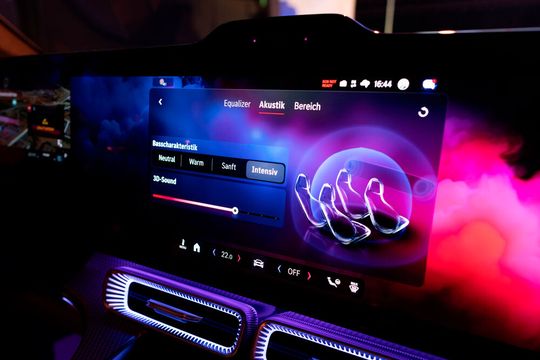
The Fraunhofer IDMT algorithm requires significantly fewer speakers and is scalable from entry-level to high-end systems. In addition, Audiofields works in real time on serial processors, optimized for energy and computing. Tracks mixed with Dolby Atmos can also be played back with Audiofields. Above all, however, the new algorithm is intended for 2D upmixes—i.e. spatial yet authentic sound from stereo files. This means that there is not simply more reverb on one channel, but instruments and voices are given a significantly larger stage.
"Virtual loudspeakers placed around the outside of the vehicle ensure that channel-based audio content is reproduced in 3D," explained Christoph Sladeczek, Group Manager Smart Acoustic Solutions at Fraunhofer IDMT, at the presentation in Erfurt at the end of February. "In addition, virtual loudspeakers offer new possibilities for interactively adapting the sound image to personal preferences: By changing the stereo panorama, a wide yet deep sound stage can be created, which gives the instruments significantly more spatiality—for lively sound with a live character."
Convincing Audio Sample
The first listening impression in the GLC was convincing; the pure sound, apart from the immersion, is also very clean and precise, typical of Burmester. Sladeczek answers the question of how exactly the algorithm extracts from the 2D signal where the instruments should be arranged in the room, and how the algorithm can determine what is an instrument or vocal in the data stream with a smile and a reference to the "fairy dust" of development. "It's a lot of math," he says.
Warning Sounds in Real Time—And Other Applications
However, this upmixing is only part of what Audiofields can do. Arranging audio objects in space can also be used, for example, to warn the driver of a cyclist in the car's blind spot. In sensor fusion with the surrounding vehicle sensors, it is conceivable, for example, to accompany the cyclist's changing position with a sound in the interior. This makes it clear where the cyclist is at all times—without taking their eyes off the road. This also works with navigation instructions, for example, combined with visual elements in the cockpit if required.
Date: 08.12.2025
Naturally, we always handle your personal data responsibly. Any personal data we receive from you is processed in accordance with applicable data protection legislation. For detailed information please see our privacy policy.
Consent to the use of data for promotional purposes
I hereby consent to Vogel Communications Group GmbH & Co. KG, Max-Planck-Str. 7-9, 97082 Würzburg including any affiliated companies according to §§ 15 et seq. AktG (hereafter: Vogel Communications Group) using my e-mail address to send editorial newsletters. A list of all affiliated companies can be found here
Newsletter content may include all products and services of any companies mentioned above, including for example specialist journals and books, events and fairs as well as event-related products and services, print and digital media offers and services such as additional (editorial) newsletters, raffles, lead campaigns, market research both online and offline, specialist webportals and e-learning offers. In case my personal telephone number has also been collected, it may be used for offers of aforementioned products, for services of the companies mentioned above, and market research purposes.
Additionally, my consent also includes the processing of my email address and telephone number for data matching for marketing purposes with select advertising partners such as LinkedIn, Google, and Meta. For this, Vogel Communications Group may transmit said data in hashed form to the advertising partners who then use said data to determine whether I am also a member of the mentioned advertising partner portals. Vogel Communications Group uses this feature for the purposes of re-targeting (up-selling, cross-selling, and customer loyalty), generating so-called look-alike audiences for acquisition of new customers, and as basis for exclusion for on-going advertising campaigns. Further information can be found in section “data matching for marketing purposes”.
In case I access protected data on Internet portals of Vogel Communications Group including any affiliated companies according to §§ 15 et seq. AktG, I need to provide further data in order to register for the access to such content. In return for this free access to editorial content, my data may be used in accordance with this consent for the purposes stated here. This does not apply to data matching for marketing purposes.
Right of revocation
I understand that I can revoke my consent at will. My revocation does not change the lawfulness of data processing that was conducted based on my consent leading up to my revocation. One option to declare my revocation is to use the contact form found at https://contact.vogel.de. In case I no longer wish to receive certain newsletters, I have subscribed to, I can also click on the unsubscribe link included at the end of a newsletter. Further information regarding my right of revocation and the implementation of it as well as the consequences of my revocation can be found in the data protection declaration, section editorial newsletter.
Another example is conversations with several people on the telephone. Audiofields places voices as spatial audio objects in the interior. This makes it easier to differentiate between conversation partners, which increases intelligibility and is less tiring. Other examples include acoustic feedback when buttons are pressed from the exact direction of the control element. The active autonomous driving mode can also be accompanied by an atmospheric soundscape. And: personalized sound zones are conceivable. By means of loudspeakers in the headphones and the correct masking of frequencies from the other seats. Many possibilities—which the people at Fraunhofer IDMT are working on.
Available in the Fourth Generation "MBUX"
Audiofields is primarily intended for upmixing 2D content—but the object-based process is also suitable for a number of other applications in vehicles.
(Image: Fraunhofer ICT Group)
The 3D sound algorithm developed by the Fraunhofer IDMT under the name "SpatialSound Wave" can be integrated into existing vehicle and sound systems. Mercedes offers the 3D audio technology in all models equipped with the fourth generation of the "MBUX" infotainment system. Starting with the CLA, GLC, GLB and S-Class. Burmester is responsible for fine-tuning the sound systems. Mercedes has been working with the manufacturer of high-end audiophile components since 2013.
In future, Audiofields will enable uniform sound management, in which all audio functions that were previously produced separately will converge: Infotainment, driver assistance or Active Sound Design.
Outlook for Audiofields
What's next? "The boundaries imposed by the car must be removed," said Ingolf Franke, Head of Development Sound & Acoustics at Mercedes-Benz, describing the goal for the next few years. In other words, audio objects should be able to be displayed around the car in such a way that there is no longer a sense of being limited by the bodywork, i.e. the feeling of space should be enhanced.
Development of Object-Based Audio Systems
Since the early 2000s, the Fraunhofer IDMT has been developing object-based 3D audio systems for professional audio and entertainment applications, with success: the researchers have won the Thuringian Research Award, the German stage award "Opus", the "Tony Award" 2018 for the best sound design and the "Avard 2024", an award for professional audio and video applications, among others.
Fraunhofer IDMT's 3D audio technology has also been used in international installations, including at the Bregenz Festival, the Berlin State Opera, the Zurich Opera House and the Barrymore Theatre on Broadway.
The researchers have also been developing for the automotive industry since 2007. Together with Mercedes-Benz and Burmester, the 3D sound algorithm now presented was developed for Mercedes-Benz models from 2021. In 2025, the companies integrated the algorithm into a CLA for the first time.



:quality(80)/p7i.vogel.de/wcms/ef/1e/ef1e248f58a3697ec1384f6849762d5a/0129842086v1.jpeg "Bodo will soon be hitting it off smart! Signing the memorandum of understanding in Las Vegas: Steffen Haack, Member of the Board of Bosch Rexroth, and Yoshimoto Matsuda, Managing Director of Precision Machinery & Robot Company, Kawasaki Heavy Industries. Here's what it's all about ... (Image:Bosch Rexroth)")
:quality(80)/p7i.vogel.de/wcms/f9/7d/f97deef8fde21c8630d76411b18a20a7/0129803665v1.jpeg "Skoda has invested well over 220 million US dollars in the high-tech battery plant that has now opened in Mlada Boleslav. It has now started its work, which is highly automated ... (Image:Skoda)")
:quality(80)/p7i.vogel.de/wcms/f5/61/f561ad7c72ed41fd7a67ad9c481cb15d/0129799343v1.jpeg "Engine-generator units (MGU) from Steyr Motors are at work in the Leopard 2 main battle tank and the Leguan bridge vehicle (pictured). An extended contract is now to secure at least 500 more systems of this type for the Bundeswehr ... (Image:German Armed Forces)")
:quality(80)/p7i.vogel.de/wcms/6c/b5/6cb5ce2155433f6e73b16399adc4c561/0113143253v1.jpeg "In our China Market Insider we regularly provide you with relevant information directly from China. (Image:© Eisenhans - stock.adobe.com)")
:quality(80)/p7i.vogel.de/wcms/9c/ac/9cac6246660e746c5a3989399ac4d250/0128561645v1.jpeg "Artificial intelligence can drive efficiency in smart factories through centralized data management and predictive maintenance. (Picture: ©Fardived - stock.adobe.com)")
:quality(80)/p7i.vogel.de/wcms/6b/e2/6be235b5ad8a442ccd9d164b0b300d8b/0129763992v1.jpeg "As early as 2020, the Zimmer Group announced that it would convert its production to be sustainably CO2-neutral. (Image:Zimmer Group)")
:quality(80)/p7i.vogel.de/wcms/d4/ba/d4bab9481e66f8570f40eb8ef2a90198/0129795613v1.jpeg "A camera inspection during removal ensures that the components are placed correctly in the KLTs. (Image:Yaskawa Europe)")
:quality(80)/p7i.vogel.de/wcms/cb/56/cb56e42b01638b618e8d1b9b38f32faa/0129810132v1.jpeg "From summer 2026, \"AEON\" will support people at the BMW plant in Leipzig. (Image:diephotodesigner.de/BMW)")
:quality(80)/p7i.vogel.de/wcms/b5/5e/b55ed9355e0395ec0caf111d6af6b494/adobestock-495980372--c2-a9-20natali-mis-20-e2-80-93-20stock-adobe-com-6720x3778v1v1.jpeg "Which engineering skills will be in vogue in 2026? (Image:natali_mis - stock.adobe.com)")
:quality(80)/p7i.vogel.de/wcms/bf/a5/bfa5d882e93f159ce93e933742272b00/nord-vibn-cmyk-2196x1235v1v1.jpeg "With digital twins for virtual commissioning, Nord supports customers in ensuring that systems are available more quickly, even with complex drive systems. (Image:Nord Drivesystems)")
:quality(80)/p7i.vogel.de/wcms/f5/7e/f57ef535ee35e7b3b7ff15a8a63cef10/eds-keyvisual-8000x4496v1.jpeg "(Source: European Defence Supply)")
:quality(80)/p7i.vogel.de/wcms/af/a3/afa312176d956068af20491957eef642/newsimage418262-3100x1745v1v1.jpeg "The autonomous shuttle of the Aula AI project during a demonstration of sensor data with artificial fog. (Image:University of Magdeburg)")
:quality(80)/p7i.vogel.de/wcms/40/b3/40b38efc9eae25e69d644512a2dc4b7c/0129806862v1.jpeg "This is one of the new MDA power clamping nuts from Jakob Antriebstechnik from various angles. It is described as particularly durable and powerful. Here are a few specific data ... (Image:Jakob Drive Technology)")
:quality(80)/p7i.vogel.de/wcms/29/3a/293a6a8483f59bc2fa65a7e1a4d9a703/0129822140v1.jpeg "The Fraunhofer IDMT, Mercedes-Benz and Burmester have developed the 3D audio technology \"Audiofields\". (Image:Thomas Günnel - Automotive Industry)")
:quality(80)/p7i.vogel.de/wcms/cb/23/cb23acd8e9de969d52522692b62b1892/0129680605v1.jpeg "The Z22198 is an extremely compact, three-axis IEPE acceleration sensor for measuring oscillations (vibrations) and shocks in demanding applications. With an edge length of just 0.24 inches and a weight of 0.03 ounces, it is ideal for lightweight structures and confined spaces. (Image:Copyright 2020 ScROGERS,All Rights Reserved)")
:quality(80)/p7i.vogel.de/wcms/c4/40/c44043c61f9dd99b80ccca398c284018/0129795093v1.jpeg "Subaru manufactures the E-Outback at its Yajima plant, marking the first time it has produced an electric vehicle in-house. (Image:Subaru)")
:quality(80)/p7i.vogel.de/wcms/8f/48/8f48b0ed0d6c5c4f299b1310a7b577e9/0129830738v1.jpeg "Data centers in orbit are indeed dreams of the future, while data centers under water are already being tested. (Image:Dall-E / AI-generated)")
:quality(80)/p7i.vogel.de/wcms/36/ec/36ec46b311c3fb2cf9759ba4843047c5/0129831604v1.jpeg "Keysight and Ericsson enable validation of pre-6G interoperability with real network infrastructure and devices. (Image:Keysight)")
:quality(80)/p7i.vogel.de/wcms/c5/7a/c57ab05221defbbcaf6bddc346d21464/0129752421v1.jpeg "(Image:concept electronic GmbH)")
:quality(80)/p7i.vogel.de/wcms/12/e4/12e428b994a4f83779ce72d333964fcf/wth1pi1740-01-2048x1152v1v1.jpeg "Würth Elektronik has developed a customized transformer for the intelligent Motion Mate orthosis from Powered Orthotics, which was presented at DLD. (Image:Philipp Guelland for DLD Hubert Burda Media)")
:fill(fff,0)/p7i.vogel.de/companies/67/eb/67eba621ef6ea/logo2.png "logo2 (Wuxi InfiMotion)")
:quality(80):fill(efefef,0)/p7i.vogel.de/wcms/67/ad/67adf4a647532/elatec-wp-machine-authentication.png "Elatec WP Machine Authentication")
:quality(80)/p7i.vogel.de/wcms/09/ac/09acdff24adcd04d03b741a3230b2ad5/0129234647v1.jpeg "Mercedes has given its prestige S-Class model more comfort and luxury for model year 2026. (Image:Mercedes-Benz)")
:quality(80)/p7i.vogel.de/wcms/89/ee/89eeebbfcf65b06f2326de05b9b46bff/0127629705v1.jpeg "Actuators can be placed in various locations and then create a spatial sound experience—without traditional speakers. (Image:Aumovio)")