Dimitrios Patsouras has been working for many years on actuators that turn interior components into soundboards. Now the technology is ready for series production. The Director of Acoustic Solutions at Aumovio Engineering Solutions describes the benefits.
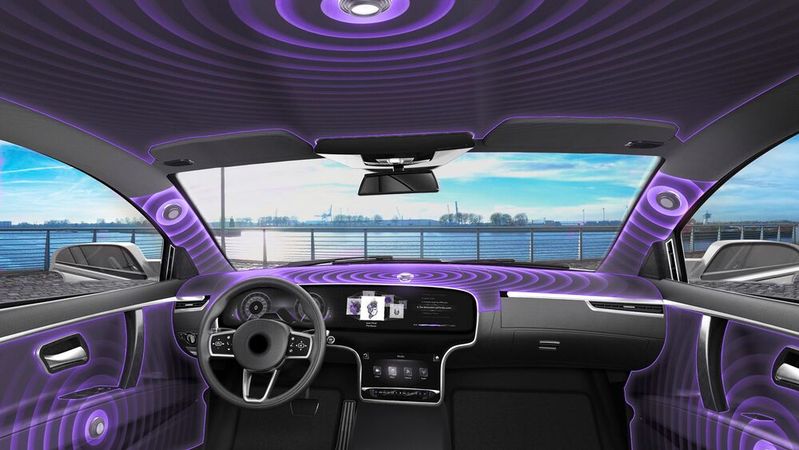
Actuators can be placed in various locations and then create a spatial sound experience—without traditional speakers.
(Image: Aumovio)
The supplier Aumovio has integrated actuators into a screen unit. The technology makes the surface vibrate, producing sound. The system, called "Ac2ated Sound" (pronounced like actuated), can be used to specifically draw drivers' attention to the displayed content. Some automakers, for example, use an avatar positioned as an assistant on the central screen. With the actuator technology, the voice of the avatar can be generated directly from its position on the display.
The technology can also be used to completely replace traditional speakers in vehicles. Dimitrios Patsouras, Director of Business Segment Acoustic Solutions at Aumovio Engineering Solutions (formerly Continental Engineering Services), describes the advantages and maturity of "Ac2ated Sound."
Mr. Patsouras, you say, we are bringing sound back to its origin. What do you mean by that?
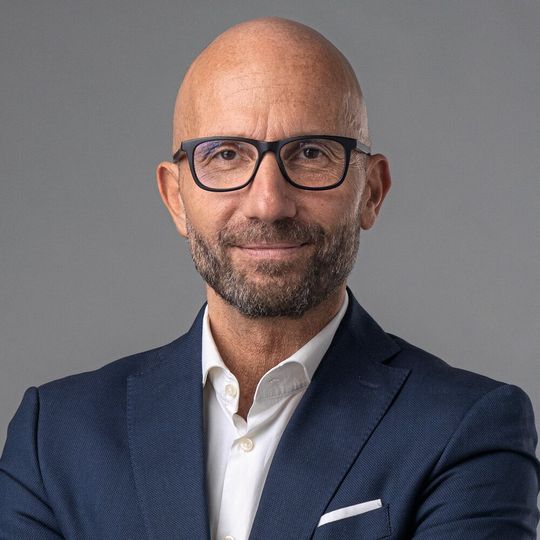
Dimitrios Patsouras, Director of Business Segment Acoustic Solutions at Aumovio Engineering Solutions
(Image: Aumovio)
In classical musical instruments like violins, cellos, or pianos, the body, or casing, ultimately serves as the soundboard. The idea behind "Ac2ated Sound" was similar. We see the vehicle as a complex soundboard. It consists of many components and materials with specific properties. When orchestrated together, it creates a symphony orchestra.
How does "Ac2ated Sound" work in detail?
We use actuators that set vehicle parts into vibration. These then act as resonators and produce sound. We use components such as pillar trims or the headliner for sound generation. Additionally, the same actuator-based approach can be used to generate external sounds for the—now mandatory in many countries—Acoustic Vehicle Alerting System.
In the meantime, it has been quiet. Eight years after the initial presentation, you have now introduced new use cases and partnerships.
We screened the entire market for suitable actuators. We found some that worked acoustically, but none met the high automotive standards for durability. About three years ago, we realized: if we want to open up a new market, we need our own product. Now we are reaching a maturity level suitable for industrialization. We plan to start production at the end of next year.
In which vehicle category?
The focus is initially on premium vehicles, particularly with manufacturers where limited installation space is a concern. Here, the volume and weight of our components play a significant role. However, performance is also crucial. As the demand for immersive sound experiences continues to grow, we are confident that the product can successfully scale to the volume market in the next phase.
Do your customers need new approaches for integrating the audio system?
The electronic connectivity remains unchanged. We can build on existing infrastructure. Through large-area excitation, we achieve immersive soundscapes with fewer components. Premium vehicles today incorporate over 30 speakers. We achieve comparable performance with only twelve to fifteen actuators and can save up to eight kilograms of weight, depending on the vehicle architecture.
Each actuator behaves differently depending on its installation position and the respective material. This requires careful tuning as well as adjustments in the specification and integration strategy.
In which regions do you want to market the product?
We produce in Germany, and our first customers are from Europe. So we are starting here, but we also aim to operate outside of Europe.
Primarily, we can completely replace speakers. However, new applications emerge. In headrests or roofliners, speakers are heavy or sometimes impossible to integrate. Door speakers are a very good example. They are standard in every vehicle, but everyone knows that when an object is placed in the door compartment, it can cause annoying rattling noises. Doors are sensitive areas with many attached components, such as window regulators, wires, and cables. With our approach, we can move away from doors altogether. At the same time, space is saved: customers gain the flexibility to place actuators wherever their design best allows—thereby saving space and weight.
Generating sound at knee level is not good.
Historically, the cavities in doors were unused, and speakers could therefore be easily integrated there. Even though this solution has become an industry standard, it is not necessarily optimal. With increasingly demanding customer needs, the industry will gradually move toward more individualized solutions, such as actuators in pillar trim.
Another problem: With some hands-free systems, outsiders can overhear the call.
When I connect the actuator to an interior panel, it strongly directs sound inward, while the external sound portion is reduced. Placing it on the metal body results in more sound projected outward. I can focus: only inward, only outward, or both. Using the same components, we can also suppress noise, such as from the wheels. Targeted sound design, for example through the headrest, becomes even more important here to enhance the privacy of occupants during phone calls or media use.
Date: 08.12.2025
Naturally, we always handle your personal data responsibly. Any personal data we receive from you is processed in accordance with applicable data protection legislation. For detailed information please see our privacy policy.
Consent to the use of data for promotional purposes
I hereby consent to Vogel Communications Group GmbH & Co. KG, Max-Planck-Str. 7-9, 97082 Würzburg including any affiliated companies according to §§ 15 et seq. AktG (hereafter: Vogel Communications Group) using my e-mail address to send editorial newsletters. A list of all affiliated companies can be found here
Newsletter content may include all products and services of any companies mentioned above, including for example specialist journals and books, events and fairs as well as event-related products and services, print and digital media offers and services such as additional (editorial) newsletters, raffles, lead campaigns, market research both online and offline, specialist webportals and e-learning offers. In case my personal telephone number has also been collected, it may be used for offers of aforementioned products, for services of the companies mentioned above, and market research purposes.
Additionally, my consent also includes the processing of my email address and telephone number for data matching for marketing purposes with select advertising partners such as LinkedIn, Google, and Meta. For this, Vogel Communications Group may transmit said data in hashed form to the advertising partners who then use said data to determine whether I am also a member of the mentioned advertising partner portals. Vogel Communications Group uses this feature for the purposes of re-targeting (up-selling, cross-selling, and customer loyalty), generating so-called look-alike audiences for acquisition of new customers, and as basis for exclusion for on-going advertising campaigns. Further information can be found in section “data matching for marketing purposes”.
In case I access protected data on Internet portals of Vogel Communications Group including any affiliated companies according to §§ 15 et seq. AktG, I need to provide further data in order to register for the access to such content. In return for this free access to editorial content, my data may be used in accordance with this consent for the purposes stated here. This does not apply to data matching for marketing purposes.
Right of revocation
I understand that I can revoke my consent at will. My revocation does not change the lawfulness of data processing that was conducted based on my consent leading up to my revocation. One option to declare my revocation is to use the contact form found at https://contact.vogel.de. In case I no longer wish to receive certain newsletters, I have subscribed to, I can also click on the unsubscribe link included at the end of a newsletter. Further information regarding my right of revocation and the implementation of it as well as the consequences of my revocation can be found in the data protection declaration, section editorial newsletter.
How durable are the actuators?
In terms of durability, our goal is for the actuators to outlast the entire lifespan of the vehicle. The components are designed accordingly—for example, we use steel springs instead of textile materials, ensuring higher temperature resistance and robustness. Conventional subwoofers often lose their specified performance at interior temperatures of 50 to 60 degrees.
We have designed the actuators so that they can be removed, refurbished, and reused in new applications after the end of vehicle use—in the spirit of a circular economy and waste reduction.
How does an exchange work?
We have two types of actuators: Bass and Wide Range. The bass actuator is screwed in like a wheel bolt. The Wide Range is clipped or glued, using a removable adhesive connection.
What are the technical limits?
I see barriers more in our imagination. Customers often can't imagine that a plastic panel can deliver comparable sound quality. The technology will prevail. It’s just a matter of time.
Dimitrios Patsouras
is Director of Business Segment Acoustic Solutions at Aumovio Engineering Solutions (formerly Continental Engineering Services) and holds more than 50 granted patents.
Patsouras began studying shipbuilding in Athens, but the amateur acoustician switched to electrical engineering with a focus on electroacoustics and psychoacoustics. From 1997 to 1999, he was also a research associate at the Technical University of Munich (in the field of psychoacoustics). Patsouras began his professional career in 1999 as an acoustic engineer at FAIST Automotive. After the company's merger with AKsys GmbH, he led the acoustic center there starting in 2003. In 2008, Patsouras became managing partner of FAIST Akustikzentrum GmbH, until five years later he founded the acoustics division "Acoustic Solutions" at Continental Engineering Services.



:quality(80)/p7i.vogel.de/wcms/a0/47/a04725ef9bd09fb6c9341a1bea1b5d93/0130443083v1.jpeg "Here, a type of plastic pallet is produced by thermoforming (vacuum forming or deep drawing) at the corresponding division of New England Plastics in the USA. This division, which specializes in so-called liners, is now part of Ringmetall ... (Image:New England Plastics)")
:quality(80)/p7i.vogel.de/wcms/23/99/23992bf2dcdc432c9b7209c34a4a7c48/0129733089v1.jpeg "Stork relies on the modular Neoswiss turning system from Iscar to shorten the set-up times for its sliding headstock lathes and work more productively. (Image:Iscar)")
:quality(80)/p7i.vogel.de/wcms/7d/e2/7de2923434b2f1a78ba5482d8d335269/0113143253v1.jpeg "In our China Market Insider we regularly provide you with relevant information directly from China. (Image:© Eisenhans - stock.adobe.com)")
:quality(80)/p7i.vogel.de/wcms/9d/2b/9d2b802f800e5caf17b2831e74228cd3/screenshot-202026-03-03-20103822-609x343v1v1.png "Visual comparison: on the left, a clean, burr-free cut edge; on the right, typical burr formation with oxidation discoloration. This illustrates how strongly parameter control and gas management influence the quality of the result. (CO₂ laser, oxygen cutting gas, sheet thickness approx. 15 mm). (Image:Picture: Rime)")
:quality(80)/p7i.vogel.de/wcms/b7/36/b736dfebc16c42d6901d0d0e1f390493/3d-druck-20factory-20--20ki-20generiert-1920x1079v1.png "(Source: AI-generated)")
:quality(80)/p7i.vogel.de/wcms/79/b2/79b21aad663f4a7bd4472afc1c1afc62/0130433994v1.jpeg "Mission Joyride: The free-flying robot (shown here in the rendering) will relieve the ISS crew of logistics tasks from 2027 with its two mechanical arms. (Image:Icarus Robotics)")
:quality(80)/p7i.vogel.de/wcms/6b/45/6b4546fa6ebf305c3660326909363f32/0130437089v1.jpeg "Industrial AI in action: Rockwell Automation presents practical solutions for self-controlling production systems at the Hannover Messe. (Image:Rainer Jensen, Deutsche Messe)")
:quality(80)/p7i.vogel.de/wcms/78/e9/78e9188c25a8a94e67c34c9bf8ffe495/visual-agile-20robots-20and-20google-20deepmind-20partner-20to-20bring-20intelligence-20to-20robotics-2500x1406v1v1.jpeg "Together, the partners are developing adaptable, intelligent robots for a wide range of applications (Image:Agile Robots SE)")
:quality(80)/p7i.vogel.de/wcms/59/a2/59a2b11f0aa1b700eff02addd5de8703/adobestock-1788280853--c2-a9-20satria-20-e2-80-93-20stock-adobe-com-5081x2860v1v1.jpeg "Quantum computers require extreme cooling to temperatures close to absolute zero in order to keep qubits stable. (Image:satria - stock.adobe.com)")
:quality(80)/p7i.vogel.de/wcms/49/38/493876a248943456b7e4a6db6edfc454/0130230765v1.jpeg "Safe and reliable in aircraft construction: light-curing adhesive bond combined with universal fastening elements. (Source: Delo)")
:quality(80)/p7i.vogel.de/wcms/b5/c7/b5c749d16c8a2e789c1469c2c8c1c387/0130452780v1.jpeg "Volvo Trucks completes road tests with its new hydrogen-powered trucks. (Image:Volvo Trucks)")
:quality(80)/p7i.vogel.de/wcms/ba/69/ba6975f417a85147084f38dc2cd209e2/0130451386v1.jpeg "Together with Nvidia, Hyundai wants to develop an architecture that will be used for level 4 robotaxis (image) as well as for level 2 customer vehicles. (Image:Hyundai)")
:quality(80)/p7i.vogel.de/wcms/93/4d/934de334b47abaa526c78cba1417d7af/0130343495v1.jpeg "The new SU7 is available in three price categories, \"Standard\", \"Pro\" and \"Max\" (Image:Xiaomi)")
:quality(80)/p7i.vogel.de/wcms/df/a0/dfa048434bb94f1b7d030e346b25b3ae/0130373541v1.jpeg "From August, BMW will be producing the i3 at its main plant in Munich - which the car manufacturer has extensively rebuilt for this purpose. (Image:Rainer Haeckl)")
:quality(80)/p7i.vogel.de/wcms/ee/09/ee09acbd6dc896df25affaa9e871e6e5/0130440053v1.jpeg "IMS chip module for simple system integration into an ion mobility spectrometer. (Image:Fraunhofer IPMS)")
:quality(80)/p7i.vogel.de/wcms/10/6c/106cd22de5f68a0f74639d654827228c/0130345302v1.jpeg "Made in India: According to the India Electronics and Semiconductor Association (IESA), the country should be able to produce between 75 and 80 million chips by the beginning of 2027, once the plants currently under construction become operational. (Image:Pixabay (Montage: Sebastian Gerstl))")
:quality(80)/p7i.vogel.de/wcms/a5/ed/a5ed6fda029d362732a293d6b19d74c4/0130444216v1.jpeg "Thirteen executives from the Chinese chip industry have drawn up a plan to achieve an 80% self-sufficiency rate for semiconductors by 2030. (Image:Maxim_Kazmin - stock.adobe.com)")
:quality(80)/p7i.vogel.de/wcms/31/a6/31a646018b34d8e0a44bfc8bf17837f6/0130361632v1.jpeg "For many companies, PFAS are considered indispensable in electronics production. (Image:freely licensed)")
:fill(fff,0)/images.vogel.de/vogelonline/companyimg/76800/76895/65.jpg "FAULHABER_120mm.jpg ()")
:quality(80)/p7i.vogel.de/wcms/ee/99/ee99d84cf159f9362b968f7c587159e2/0124834487v1.jpeg "Pure elegance: European premiere of the concept vehicle Genesis X Gran Convertible in early May in Munich. (Image:Jules Foto Garage)")
:quality(80)/p7i.vogel.de/wcms/29/3a/293a6a8483f59bc2fa65a7e1a4d9a703/0129822140v1.jpeg "The Fraunhofer IDMT, Mercedes-Benz and Burmester have developed the 3D audio technology \"Audiofields\". (Image:Thomas Günnel - Automotive Industry)")
:quality(80)/p7i.vogel.de/wcms/62/e8/62e867b88d9aa0cdd11522eb5a1971ac/0129096984v1.jpeg "Automotive topics play an important role at Lopec 2026. (Image:Munich Trade Fair)")