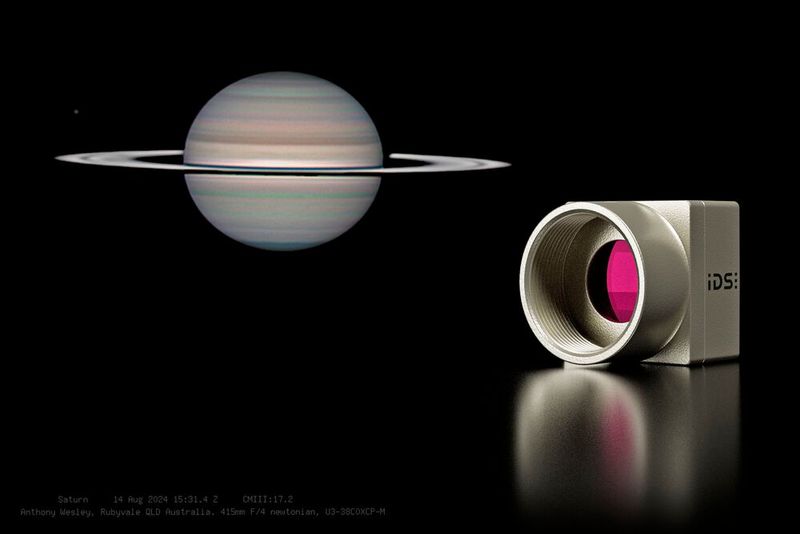
Not only do giant space telescopes enable spectacular images. The Australian amateur astronomer Anthony Wesley considers the IDS uEye XCP camera, equipped with Sony Starvis 2 sensors, to be an excellent choice for capturing high-resolution images of our neighboring planets like Venus, Mars, Jupiter, and Saturn.
Our solar system has fascinated humanity for thousands of years. Astronomical research seeks answers to the great questions of human existence.
(Image: Anthony Wesley)
Astrophotography has to overcome special challenges in two respects, both technical and natural. This is especially true for telescope images of planets. On the one hand, the Earth's atmosphere is constantly in motion, creating turbulence that leads to distortions of the light coming from stars or planets. This so-called "seeing" causes a flickering or blurring of objects, especially when observed through ground-based telescopes. These blurriness and distortions due to atmospheric turbulence make it difficult to capture detailed images.
Light sensitivity that goes far beyond the human eye— that's what sensors with Sony's Starvis 2 technology stand for.
Jürgen Hejna, Product Manager uEye cameras at IDS
Looking Behind the Interstellar Dust Clouds
On the other hand, the Earth's atmosphere absorbs and scatters visible or short-wave blue light. Near-infrared light, however, is less scattered, leading to clearer and sharper images. This is particularly important in regions with poorer "seeing" conditions caused by air turbulence. Furthermore, infrared light penetrates thin clouds and dust particles better than visible light. By using a NIR-sensitive camera, astronomers can look behind these interstellar dust clouds and recognize structures that remain hidden in visible light. This applies, for example, to young stars and star-forming regions, which are usually surrounded by dense dust clouds.
However, for capturing images of large planets like Saturn or Jupiter, the more powerful the camera in low-light conditions, the more meaningful the images. Not to be overlooked: infrared light is less affected by artificial light sources on Earth. This means that NIR-sensitive sensors provide better conditions for sky observation even in areas with moderate light pollution.
Excellent Results in Application
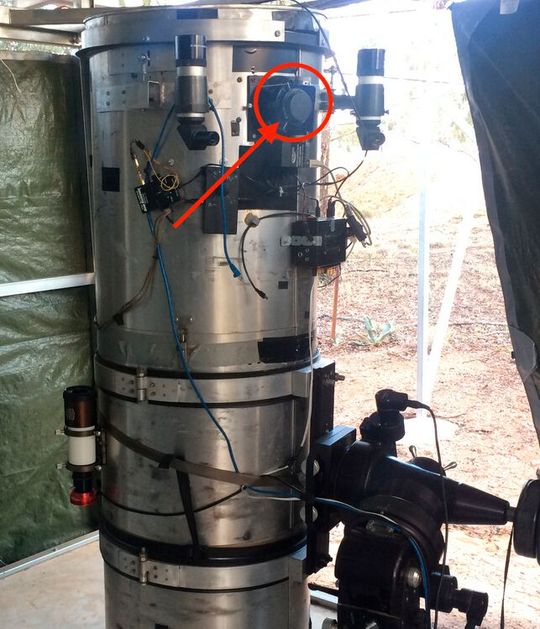
Telescope with IDS industrial camera uEye XCP in the eyepiece holder
(Image: Anthony Wesley)
Cameras with particularly high NIR sensitivity are therefore in high demand. Amateur astronomer Anthony Wesley has studied the performance of IDS cameras from the XCP family with Starvis 2 class sensors and their suitability for planetary photography - with success: The IDS camera model U3-38C0XCP-M-NO, equipped with the monochrome sensor IMX662, delivers outstanding results.
"The IDS camera is the imaging element for a telescope with an aperture of 16.3 inches and a focal length of 236.2 inches," he explains the camera's function. "It records one to two minute video segments of planets like Jupiter and Saturn at a speed of about 60 frames per second through interchangeable filters, both in visible light and in the infrared range."
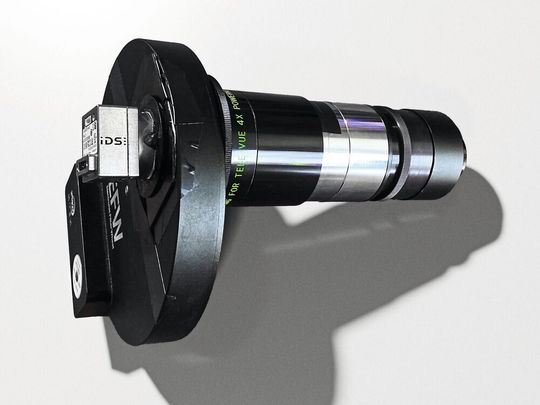
To form a single optical unit that fits into the telescope's eyepiece holder, Anthony Wesley directly screwed the IDS camera together with the filter wheel and Barlow lens. The Barlow lens between the eyepiece and telescope extends the telescope's focal length, thereby increasing magnification without the need for an additional eyepiece. "The IDS camera mount was modified to allow low-distance mounting as I do not need the standard C/CS distance," he explains the setup.
The compact, lightweight uEye XCP is well-suited for amateur telescopes. The uEye cameras are affordable, yet offer almost all the features that amateur astronomers desire for this application.
Anthony Wesley, Amateur astronomer
But What Features Recommended the Camera?
Camera and filter wheel and Barlow lens form an optical unit in the eyepiece holder.
(Image: Anthony Wesley)
"Light sensitivity that goes far beyond the human eye—that's what sensors with Sony's Starvis 2 technology stand for," says Jürgen Hejna, Product Manager for uEye cameras at IDS, highlighting the sensors' strength. For example, those who opt for the model U3-38C0XCP Rev.1.2 with the 2.16 MPixel rolling shutter sensor IMX662 achieve exceptional image quality with a particularly high dynamic range thanks to the pixel technology. The USB3 camera delivers a fast 88 frames per second and is particularly strong in low-light applications where high sensitivity with simultaneously low resolution is required. The 1/3'' sensor further minimizes disruptive reflections within the camera through so-called "anti-reflection coating."
For Anthony Wesley, the compact camera has additional advantages: "The compact, lightweight uEye XCP is well-suited for amateur telescopes. The uEye cameras are affordable, yet offer almost all the features that amateur astronomers desire for this application." He is also convinced by the easy integration of IDS cameras via the software development kit IDS peak. "I am the developer and maintainer of the IDS camera module in the software Fire Capture, which is popular among amateur astronomers. The IDS module is written in C with Microsoft Visual Studio and is compiled into a DLL that can be easily loaded into Fire Capture to enable the use of the comprehensive software features."
A Software Processes the Images Further
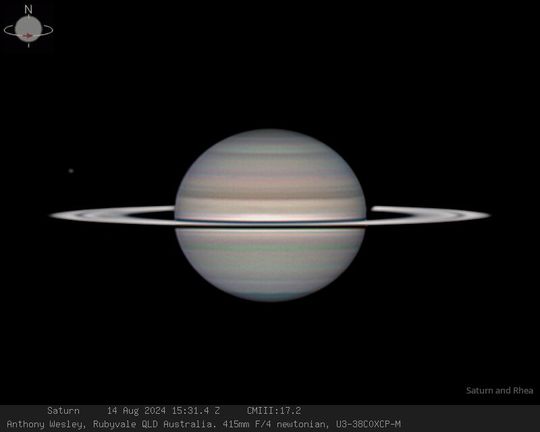
Telescope image of the planet Saturn (with color filter from the Astrodon I series)
(Image: Anthony Wesley)
The video segments recorded using Fire Capture are then further processed with Autostakkert, a Windows software that automatically aligns and combines images of the night sky. "The software combines and averages the individual images and corrects blurriness and distortions caused by the Earth's atmosphere," describes Anthony Wesley. These blurriness effects can appear as smudging or image noise and hide important details in the images. In astronomical imaging, the method of deconvolution is therefore used to optimize the image quality of telescope images and correct blurry or distorted images. In this case, the software packages Astra Image and Registax are used for deconvolution and image sharpening. The next step involves correcting the observed rotation of the target object during the recording time. "For example, Jupiter rotates one degree every 90 seconds," Anthony explains. For this purpose, the software Winjupos is used, which allows time-delayed images and videos to be superimposed, derotated and adjusted, and Red/Green/Blue images to be combined into a color image. "The final image cleaning is done with Gimp. This way, the post-processing of the video can compensate for the blurring effect of the Earth's atmosphere and reduce it so drastically that a clear image of the target object emerges," summarizes Anthony the final image processing process.
Date: 08.12.2025
Naturally, we always handle your personal data responsibly. Any personal data we receive from you is processed in accordance with applicable data protection legislation. For detailed information please see our privacy policy.
Consent to the use of data for promotional purposes
I hereby consent to Vogel Communications Group GmbH & Co. KG, Max-Planck-Str. 7-9, 97082 Würzburg including any affiliated companies according to §§ 15 et seq. AktG (hereafter: Vogel Communications Group) using my e-mail address to send editorial newsletters. A list of all affiliated companies can be found here
Newsletter content may include all products and services of any companies mentioned above, including for example specialist journals and books, events and fairs as well as event-related products and services, print and digital media offers and services such as additional (editorial) newsletters, raffles, lead campaigns, market research both online and offline, specialist webportals and e-learning offers. In case my personal telephone number has also been collected, it may be used for offers of aforementioned products, for services of the companies mentioned above, and market research purposes.
Additionally, my consent also includes the processing of my email address and telephone number for data matching for marketing purposes with select advertising partners such as LinkedIn, Google, and Meta. For this, Vogel Communications Group may transmit said data in hashed form to the advertising partners who then use said data to determine whether I am also a member of the mentioned advertising partner portals. Vogel Communications Group uses this feature for the purposes of re-targeting (up-selling, cross-selling, and customer loyalty), generating so-called look-alike audiences for acquisition of new customers, and as basis for exclusion for on-going advertising campaigns. Further information can be found in section “data matching for marketing purposes”.
In case I access protected data on Internet portals of Vogel Communications Group including any affiliated companies according to §§ 15 et seq. AktG, I need to provide further data in order to register for the access to such content. In return for this free access to editorial content, my data may be used in accordance with this consent for the purposes stated here. This does not apply to data matching for marketing purposes.
Right of revocation
I understand that I can revoke my consent at will. My revocation does not change the lawfulness of data processing that was conducted based on my consent leading up to my revocation. One option to declare my revocation is to use the contact form found at https://contact.vogel.de. In case I no longer wish to receive certain newsletters, I have subscribed to, I can also click on the unsubscribe link included at the end of a newsletter. Further information regarding my right of revocation and the implementation of it as well as the consequences of my revocation can be found in the data protection declaration, section editorial newsletter.
Perfect Interaction between Hardware and Software is Necessary
To ensure all this, however, a perfect interplay of hardware and software is necessary. The easy integration of IDS cameras is carried out via the software development kit (SDK) IDS peak. "IDS peak is perfectly tuned to our hardware, allowing users to get the most out of our cameras. It includes programming interfaces and software tools that ensure an intuitive programming experience, quick and easy commissioning, and versatile application possibilities," emphasizes Damian Wang, Area Sales Manager at IDS. This enables the use of the extensive features of the software FireCapture, specially developed for astrophotography. "With the uEye XCP models, we not only offer something new in our portfolio but also remain pioneers in the industrial camera market. The current sensor technology of these cameras ensures high frame rates, remarkable high image quality—and impresses with its high sensitivity in the infrared range, even when used in low-light situations such as planetary photography. With the components used here, both professional and amateur astronomers are able to take particularly high-resolution images of celestial objects," confirms Jürgen Hejna.
Anthony Wesley has been closely observing planets and the camera market for over twenty years. "Camera and sensor technology have made an evolutionary leap forward, both in terms of NIR sensitivity and reduced noise performance. The technology of the uEye XCP in combination with the Sony Starvis 2 sensors is undoubtedly among the best currently available," he concludes.
Advance Our Understanding of Other Planets
"Cameras based on the Sony Starvis 2 sensors will be popular among amateur astronomers in the community for planetary imaging due to their high sensitivity, great depth of field, and low noise," Anthony Wesley is certain. "Especially in the NIR range between 700 nm and 1000 nm, where very interesting work can be done that advances our understanding of other planets in our solar system."
About the photographer and the camera
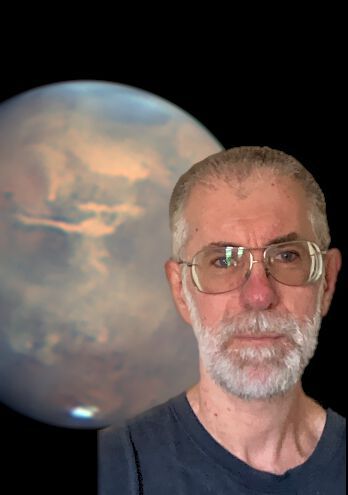
Anthony Wesley—with Mars in the background
(Image: Anthony Wesley)
Anthony Wesley is an amateur astronomer from Australia who specializes in video astronomy and low-light imaging of planets in the solar system. He has expanded Fire Capture, a special software for capturing images and videos of astronomical objects, to support cameras from various manufacturers. The uEye+ XCP cameras with Sony Starvis 2 sensors have more than convinced Anthony Wesley.
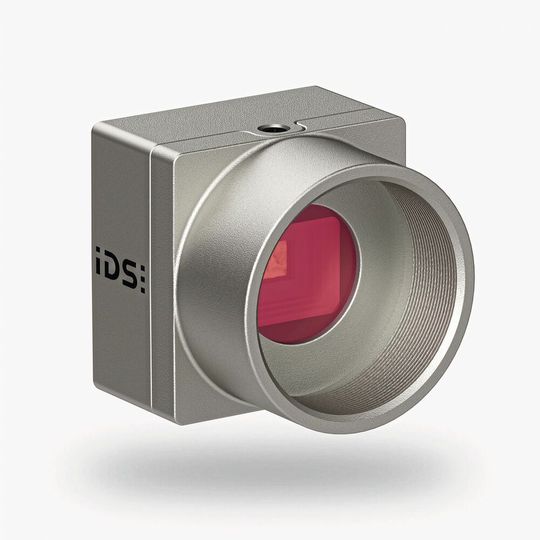
The uEye XCP camera family offers the smallest housing camera in the industry with C-mount. The model U3-38C0XCP-M-NO was used for the recordings.
uEye XCP
(Image: Anthony Wesley)
Future-Proof Authentication with Universal RFID Readers



:quality(80)/p7i.vogel.de/wcms/b5/67/b5676f3bfb36251ed31f9a0cccf650b6/0133167827v1.jpeg "Thanks to JumboFlex Generation 2, employees can effortlessly move wheelchairs weighing as much as 40 kilograms. (Image:Lard)")
:quality(80)/p7i.vogel.de/wcms/5e/c6/5ec615b7a51440f668259f2af9158cb9/0132654694v1.jpeg "Strategic Partnerships in Industry: As buyers and restructuring partners, Chinese investors are increasingly helping to preserve jobs in Germany. (Image: ©Anatolii Rymarchuk - stock.adobe.com)")
:quality(80)/p7i.vogel.de/wcms/eb/2b/eb2bd1b8487afe577b37363cd02f16ff/0113143253v1.jpeg "In our China Market Insider, we regularly provide you with relevant information straight from China. (Image:© Eisenhans - stock.adobe.com)")
:quality(80)/p7i.vogel.de/wcms/dd/b8/ddb8edc98c49b384734ab2432b297eb5/adobestock-1913662309--irene-stock-adobe-com-ki-generiertv1.jpeg "Rotary joints are used in grippers and swivel mechanisms to allow assemblies to rotate or swivel smoothly relative to one another, even under very high loads (illustrative image). (Source: Irene - stock.adobe.com / KI-generiert)")
:quality(80)/p7i.vogel.de/wcms/3a/9c/3a9c1fd546e1f041b86bb1d03cf39101/0133610524v1.jpeg "The Mason W-01 combines industrial-grade humanoid hardware, Physical AI-based perception, and autonomous task planning. (Image:Nova X Robotics)")
:quality(80)/p7i.vogel.de/wcms/d0/74/d074ae5d5d705b841b63107b20f9d8c2/699711-xpeng-iron-01-79661c-original-1788864313v1.png "(Source: XPeng Motors (Germany) GmbH)")
:quality(80)/p7i.vogel.de/wcms/60/ef/60ef4f07e4829b2c2929befc0f353c58/0133511729v1.jpeg "Humanoid robots can match human performance in certain tasks. (Image:Gemini / AI-generated)")
:quality(80)/p7i.vogel.de/wcms/2e/99/2e99726b522e4b35b690e25eb6a42643/0133463991v1.jpeg "Robotics: In AMR applications, connection technology must reliably transmit power, signals, and data despite vibration and shock loads—in very confined spaces and in a way that allows for regular maintenance. (Image:Hyperever)")
:quality(80)/p7i.vogel.de/wcms/3d/ff/3dff5e51c24b30c8dc37c1d024887157/0133602931v1.jpeg "Just a few years ago, SpaceX specialists were working on the world’s largest rocket—the Starship. Now, Elon Musk’s company has reached a milestone during a test flight: Earth’s orbit! But there was also a downside... (Image: SpaceX)")
:quality(80)/p7i.vogel.de/wcms/55/06/5506709cc56afcc7301c9d3319e19114/2026-03-08-aerospike-09-980x551v1.jpeg "The engine was developed using Noyron, the computer-aided design model for the LEAP 71. Noyron uses fundamental physical principles, engineering logic, and manufacturing specifications to design independently, without human intervention. (Source: LEAP 71)")
:quality(80)/p7i.vogel.de/wcms/b6/1f/b61f4081bab96d308e87eebaeb756c4f/pm4526-1v1.jpeg "Call for Innovative Ideas: The 2027 Manus Award will once again recognize unique projects featuring lubrication-free polymer plain bearings. (Source: Igus SE & Co. KG)")
:quality(80)/p7i.vogel.de/wcms/c0/52/c052f405eb55fc3d08c4837e77206fc0/adobestock-2021845957--aucartstudio-stock-adobe-com-ki-generiertv1.jpeg "An innovation from China to combat extreme summer heat: A novel coating lowers temperatures. (Source: © AucArtStudio – stock.adobe.com_AI-generated)")
:quality(80)/p7i.vogel.de/wcms/fc/be/fcbe4fcc65f3f972323d69796fd88d27/0133603683v1.jpeg "For those who don't know: Volkswagen has a subsidiary called Powerco that manufactures batteries for electric cars. The Chinese battery expert Gotion has been supporting this effort for some time. Now the two companies plan to significantly expand their collaboration in Europe for mutual benefit ... (Image: Volkswagen)")
:quality(80)/p7i.vogel.de/wcms/42/95/4295a1b01f6fa1f696ffff89cd542737/0133563161v1.jpeg "At its plant in Zaragoza, Spain, Stellantis draws energy from a hybrid energy portfolio. Solar and wind power are expected to cover about 80 percent of the plant’s local electricity needs. (Image:Stellantis)")
:quality(80)/p7i.vogel.de/wcms/3e/2f/3e2f1ec6c4e1a24eac32957acebd0901/0133601693v1.jpeg "From the boule (bottom) to the wafer to the chip (on top of the boule). Transistors are used as switches in power electronics. (Image:Bosch)")
:quality(80)/p7i.vogel.de/wcms/8f/99/8f9956e7dce99d1b28c27fb1c30ea236/04-dsc-2230v1.jpeg "Bosch is cutting jobs in Nuremberg. (Source: Bosch)")
:quality(80)/p7i.vogel.de/wcms/f6/9f/f69f7aad844f2f2c369ee012505f3e37/0133630806v1.jpeg "Even though prices for DRAM and NAND memory remain high due to strong demand and limited capacity, the market appears to be showing the first signs of a slowing boom. Consequently, investors are becoming increasingly skeptical about how much longer the AI boom can sustain the ongoing upward trend in the memory market. (Image:Dall-E / AI-generated)")
:quality(80)/p7i.vogel.de/wcms/c0/e9/c0e91df681b13f3a8f37badeae0a32b3/0133619268v1.jpeg "AMD CEO Lisa Hsu (left) and World Labs founder Dr. Fei-Fei Li (right) at the signing of the letter of intent. AMD plans to acquire World Labs, a startup specializing in AI “world models,” for $8.2 billion. (Image:World Labs)")
:quality(80)/p7i.vogel.de/wcms/ed/b1/edb1335d07debd3de7ae5a2fb74b571a/0133546658v1.jpeg "Securing digital infrastructure is not just about technical risks, but increasingly also about origin, supply chains, and political requirements. (Image:Dall-E / AI-generated)")
:quality(80)/p7i.vogel.de/wcms/22/f0/22f07d1635c733a29049fff5b1b8ccc8/0133601916v1.jpeg "AI models from various providers have been causing quite a stir lately because they’ve done things they weren’t supposed to—or so they say! Now, in light of recent incidents, the company “OpenAI” has decided against releasing a new AI model... (Image: AI-generated)")
:fill(fff,0)/images.vogel.de/vogelonline/companyimg/76800/76895/65.jpg "FAULHABER_120mm.jpg ()")
:fill(fff,0)/p7i.vogel.de/companies/69/de/69de1b7403b0d/simtos-logo.jpeg "simtos-logo (SIMTOS)")
:quality(80):fill(efefef,0)/p7i.vogel.de/wcms/67/ae/67ae0b9ac31f8/elatec-wp-universal-reader.png "Elatec WP Universal Reader")
:quality(80)/p7i.vogel.de/wcms/30/76/3076278d4a7b51a5c566581a20135afc/54963580015-cdcb4657c5-k-2047x1151v1v1.jpeg "The Nancy Grace Roman space telescope was completed in the largest clean room at NASA's Goddard Space Flight Center. It is due to be launched into space in September 2026. (Image:NASA/Jolearra Tshiteya / CC BY 4.0)")
:quality(80)/p7i.vogel.de/wcms/bd/5b/bd5b7444481cfe00cd39cb85a480ff13/newsimage417012-1746x982v1v1.png "A worker forming a test piece. Thanks to the measuring system, the use of test templates can be dispensed with during forming. (Image:Fraunhofer IOF)")