Automation and efficiency are essential for competitive SMT production. A solid data base is necessary to identify production problems and initiate corresponding optimization measures. Functionality in the software is required to analyze the SMT process in detail and carry out benchmarking at various production levels, which includes all roles from operation to global management.
(Image: ASMPT)
*Bernhard Fritz is Head of Global Marketing at ASMPT SMT Solutions.
On the one hand, there is a rapidly increasing miniaturization, a high variety of products and high complexity of components to be processed, on the other hand, there is increasing cost pressure, high quality requirements and tight delivery deadlines. SMT lines must reliably produce at maximum speed and deliver the highest product quality. Because no one can afford errors or delays in production today.
How complex a modern electronics production is becomes clear at the latest when the results fall short of expectations. Why don't I achieve my goal even though the machine is running productively and there is no obvious error? To answer such and similar questions, exact machine data is needed, which must be recorded across the board, meaningfully prepared and related to each other.
In practice, continuous analysis and optimization is a very demanding and time-consuming task. Although the numerous sensors and quality assurance systems of the line provide the necessary data, the evaluation so far has often been a science in itself.
Because in SMT manufacturing today, every line is unique. The many different configurations, the branched technical connections and dependencies make SMT production a very complex system. Insufficient performance can have many causes, for example, problems in logistics, personnel planning or with the machines.
SMT process analysis—often depends on experienced staff.
Why does the production of this batch now take 30 seconds, when it used to only take 25 seconds? To answer such questions, an analysis in the overall context of the SMT production process is required. Only this can show which factors are actually causing the productivity losses.
Here, employees are required who have developed a sense over time for why something is not going as it should. But this mix of technical knowledge, experience, and intuition cannot be acquired overnight. And even "old hands" sometimes hit their limits, because the processes are becoming increasingly complex, the products increasingly demanding, and the components increasingly smaller. When experienced specialists leave the company, they often take with them the knowledge accumulated over the years for process optimization—a brain drain, which can hit the company hard.
Automating the analysis—a task for practitioners.
It therefore makes sense to automate the analysis process. Appropriate software has been available for some time, but it has not yet been able to establish itself comprehensively. This is because the requirements for a truly practical analysis software are extensive:
Cross-manufacturer data analysis for the entire SMT line
Capture and addressing of multiple equipment and equipment levels as well as various SMT task areas
Detailed analysis of the SMT process, but also benchmarking at line and manufacturing level, taking into account all roles, from the operator to global management
User-friendly dashboards that provide information anywhere, anytime and automatically
Integration of the entire data basis, by analyzing historical and real-time data as well as reference data
Standardization and combination of expertise for process optimization, as otherwise only possible by experienced employees
Combining and fully implementing all these functions in one program has now been achieved for the first time by the technology and market leader ASMPT - with the software SMT Analytics. The fact that the manufacturing specialist is also introducing the leading product in the market in this area may hardly be surprising. The company covers almost the entire manufacturing process with its hardware and software portfolio.
In contrast to most pure software developers, the market and technology leader therefore has practical experience with SMT hardware and the many multi-layered and interconnected processes in manufacturing. The company has been dealing with performance optimization at the machine, line and manufacturing level for many years. The result is not least the holistic, data-driven concept of intelligent manufacturing, which guarantees the maximum return on investment with integrative data analysis.
The global player has intensively dealt with the problems and questions of SMT manufacturing. The result is five basic use cases provided by SMT Analytics to analyze time, material, and status, thus improving the throughput of existing equipment.
Date: 08.12.2025
Naturally, we always handle your personal data responsibly. Any personal data we receive from you is processed in accordance with applicable data protection legislation. For detailed information please see our privacy policy.
Consent to the use of data for promotional purposes
I hereby consent to Vogel Communications Group GmbH & Co. KG, Max-Planck-Str. 7-9, 97082 Würzburg including any affiliated companies according to §§ 15 et seq. AktG (hereafter: Vogel Communications Group) using my e-mail address to send editorial newsletters. A list of all affiliated companies can be found here
Newsletter content may include all products and services of any companies mentioned above, including for example specialist journals and books, events and fairs as well as event-related products and services, print and digital media offers and services such as additional (editorial) newsletters, raffles, lead campaigns, market research both online and offline, specialist webportals and e-learning offers. In case my personal telephone number has also been collected, it may be used for offers of aforementioned products, for services of the companies mentioned above, and market research purposes.
Additionally, my consent also includes the processing of my email address and telephone number for data matching for marketing purposes with select advertising partners such as LinkedIn, Google, and Meta. For this, Vogel Communications Group may transmit said data in hashed form to the advertising partners who then use said data to determine whether I am also a member of the mentioned advertising partner portals. Vogel Communications Group uses this feature for the purposes of re-targeting (up-selling, cross-selling, and customer loyalty), generating so-called look-alike audiences for acquisition of new customers, and as basis for exclusion for on-going advertising campaigns. Further information can be found in section “data matching for marketing purposes”.
In case I access protected data on Internet portals of Vogel Communications Group including any affiliated companies according to §§ 15 et seq. AktG, I need to provide further data in order to register for the access to such content. In return for this free access to editorial content, my data may be used in accordance with this consent for the purposes stated here. This does not apply to data matching for marketing purposes.
Right of revocation
I understand that I can revoke my consent at will. My revocation does not change the lawfulness of data processing that was conducted based on my consent leading up to my revocation. One option to declare my revocation is to use the contact form found at https://contact.vogel.de. In case I no longer wish to receive certain newsletters, I have subscribed to, I can also click on the unsubscribe link included at the end of a newsletter. Further information regarding my right of revocation and the implementation of it as well as the consequences of my revocation can be found in the data protection declaration, section editorial newsletter.
Rate Efficiency Analysis (Time Analysis)
The basic problem with Rate Efficiency Analysis is: Why am I not achieving my goal even though the system is productive and there is no obvious error?
The manufacturer's placement machines are designed to continue working even when certain components have failed. For example, if a segment of the placement head is no longer used, the machine continues to place, albeit at a somewhat slower rate. SMT Analytics identifies these speed losses by comparing the actual placement time with the theoretical placement time calculated in SIPLACE Pro for the individual batch, and displays the potential impact on performance. The software answers the following detailed questions:
Why is there a loss (even though the line is productive)?
Where do the time losses occur?
What is the impact?
What is the main cause?
Reject Analysis (Material Analysis)
The basic problem with Reject Analysis is: What is the main cause of my total rejection rate?
The placement machines optically check every component to be processed. The machine checks whether the component is undamaged, whether it meets the stored dimensions, and whether it is correctly seated on the pipette. Unsuitable components are automatically sorted out. The software tool displays their number, sorted by component ID, component shape ID, and feeder ID. This gives information about the component quality, handling and feeding process.
This use case also shows the proportion of each component ID and component shape ID to the total rejection rate of the line. This makes it clear which of these parameters is the main cause. The total rejection rate of the line is displayed over time to identify when peaks occur.
The analysis tool answers the following detailed questions:
What rejection rates occur?
What is the contribution of individual materials?
What is the line benchmark?
Where do drops/component losses occur?
How frequently do they occur?
Recipe Time Analysis (Time Analysis)
The basic problem: What impact do changes in SIPLACE Pro settings have on cycle time?
Often, the production settings of a lot are changed. In order to assess whether such a change has a positive or negative effect, you have to analyze the cycle times before and after the change. The comparison dashboard accurately displays the impact on performance, so that short and long-term performance losses can be prevented.
The web tool answers the following detailed question:
Does a change in SIPLACE Pro settings affect line cycle time?
Error Analysis (status analysis)
The basic problem with Error Analysis: How do the occurring machine errors affect productivity time?
With this use case, all downtime due to possible machine errors is analyzed and identified. Detailed localization down to the assembly area and precise descriptions of the causes is carried out.
By identifying the start and end time of the downtime, the impact on throughput is shown regardless of the duration of the downtime. The downtimes of different lines can be compared. SMT Analytics answers the following questions:
What was the cause of my downtime?
What machine errors have occurred?
Where did the machine errors occur?
When did the downtime start and when was it resolved?
Operational Analysis (state analysis available soon)
The basic problem: Why is my line not in a productive state, and how high is the availability loss of my power? The dashboard focuses on analyzing production availability or the individual status of the placement areas, the line, or the system. This is done by evaluating the machine condition live and over time.
The comparison of the results with the theoretical SIPLACE-Pro values provides information about whether and possibly where and why a change or loss has occurred.
Customers who operate multiple SMT lines in different areas or buildings receive statistics about production interruptions of the placement machines in the entire production environment. The web tool answers the following detailed questions:
Where do the time losses occur?
How big are the impacts?
What is the main cause?
What is the time distribution?
What is the line benchmark?
Practical tests and customer experiences clearly show: With the five use cases presented by SMT Analytics, ASMPT can further expand its role as market and technology leader.
Optimize processes, exploit potential
The functional and practical software also enables newcomers to continuously optimize the entire SMT process and specifically addresses the important areas of efficiency, effectiveness and flexibility. The web-based tool is so user-friendly that even less experienced staff can quickly work with it and easily identify problems. This also strengthens the standardization of SMT process optimization. The software finds the cause of problems in a few steps and relieves specialists of standard tasks. Short-term downtimes are also detected - before they accumulate into a real production bottleneck. The application also detects problems that are difficult to assign - before they remain unnoticed in the system and reduce throughput and performance over longer periods of time.
The software tool gives the SMT manufacturer a real competitive advantage in an increasingly dynamic and competitive market environment: Because the software reduces production time and effort, thereby saving unnecessary additional costs.
Material losses and problems are analyzed and eliminated, critical deadlines are easier and more relaxed to meet. SMT Analytics helps to make the best possible use of existing ASMPT equipment, maximize efficiency, and fully exploit performance potential. (mbf)
The article was first published on our sisterbrand 'ElektronikPraxis' (German Edition), Vogel Communictaions Group GmbH & Co. KG



:quality(80)/p7i.vogel.de/wcms/dd/08/dd086510d9ae7b50181f6070e4463b44/0129363730v1.jpeg "Typical application for ionizing devices: Wrapping films. (Picture: ©Adobe Stock/SMC)")
:quality(80)/p7i.vogel.de/wcms/35/57/3557c819943c53acec41a0ccba87da4f/0130049064v1.jpeg "Researchers at the Fraunhofer IWU in Chemnitz have long known that many typical sheet metal parts can be manufactured more cost-effectively using hollow embossing rollers. Now there is news to report ... (Image:Fraunhofer IWU)")
:quality(80)/p7i.vogel.de/wcms/59/02/590246e3b3f415c65edbee377c14ca77/26-06-pi-fraunhofer-iws-41450-direktplattieren-pic-01-7771x4369v1v1.jpeg "The Fraunhofer IWS has developed the new \"direct laser cladding\" process, which creates a functional layer directly on the base body by applying a strip-shaped metal to rotationally symmetrical components in a spiral and bonding it locally by laser. (Image:Christoph Wilsnack/Fraunhofer IWS)")
:quality(80)/p7i.vogel.de/wcms/73/60/73608418789b1d9c393f5e2fa974eda2/0130209906v1.jpeg "The robots of the X6 generation from b+m enable very high painting quality and are also particularly compact and easy to maintain. (Image:Beckhoff)")
:quality(80)/p7i.vogel.de/wcms/78/e9/78e9188c25a8a94e67c34c9bf8ffe495/visual-agile-20robots-20and-20google-20deepmind-20partner-20to-20bring-20intelligence-20to-20robotics-2500x1406v1v1.jpeg "Together, the partners are developing adaptable, intelligent robots for a wide range of applications (Image:Agile Robots SE)")
:quality(80)/p7i.vogel.de/wcms/e7/66/e7669ecf0260ae8fc54c214e34e4902a/0130316817v1.jpeg "Siemens and Palo Alto Networks offer tested cybersecurity solution for industrial 5G. (Image:Siemens)")
:quality(80)/p7i.vogel.de/wcms/9f/55/9f55324832c4f426958031375124d9de/siemens-20ubtech-20hmnd-1920x1079v1v1.png "Ready for the factory floor: While Ubtech is planning mass production, Siemens is already testing humanoids in real factory applications in Erlangen. (Image:Siemens)")
:quality(80)/p7i.vogel.de/wcms/11/36/113695ed260e29c8c2d9d39dc5f9d869/0130213768v1.jpeg "AI can work cheaply in China and deliver the results rapidly all over the world. (Image:Dall-E / AI-generated)")
:quality(80)/p7i.vogel.de/wcms/62/5f/625f41e87ebfef156a98c8e6393e32fd/0130211654v1.jpeg "Axial flux motors have some advantages over radial flux motor—but their production is currently still expensive. (Image:RWTH Aachen University)")
:quality(80)/p7i.vogel.de/wcms/77/9b/779b0685d010dfe45c9c2cb1cfecd467/0128886425v1.jpeg "The BlueEye is the first \"real\" hyperspectral camera for the UV range and covers the wavelength range from 220 to 380nm. (Image:Inno-spec GmbH)")
:quality(80)/p7i.vogel.de/wcms/e4/51/e451d52ce0182fb0aaa46a5774f832ef/26-04-pi-fraunhofer-iws-21160-bioslide-pic-01-4128x2321v1v1.jpeg "With the BioSlide research project, the Fraunhofer IWS is investigating how sliding systems can be designed to be more sustainable and energy-efficient. New materials can be tested in a particularly application-oriented manner on this plain bearing test stand. (Image:Fraunhofer IWS)")
![Thanks to advanced 3D printing technology, a more efficient use of resources should contribute to lower-emission aviation—this is the goal of ['skai]-lab. (Image:Oleksandr Pashchenko - stock.adobe.com / AI-generated)](https://cdn1.vogel.de/nghHNSbySccfOjG3n1qCA-FVOjQ=/288x162/smart/filters:format(jpg):quality(80)/p7i.vogel.de/wcms/62/64/626424c97a16e69f871bf216c9629c2a/adobestock-1927043193--c2-a9-20oleksandr-20pashchenko-20-e2-80-93-20stock-adobe-com-ki-generiertv1v1.jpeg "Thanks to advanced 3D printing technology, a more efficient use of resources should contribute to lower-emission aviation—this is the goal of ['skai]-lab. (Image:Oleksandr Pashchenko - stock.adobe.com / AI-generated)")
:quality(80)/p7i.vogel.de/wcms/c3/c4/c3c4ce270b083eeac55654148611f064/0130237945v1.jpeg "China is not giving up on hydrogen, but is intensifying its efforts. (Image:freely licensed from Pixabay)")
:quality(80)/p7i.vogel.de/wcms/4e/c0/4ec0bd19390b169edfa23677373dcdf1/0130260089v1.jpeg "Renewable fuels can supply European road traffic, according to a study. (Image:Aral)")
:quality(80)/p7i.vogel.de/wcms/6f/c9/6fc9050301d745cad25585c6780f8f51/0130197341v1.jpeg "Production facilities are a worthwhile target and are therefore at risk. (Image:ABB Robotics)")
:quality(80)/p7i.vogel.de/wcms/b6/62/b662adc2cec8227d8172509bbfb6ee42/25c0207-107-4961x2789v1v1.jpeg "The GLB is the second model based on Mercedes' new MMA platform. Apparently, Geely's platform is better and cheaper, which is why the two companies are negotiating a partnership. (Image:Mercedes-Benz)")
:quality(80)/p7i.vogel.de/wcms/4d/dd/4dddf438e91f394c04a095dbfd109d1c/0130236430v1.jpeg "Measurement modules: The 720301 module in combination with the SL2000 enables RMS and power calculations, among other things. (Image:Yokogawa)")
:quality(80)/p7i.vogel.de/wcms/61/fc/61fcf95f5cca15494ad18343901ae585/0130317237v1.jpeg "With the AGI CPU, Arm says it is taking a \"historic step\": With the processor aimed at AI in data centers, the company is presenting itself for the first time as a provider of its own chips, not just as a pure IP licensor. (Image:Arm)")
:quality(80)/p7i.vogel.de/wcms/82/90/8290dfe3595b6c6b33726ae8b76172c7/0130319587v1.jpeg "The concept image illustrates how the pattern of tiny protrusions and depressions created on the substrate (MgO, bottom) controls the arrangement of atoms in the superconducting material (YBCO, top). At the interface between the two layers, an electronic structure enables superconductivity to occur at higher temperatures than previously possible. (Image:Chalmers University of Technology / Riccardo Arpaia)")
:fill(fff,0)/images.vogel.de/vogelonline/companyimg/76800/76895/65.jpg "FAULHABER_120mm.jpg ()")
:fill(fff,0)/p7i.vogel.de/companies/69/88/69882c428938e/tmts2026-ticec-banner-en-2000px.png "tmts2026-ticec-banner-en-2000px (https://www.tmts.tw/en)")
:fill(fff,0)/p7i.vogel.de/companies/67/eb/67eba621ef6ea/logo2.png "logo2 (Wuxi InfiMotion)")
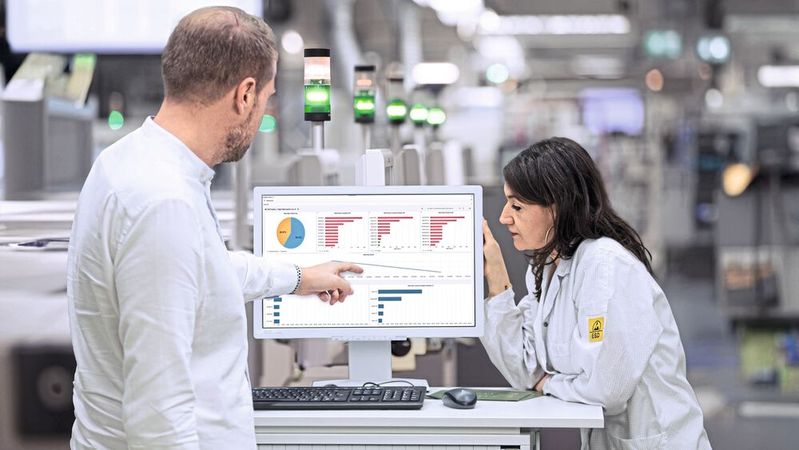
:quality(80)/p7i.vogel.de/wcms/6d/a7/6da7220b24bd0d8c665269121a41aca1/0118295902v1.jpeg "Image 2: With user-friendly dashboard displays, SMT Analytics provides information automatically anywhere and anytime.(Image: ASMPT)")
:quality(80)/p7i.vogel.de/wcms/d2/56/d2560dba195785e43196534de3765535/0118971198v1.jpeg "Image: Deep material and dropout rate analysis with the Reject Analysis Use Case.(Image: ASMPT)")
:quality(80)/p7i.vogel.de/wcms/05/d4/05d4c21e5746d194936d3eb058cf415a/0118296206v1.jpeg "(Image: ASMPT)")
:quality(80)/p7i.vogel.de/wcms/44/5e/445e4466c6d06bf040ee54a736559681/0118355865v1.jpeg "Bernhard Fritz, Head of Global Marketing ASMPT SMT Solutions(Image: ASM AS CRM MK Munich)")
:quality(80)/p7i.vogel.de/wcms/60/fd/60fd12ddfe1fb623568736f27d1cfe61/0128606899v1.jpeg "The future of supply chains: AI and dashboards to ensure optimal OTIF values (Picture: ©immimagery - stock.adobe.com)")
:quality(80)/p7i.vogel.de/wcms/70/14/70142aa050f8d3f7784c5ddbb2aba5f1/0129778339v1.jpeg "The software investments in production have saved time in Lacon production. (Image:Lacon)")