How do you protect sensitive semiconductor materials from oxidation without compromising their performance? Researchers have found a solution: amorphous boron nitride (a-BN), which not only prevents corrosion but also enhances the performance of semiconductor devices. Could a-BN optimize the electronics of the future?
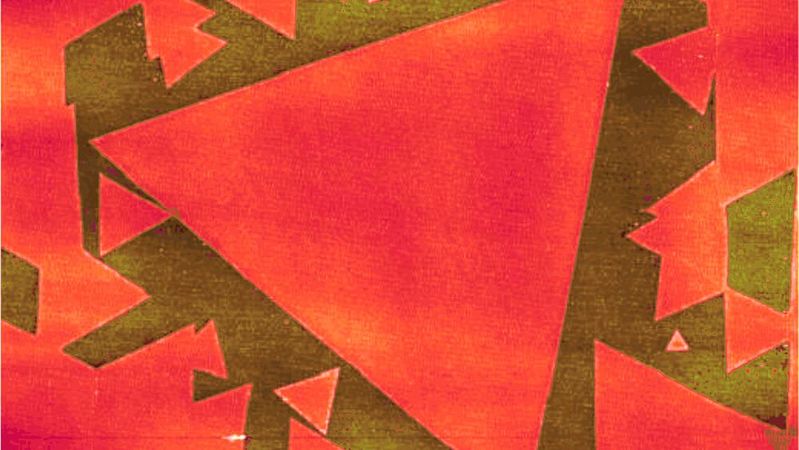
These materials consist of molybdenum disulfide, a two-dimensional semiconductor grown on a sapphire surface. The triangular shapes are aligned due to epitaxy and follow the pattern of the surface on which the material has grown. During the production of these ultra-thin materials, which are used for building next-generation electronic devices, insulating layers such as amorphous boron nitride are added.
(Image: J.A. Robinson Research Group/Penn State)
Oxidation in semiconductors can be problematic as it negatively affects the properties of semiconductor materials. For instance, if metal contacts oxidize, the electrical resistance increases, which deteriorates conductivity and reduces the efficiency of components like MOSFETs or diodes. Additionally, uncontrolled oxidation layers on semiconductor surfaces can lead to unwanted insulation effects that impair the function of components. In short, oxidation leads to electrical losses, impairs durability, and can render components unusable in the long term.
In particular, oxidation is considered a problem for 2D materials for advanced semiconductors that are only one or a few atoms thick. These materials control the flow of electricity in electronic devices, and any corrosion can render the material unusable. Since their thinness offers electrons a shorter and more direct path to move quickly and with less resistance through the material, they enable faster and more efficient electronic performance. How can the issue of oxidation be addressed in this case?
Rust-free coating with additional properties—and without water
Researchers have developed a synthesis process to create a "rust-free" coating with additional properties suitable for the development of faster and more durable electronics. The team, led by researchers from Penn State University, published their work in Nature Communications.
In addition to Robinson, other authors of the study include experts from Penn State. Additional co-authors are scientists from the National Yang Ming Chiao Tung University in Taiwan, Purdue University, Intel Corporation, and the Kurt J. Lesker Company.
"One of the biggest problems in researching 2D semiconductors today is the fact that the materials oxidize quickly," says Joshua Robinson, professor of materials science and engineering and co-author of the paper. "You have to ensure their long-term reliability because they are used in transistors or sensors that are supposed to last for years. Currently, these materials don't last more than a week outdoors."
Conventional methods for protecting these materials from rust include oxide-based coatings, but these processes often involve water, which can ironically accelerate oxidation. The team therefore sought a coating material and method that completely avoids water. The choice fell on amorphous boron nitride (a-BN).
"We wanted to get away from water in this process, so we thought about what kind of 2D materials we could produce that don't use water in their processing. Amorphous boron nitride is one of those materials," said Robinson.
Amorphous boron nitride as a complement to dielectrics
This non-crystalline form of boron nitride, namely a-BN, is known for its high thermal stability and electrical insulation properties. This qualifies it for use in semiconductors to insulate components, prevent unwanted electrical currents, and improve device performance, says Robinson. He explains that a-BN has a high dielectric strength—a measure of how well a material can withstand high electric fields without breaking down. This is a crucial factor for reliable performance.
"The high strength of a-BN is comparable to the best available dielectrics, and we do not need water to produce it," said Robinson. "In the paper, we demonstrate that amorphous boron nitride improves the performance of components compared to conventional dielectrics alone." This means that a-BN could potentially be used in addition to other dielectrics to enhance the overall efficiency and reliability of the semiconductor. It is still unclear whether a-BN is used solely as a complementary material in all designs, or if it might also be employed as a primary dielectric in some cases.
Two-step method
While the coating helped to create a better 2D transistor, coating the 2D materials proved to be a challenge. Two-dimensional materials lack "free bonds," meaning they have no unpaired electrons on their surface that could react or bond with other atoms. A conventional coating process, conducted in a single step and at higher temperatures, results in uneven and incomplete coatings—and this is far from sufficient for electronics to function reliably.
To uniformly coat 2D materials with a-BN, the team developed a two-step atomic layer deposition method, where initially a thin a-BN "seed layer" is deposited at low temperatures before the chamber is heated to typical deposition temperatures between 482°F and 572°F. This approach allowed the researchers not only to create a uniform a-BN coating on the 2D semiconductors but also to improve the transistor performance by 30% to 100%, depending on the transistor design, compared to devices without a-BN.
Date: 08.12.2025
Naturally, we always handle your personal data responsibly. Any personal data we receive from you is processed in accordance with applicable data protection legislation. For detailed information please see our privacy policy.
Consent to the use of data for promotional purposes
I hereby consent to Vogel Communications Group GmbH & Co. KG, Max-Planck-Str. 7-9, 97082 Würzburg including any affiliated companies according to §§ 15 et seq. AktG (hereafter: Vogel Communications Group) using my e-mail address to send editorial newsletters. A list of all affiliated companies can be found here
Newsletter content may include all products and services of any companies mentioned above, including for example specialist journals and books, events and fairs as well as event-related products and services, print and digital media offers and services such as additional (editorial) newsletters, raffles, lead campaigns, market research both online and offline, specialist webportals and e-learning offers. In case my personal telephone number has also been collected, it may be used for offers of aforementioned products, for services of the companies mentioned above, and market research purposes.
Additionally, my consent also includes the processing of my email address and telephone number for data matching for marketing purposes with select advertising partners such as LinkedIn, Google, and Meta. For this, Vogel Communications Group may transmit said data in hashed form to the advertising partners who then use said data to determine whether I am also a member of the mentioned advertising partner portals. Vogel Communications Group uses this feature for the purposes of re-targeting (up-selling, cross-selling, and customer loyalty), generating so-called look-alike audiences for acquisition of new customers, and as basis for exclusion for on-going advertising campaigns. Further information can be found in section “data matching for marketing purposes”.
In case I access protected data on Internet portals of Vogel Communications Group including any affiliated companies according to §§ 15 et seq. AktG, I need to provide further data in order to register for the access to such content. In return for this free access to editorial content, my data may be used in accordance with this consent for the purposes stated here. This does not apply to data matching for marketing purposes.
Right of revocation
I understand that I can revoke my consent at will. My revocation does not change the lawfulness of data processing that was conducted based on my consent leading up to my revocation. One option to declare my revocation is to use the contact form found at https://contact.vogel.de. In case I no longer wish to receive certain newsletters, I have subscribed to, I can also click on the unsubscribe link included at the end of a newsletter. Further information regarding my right of revocation and the implementation of it as well as the consequences of my revocation can be found in the data protection declaration, section editorial newsletter.
"When you place 2D semiconductors between the amorphous boron nitride, you essentially get a flat electronic highway that enables improved electronics," says Robinson. "The electrons can move faster through the 2D material than if they were between other dielectric materials."
Despite these findings, the team is only scratching the surface of the potential of a-BN as a dielectric material for semiconductor devices. "We still have room for improvement, even though it already surpasses other dielectric materials," explains Robinson. "At the moment, we are mainly trying to improve the overall quality of the material and then integrate it into some complex structures that will be seen in future electronics."



:quality(80)/p7i.vogel.de/wcms/72/a0/72a0ffc94f0929c8b193b4bc40638d72/0129755066v1.jpeg "Tens of billions less! After Ford and General Motors, Stellantis is now also feeling the painful consequences of Donald Trump's decision to change its electric car strategy ... (Image:Stellantis)")
:quality(80)/p7i.vogel.de/wcms/7f/fd/7ffd32863352c40f562f4245e4766e61/0129745849v1.jpeg "After US President Donald Trump once again resorted to his favorite weapon, tariffs, concerns rose in the EU that the so-called tariff deal could become invalid. But it looks as if the sea remains relatively calm ... (Image:F. Schneidler)")
:quality(80)/p7i.vogel.de/wcms/53/69/5369bed136061188d873441dfefd6d6e/0129245111v1.jpeg "The company revised the factory layout even though construction work had already begun. (Image:Efeso Management Consultants)")
:quality(80)/p7i.vogel.de/wcms/d2/d7/d2d79e3fb84663cb7e918c88f123989b/0129733908v1.jpeg "Mineral decision! This is how lithium is mined. There is a lot of it in Chile, Australia, Bolivia and also in Zimbabwe. However, the latter country has now announced that the export of all minerals, including lithium concentrate, will be stopped. Read more about the reasons here ... (Image:Largbatt)")
:quality(80)/p7i.vogel.de/wcms/d9/bd/d9bd1bfa7d02f586e092f06c61ee3d9a/0129464423v1.jpeg "This is what the Black Soldier Fly (BSF) looks like. The first impression is of a common two-winged insect. But appearances are deceptive, because its larvae are true protein reactors, whose industriousness is now to be exploited for food ... (Image:Fly Friends)")
:quality(80)/p7i.vogel.de/wcms/13/4d/134dee0c2b8af6b4f28937ca5b586e0d/0129499541v1.jpeg "The industry now needs to build a flexible, powerful and sovereign infrastructure that can exploit the full potential of artificial intelligence while guaranteeing control over data and processes. (Picture: ©Gorodenkoff - stock.adobe.com)")
:quality(80)/p7i.vogel.de/wcms/c6/71/c671ce338f12be49d39d1b04b40a54f7/0129697443v1.jpeg "Claas is working on making its combine harvesters fit for refurbishment. (Image:Claas)")
:quality(80)/p7i.vogel.de/wcms/f2/4b/f24b8f1c3070e7f13e4f0ffd7854e75a/0129653538v1.jpeg "The production of the BMW iX3 is to be taken as far as possible in terms of sustainability. This is also ensured by the climate-friendly Blueprint recycled steel from Thyssenkrupp Steel ... (Image:BMW)")
:quality(80)/p7i.vogel.de/wcms/f5/7e/f57ef535ee35e7b3b7ff15a8a63cef10/eds-keyvisual-8000x4496v1.jpeg "(Source: European Defence Supply)")
:quality(80)/p7i.vogel.de/wcms/af/a3/afa312176d956068af20491957eef642/newsimage418262-3100x1745v1v1.jpeg "The autonomous shuttle of the Aula AI project during a demonstration of sensor data with artificial fog. (Image:University of Magdeburg)")
:quality(80)/p7i.vogel.de/wcms/84/2d/842d51915fa4fe69c72da5cc4ba52ed1/newsimage418103-3408x1917v1v1.jpeg "3 Printing can also be sustainable—if recyclable ink is used. (Image:Hereon/Steffen Niemann)")
:quality(80)/p7i.vogel.de/wcms/b0/78/b078e07634ffd4d5ee6b73af42cc7c55/newsimage418259-1000x563v1v1.jpeg "Magnesium during forming. (Image:TU Bergakademie Freiberg)")
:quality(80)/p7i.vogel.de/wcms/c7/5e/c75e5942cd1d7e6bce973391af6dafe8/0129757614v1.jpeg "Pony.ai is cooperating with Moore Threads to bring Level 4 autonomous driving to the roads in China more quickly. (Image:Pony.ai)")
:quality(80)/p7i.vogel.de/wcms/a8/9f/a89ff7a3e28a19c03a22fd16cf3404b4/0129761837v1.jpeg "KD and Hitachi High-Tech have concluded a distribution agreement. (Image:KD)")
:quality(80)/p7i.vogel.de/wcms/29/b5/29b536a22d9b5ac80387b02620cce554/20260212-sue-60-6000x3372v1v1.jpeg "The People Mover at its world premiere. The large polycarbonate windshield is clearly visible. One of several materials contributed by Covestro. (Image:UE | STUDIOS)")
:quality(80)/p7i.vogel.de/wcms/a0/3e/a03e71cec3a956df095607a0b176a7b0/0129584071v1.jpeg "Andreas Mindt will be Head of Design at the Volkswagen Group from March. (Image:Volkswagen AG)")
:quality(80)/p7i.vogel.de/wcms/eb/4e/eb4e449562174ec95a5b3d30fb0137a2/0129648135v1.jpeg "The III-V germanium PV module with an efficiency of 34.2% is currently the most efficient solar module in the world. (Image:Jacob Forster)")
:quality(80)/p7i.vogel.de/wcms/92/c2/92c23fd5d95286c8c8c634314f6b22f8/0129722027v1.jpeg "The Meta Group has signed a five-year contract for GPU and CPU deliveries to expand its AI capacities. The agreement covers the delivery of up to 6 gigawatts of GPU computing power with a total value of around USD 60 billion. (Image:freely licensed)")
:quality(80)/p7i.vogel.de/wcms/01/77/017742db7d5eb5964c297bb8917df701/0129696639v1.jpeg "Mini-STX K3921-N: The motherboard masters Intel's Core i3 and N-Series processors and can connect multiple monitors with Full HD. (Image:Kontron)")
:quality(80)/p7i.vogel.de/wcms/17/21/1721b98b7580a86c7790f607395878a1/0129697493v1.jpeg "Universal: Motors are used everywhere. (Image:Microchip Technology)")
:fill(fff,0)/images.vogel.de/vogelonline/companyimg/76800/76895/65.jpg "FAULHABER_120mm.jpg ()")
:fill(fff,0)/p7i.vogel.de/companies/67/eb/67eba621ef6ea/logo2.png "logo2 (Wuxi InfiMotion)")
:quality(80)/p7i.vogel.de/wcms/b5/32/b532d819a7aec29f1cd85ad30f4cf516/0128508030v1.jpeg "A new manufacturing technique, in which multiple active components are stacked on the back of a computer chip, could significantly increase the energy efficiency of microelectronics. (Image:Dall-E / AI-generated)")
:quality(80)/p7i.vogel.de/wcms/b3/f3/b3f3af814cc53594c8578026eed04a98/0125300370v1.jpeg "A GaN block on a chip (symbolic image): Researchers have developed a new manufacturing process that enables powerful gallium nitride transistors to be integrated into standard silicon CMOS chips cost-effectively and on a scalable basis. (Image:MIT News)")