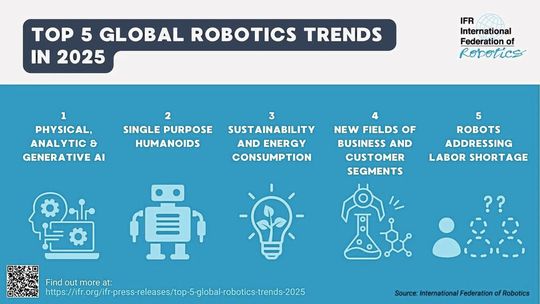
The International Federation of Robotics (IFR) highlights the five key trends driving development in 2025.
Intelligent, humanoid, efficiently innovative, and supportive in the labor market - these are robots in 2025 according to IFR.
(Image: International Federation of Robotics)
The market value of installed industrial robots has reached a historic high of 16.5 billion USD worldwide. Future demand will be driven by technological innovations, new market developments, and the exploration of new business areas. The International Federation of Robotics has identified five important trends that will shape robotics and automation in 2025:
The trend towards increased use of artificial intelligence continues: In robotics, various AI technologies help perform a wide range of tasks more efficiently:
With analytical AI, large amounts of data collected by robot sensors can be processed and analyzed. This helps to respond to unpredictable situations or changing conditions in public spaces or during the production of "high-mix-low-volume tasks". Robots equipped with image processing systems analyze their work steps to recognize patterns and optimize workflows. The goal is, for example, to increase speed and precision.
Robot and chip manufacturers are currently investing in the development of special hardware and software that simulate real-world environments. This so-called physical AI enables robots to train themselves in such virtual environments. Experiences gained in this way replace traditional programming. Such generative AI projects aim to create a "ChatGPT moment" for physical AI. AI-powered simulation technology for robots is likely to become established both in typical industrial environments and in service robotics applications.
2. Humanoid robots
Robots in human form attract great media attention. The vision: robots will become general-purpose tools that can independently load a dishwasher or work on the assembly line. Robotics startups are working on these humanoid all-rounders.
Industrial manufacturers, on the other hand, are concentrating on humanoids that initially accomplish individual single tasks. Most of these pilot projects are running in the automotive industry. This sector has always played a pioneering role in the development of robot applications. This applies to both industrial robotics and logistics and warehousing. From today's perspective, however, it remains to be seen whether humanoid robots will represent an economically viable and scalable business model for broad industrial application, particularly in comparison to already existing solutions.
Nevertheless, there are numerous applications that could benefit from the humanoid form and offer market potential for robotics, for example in logistics and warehousing.
3. Sustainability and energy efficiency
Meeting the United Nations (UN) sustainable development goals and corresponding regulations worldwide will become an important prerequisite for qualifying as a supplier. Robots play a key role for manufacturers in achieving these goals.
Fundamentally, robotics with its precision work reduces material waste and improves the input-to-output ratio in manufacturing processes. These automated systems also ensure consistent quality, which is essential for products with long lifespans and minimal maintenance. In the production of environmentally friendly energy technologies such as solar cells, batteries for electric cars, or recycling facilities, robots are crucial for cost-efficient production. They enable manufacturers to quickly scale their production to meet growing customer demand without compromising on quality or sustainability.
In addition, robot technology is being improved to make machines more energy-efficient: for example, the lightweight design of movable robot components reduces their energy consumption, as do new standby modes that bring the hardware into an energy-saving parking position. In gripper technology, there are advances in the application of bionic solutions to achieve high gripping force with very low energy consumption.
4. New business areas and customer industries
In the manufacturing industry, there is still a lot of potential for automation with robots. Most companies in the manufacturing sector are small and medium-sized enterprises (SMEs). Currently, high initial investments and total operating costs pose a hurdle for SMEs to use industrial robots. Business models like Robot-as-a-Service (RaaS) aim to make it easier for companies to benefit from robotic automation without having to invest a fixed capital sum. RaaS providers specializing in specific industries or applications can quickly deliver sophisticated solutions. Additionally, low-cost robotics offers solutions for potential customers for whom a high-performance robot would be oversized. Many applications have low requirements for precision, load capacity, and lifespan. Low-cost robotics addresses this new "good enough" segment.
Date: 08.12.2025
Naturally, we always handle your personal data responsibly. Any personal data we receive from you is processed in accordance with applicable data protection legislation. For detailed information please see our privacy policy.
Consent to the use of data for promotional purposes
I hereby consent to Vogel Communications Group GmbH & Co. KG, Max-Planck-Str. 7-9, 97082 Würzburg including any affiliated companies according to §§ 15 et seq. AktG (hereafter: Vogel Communications Group) using my e-mail address to send editorial newsletters. A list of all affiliated companies can be found here
Newsletter content may include all products and services of any companies mentioned above, including for example specialist journals and books, events and fairs as well as event-related products and services, print and digital media offers and services such as additional (editorial) newsletters, raffles, lead campaigns, market research both online and offline, specialist webportals and e-learning offers. In case my personal telephone number has also been collected, it may be used for offers of aforementioned products, for services of the companies mentioned above, and market research purposes.
Additionally, my consent also includes the processing of my email address and telephone number for data matching for marketing purposes with select advertising partners such as LinkedIn, Google, and Meta. For this, Vogel Communications Group may transmit said data in hashed form to the advertising partners who then use said data to determine whether I am also a member of the mentioned advertising partner portals. Vogel Communications Group uses this feature for the purposes of re-targeting (up-selling, cross-selling, and customer loyalty), generating so-called look-alike audiences for acquisition of new customers, and as basis for exclusion for on-going advertising campaigns. Further information can be found in section “data matching for marketing purposes”.
In case I access protected data on Internet portals of Vogel Communications Group including any affiliated companies according to §§ 15 et seq. AktG, I need to provide further data in order to register for the access to such content. In return for this free access to editorial content, my data may be used in accordance with this consent for the purposes stated here. This does not apply to data matching for marketing purposes.
Right of revocation
I understand that I can revoke my consent at will. My revocation does not change the lawfulness of data processing that was conducted based on my consent leading up to my revocation. One option to declare my revocation is to use the contact form found at https://contact.vogel.de. In case I no longer wish to receive certain newsletters, I have subscribed to, I can also click on the unsubscribe link included at the end of a newsletter. Further information regarding my right of revocation and the implementation of it as well as the consequences of my revocation can be found in the data protection declaration, section editorial newsletter.
Outside of the manufacturing sector, construction, laboratory automation, and warehousing are interesting new customer segments. Across industries, demand is also driven by the expansion of domestic production capacities in strategically important sectors, whose importance has come into political focus due to recent crises. Automation enables manufacturers to relocate production capacities closer to the customer without sacrificing cost efficiency.
5. Robots against the labor shortage
According to the International Labour Organization (ILO), the manufacturing industry worldwide continues to suffer from a labor shortage. One of the main reasons for this is demographic change, which strains labor markets in leading economies such as the United States, Japan, China, the Republic of Korea, and Germany. Although the specific effects vary from country to country, they are a cause for concern throughout the supply chain.
The use of robots significantly reduces the impact of labor shortages in manufacturing. By automating dangerous, dirty, or repetitive tasks, human workers can focus on more interesting and higher-value tasks. Robots take on jobs such as tedious visual quality inspections, hazardous painting tasks, or heavy lifting. Technological innovations like ease of use, collaborative robots, or so-called mobile manipulators help fill gaps in the work process whenever and wherever they are needed.



:quality(80)/p7i.vogel.de/wcms/a0/47/a04725ef9bd09fb6c9341a1bea1b5d93/0130443083v1.jpeg "Here, a type of plastic pallet is produced by thermoforming (vacuum forming or deep drawing) at the corresponding division of New England Plastics in the USA. This division, which specializes in so-called liners, is now part of Ringmetall ... (Image:New England Plastics)")
:quality(80)/p7i.vogel.de/wcms/23/99/23992bf2dcdc432c9b7209c34a4a7c48/0129733089v1.jpeg "Stork relies on the modular Neoswiss turning system from Iscar to shorten the set-up times for its sliding headstock lathes and work more productively. (Image:Iscar)")
:quality(80)/p7i.vogel.de/wcms/7d/e2/7de2923434b2f1a78ba5482d8d335269/0113143253v1.jpeg "In our China Market Insider we regularly provide you with relevant information directly from China. (Image:© Eisenhans - stock.adobe.com)")
:quality(80)/p7i.vogel.de/wcms/9d/2b/9d2b802f800e5caf17b2831e74228cd3/screenshot-202026-03-03-20103822-609x343v1v1.png "Visual comparison: on the left, a clean, burr-free cut edge; on the right, typical burr formation with oxidation discoloration. This illustrates how strongly parameter control and gas management influence the quality of the result. (CO₂ laser, oxygen cutting gas, sheet thickness approx. 15 mm). (Image:Picture: Rime)")
:quality(80)/p7i.vogel.de/wcms/b7/36/b736dfebc16c42d6901d0d0e1f390493/3d-druck-20factory-20--20ki-20generiert-1920x1079v1.png "(Source: AI-generated)")
:quality(80)/p7i.vogel.de/wcms/79/b2/79b21aad663f4a7bd4472afc1c1afc62/0130433994v1.jpeg "Mission Joyride: The free-flying robot (shown here in the rendering) will relieve the ISS crew of logistics tasks from 2027 with its two mechanical arms. (Image:Icarus Robotics)")
:quality(80)/p7i.vogel.de/wcms/6b/45/6b4546fa6ebf305c3660326909363f32/0130437089v1.jpeg "Industrial AI in action: Rockwell Automation presents practical solutions for self-controlling production systems at the Hannover Messe. (Image:Rainer Jensen, Deutsche Messe)")
:quality(80)/p7i.vogel.de/wcms/78/e9/78e9188c25a8a94e67c34c9bf8ffe495/visual-agile-20robots-20and-20google-20deepmind-20partner-20to-20bring-20intelligence-20to-20robotics-2500x1406v1v1.jpeg "Together, the partners are developing adaptable, intelligent robots for a wide range of applications (Image:Agile Robots SE)")
:quality(80)/p7i.vogel.de/wcms/59/a2/59a2b11f0aa1b700eff02addd5de8703/adobestock-1788280853--c2-a9-20satria-20-e2-80-93-20stock-adobe-com-5081x2860v1v1.jpeg "Quantum computers require extreme cooling to temperatures close to absolute zero in order to keep qubits stable. (Image:satria - stock.adobe.com)")
:quality(80)/p7i.vogel.de/wcms/49/38/493876a248943456b7e4a6db6edfc454/0130230765v1.jpeg "Safe and reliable in aircraft construction: light-curing adhesive bond combined with universal fastening elements. (Source: Delo)")
:quality(80)/p7i.vogel.de/wcms/b5/c7/b5c749d16c8a2e789c1469c2c8c1c387/0130452780v1.jpeg "Volvo Trucks completes road tests with its new hydrogen-powered trucks. (Image:Volvo Trucks)")
:quality(80)/p7i.vogel.de/wcms/ba/69/ba6975f417a85147084f38dc2cd209e2/0130451386v1.jpeg "Together with Nvidia, Hyundai wants to develop an architecture that will be used for level 4 robotaxis (image) as well as for level 2 customer vehicles. (Image:Hyundai)")
:quality(80)/p7i.vogel.de/wcms/93/4d/934de334b47abaa526c78cba1417d7af/0130343495v1.jpeg "The new SU7 is available in three price categories, \"Standard\", \"Pro\" and \"Max\" (Image:Xiaomi)")
:quality(80)/p7i.vogel.de/wcms/df/a0/dfa048434bb94f1b7d030e346b25b3ae/0130373541v1.jpeg "From August, BMW will be producing the i3 at its main plant in Munich - which the car manufacturer has extensively rebuilt for this purpose. (Image:Rainer Haeckl)")
:quality(80)/p7i.vogel.de/wcms/ee/09/ee09acbd6dc896df25affaa9e871e6e5/0130440053v1.jpeg "IMS chip module for simple system integration into an ion mobility spectrometer. (Image:Fraunhofer IPMS)")
:quality(80)/p7i.vogel.de/wcms/10/6c/106cd22de5f68a0f74639d654827228c/0130345302v1.jpeg "Made in India: According to the India Electronics and Semiconductor Association (IESA), the country should be able to produce between 75 and 80 million chips by the beginning of 2027, once the plants currently under construction become operational. (Image:Pixabay (Montage: Sebastian Gerstl))")
:quality(80)/p7i.vogel.de/wcms/a5/ed/a5ed6fda029d362732a293d6b19d74c4/0130444216v1.jpeg "Thirteen executives from the Chinese chip industry have drawn up a plan to achieve an 80% self-sufficiency rate for semiconductors by 2030. (Image:Maxim_Kazmin - stock.adobe.com)")
:quality(80)/p7i.vogel.de/wcms/31/a6/31a646018b34d8e0a44bfc8bf17837f6/0130361632v1.jpeg "For many companies, PFAS are considered indispensable in electronics production. (Image:freely licensed)")
:fill(fff,0)/images.vogel.de/vogelonline/companyimg/76800/76895/65.jpg "FAULHABER_120mm.jpg ()")
:fill(fff,0)/p7i.vogel.de/companies/69/88/69882c428938e/tmts2026-ticec-banner-en-2000px.png "tmts2026-ticec-banner-en-2000px (https://www.tmts.tw/en)")
:quality(80)/p7i.vogel.de/wcms/0b/0a/0b0a06d5be350ad70ce9374896d794af/robot-trends-2026-1600x899v1.webp "robot-trends-2026-1600x899v1 (Source: IFR)")
:quality(80)/p7i.vogel.de/wcms/57/e9/57e9a98c378304dc3fead8e82f4fc57b/0128822917v1.jpeg "More than just eye-catchers at trade fairs: Humanoid robots, like the 4NE1 from Neura at CES 2026, are set to prove their practical value this year. (Image:Neura Robotics)")