Agricultural technology remains a promising yet currently very challenging market. Technological disruptions offer numerous opportunities to expand businesses or enter this market with good solutions.
After mechanization, the digitalization of agriculture now follows.
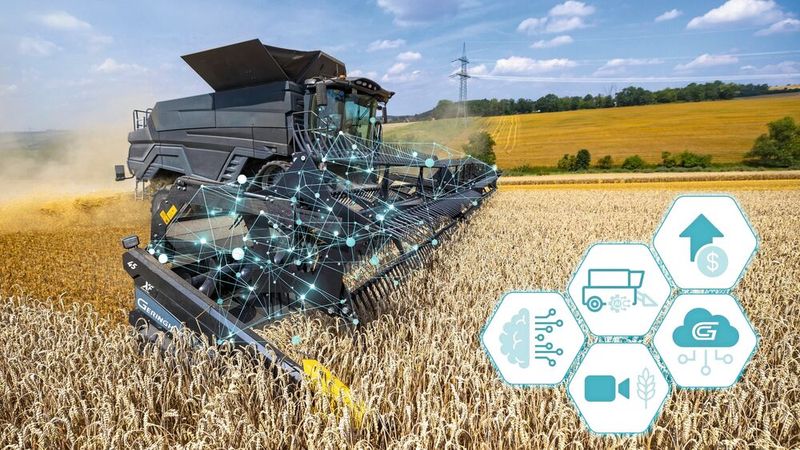
(Source: Geringhoff)
The boom following the corona shock of 2020 is over. While the agricultural machinery market experienced almost continuous strong growth worldwide between 2021 and 2023, the figures have been significantly weaker since 2024. This is partly because the catch-up effects of the pandemic have temporarily led to high inventory levels.
In this challenging environment, German agricultural machinery companies are also struggling, having previously benefited from a growth phase lasting around a decade. The revenue of German agricultural machinery and tractor manufacturers fell from 15.4 to 11.1 billion euros from 2023 to 2024 (minus 28 percent). In the first half of 2025, this decline has reduced to about 10 percent. Tractors and harvesting technology were particularly affected.
"2025 and 2026 will remain challenging for the market," described Christoph Gröblinghoff, chairman of Fendt management, about a year ago. According to recent surveys, however, the industry sentiment is gradually improving, said the German Engineering Federation (VDMA).
Technology Transfer Possible
Globally, the agricultural sector is navigating the tension between the hunger of a growing world population and, on the other hand, stress factors such as diminishing resources (land, water, fertilizer), increasing regulation and sustainability debates, rising energy prices, and trade barriers. "The task is to generate higher crop yields with fewer resources. This can only be achieved with innovative and resource-efficient technologies, which offers lucrative growth opportunities for the industry," explains Peter Fintl, Vice President Technology & Innovation at Capgemini Engineering. He sees particular potential in the drive sector for traditional automotive suppliers. "In this area, the existing expertise can be very well transferred, from the base engine to exhaust after-treatment and thermal management."
Since the implementation of Stage 5 emissions standards for non-road vehicles, the focus for combustion engines has shifted less towards nitrogen oxides and particulates and more towards adaptation for drop-in fuels. Many manufacturers have now approved engines for RME (rapeseed methyl ester) and HVO (hydrotreated vegetable oil). Another alternative is ethanol-compatible combustion concepts, which have been widely used in Brazil for years. At the same time, many individual measures are being implemented to increase drive efficiency, such as various operating characteristics or increasing engine drag torque during downhill driving to minimize the use of service brakes. For the latter, tractor manufacturers are using, for example, throttle valves in the air path, variable geometry turbochargers, decompression valves, and retarder-like hydraulic solutions.
Stepless in the Upswing
Battery-electric driving has now arrived in tractors in the lower power range and other vehicles with smaller operating radiuses. However, despite foreseeably lower variable costs, the high battery costs and limited practical experience in everyday use mean that no cost advantages in terms of Total Cost of Ownership (TCO) are yet apparent compared to combustion engine drives. However, those who can "refuel" their electric vehicles with energy from their own photovoltaic system can drive green and cost-effectively. It's no surprise that numerous other battery-electric agricultural machines or e-axles are being showcased at Agritechnica, with outputs of up to roughly 250 kilowatts, voltage levels ranging from 48 to 800 volts, and mostly LFP rather than NMC battery cell technology.
In the transmission sector, continuously variable transmissions are spreading to more and more tractor classes, such as the Variodrive concept from Fendt, the hydrostatic-mechanical power split at CNH, or the stepless transmissions from ZF at JCB. Current innovations in hydraulic systems include electronically controlled load-sensing systems and new connection concepts for the hydraulic oil supply of attachments.
Learning from the Road
Good entry opportunities for suppliers into agricultural technology also exist in electronics – from the on-board network to data transmission to the software-defined vehicle. Here, the innovation pressure on the industry is particularly high. Competent suppliers are especially in demand for autonomous driving, precision farming, and the digitalization of operations.
Date: 08.12.2025
Naturally, we always handle your personal data responsibly. Any personal data we receive from you is processed in accordance with applicable data protection legislation. For detailed information please see our privacy policy.
Consent to the use of data for promotional purposes
I hereby consent to Vogel Communications Group GmbH & Co. KG, Max-Planck-Str. 7-9, 97082 Würzburg including any affiliated companies according to §§ 15 et seq. AktG (hereafter: Vogel Communications Group) using my e-mail address to send editorial newsletters. A list of all affiliated companies can be found here
Newsletter content may include all products and services of any companies mentioned above, including for example specialist journals and books, events and fairs as well as event-related products and services, print and digital media offers and services such as additional (editorial) newsletters, raffles, lead campaigns, market research both online and offline, specialist webportals and e-learning offers. In case my personal telephone number has also been collected, it may be used for offers of aforementioned products, for services of the companies mentioned above, and market research purposes.
Additionally, my consent also includes the processing of my email address and telephone number for data matching for marketing purposes with select advertising partners such as LinkedIn, Google, and Meta. For this, Vogel Communications Group may transmit said data in hashed form to the advertising partners who then use said data to determine whether I am also a member of the mentioned advertising partner portals. Vogel Communications Group uses this feature for the purposes of re-targeting (up-selling, cross-selling, and customer loyalty), generating so-called look-alike audiences for acquisition of new customers, and as basis for exclusion for on-going advertising campaigns. Further information can be found in section “data matching for marketing purposes”.
In case I access protected data on Internet portals of Vogel Communications Group including any affiliated companies according to §§ 15 et seq. AktG, I need to provide further data in order to register for the access to such content. In return for this free access to editorial content, my data may be used in accordance with this consent for the purposes stated here. This does not apply to data matching for marketing purposes.
Right of revocation
I understand that I can revoke my consent at will. My revocation does not change the lawfulness of data processing that was conducted based on my consent leading up to my revocation. One option to declare my revocation is to use the contact form found at https://contact.vogel.de. In case I no longer wish to receive certain newsletters, I have subscribed to, I can also click on the unsubscribe link included at the end of a newsletter. Further information regarding my right of revocation and the implementation of it as well as the consequences of my revocation can be found in the data protection declaration, section editorial newsletter.
Same Deutz Fahr, for example, has developed a functional package that includes features known from passenger cars and trucks, such as lane-keeping assist, turn assist, adaptive cruise control with collision warning, traffic sign recognition, and object/person detection. These functions are specifically designed for tractors, taking into account front and rear attachments as well as driving on secondary roads without white lane markings or close following in the field. Trailers are also increasingly being assisted, for instance, through automatic braking of trailers when pushing against the tractor or the automatic locking of trailing steering axles. Even teleoperated driving with large tractors using a joystick, camera-based environmental monitoring, and mobile network communication is already technically possible over long distances.
In principle, the requirements for automated driving functions during field use are somewhat lower, according to TÜV Nord. However, once the agricultural machine is also approved for road traffic, it must additionally meet the extensive testing and driving requirements for automated driving functions of cars and trucks.
The Farm Goes Digital
The basis for electrified drives and driver assistance systems lies in new electronic architectures as well as various sensor and camera systems. These are also sensibly used for the further digitalization of agriculture. For example, crop production requires sophisticated process control and monitoring, and early fault detection is also based on extensive sensor and actuator systems.
New players in agricultural technology should additionally understand the specific challenges of this industry. For example, there is often a lack of highly qualified personnel for the complex operation of machines and other digital systems. Thus, the need arises for operation concepts that are as simple as possible but still allow for very detailed machine settings to accommodate all operating parameters and environmental conditions.
Compared to the passenger car and commercial vehicle segments, agricultural technology is already very advanced in embedding all work and monitoring functions in the vehicles, along with geodata and operating data, into a comprehensive management system. The industry is already widely leveraging artificial intelligence (AI) in this field. Examples include component monitoring through vibration analysis, camera image evaluation, management tasks such as maintenance and repair planning, or efficiency-oriented analysis of vehicle operation. A current showcase example is Claas's cloud-based grain processing analysis for corn silage, which eliminates the need for labor-intensive external laboratory analysis. Using a camera in the discharge spout and AI-driven image evaluation, the structure of the chopped material can be analyzed in real-time, allowing the cracker gap, driving speed, and engine power of the Claas forage harvester to be adjusted accordingly. The data can also be transferred to a cloud-based farm management system and used there for further services.
Tension Between Manual and Cyber World
However, "It doesn't work entirely without people," says Dr. Arne Bohl from Claas, for example. Practitioners from the field also regularly warn against over-engineering in digitalization, particularly in processes and machinery for arable farming. Another significant risk is cyberattacks, as digital systems in agricultural technology are traditionally designed for various brand-oriented system environments and are therefore equipped with manufacturer-independent interfaces. Such extensive digital networks offer plenty of attack points for hackers and data theft.
According to TÜV Nord, UN Regulation No. 155 (Uniform Provisions Concerning the Approval of Vehicles with regards to Cybersecurity) is currently not mandatory for agricultural machinery. However, the new Machinery Regulation EU Regulation 2023/1230 includes cybersecurity requirements that also apply to agricultural machinery. Additionally, the agricultural technology industry is currently developing the industrial standard ISO 24882 as a future state-of-the-art guideline for the cybersecurity of agricultural machines, according to TÜV Nord. For functional safety, the industry has had two specific standards, ISO 26262 and ISO 25119, in place for several years.



:quality(80)/p7i.vogel.de/wcms/31/84/3184f9ac736d8df7c2e934593684bc74/0130024314v1.jpeg "Here, the Bavarian car manufacturer BMW looks ahead to 2025: business was sluggish due to US tariffs and weakening sales in China ... (Image:BMW)")
:quality(80)/p7i.vogel.de/wcms/49/09/49095c6192a6c46d47b567e1def31ea6/0130024626v1.jpeg "The new TUM \"RoboGym\" (powered by Neura) is Europe's largest training center for next-generation humanoid robots. It focuses on the implementation of artificial intelligence in robotic systems. At the same time, it is a forge for AI experts ... (Image:Neura Robotics)")
:quality(80)/p7i.vogel.de/wcms/fe/8a/fe8af1b829b085210fef4c1fa8abddb5/0129784389v1.jpeg "As an integral part of Koch Pac-Systeme's Predictive Pack digital service product, the gearboxes with Cynapse and Wittenstein's Smart Services make it possible to detect damage risks in the packaging specialist's machines at an early stage. (Image:Koch Pac systems)")
:quality(80)/p7i.vogel.de/wcms/9f/7b/9f7be35880605811e045acd3af8b571b/0129558586v1.jpeg "An example of the V210 processing machine, which, according to Voortman, supplements the laser cutting of the V353 with drilling, thread cutting and milling. (Image:Voortman)")
:quality(80)/p7i.vogel.de/wcms/db/68/db689490e348201603dd30447711ea2b/0129578734v1.jpeg "With three-axis vibration measurement (X, Y and Z axes) and temperature detection, the CMSVT38 condition monitoring sensor provides detailed status information that helps to detect machine damage at an early stage. (Image:Kübler)")
:quality(80)/p7i.vogel.de/wcms/92/5e/925ee98ea36ad9bd574fa1cea11d0e53/0129964352v1.jpeg "The production of hardware components for humanoid robots offers great market potential. (Image:Fraunhofer IPA)")
:quality(80)/p7i.vogel.de/wcms/08/72/0872dd2dd119a54824c41e0e580e45a8/0129576591v1.jpeg "The Rose enclosure systems can be customized on request. (Image:Rose Systemtechnik GmbH)")
:quality(80)/p7i.vogel.de/wcms/73/17/7317794432521bf911711b91287cfc28/0129961259v1.jpeg "ABB Robotics and Nvidia are enabling the widespread use of physical AI in the world of robotics. This means that systems can be created virtually and with high precision and optimized much more cost-effectively. In the large image the virtual system, next to it the real robot cell ... (Image:ABB)")
:quality(80)/p7i.vogel.de/wcms/dd/ce/ddcef80b290218276bf857cdb64a45e1/finkel-stephan-4162x2341v1.jpeg "Stephan Finkel, Partner and Industry Lead Defence & Security at 3DSE (Source: 3DSE)")
:quality(80)/p7i.vogel.de/wcms/cb/fe/cbfe2741917274bbbf93d5b93e47a4f5/contact-software-launcht-fourier-20aiv1v1.png "Fourier AI combines AI models with AI applications developed for demanding engineering tasks. (Image:Contact Software)")
:quality(80)/p7i.vogel.de/wcms/bc/f7/bcf7a56980850be13ed37d220cd514bc/elchinator-security-5042249-1280-1280x720v1v1.jpeg "The HP Wolf Security Report shows: Attackers use AI for speed, modularity and automation, while the quality of campaigns is low. (Image:Picture: Pixabay)")
:quality(80)/p7i.vogel.de/wcms/68/89/688937087188b77da95b2079399ca862/0130009534v1.jpeg "Here you can see the Dualis layout configurator in use at Montratec. (Picture: ©Gorodenkoff - stock.adobe.com)")
:quality(80)/p7i.vogel.de/wcms/69/f5/69f516f07a0ba999c5ba8763891853f1/0130030553v1.jpeg "Can be reloaded in 210 seconds for a return trip on the Greenford branch line: the GWR's 230001. (Image:Jack Boskett Media | GWR)")
:quality(80)/p7i.vogel.de/wcms/f0/5e/f05e720c52f757660ddbf7c410074f64/adobestock-222131875-5616x3157v1.jpeg "(Source: © jeson - stock.adobe.com)")
:quality(80)/p7i.vogel.de/wcms/b2/64/b2641254fef5afa15645cefc37089c88/0130021093v1.jpeg "Daimler Truck and Quantum Systems are jointly developing unmanned military vehicles. (Image:Quantum Systems)")
:quality(80)/p7i.vogel.de/wcms/30/7e/307e71ec64f7c52c29458544ca29adf1/org-blobs-user-response-file-output-799034cb-2ad7-4031-859a-15013f5b78e3-plugin-output-toolu-01vwfuenhw3cadvud7pddgyq-1536x864v1v1.png "China's government is debating the contents of the 15th five-year plan. The focus will change for the automotive industry. (Image:AI-generated)")
:quality(80)/p7i.vogel.de/wcms/61/8f/618f16f8fa95ec6cc838ca9bfb5dbaf1/0130027046v1.jpeg "The Belgian Research Institute has set up a European university consortium on the subject of CMOS 2.0. It brings together 26 university groups to research chip technologies that go beyond conventional transistor scaling. (Image:Imec)")
:quality(80)/p7i.vogel.de/wcms/db/a2/dba29322d0934dea1bbc4b31df80e392/0129953760v1.jpeg "SEM image: High-density electrode array with 128 nm dots. (Image:imec)")
:quality(80)/p7i.vogel.de/wcms/c2/a8/c2a8a93f306c1475489dff074ad59731/0129967672v1.jpeg "Figure 1: Imec's logic technology roadmap showing the extension of the nanosheet era from 2nm to the A10 node with the outer-wall forksheet, before the transition to CFET for A7 and beyond. (Image:imec)")
:quality(80)/p7i.vogel.de/wcms/07/79/0779a3ba2b38d583fc9b515900be2add/0129957428v1.jpeg "If the Chinese government has its way, domestic data centers full of Nvidia hardware will be a thing of the past. (Image:Nvidia)")
:fill(fff,0)/images.vogel.de/vogelonline/companyimg/76800/76895/65.jpg "FAULHABER_120mm.jpg ()")
:fill(fff,0)/p7i.vogel.de/companies/67/eb/67eba621ef6ea/logo2.png "logo2 (Wuxi InfiMotion)")
:quality(80)/p7i.vogel.de/wcms/3c/a2/3ca274ba126cf193719c8f784c553e79/agritechnica-2020251113-at136200-spfoertner-3500x1967v1v1.jpeg "Agritechnica in Hanover brought together the agricultural machinery sector - which is also served by classic car suppliers. (Image:Arnold NextG)")
:quality(80)/p7i.vogel.de/wcms/53/ef/53ef65b954ddefadb2956dea1ca24369/bild1-deutz-agritechnica-4047x2275v1v1.jpeg "Telehandlers are pioneers in the application of electric drives. Pictured here: a Magni telehandler with a Deutz battery. (Image:Deutz AG)")