In the EU project InShaPe, the project partners optimized the additive manufacturing of metals. To achieve this, the researchers combined AI-driven beam shaping with multispectral imaging (MSI) in powder bed fusion of metals (PBF-LB/M). The results: manufacturing rate sextupled, production costs halved, energy consumption and material waste significantly reduced.
Manufacturing rate sextupled, production costs halved, energy consumption and material waste significantly reduced while simultaneously improving component quality—this summarizes the research results of the EU project InShaPe.
(Image: Frederik Watzka)
Powder bed-based additive manufacturing of metals is now considered a key technology for producing complex metal components. Nevertheless, rigid laser beam profiles and insufficient process monitoring methods often cause issues in the melting process, leading to material defects and production stoppages. This results in waste, increased energy consumption, and production costs, while fundamentally slowing down the production process. In the EU project InShaPe, a consortium addressed these challenges and developed a new manufacturing approach combining AI-driven beam shaping and multispectral imaging in its research work. The project aimed to significantly improve the efficiency, cost-effectiveness, and sustainability of this manufacturing process. These innovations were successfully tested by the project partners on five demanding industrial demonstrators from aerospace, the energy sector, and mechanical engineering. The Chair for Laser-based Additive Manufacturing at the Technical University of Munich (TUM) coordinated the project and carried it out together with ten other partners from eight countries. The European Union supported InShaPe with $8.48 million USD from the "Horizon Europe" framework program.
Productivity Increased Sixfold—New Manufacturing Process Proves Effective in Practice
The InShaPe project partners succeeded in significantly increasing the productivity of the PBF-LB/M process. For various industrial applications, they achieved productivity increases of over 600 percent (6.2x), including production rates of up to 5.69 in³/hfor Inconel 718 components. The original production rate was 0.91 in³/h. At the same time, the consortium managed to reduce costs by 50 percent, achieving a key project objective. Inconel 718 is a nickel-chromium alloy characterized by high strength, corrosion resistance, and heat resistance. It is commonly used for components exposed to high temperatures, pressures, or corrosive environments, such as in aerospace.
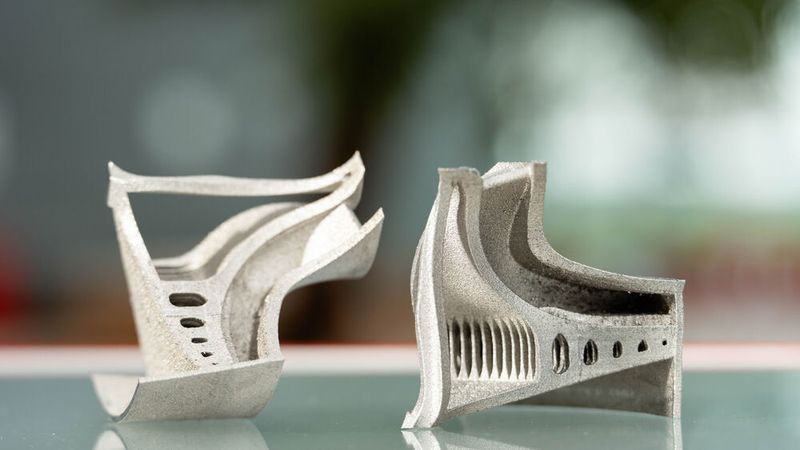
The innovation of beam shaping and multispectral imaging (MSI) was demonstrated by the project partners in five industrial use cases: an impeller for aerospace (Inconel 718), an industrial gas turbine part (Inconel 718), a part of a spacecraft combustion chamber (CuCrNb), a cylinder head for a chainsaw engine (AlSi10Mg), and components of satellite antennas for space communication.
AI-Driven Beam Shaping And Multispectral Imaging in Interaction
The intelligent beam shaping and multispectral imaging work closely together to significantly improve the additive manufacturing process. The laser beam profile is adapted specifically for each component, taking geometry and material into account. This improves the quality of the component and enables faster processing by reducing defects such as cracks, splashes, and condensate formation, which would otherwise cause rework and/or waste. During the InShaPe research, a ring-shaped beam profile—combined with optimized scanning strategies—proved particularly advantageous for diverse applications. Here, the laser energy is applied not through a Gaussian profile but through a ring-shaped intensity distribution to create the melt pool. This results in a more stable melt zone and more uniform material processing.
In parallel, the new multispectral imaging captures signals in different wavelength ranges and monitors the PBF-LB/M process in real time. This allows thermal changes in the melt pool to be detected early. The captured data flows directly into process control. Errors that previously led to production interruptions or rework can now be corrected, enabling the process to continue without significant delays.
We look forward to this technology being integrated into industrial systems in the near future, contributing to advancements in process control, quality assurance, and application performance across various sectors.
Prof. Dr.-Ing. Katrin Wudy
Pioneer for the Industrial Adoption of Serial Production
Overall, this approach marks an important advancement toward industrial serial production using PBF-LB/M: the interplay of intelligent beam shaping and MSI-based process control results in a more stable melting process, reduces sources of error, and enables targeted, resource-efficient energy use. This allows complex metal components to be produced faster, more cost-effectively, and more sustainably—while achieving higher quality and significantly increased productivity. InShaPe thus paves the way for the accelerated industrial adoption of AI-driven beam shaping and MSI-based process control, strengthening technological progress in additive manufacturing—particularly for the aerospace, energy, and automotive industries. "There is significant interest from academia and industry in our work. We look forward to seeing this technology integrated into industrial systems in the near future, contributing to advancements in process control, quality assurance, and application performance across various sectors," says InShaPe coordinator Prof. Dr.-Ing. Katrin Wudy from the School of Engineering and Design at the Technical University of Munich.
Date: 08.12.2025
Naturally, we always handle your personal data responsibly. Any personal data we receive from you is processed in accordance with applicable data protection legislation. For detailed information please see our privacy policy.
Consent to the use of data for promotional purposes
I hereby consent to Vogel Communications Group GmbH & Co. KG, Max-Planck-Str. 7-9, 97082 Würzburg including any affiliated companies according to §§ 15 et seq. AktG (hereafter: Vogel Communications Group) using my e-mail address to send editorial newsletters. A list of all affiliated companies can be found here
Newsletter content may include all products and services of any companies mentioned above, including for example specialist journals and books, events and fairs as well as event-related products and services, print and digital media offers and services such as additional (editorial) newsletters, raffles, lead campaigns, market research both online and offline, specialist webportals and e-learning offers. In case my personal telephone number has also been collected, it may be used for offers of aforementioned products, for services of the companies mentioned above, and market research purposes.
Additionally, my consent also includes the processing of my email address and telephone number for data matching for marketing purposes with select advertising partners such as LinkedIn, Google, and Meta. For this, Vogel Communications Group may transmit said data in hashed form to the advertising partners who then use said data to determine whether I am also a member of the mentioned advertising partner portals. Vogel Communications Group uses this feature for the purposes of re-targeting (up-selling, cross-selling, and customer loyalty), generating so-called look-alike audiences for acquisition of new customers, and as basis for exclusion for on-going advertising campaigns. Further information can be found in section “data matching for marketing purposes”.
In case I access protected data on Internet portals of Vogel Communications Group including any affiliated companies according to §§ 15 et seq. AktG, I need to provide further data in order to register for the access to such content. In return for this free access to editorial content, my data may be used in accordance with this consent for the purposes stated here. This does not apply to data matching for marketing purposes.
Right of revocation
I understand that I can revoke my consent at will. My revocation does not change the lawfulness of data processing that was conducted based on my consent leading up to my revocation. One option to declare my revocation is to use the contact form found at https://contact.vogel.de. In case I no longer wish to receive certain newsletters, I have subscribed to, I can also click on the unsubscribe link included at the end of a newsletter. Further information regarding my right of revocation and the implementation of it as well as the consequences of my revocation can be found in the data protection declaration, section editorial newsletter.
Future-Proof Authentication with Universal RFID Readers



:quality(80)/p7i.vogel.de/wcms/57/3e/573e5f8be45ba0d96122888a75ee68c0/0132000673v1.jpeg "EU Economic Affairs Commissioner Valdis Dombrovskis, speaking in the context of a reform of corporate tax rules, promises: “Our proposals for tax simplification include changes that will make life easier for businesses.” Read more here ... (Image:EU)")
:quality(80)/p7i.vogel.de/wcms/5b/99/5b99952e2dabf8632a55cfb60394c123/0131999764v1.jpeg "Billions are at stake! The preliminary proceedings for a project involving the construction of several cruise ships (stock photo) to be built by Meyer Werft and MSC are well underway ... (Image:Meyer Shipyard)")
:quality(80)/p7i.vogel.de/wcms/1f/8c/1f8cd24f2125a5bde27edde12d055d4b/0132000259v1.jpeg "No launch! Rheinmetall had hoped to land a contract for six F126-class frigates as a maritime construction project. But the federal government has now put a stop to the whole thing. Rheinmetall’s stock price dropped a bit further. Meanwhile, TKMS is now celebrating a government contract... (Image:dpa)")
:quality(80)/p7i.vogel.de/wcms/76/d4/76d453c828381481dcda836dfe11685e/0131992071v1.jpeg "The Profimill 3 from Waldrichsiegen has claimed the top spot as the largest machining system in the world. Read here what it can do and who the next three machining giants are... (Image: Waldrichsiegen)")
:quality(80)/p7i.vogel.de/wcms/12/c6/12c6bb1b6dbcdd48fd89da058cf5c80e/0131939666v1.jpeg "Libra is expected to process more than 256 corrected logical qubits and enable approximately one million reliable logical quantum operations. As part of an expanded collaboration with AWS, the system is expected to be available in the cloud via Amazon Braket starting in 2028. (Image:QuEra)")
:quality(80)/p7i.vogel.de/wcms/5f/a0/5fa0f04f647c40da140fceb082a72c86/0131975563v1.jpeg "After nine years, China has once again managed to dethrone the U.S. leader in supercomputing. The Lineshine supercomputer was the fastest of all in a standardized test ... (Image:Shuangong)")
:quality(80)/p7i.vogel.de/wcms/20/05/200513bd2a5145cc89ea9a1633b51abb/0131969098v1.jpeg "With the release of RealSource, RealMan Robotics aims to break down data silos and advance research in the field of AI-powered robot control. (Image:RealMan)")
:quality(80)/p7i.vogel.de/wcms/f1/e0/f1e0762012ba63607bd0ee537ef4db7a/bild1-phoenix-20contact-00167373-full-b5000v1.jpeg "The driverless transport systems (DTS) or automated guided vehicles (AGVs) used in intralogistics must meet one essential requirement: they should operate safely, quickly, and interoperably within the existing infrastructure. (Image: Phoenix Contact)")
:quality(80)/p7i.vogel.de/wcms/2d/da/2ddacc61c32608e3404dff7e9b102f7f/0131807833v1.jpeg "UCS housing with heat sink and heat spreader. (Image: Phoenix Contact)")
:quality(80)/p7i.vogel.de/wcms/9d/0c/9d0cde767c99aa00f527de1a7b0904f5/voss-evtech-2026v1.jpeg "Voss Automotive showcased, among other things, a liquid-cooled charging cable system and a thermal management system in a simulated passenger car application at the dual trade fair EVTech/The Battery Show. (Source: )")
:quality(80)/p7i.vogel.de/wcms/f1/dd/f1dd997329564af5537dc412cc205bd7/0131954184v1.jpeg "At Innovent Technology Development in Jena, it has been demonstrated that atmospheric pressure plasma can be used to clean copper (as shown here) and silver surfaces of oxides and sulfides— without harsh chemicals and with minimal energy consumption... (Image: Innovent)")
:quality(80)/p7i.vogel.de/wcms/0b/ff/0bffa42ea605978169d5e25eedb2c1ee/0131826953v2v1.jpeg "In the picture: from right to left, Pascale Herman, Christophe Delhovren, Antoine de Ryckel, Olivier de Laet. They intend to work together in the future. (Image:Valeo)")
:quality(80)/p7i.vogel.de/wcms/c5/97/c5970168e6bc3c0538715b5071836637/homelink-20console-2560x1439v1v1.jpeg "Gentex integrates Home Link into its rearview mirrors. Automakers can also integrate the supplier's product into their infotainment systems. (Image:Gentex)")
:quality(80)/p7i.vogel.de/wcms/7f/81/7f8112067de570333f3a730b9ed72a26/iaa-20mobility-202025-jf-1-01491-7953x4471v1v1.jpeg "\"AITO\" is the joint automotive brand of Seres and Huawei. With this new brand, Seres is seeking to become more independent from the electronics conglomerate. (Image:VDA/IAA Mobility)")
:quality(80)/p7i.vogel.de/wcms/a1/87/a187d1463ebbed0941233bc14bdde451/0131954862v1.jpeg "A new high-performance dispenser is now included with the Alpitronics HYC1000. (Image:Alpitronic)")
:quality(80)/p7i.vogel.de/wcms/f1/c3/f1c3428d7076590511abe1fb7c9f5bac/lucid-20uber-20nuro-20houston-201v1.webp "Lucid is currently testing its robotaxis in San Francisco and Houston with safety drivers on board. (Image: Lucid Motors)")
:quality(80)/p7i.vogel.de/wcms/3d/69/3d69a2ac15675566050d304cbb7c595a/0132006001v1.jpeg "The productivity paradox: AI speeds up code development, but according to GitLab’s AI Accountability Report, control, traceability, and governance are becoming the new bottleneck in the software delivery process. (Image:Dall-E / AI-generated)")
:quality(80)/p7i.vogel.de/wcms/98/c8/98c8d760f4a3a26c39d5ee61a3fc61d5/0131983597v1.jpeg "SanDisk goes beyond HBM: A U.S. patent reveals the direct connection of a processor to a NAND stack array, with HBM stacks on a shared interposer. (Image:U.S. Patent and Trademark Office / SanDisk)")
:quality(80)/p7i.vogel.de/wcms/44/7d/447da8981c8d2fa36153b34ac87929f5/0131993774v1.jpeg "When copper and aluminum reach their limits, composite material solutions come into play. At the Power of Electronics conference, Dr. Björn Reetz will speak about the potential of special alloys and metal composites. (Image:Materion)")
:quality(80)/p7i.vogel.de/wcms/41/26/4126391b01560b66d9409c831256e97e/0131986045v1.jpeg "Symbolic image: An autonomous mini-robot maps the environment. (Image:AI-generated)")
:fill(fff,0)/images.vogel.de/vogelonline/companyimg/76800/76895/65.jpg "FAULHABER_120mm.jpg ()")
:fill(fff,0)/p7i.vogel.de/companies/69/88/69882c428938e/tmts2026-ticec-banner-en-2000px.png "tmts2026-ticec-banner-en-2000px (https://www.tmts.tw/en)")
:fill(fff,0)/p7i.vogel.de/companies/69/de/69de1b7403b0d/simtos-logo.jpeg "simtos-logo (SIMTOS)")
:quality(80)/p7i.vogel.de/wcms/dd/d4/ddd497299aa6fd4106fa8a78f9abca70/0125885537v1.jpeg "Prof. Dr.-Ing. Katrin Wudy, TUM School of Engineering and Design, coordinator of the EU project InShaPe(Image: Frederik Watzka)")
:quality(80)/p7i.vogel.de/wcms/fc/bf/fcbf153ea7e16166cb6975479ec6e6ad/0125885527v1.jpeg "Industrial gas turbine component for the energy sector (Material: IN718)(Image: Frederik Watzka)")
:quality(80)/p7i.vogel.de/wcms/5a/1d/5a1dd2914fae000c2fd7eeae27b2ccaf/0125885535v1.jpeg "Cylinder head of a chainsaw engine (Material: AlSi10Mg)(Image: Frederik Watzka)")
:quality(80)/p7i.vogel.de/wcms/c5/6d/c56d63a63ffaa3d05d839f440f4849be/0125885528v1.jpeg "Impeller for aerospace (Material: IN718)(Image: Frederik Watzka)")
:quality(80):fill(efefef,0)/p7i.vogel.de/wcms/67/ae/67ae0b9ac31f8/elatec-wp-universal-reader.png "Elatec WP Universal Reader")
:quality(80)/p7i.vogel.de/wcms/f1/c4/f1c437d2910f26c755f075c1483dc570/0125826799v1.jpeg "The additive manufacturing of metal is becoming more efficient, cheaper, and sustainable. This is the result of the research efforts by the Bayfor consortium. Read here about all the other achievements so far... (Image:TUM)")
:quality(80)/p7i.vogel.de/wcms/1c/18/1c188a2a23605e9e8d83344404d69eff/0128047590v1.jpeg "When the laser learns: Laser-based welding processes can be optimized in real time thanks to machine learning. (Image:Empa)")