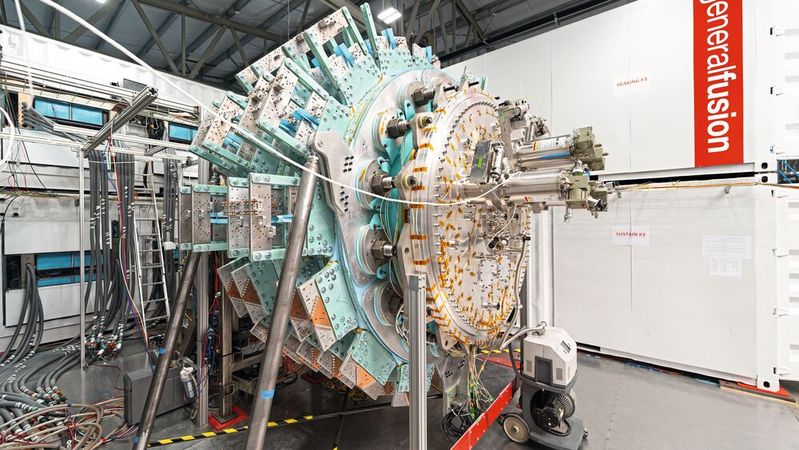
The Lawson Machine 26 is General Fusion's first large-scale fusion machine. Controlled by multiphysics simulation instead of trial-and-error. When plasma, metal and magnetic fields collide in milliseconds, only physics counts.
The General Fusion demonstration reactor.
(Image: General Fusion)
The development of fusion systems presents engineers with extreme technical challenges. With the Lawson Machine 26, General Fusion has successfully commissioned a large-scale fusion demonstration plant for the first time. The development process was continuously supported by a multiphysics simulation, with which highly dynamic, non-linear processes could be realistically mapped and specifically optimized.
The controlled use of fusion energy is considered one of the most challenging tasks of modern energy technology. While many research approaches rely on tokamaks or laser-driven inertial confinement fusion, General Fusion is pursuing a different path with so-called magnetized target fusion. This involves introducing a magnetized plasma into a solid or liquid metal container and then compressing it in order to achieve the temperatures and pressures required for fusion reactions.
Gallery
The Lawson Machine 26, LM26 for short, serves as a demonstration facility to clarify key physical and technical issues and reduce risks for future commercial facilities. The focus is on the electromagnetic compression of a lithium liner, which brings the plasma to fusion conditions within a few milliseconds. The resulting forces, deformations and thermal effects are so extreme that conventional development and testing methods quickly reach their limits.
When Physics Cannot Be Considered Separately
The compression of the lithium liner is a prime example of a highly coupled physical system. Electromagnetic forces drive the movement, mechanical stresses lead to plastic deformation, while at the same time material properties change due to an increase in temperature, while the enclosed plasma must be kept stable. Every change in electrical parameters or geometry has a direct effect on several areas of physics.
To map these interactions realistically, General Fusion relied on integrated multiphysics modeling right from the start. Comsol Multiphysics made it possible to couple and consistently calculate electromagnetic fields, structural mechanics, heat transport and external circuits within a uniform, time-dependent model.
From the Material Sample to the System Geometry
A central component of the development process was the realistic modeling of the lithium liner. Under the extreme loads during compression, lithium exhibits a highly non-linear, rate- and temperature-dependent material behavior. Extensive experimental investigations were carried out in order to model this correctly. In collaboration with Veryst Engineering, tensile tests were carried out in which lithium samples were subjected to high strain rates under controlled temperature conditions until failure.
The experimentally obtained data was used to calibrate a Johnson-Cook material model, which was then directly integrated into the multi-physics simulations. On this basis, the engineers were able to reliably predict the trajectories and deformations of the lithium liners during electromagnetic compression.
The simulations themselves were time-dependent and fully coupled. Large deformations, changing contact conditions and extremely short time constants required the use of automatic remeshing methods to ensure numerical stability and accuracy. In order to keep the computational effort manageable, a 2D axisymmetric model was also used, which captures the essential physical effects but can be calculated much more efficiently than a full-resolution 3D model.
A particular focus was on matching the compressor impedance between the power supply and the mechanical dynamics of the liner. A high proportion of the stored electrical energy can only be converted into kinetic energy if the electrical and mechanical time constants are matched. With the help of the simulation, parameters such as coil geometry, number of windings and distance between coils and liner could be specifically varied in order to maximize compression efficiency.
The models were validated by closely interlinking simulation and experiment. A total of 40 lithium liners were electromagnetically compressed in order to verify the numerical results. Measurement methods such as Structured Light Reconstruction and Photon Doppler Velocimetry provided detailed deformation and velocity profiles that showed a high degree of agreement with the simulation results. This iterative approach made it possible to gradually increase the model complexity and at the same time build confidence in the predictions.
Date: 08.12.2025
Naturally, we always handle your personal data responsibly. Any personal data we receive from you is processed in accordance with applicable data protection legislation. For detailed information please see our privacy policy.
Consent to the use of data for promotional purposes
I hereby consent to Vogel Communications Group GmbH & Co. KG, Max-Planck-Str. 7-9, 97082 Würzburg including any affiliated companies according to §§ 15 et seq. AktG (hereafter: Vogel Communications Group) using my e-mail address to send editorial newsletters. A list of all affiliated companies can be found here
Newsletter content may include all products and services of any companies mentioned above, including for example specialist journals and books, events and fairs as well as event-related products and services, print and digital media offers and services such as additional (editorial) newsletters, raffles, lead campaigns, market research both online and offline, specialist webportals and e-learning offers. In case my personal telephone number has also been collected, it may be used for offers of aforementioned products, for services of the companies mentioned above, and market research purposes.
Additionally, my consent also includes the processing of my email address and telephone number for data matching for marketing purposes with select advertising partners such as LinkedIn, Google, and Meta. For this, Vogel Communications Group may transmit said data in hashed form to the advertising partners who then use said data to determine whether I am also a member of the mentioned advertising partner portals. Vogel Communications Group uses this feature for the purposes of re-targeting (up-selling, cross-selling, and customer loyalty), generating so-called look-alike audiences for acquisition of new customers, and as basis for exclusion for on-going advertising campaigns. Further information can be found in section “data matching for marketing purposes”.
In case I access protected data on Internet portals of Vogel Communications Group including any affiliated companies according to §§ 15 et seq. AktG, I need to provide further data in order to register for the access to such content. In return for this free access to editorial content, my data may be used in accordance with this consent for the purposes stated here. This does not apply to data matching for marketing purposes.
Right of revocation
I understand that I can revoke my consent at will. My revocation does not change the lawfulness of data processing that was conducted based on my consent leading up to my revocation. One option to declare my revocation is to use the contact form found at https://contact.vogel.de. In case I no longer wish to receive certain newsletters, I have subscribed to, I can also click on the unsubscribe link included at the end of a newsletter. Further information regarding my right of revocation and the implementation of it as well as the consequences of my revocation can be found in the data protection declaration, section editorial newsletter.
Faster Development Cycles Through Parallel Simulation
A significant advantage of the chosen approach was the speed of the development process. With the help of cluster sweep functions, extensive parameter studies could be carried out in parallel on computing clusters. Simulation runs that would previously have taken weeks or months could be completed in less than 24 hours. This enabled the development team to make design decisions based on a much broader database and to define safe operating areas at an early stage.
Relevance for Other High-Tech Applications
Even though the LM26 is an unusual project, the underlying simulation approach can be transferred to many other fields of application. Particularly in power electronics, high-current systems or complex electromagnetic-mechanical actuators, similar couplings between electrical, thermal and structural effects occur. In such systems, integrated multiphysical simulation can make a decisive contribution to reducing development risks and shortening innovation cycles.
Central Development Tool
With the successful commissioning of Lawson Machine 26, General Fusion has shown that multiphysical simulation has long since become a key development tool. It enables extremely complex energy systems to be mastered step by step and sound design decisions to be made. While the plant is now being further optimized, the developed workflow already forms the basis for the next step on the way to the commercial use of fusion energy. (mr)
Future-Proof Authentication with Universal RFID Readers



:quality(80)/p7i.vogel.de/wcms/f9/7d/f97deef8fde21c8630d76411b18a20a7/0129803665v1.jpeg "Skoda has invested well over 220 million US dollars in the high-tech battery plant that has now opened in Mlada Boleslav. It has now started its work, which is highly automated ... (Image:Skoda)")
:quality(80)/p7i.vogel.de/wcms/f5/61/f561ad7c72ed41fd7a67ad9c481cb15d/0129799343v1.jpeg "Engine-generator units (MGU) from Steyr Motors are at work in the Leopard 2 main battle tank and the Leguan bridge vehicle (pictured). An extended contract is now to secure at least 500 more systems of this type for the Bundeswehr ... (Image:German Armed Forces)")
:quality(80)/p7i.vogel.de/wcms/6c/b5/6cb5ce2155433f6e73b16399adc4c561/0113143253v1.jpeg "In our China Market Insider we regularly provide you with relevant information directly from China. (Image:© Eisenhans - stock.adobe.com)")
:quality(80)/p7i.vogel.de/wcms/7f/fd/7ffd32863352c40f562f4245e4766e61/0129745849v1.jpeg "After US President Donald Trump once again resorted to his favorite weapon, tariffs, concerns rose in the EU that the so-called tariff deal could become invalid. But it looks as if the sea remains relatively calm ... (Image:F. Schneidler)")
:quality(80)/p7i.vogel.de/wcms/9c/ac/9cac6246660e746c5a3989399ac4d250/0128561645v1.jpeg "Artificial intelligence can drive efficiency in smart factories through centralized data management and predictive maintenance. (Picture: ©Fardived - stock.adobe.com)")
:quality(80)/p7i.vogel.de/wcms/6b/e2/6be235b5ad8a442ccd9d164b0b300d8b/0129763992v1.jpeg "As early as 2020, the Zimmer Group announced that it would convert its production to be sustainably CO2-neutral. (Image:Zimmer Group)")
:quality(80)/p7i.vogel.de/wcms/d4/ba/d4bab9481e66f8570f40eb8ef2a90198/0129795613v1.jpeg "A camera inspection during removal ensures that the components are placed correctly in the KLTs. (Image:Yaskawa Europe)")
:quality(80)/p7i.vogel.de/wcms/cb/56/cb56e42b01638b618e8d1b9b38f32faa/0129810132v1.jpeg "From summer 2026, \"AEON\" will support people at the BMW plant in Leipzig. (Image:diephotodesigner.de/BMW)")
:quality(80)/p7i.vogel.de/wcms/b5/5e/b55ed9355e0395ec0caf111d6af6b494/adobestock-495980372--c2-a9-20natali-mis-20-e2-80-93-20stock-adobe-com-6720x3778v1v1.jpeg "Which engineering skills will be in vogue in 2026? (Image:natali_mis - stock.adobe.com)")
:quality(80)/p7i.vogel.de/wcms/bf/a5/bfa5d882e93f159ce93e933742272b00/nord-vibn-cmyk-2196x1235v1v1.jpeg "With digital twins for virtual commissioning, Nord supports customers in ensuring that systems are available more quickly, even with complex drive systems. (Image:Nord Drivesystems)")
:quality(80)/p7i.vogel.de/wcms/f5/7e/f57ef535ee35e7b3b7ff15a8a63cef10/eds-keyvisual-8000x4496v1.jpeg "(Source: European Defence Supply)")
:quality(80)/p7i.vogel.de/wcms/af/a3/afa312176d956068af20491957eef642/newsimage418262-3100x1745v1v1.jpeg "The autonomous shuttle of the Aula AI project during a demonstration of sensor data with artificial fog. (Image:University of Magdeburg)")
:quality(80)/p7i.vogel.de/wcms/cb/23/cb23acd8e9de969d52522692b62b1892/0129680605v1.jpeg "The Z22198 is an extremely compact, three-axis IEPE acceleration sensor for measuring oscillations (vibrations) and shocks in demanding applications. With an edge length of just 0.24 inches and a weight of 0.03 ounces, it is ideal for lightweight structures and confined spaces. (Image:Copyright 2020 ScROGERS,All Rights Reserved)")
:quality(80)/p7i.vogel.de/wcms/c4/40/c44043c61f9dd99b80ccca398c284018/0129795093v1.jpeg "Subaru manufactures the E-Outback at its Yajima plant, marking the first time it has produced an electric vehicle in-house. (Image:Subaru)")
:quality(80)/p7i.vogel.de/wcms/fe/18/fe1824e572677900655c854f6c92c391/0129811281v1.jpeg "BMW and CATL deepen their partnership and work together on the battery pass. (Image:BMW)")
:quality(80)/p7i.vogel.de/wcms/15/54/15546b27b3a679871325ef6d92509a95/0129750872v1.jpeg "Webasto plans to open its third plant for sunroofs in India. (Image:Webasto)")
:quality(80)/p7i.vogel.de/wcms/70/14/70142aa050f8d3f7784c5ddbb2aba5f1/0129778339v1.jpeg "The software investments in production have saved time in Lacon production. (Image:Lacon)")
:quality(80)/p7i.vogel.de/wcms/5c/0f/5c0fee074c4b6c8e8c0993f3217c2f5a/0129773718v1.jpeg "The General Fusion demonstration reactor. (Image:General Fusion)")
:quality(80)/p7i.vogel.de/wcms/7f/c1/7fc1c83b8509df676d27518b82aaef02/0129764984v1.jpeg "China Resources Microelectronics (CR Micro) has announced its intention to increase the prices of its own products. (Image:China Resources Microelectronics)")
:quality(80)/p7i.vogel.de/wcms/eb/4e/eb4e449562174ec95a5b3d30fb0137a2/0129648135v1.jpeg "The III-V germanium PV module with an efficiency of 34.2% is currently the most efficient solar module in the world. (Image:Jacob Forster)")
:fill(fff,0)/images.vogel.de/vogelonline/companyimg/76800/76895/65.jpg "FAULHABER_120mm.jpg ()")
:fill(fff,0)/p7i.vogel.de/companies/69/88/69882c428938e/tmts2026-ticec-banner-en-2000px.png "tmts2026-ticec-banner-en-2000px (https://www.tmts.tw/en)")
:fill(fff,0)/p7i.vogel.de/companies/67/eb/67eba621ef6ea/logo2.png "logo2 (Wuxi InfiMotion)")
:quality(80)/p7i.vogel.de/wcms/29/c2/29c2e4556110fabb63b4a83d760484e9/0129773819v1.jpeg "The General Fusion demonstration reactor.(Image: General Fusion)")
:quality(80)/p7i.vogel.de/wcms/99/ce/99cefd391cc9e0e360a1d4f7b453cfcd/0129773438v1.jpeg "Structure of the reactor.(Image: General Fusion)")
:quality(80)/p7i.vogel.de/wcms/52/f2/52f25b8cab987cd77e745ebd6ba9d811/0129773817v1.jpeg "(Image: General Fusion)")
:quality(80):fill(efefef,0)/p7i.vogel.de/wcms/67/ae/67ae0b9ac31f8/elatec-wp-universal-reader.png "Elatec WP Universal Reader")
:quality(80)/p7i.vogel.de/wcms/b5/74/b57433bf5017d155b7f19f4905a73449/0127384204v1.jpeg "A deep understanding and careful definition of the challenges are essential for the development of reliable and efficient electric drives. This requires the use of advanced simulation and optimization techniques. (Image: ©k_viktar - stock.adobe.com / AI-generated)")
:quality(80)/p7i.vogel.de/wcms/e1/be/e1be9e715b016340630e787c6aba3177/0128086833v1.jpeg "In light of the increasing demands for efficiency, sustainability, and innovation speed, modern product development can no longer bypass multiphysics simulation and artificial intelligence. (Image:Altair)")